The main category of All News Articles.
You can use the search box below to find what you need.
[wd_asp id=1]
The main category of All News Articles.
You can use the search box below to find what you need.
[wd_asp id=1]
Today’s bull breakout further confirms strength of the counter-trend rally. It looks poised to test resistance near the 50-day average, now at $59.13. Until proven otherwise, some degree of resistance can be anticipated. Since the area near the 50-day average reversed the bull reversal from the October swing low, it was confirmed several times as a dynamic resistance area, most recently the December lower swing high at $60.56.
Since the average identifies an area of possible resistance, the 12-day high at $59.22 can be included in the price zone as well, along with a 78.6% Fibonacci retracement level at $59.37. Together, these indicators show a price zone from around $59.13 to $59.37 where the current bounce could stop and reverse – or breakthrough.
A sustained recapture of the $60.56 lower swing high from early December would be needed to show a reversal of the trend on the daily chart. However, a one-week bullish reversal triggered this week from a bullish hammer candle pattern. The weekly breakout will confirm if this week ends above last week’s high of $57.82. Nevertheless, the reversal of the lower swing high is needed to satisfy the internal downtrend that began from the June spike high at $78.44.
The series of lower swing highs from that peak suggests at least another pullback from resistance near the top of the short-term decline bounded by a dashed falling trendline. Despite recent signs of strength, demand will need to remain strong enough to advance further and then break out through a resistance zone and remain in a bullish technical position. That would be difficult without another dip, even if to generate a higher swing low rather than another test of this month’s lows.
Crude oil’s counter-trend rally has gained traction with the 20-day reclaim and weekly reversal signal, but the $59.13–$59.37 confluence looms as the decisive test. Clearance and hold above the 50-day average shifts the daily structure to short-term bullish; rejection there favors another leg lower within the larger downtrend from June.
For a look at all of today’s economic events, check out our economic calendar.
– Written by
Tim Boyer
STORY LINK Pound Sterling to Dollar Forecast: Festive Mood Lifts GBP/USD Toward 2026
The Pound to US Dollar exchange rate (GBP/USD) pushed past the $1.35 mark on Tuesday, rising to its strongest level since the end of September.
At the time of writing, GBP/USD was trading near $1.3501, up around 0.3% from Tuesday’s opening levels.
The US Dollar (USD) softened broadly on Tuesday, even after US GDP data surprised sharply to the upside.
Markets had expected growth to cool in the third quarter, with forecasts pointing to a slowdown from 3.8% to 3.3% amid concerns that President Donald Trump’s tariff policies were beginning to weigh on activity.
Instead, figures from the Bureau of Economic Analysis showed the US economy expanded by a robust 4.3% between July and September, driven by stronger consumer spending as well as renewed momentum in exports and government outlays.
Rather than lifting the Dollar, the data reinforced a risk-on market backdrop, prompting investors to rotate away from safe-haven assets.
The release also failed to shift expectations for US monetary policy, with markets continuing to price in multiple Federal Reserve interest rate cuts over the course of 2026.
Get better rates and lower fees on your next international money transfer.
Compare TorFX with top UK banks in seconds and see how much you could save.
The Pound (GBP) also advanced on Tuesday, benefiting from the typically upbeat sentiment associated with the year-end ‘Santa rally’.
Thin liquidity conditions during the holiday period appeared to amplify Sterling’s gains, as an optimistic market mood favoured risk-sensitive currencies.
Beyond seasonal effects, the Pound drew modest support from tentative optimism around the UK’s medium-term outlook. While recent inflation and growth data point to near-term challenges, some investors are increasingly hopeful that conditions could improve into 2026 as global growth steadies and policy uncertainty eases.
Looking ahead, with no major UK or US economic releases scheduled, movement in GBP/USD is likely to remain closely tied to broader market sentiment.
If festive optimism continues to underpin risk appetite, the Pound to US Dollar exchange rate may be able to extend its upward momentum into the Christmas period.
However, any sudden shift in mood or external geopolitical headlines could quickly reintroduce volatility.

International Money Transfer? Ask our resident FX expert a money transfer question or try John’s new, free, no-obligation personal service! ,where he helps every step of the way,
ensuring you get the best exchange rates on your currency requirements.
TAGS: Pound Dollar Forecasts
Use left and right arrow keys to navigate between menu items.
Use escape to exit the menu.
Sign Up
Create a free account to access exclusive content, play games, solve puzzles, test your pop-culture knowledge and receive special offers.
Already have an account? Login
Ali Charts, a popular on-chain analyst, said data shows that large Bitcoin holders, commonly known as whales, have been net sellers throughout the past year, as per a report. According to the analyst, whale holdings declined by 161,294 BTC over the last 12 months, a move he said typically appears before or during deeper market corrections rather than after prices have bottomed, as per a Zycrypto report.
He wrote in an X post, “The 1-year change in Bitcoin whale holdings is −161,294 $BTC,” adding, “That tells us whales have been net sellers over the last year. This behavior usually shows up before or during deeper corrections, not after bottoms,” as quoted by Zycrypto.
Also read:
Despite posting multiple new all-time highs this year, Bitcoin’s performance has been uneven, with several sharp flash crashes linked to heavy selling by large holders. At current levels, the cryptocurrency is hovering around $87,000, but market sentiment has become increasingly fragile as bearish pressure returns.
In total, whales are estimated to have sold about 161,294 BTC in 2025, worth roughly $15 billion, as per the Zycrypto report. Much of this selling occurred during key market moments, weighing on the bullish narrative. If the trend extends into 2026, analysts suggest it could be difficult for Bitcoin to achieve a sustained recovery.
Also read: Top Republican suddenly emerges as serious 2028 threat to JD Vance’s White House ambitions
Ali noted that heavy selling by whales often signals either an upcoming correction or the continuation of a bearish trend. In contrast, strong buying activity from large holders is typically associated with the early stages of bull markets, something that has been largely absent over the past year.
However, not all large investors have been selling. Medium-sized holders, often referred to as “sharks” and defined as wallets holding between 100 and 1,000 BTC, have been net buyers throughout the year. Their accumulation has helped absorb some of the pressure created by whale selling and has fueled speculation that market influence is slowly shifting away from legacy whales toward a broader base of participants, as per the Zycrypto report.
Even after the sell-off, whales still control more than 2 million BTC, giving them significant influence over price movements. Still, there are limits to how much they can sell, and the market’s ability to withstand sustained distribution in 2025 has highlighted Bitcoin’s resilience.
Looking ahead to 2026, analysts are expected to closely monitor whale activity for clues about the market’s next direction. A slowdown in selling, even if temporary, could provide short-term relief for bullish investors, while continued distribution may keep pressure on prices in the months ahead.
How much Bitcoin did whales sell in 2025?
About 161,294 BTC, worth roughly $15 billion.
How much Bitcoin do whales still control?
More than 2 million BTC.
Gold price soared to a fresh all-time high on Tuesday, trading at $4,497 a troy ounce during European trading hours as market players kept dropping the US Dollar (USD). The bright metal also found favor in Middle East tensions, following weekend headlines indicating Israel is considering resuming its war with Iran.
The USD, however, found some near-term footing at the beginning of the American session after the release of mixed United States (US) data. The ADP Employment Change 4-week average showed that the private sector added an average of 11,500 jobs per week, in the week ending December 6, slightly below the previous 16,250 but still positive. Additionally, the Q3 Gross Domestic Product (GDP) reported annualized growth of 4.3% in the three months to September, well above the previous 3.8% and the expected 3.3%. On a negative note, the GDP Price Index, a measure of inflation, jumped from 2.1% to 3.7%.
The country also reported that Durable Goods Orders fell 2.2% in October, a worsening from the 0.7% advance posted in September. Finally, CB Consumer Confidence in December edged lower for the fifth consecutive month, declining to 89.1 from 92.9 in November.
Most countries celebrate Christmas, which means there won’t be any macroeconomic releases to worry about in the coming days. Japan is the only exception, releasing some interesting figures, including Tokyo Consumer Price Index (CPI) data, next Friday.
The XAU/USD fell towards the $4,450 region with the headlines, but resumed its advance after the dust settled, and trades around $4,480 at the time of writing.
Technically, the 4-hour chart shows XAU/USD trades at $4,474.84, holding on to modest intraday gains. The 20-, 100-, and 200-period Simple Moving Averages (SMAs) are bullish, with the price holding above all three, usually indicating that bulls maintain the lead. The 20 SMA near $4,398.04 offers nearby dynamic support. At the same time, the Momentum indicator eased but holds well above its midline, while the Relative Strength Index (RSI) indicator stands at 70. With the Momentum still positive and the RSI stretched, consolidation could precede another leg higher. A sustained push from current levels would extend the uptrend, while a pullback that holds above the cited SMAs would keep the bullish structure intact.
In the daily chart, XAU/USD trades far above an ascending 20-day SMA, with the latter developing above the 100- and 200-day SMAs. Price holds above all three, with the 20-day SMA at $4,267.83 providing nearby support and the 100-day SMA at $3,891.93 anchoring the trend. Finally, the Momentum indicator advances above its midline, while the RSI indicator at 80 barely decelerated its advance.
(The technical analysis of this story was written with the help of an AI tool)
– Written by
Tim Boyer
STORY LINK Pound-to-Dollar Forecast: GBP/USD Higher as Rate Outlooks Diverge
The Pound to Dollar exchange rate (GBP/USD) edged higher as a softer US currency offset lingering concerns over the UK growth outlook.
Markets are increasingly focused on Fed policy and political pressure for looser monetary conditions in the US.
Any further gains in GBP/USD are likely to depend on continued dollar losses rather than renewed confidence in the UK economy.
The Pound to Dollar (GBP/USD) exchange rate has secured net gains to around 1.3440 on Monday with pair within touching distance of 2-month highs just above 1.3450.
The Pound has secured a limited net gain in global markets while there was a generally soft dollar.
The main focus was a fresh surge in precious metals prices with gold and silver both surging to fresh record highs.
Get better rates and lower fees on your next international money transfer.
Compare TorFX with top UK banks in seconds and see how much you could save.
US equity markets held firm, although the FTSE 100 index posted a decline of just over 0.5%.
There is the risk of choppy trading in the very short term as trading volumes dip ahead of the Christmas holiday period.
Federal Reserve policy and personnel will remain a key element over the next few months.
At this stage, markets are pricing in close to a 20% chance of a further cut in January with a round a 50% chance of a cut by March.
Danske Bank commented; “We expect the Fed to pause in January and deliver two additional 25bp cuts in 2026, in March and June.”
The policy outlook is complicated by the fact that a new Fed Chair will be nominated while the Administration is continuing to lobby for faster and further rate cuts.
According to MUFG; “Whether Hassett, Waller, or Warsh is chosen, the likelihood is that the new Chair will be more aligned with Trump’s views and will push more forcefully for fundamental change at the Fed that will inevitably shape investor expectations that the Fed will align more toward policies to fuel growth over price stability rather than the current symmetric policy approach.
It added; “This would give momentum to the US yield curve steepening which tends to coincide with a weaker dollar.”
Markets will also be monitoring any developments surrounding the Supreme Court with two crucial cases surrounding the dismissal of Fed Governor Cook and Trump’s reciprocal tariffs.
Domestically, the final GDP data for the third quarter confirmed GDP growth of 0.1%, although there was a slight downward revision to 0.1% for the second quarter from the previous estimate of 0.2%.
The year-on-year growth rate was unchanged at 1.3% due to a small upward revision to 2024 data.
AJ Bell head of financial analysis Danni Hewson remains uneasy over the outlook; “With the Bank of England expecting growth to come to a standstill in the last few months of the year, thanks in part to the impact of the Budget on overall confidence, it’s clear there are huge challenges to overcome if the UK’s growth story is going to become more compelling.”
Elsewhere, the current account deficit was estimated at £12.1bn for the third quarter of 2025 from a revised £21.2bn the previous quarter.
Danske Bank is still concerned over balance of payments risks; “The UK runs a large current-account deficit, which makes GBP vulnerable when capital inflows fade.”
International Money Transfer? Ask our resident FX expert a money transfer question or try John’s new, free, no-obligation personal service! ,where he helps every step of the way,
ensuring you get the best exchange rates on your currency requirements.
TAGS: Pound Dollar Forecasts
Caroline Bishop
Dec 23, 2025 10:17
MATIC price prediction shows potential 18-53% upside to $0.45-$0.58 range if critical $0.58 resistance breaks, though immediate support at $0.35 remains crucial for bulls.
Polygon (MATIC) finds itself at a critical technical juncture as December 2025 draws to a close, trading near its 52-week lows with mixed signals emerging from key indicators. Our comprehensive MATIC price prediction analysis suggests a potential recovery phase may be brewing, contingent upon breaking through crucial resistance levels in the coming weeks.
• MATIC short-term target (1 week): $0.35-$0.42 range (+8% upside potential)
• Polygon medium-term forecast (1 month): $0.45-$0.58 range (+18-53% upside potential)
• Key level to break for bullish continuation: $0.58 resistance
• Critical support if bearish: $0.35, with ultimate support at $0.33
The latest analyst consensus reveals a cautiously optimistic outlook for Polygon’s price trajectory. Multiple forecasts from Blockchain.News over the past three days consistently point to a MATIC price target in the $0.35-$0.42 range for short-term trading, while medium-term projections suggest a more substantial recovery to $0.45-$0.58.
This Polygon forecast alignment among analysts indicates strong technical confluence around key resistance levels. The recurring mention of the $0.58 level as a critical breakout point suggests this price zone will determine whether MATIC can mount a meaningful recovery from its current oversold conditions. Notably, all recent predictions carry medium confidence levels, reflecting the uncertain market environment but acknowledging the technical setup for potential upside.
The analyst community appears divided between immediate caution and medium-term optimism, with most agreeing that breaking the $0.58 resistance could trigger a 53% rally from current levels.
Current Polygon technical analysis reveals a mixed but potentially improving picture. Trading at $0.38, MATIC sits just above the critical $0.35 support level that analysts have repeatedly identified as crucial for maintaining bullish structure. The token’s position within the Bollinger Bands at 0.29 suggests it’s trading in the lower portion of its recent range, often a precursor to mean reversion moves.
The RSI reading of 38.00 places MATIC in neutral territory with room to move higher before reaching overbought conditions. This positioning is particularly significant given the token’s proximity to its 52-week low of $0.37, suggesting limited downside risk relative to potential upside.
However, bearish momentum persists with the MACD histogram at -0.0045 and the price trading below all major moving averages except the 7-day SMA ($0.37). The 20-day SMA at $0.43 represents the first major hurdle, followed by the critical $0.58 resistance that has captured analyst attention.
Volume analysis from Binance spot trading shows $1.07 million in 24-hour volume, indicating moderate interest but lacking the conviction typically seen during major breakouts. This suggests any MATIC price prediction should account for potentially choppy price action until volume confirms directional moves.
The primary bullish scenario for our MATIC price prediction centers on breaking above the $0.42 immediate resistance, which would likely trigger momentum toward the critical $0.58 level. Successfully clearing this zone could unleash the 53% rally that analysts have identified, targeting the $0.58-$0.60 range initially.
Beyond $0.58, the next significant target sits at the 50-day SMA of $0.45, which would represent an 18% gain from current levels. A sustained break above this level could open the door to testing the upper Bollinger Band at $0.56 and potentially the $0.60 psychological resistance.
For this bullish Polygon forecast to materialize, MATIC needs to see increased buying volume and RSI momentum above 50. The stochastic indicators at %K 25.19 and %D 19.74 provide ample room for upward movement before reaching overbought territory.
The bearish scenario becomes active if MATIC fails to hold the $0.35 support level that analysts have consistently highlighted. A break below this zone would likely target the $0.33 strong support, representing a 13% decline from current levels and testing the 52-week low area.
Further deterioration could see MATIC challenge the lower Bollinger Band at $0.31, which would represent a significant breakdown from current technical structure. This scenario becomes more probable if the MACD histogram continues to trend lower and RSI breaks below 30 into oversold territory.
Key risk factors include broader cryptocurrency market weakness, reduced institutional interest in Layer 2 solutions, or failure to maintain developer activity on the Polygon network.
Based on current technical levels, the question of whether to buy or sell MATIC depends heavily on risk tolerance and investment timeframe. For aggressive traders, the current $0.38 level presents a compelling risk-reward opportunity with tight stop-losses below $0.35.
Conservative investors should wait for confirmation above $0.42 before establishing positions, as this would signal the beginning of the analyst-predicted recovery phase. This approach sacrifices some upside potential but significantly reduces the risk of catching a falling knife.
Position sizing should remain conservative given the medium confidence levels expressed by analysts. A scale-in approach works well in this environment, with initial positions at current levels and additional buying on any dip toward $0.35 support, provided that level holds on increased volume.
Stop-loss levels should be placed below $0.33 for most positions, as a break of this level would invalidate the bullish thesis and suggest further downside ahead.
Our MATIC price prediction suggests a 18-53% upside potential over the next 4-6 weeks, targeting the $0.45-$0.58 range that analyst forecasts consistently highlight. However, this Polygon forecast carries medium confidence given the current bearish momentum and requires confirmation above key resistance levels.
The critical factor for this prediction remains the $0.58 resistance level, which has emerged as the make-or-break point for MATIC’s recovery prospects. Traders should monitor this level closely, along with volume confirmation and RSI momentum above 50 for validation of the bullish scenario.
Timeline for this prediction centers on the next 4-6 weeks, with initial confirmation signals expected within 1-2 weeks if the recovery scenario begins to unfold. Failure to hold $0.35 support would invalidate this prediction and suggest further consolidation or decline ahead.
Image source: Shutterstock
Natural gas markets are ending the year in classic winter fashion: price swings driven less by what’s happening today than by what weather models might show next week.
On Tuesday, December 23, U.S. Henry Hub futures rebounded from recent weakness as record LNG export demand and a higher near-term consumption outlook helped offset a major bearish force—forecasts calling for warmer-than-normal temperatures into early January. [1]
Across the Atlantic, European benchmark prices moved the other direction. Dutch and British gas contracts slipped as traders digested weather forecasts pointing to a quicker end to a cold spell and weighed still-stable supply and LNG availability into January. [2]
Below is a complete, publication-ready rundown of the key news, forecasts, and market drivers shaping natural gas today.
U.S. (Henry Hub / NYMEX front month)
Europe (TTF / U.K. front month)
Asia (JKM as a global LNG marker)
The most important bullish headline in today’s U.S. market is straightforward: LNG export terminals are pulling record volumes of natural gas from the U.S. grid.
Reuters reporting cited:
In other words, even when domestic weather turns less supportive, export pull is creating a floor under demand—and traders are reacting.
Reuters also cited LSEG projections showing average demand across the Lower 48 (including exports) rising from about 127.9 Bcf/d this week to 136.0 Bcf/d over the next two weeks—an upward revision versus Monday’s outlook. [11]
That forecast shift matters because winter gas pricing is often determined at the margin: a few Bcf/d up or down can translate into sharp moves in futures when storage and weather risks are priced in.
Even with stronger LNG flows, the market is still fighting the same near-term problem: mild temperature outlooks reduce heating demand.
Reuters cited meteorologists calling for the U.S. to remain mostly warmer than normal through January 7, keeping heating-related consumption lower than typical for late December and early January. [12]
This push-pull—record exports vs. warm forecasts—is the core tension in natural gas today.
The other reason today’s rebound hasn’t turned into a runaway rally is supply.
Reuters cited LSEG estimates showing Lower 48 U.S. natural gas output at a record 111.1 Bcf/d in December, beating November’s record pace. [13]
High production changes the psychology of winter trading:
This is one reason the market can rally on demand revisions and export strength while still staying vulnerable to any fresh wave of “warmth-added” model runs.
One underappreciated catalyst in today’s Reuters reporting: U.S. policy news that could affect power generation.
Reuters cited that the Trump administration suspended leases for five large offshore wind projects under construction off the U.S. East Coast, citing national security concerns. The report added that reduced renewable generation expectations could mean greater reliance on natural gas-fired electricity. [14]
This is not an immediate “tomorrow morning” demand shock, but it’s a meaningful narrative tailwind for natural gas: when reliability concerns rise, gas often regains strategic importance in grid planning.
European gas pricing today is being pulled by weather expectations and the pace of winter storage drawdowns.
Reuters reporting (via LSEG data) showed:
On the fundamentals, Europe is not flashing the panic signals seen in past winters:
Bottom line: Europe’s market tone today looks more like managed winter balancing than crisis bidding—and that helps cap global LNG spillover into U.S. pricing.
Two LNG trade developments worth watching beyond day-to-day futures moves:
Reuters cited Kpler expectations that Myanmar will resume LNG imports next year, after a more than four-year hiatus (following partial cargo delivery last month). [20]
Myanmar won’t move global prices alone, but it’s a reminder that LNG demand growth increasingly comes from smaller, price-sensitive buyers—which can matter in tight winters and shoulder seasons.
Australia’s government has announced a new gas reservation approach beginning in 2027 that would require LNG exporters to set aside 15–25% of production for domestic use—designed to prevent shortages and reduce local price pressure. [21]
RBC analysis reported by The Australian described Santos-led GLNG as particularly exposed due to its supply profile and reliance on third-party gas versus peers. [22]
This is not an immediate December 2025 price mover—but in LNG, policy direction becomes today’s forward curve, influencing investment, contracting behavior, and long-term supply expectations.
With Christmas week liquidity and weather volatility, the next several sessions are likely to hinge on three catalysts:
1. www.bairdmaritime.com, 2. www.worldenergynews.com, 3. www.wsj.com, 4. www.bairdmaritime.com, 5. markets.businessinsider.com, 6. markets.ft.com, 7. www.worldenergynews.com, 8. www.investing.com, 9. www.bairdmaritime.com, 10. www.bairdmaritime.com, 11. www.bairdmaritime.com, 12. www.bairdmaritime.com, 13. www.bairdmaritime.com, 14. www.bairdmaritime.com, 15. www.worldenergynews.com, 16. www.worldenergynews.com, 17. www.worldenergynews.com, 18. www.worldenergynews.com, 19. www.worldenergynews.com, 20. www.bairdmaritime.com, 21. www.theaustralian.com.au, 22. www.theaustralian.com.au, 23. www.bairdmaritime.com, 24. www.bairdmaritime.com, 25. www.worldenergynews.com
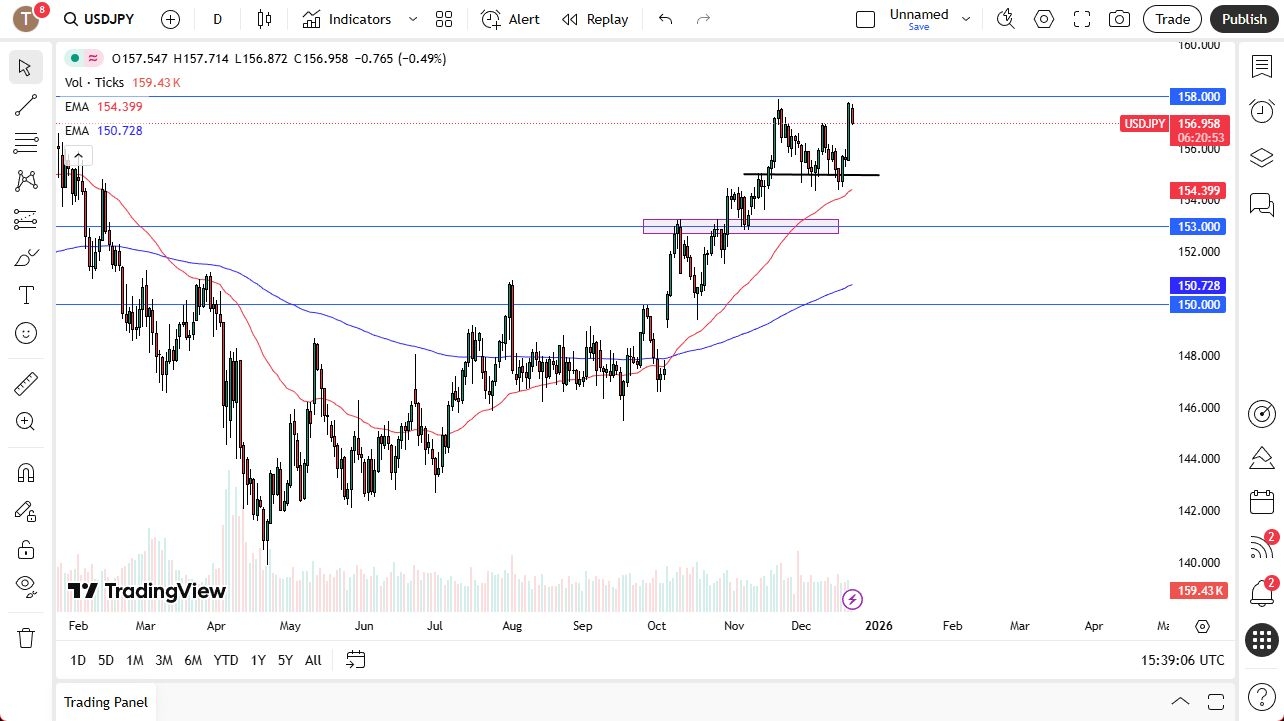
If we can break above the 158 yen level, then it’s likely that the market will eventually break out to the 160 yen level. I do believe that happens given enough time, but the US dollar itself is giving back some of its strength during the day against multiple currencies, so I think this is more or less an indictment on the US dollar during the session than it is saying anything about the Japanese yen.

The 154.50 yen level is where we had seen quite a bit of support previously, and I think ultimately the fact that the 50-day EMA is approaching that level as well opens up the possibility of it being a short-term floor. We are heading into the holiday week, and therefore, I think it’s probably a market that’s going to be choppy and sideways more than anything else, but we’ll have to wait and see how that plays out.
I do think this is a situation where you are looking for value, and you are taking advantage of it because despite the fact that the Bank of Japan just raised rates and the Federal Reserve cut rates, you could still drive a truck through the interest rate differential between the two, and that spread pays you at the end of every day. This is what I’ve been taking advantage of since July, and I don’t plan on changing that anytime soon. So with that being said, I think this is just a little bit of give back from that massive move on Friday, but I wouldn’t read much more into it than that, being the case. I think it’s just a little bit of a pullback, a little bit of profit-taking as we are reaching a resistance barrier. I remain bullish.
Want to trade our USD/JPY forex analysis and predictions? Here’s a list of forex brokers in Japan to check out.
Christopher Lewis has been trading Forex and has over 20 years experience in financial markets. Chris has been a regular contributor to Daily Forex since the early days of the site. He writes about Forex for several online publications, including FX Empire, Investing.com, and his own site, aptly named The Trader Guy. Chris favours technical analysis methods to identify his trades and likes to trade equity indices and commodities as well as Forex. He favours a longer-term trading style, and his trades often last for days or weeks.
Nearly three-quarters of Americans take supplements to help fill nutrient gaps or support overall wellness. But some commonly used products may come with an unintended side effect: disrupted sleep. Here are three to keep in mind.
Some pre-workout supplements, as well as those marketed for weight loss or energy, contain caffeine, said Pieter A. Cohen, MD, an associate professor of medicine at Harvard Medical School and an Internal Medicine doctor at the Cambridge Health Alliance. As a result, they may interfere with sleep if taken too close to bedtime.
While some supplements list caffeine as an ingredient, many do not disclose the amount. Others may contain caffeine without clearly labeling it at all. “It’s often very difficult, if not impossible, for consumers to see how much caffeine is in a product by looking at the label,” Cohen told Health.
Vitamin B12 is essential for nerve function, red blood cell formation, and energy production. It may also play a role in regulating melatonin (the hormone involved in the sleep-wake cycle), which could help support sleep and daytime functioning for people with a deficiency, Grace Derocha, RDN, spokesperson for the Academy of Nutrition and Dietetics, told Health.
That said, vitamin B12’s relationship with sleep appears to be complex—with some evidence suggesting it may actually reduce your nightly shuteye. For example, one small study in healthy adults found that vitamin B12 influenced melatonin levels, and that one form—methylcobalamin—was associated with less sleep, though not with poorer sleep quality overall.
But whether the supplements actually disrupt sleep—and why they might do so—remains unclear. “Overall, the research is mixed,” Fariha Abbasi-Feinberg, MD, a member of the board of directors of the American Academy of Sleep Medicine, told Health. “Additional cross-sectional studies are needed to fully understand the relationship between sleep, circadian rhythm, and vitamin B12.”
While there isn’t strong evidence that multivitamins interfere with sleep, there are a couple reasons why they might. Many multivitamins contain vitamin B12, a nutrient linked to sleep disruption, and one study found that people who took multivitamins reported higher rates of insomnia and more nighttime awakenings than those who did not.
However, Abassi-Feinberg cautioned against making too much of those findings. “It’s important to remember that one study is not indicative of a definitive trend or causation,” she said. The study also had important limitations, including a relatively small sample size, a nonrandomized design, and reliance on self-reported sleep data.





:max_bytes(150000):strip_icc()/Health-GettyImages-1450382928-43d2039c8e944611873fb584d9caec0e.jpg "3 Common Supplements That Could Be Ruining Your Sleep")