The main category of All News Articles.
You can use the search box below to find what you need.
[wd_asp id=1]
The main category of All News Articles.
You can use the search box below to find what you need.
[wd_asp id=1]
Dogecoin (DOGE) is hammering on $0.13 support at the time of writing on Tuesday as overhead pressure continues to spread across the crypto market. The largest meme coin by market capitalization faces a deteriorating technical structure, weighed down by a weak derivatives market.
The Dogecoin derivatives market has remained significantly suppressed since the October 10 crash, which led to extensive deleveraging. According to Glassnode’s data, futures Open Interest (OI) across all exchanges stood at approximately $645,000 as of Monday, up slightly from roughly $640,000 the previous day but significantly below the $1.5 billion recorded on October 10.
Dogecoin’s OI hit a record high of approximately $3 billion on September 13, which emphasizes the significant decline in trader interest and confidence. The suppressed OI suggests that traders are unwilling to take on risk, a situation that continues to limit rebounds.
Dogecoin’s futures perpetual funding rate continues to fluctuate, depriving the meme coin of the tailwind it needs to sustain its recovery. According to Glassnode’s data, the funding rate is silent at zero as of Monday, down from 0.001% the previous day and 0.007% on Sunday.
A negative funding rate indicates that traders are piling into short positions, helping keep the price suppressed. A positive but low funding rate suggests that fewer traders are increasing exposure to the meme coin. On the other hand, a rising funding rate would support the bullish outlook and increase the odds of a steady uptrend.

Dogecoin is trading above $0.13 at the time of writing on Tuesday. The meme coin holds below the falling 50-day Exponential Moving Average (EMA) at $0.15, the 100-day EMA at $0.17 and the 200-day EMA at $0.19, all of which underscore a bearish setup.
The Relative Strength Index (RSI) stands at 41, below the midline on the daily chart, confirming restrained buying interest. If the RSI declines further toward oversold territory, the path with the least resistance would stay downward, increasing the odds of DOGE retesting support at $0.12.
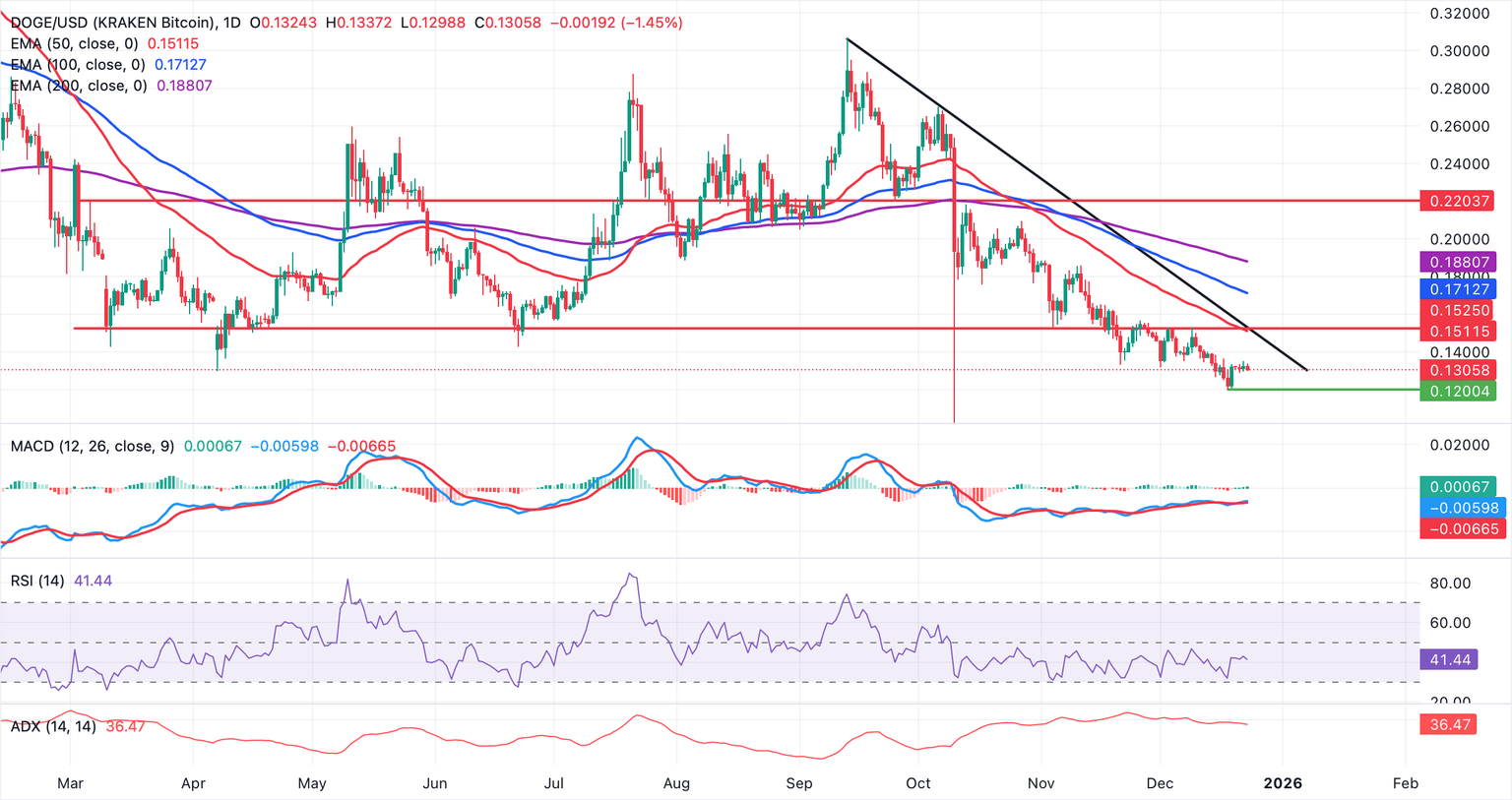
Still, a bullish crossover emerges as the Moving Average Convergence Divergence (MACD) line climbs above the signal line on the same chart. The green histogram bars have turned slightly positive above the mean line, suggesting improving momentum.
However, a sustained break above $0.15 resistance could open the way toward the 100-day EMA at $0.17. Failure to reclaim that barrier would keep bears in control beneath the 200-day EMA at $0.19. Meanwhile, the Average Directional Index (ADX) at 36 continues to fade, pointing to softer trend strength and a consolidative tone until a clear break.
(The technical analysis of this story was written with the help of an AI tool)
Recent news today in the crypto market shows new strength in NFTs and surging growth in real-world asset tokenization. These sectors have been written off in the downturn, but capital has begun to turn round as confidence returns. This pattern is familiar. Crypto bull phases rarely happen in a straight line. Capital rotates from the one story to the other as traders reposition.
Pepeto ($PEPETO) becomes relevant at this stage because meme utility historically follows these rotations. When capital completes an orbit of structured narratives, often the focus is moved to high-engagement sectors where asymmetric upside lies on the horizon.
Source: https://www.ainvest.com/news/nft-market-correction-strategic-inflection-point-investors-2512/
How Capital Usually Turns Around During Bull Phases
Every main cycle is run through by a loose progression. Bitcoin (https://coinmarketcap.com/currencies/bitcoin/) stabilizes first as confidence returns. Ethereum (https://coinmarketcap.com/currencies/ethereum/) follows as infrastructure activity picks up. Then narrative sectors emerge, this includes NFTs, gaming, and real-world asset tokenization. These areas are a boon to capital looking to gain thematic exposures.
Once these narratives get overcrowded, traders seek sectors that are a combination of attention and liquidity. This is where meme coins traditionally fit in. However, there is no pure hype in the next phase.
However, investors looking for the best crypto to buy now increasingly wish for meme exposure that entails utility and not hollow stories. This change provides the foundation for meme utility projects to provide the next wave in capital rotation.
Why Meme Utility is the Logical Next Sector
Meme coins survive on engagement. They are easy to understand, quick to trade, and culturally powerful. In previous cycles, this simplicity led to massive volume. The problem was sustainability.
The current environment is conducive to another model. Traders calculating the best crypto investment want projects that have the ability to capture one after another meme-driven volume. And that’s what utility provides. Meme utility is at the crossroads between engagement and infrastructure and is a natural next step after the capture of first flows by NFTs and RWAs (https://www.ainvest.com/news/rise-ethereum-powered-rwa-tokenization-implications-institutional-capital-allocation-2512/). This is where Pepeto enters with a structure designed specifically to monetize meme activity.
Pepeto’s Infrastructure Positions It for the Next Rotation
Pepeto (https://pepeto.io) operates on the Ethereum mainnet with a fixed supply of 420 trillion tokens. It is designed as an ecosystem where all swap, exchange, and trade volume routes through $PEPETO, turning activity into recurring token demand. PepetoSwap offers zero-fee swaps, encouraging high-frequency participation without friction. Pepeto Bridge expands access across chains while keeping liquidity unified.
Pepeto Exchange functions as a verified meme exchange, listing curated and audited projects rather than random launches. This is a direct response to discovery and trust problems that have been so prevalent in meme markets throughout history. Staking to provide further strengthening of the model. With staking APY hovering in the 216% range, holders are incentivized to lock their tokens, meaning the circulating supply of the tokens reduces the more activity increases.
Pepeto has completed audits by SolidProof and Coinsult, has raised more than $7.1M in presale funding, and is supported by a community exceeding 100,000 members. It presents itself as meme culture + real utility, sometimes referred to as “PEPE + Technology + Optimization.” This structure is why Pepeto is increasingly discussed as the best meme coin to buy and the best crypto presale to buy during early rotation phases.
How to Buy Pepeto Before Meme Utility Gains Attention
The Pepeto presale is live at https://pepeto.io. The current presale price is approximately $0.000000173 per $PEPETO token. Investors can enter by using a wallet via the official website and buy with ETH, USDT, BNB, or a bank card.
Early buyers are able to stake right away for the presale and earn high APY before launch. There is also a $700,000 giveaway in progress and on the official website as an incentive for those who participate early. Always make sure that you are using the official one, as there is a tendency of imitation sites to always come around the phase rotation.
Rotation Creates Opportunity Prior to Consensus Forming
Capital rotation does not verbally announce that it is. By the time the sector is obvious, much of the upside is already covered. This is why traders look for early signs and not confirmation.
For those looking for the best crypto to invest in, the next meme coin to blow up, or the next 100x meme coin opportunity, meme utility is an emerging phase and not a saturated phase. Pepeto fits this transition point, combining meme engagement with infrastructure that can sustain volume beyond a single trend.
As NFTs and RWAs consume attention, the next rotation convivially builds somewhere else. Pepeto offers exposure before meme utility becomes a dominant headline. Early positioning phase rotation has historically provided the strongest returns, and late May may just pick up the momentum minus multiples.
This pattern is the reason for not waiting for each sector to peak before reallocating according to experienced traders. They stand ahead of the shift, and not after it. Meme utility projects that already have infrastructure in place are better placed than reactive launches that come in once the trend is obvious.
Pepeto benefits from this timing advantage. It is already building use cases, community inertia, and token demand mechanisms-before meme utility becomes the dominant narrative. That early positioning is what makes the difference between rotation leaders and short-lived followers.
To stay ahead of key updates, listings, and announcements, follow Pepeto on its official channels only:
Website: https://pepeto.io
X (Twitter): https://x.com/Pepetocoin
Telegram: https://t.me/pepeto_channel
Instagram: https://www.instagram.com/pepetocoin/
Contact: Dani Bonocci
Website: https://www.tokenwire.io
Phone: +971586738991
SOURCE: Pepeto
Press release distribution
This release was published on openPR.
HP Inc. (HPQ) declined in its latest intraday trading, under continued negative pressure as it trades below its 50-day SMA, reinforcing the stability and dominance of the main downward trend on the medium term, especially with its movement along a downward-sloping trend line. In addition, negative signals continue to emerge from momentum indicators, despite their arrival at extremely oversold levels.
Therefore we expect the stock price to decline in its upcoming trading, as long as it remains below the key resistance level at $25.95, targeting the pivotal support level at $22.25.
Today’s price forecast: Bearish
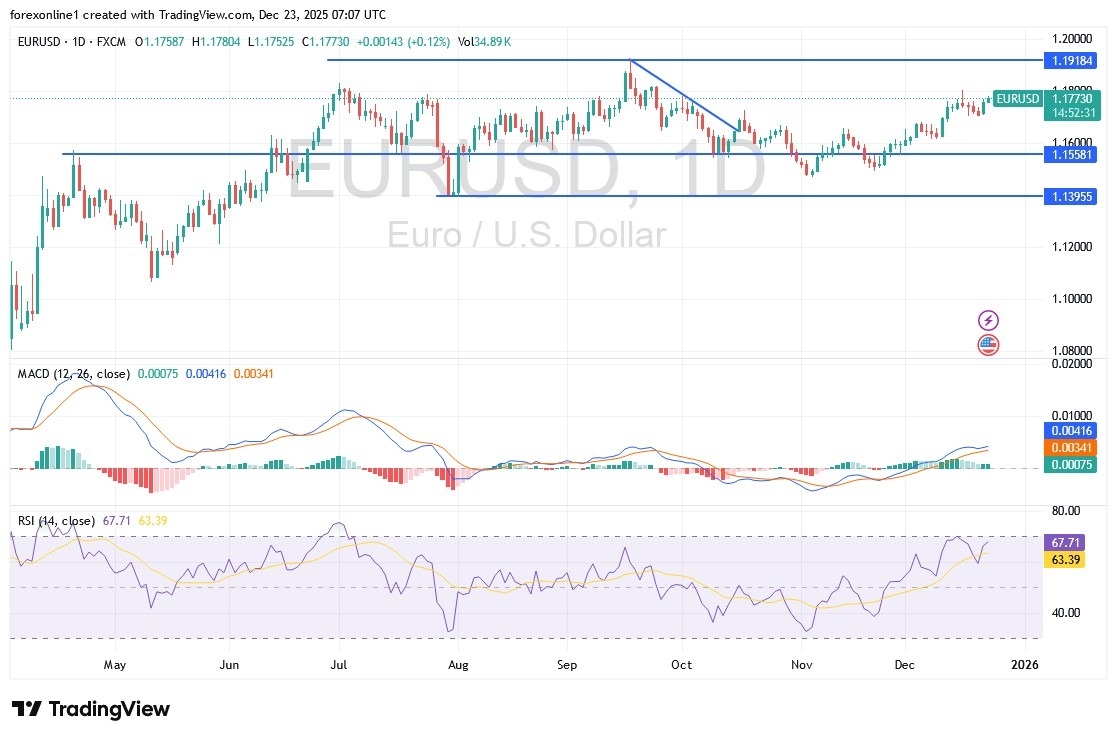
The EUR/USD began the penultimate trading week of 2025 on a positive note, rebounding toward the 1.1769 resistance level. Bulls are attempting to return to the 1.1800 psychological resistance area, a level critical for preparing for stronger upward breakouts. According to reliable trading platforms, the Euro is currently capitalising on the market’s primary focus on Federal Reserve expectations rather than Eurozone policy.

Expectations for further monetary easing by the Fed in 2026 continue to weigh on the US Dollar, even as the European Central Bank (ECB) signals no urgent need for interest rate adjustments. Risks remain tied to US economic growth, inflation, and political pressure on the Federal Reserve.
Currently, technical indicators confirm a shift in the EUR/USD trend, with the 14-day Relative Strength Index (RSI) hovering around 65, close to the overbought level, and the MACD indicator also trending upwards. The strong buying pressure from technical indicators is prompting bulls to push quickly towards the psychological resistance level of 1.2000. Today’s EUR/USD trading will be influenced by the release of US economic growth figures and durable goods orders data, both at 3:30 PM Egypt time, followed by the US consumer confidence index from Michigan at 5:00 PM Egypt time.
Traders are advised to wait for market and investor reactions to the important US economic announcements, as this reaction will determine the direction of currency prices for the remainder of 2025 trading. Therefore, it is not recommended to keep positions open during the holiday season.
In this context, Nordea Bank expects the EUR/USD exchange rate to rise to 1.24 by the end of 2026. HSBC expects EUR/USD to rise to 1.20 at the beginning of 2026 before retreating to 1.18 by the end of the same year.
Similarly, Société Générale commented on the short-term outlook for the EUR/USD pair, stating: “A slight pullback is currently forming; maintaining the 50-day moving average near 1.1610 will be crucial for the continuation of the upward trend. If the pair breaks above the 1.1800/1.1830 resistance levels, it is likely to experience further upward movement. The next targets could be the September high of 1.1920 and the psychological resistance at 1.2000.”
In this regard, the European Central Bank made no changes to interest rates at its latest meeting, keeping the deposit rate at 2.00%. Eurozone growth expectations have seen a slight improvement, while inflation is expected to remain around 2.00% over the medium term. ECB President Lagarde stated that there is no pre-determined path for interest rates.
In this regard, MUFG Bank commented on the European Central Bank’s policies, stating: “We have scrapped our forecast of a final 25 basis point interest rate cut by the ECB in 2026. However, it is still too early for the Eurozone interest rate market to expect an early rate hike next year, given that inflation is still expected to remain below the ECB’s target.” They added: “With the Bank of England and the Federal Reserve still expected to cut interest rates further next year, we anticipate continued strength in the euro in 2026, while the ECB maintains its current monetary policy stance.”
As for the United States, financial markets continue to expect further US interest rate cuts by the Federal Reserve in 2026 following the decline in inflation. The unemployment rate has reached a four-year high of 4.6%, while US jobs data overall has been mixed.
According to Nordea Bank; We expect the US dollar to weaken by 2026, as growth differentials and political uncertainty turn against it. We are particularly concerned about the Trump administration’s focus on influencing the Federal Reserve. Rabobank also commented: “We expect the US economy to enter a cyclical recession next year. While many G10 central banks have completed their interest rate-cutting cycles, the Fed is likely to continue its monetary easing until 2026.”
The bank added in its outlook: “Additional risks to the US dollar include a new round of tariffs, persistently high inflation coupled with negative real interest rates, or a sharp correction in AI-related stocks.”
Ready to trade our daily Forex forecast? Here’s a list of some of the best regulated forex brokers to check out.
New science on omega-3s emerges constantly, from fish oil to flaxseed and beyond. Well known for benefitting cardiovascular health and brain health, this ingredient also is positively correlated with mental health outcomes as previously reported.
But what if the benefits of omega-3s could be realized regardless of dietary preference? Researchers at Friedrich Schiller University Jena in Germany set out to determine how differing age, body mass index (BMI) and dietary patterns impact omega-3 levels in participants supplementing with flaxseed oil.
Flaxseed is rich in alpha-linolenic acid (ALA), a precursor for more well known omega-3 polyunsaturated fatty acids (PUFA) such as eicosapentaenoic acid (EPA) and docosahexaenoic acid (DHA). However, conversion of ALA into EPA and DHA is confounded by several factors such as age, sex and BMI.
The new study out of Germany investigates the impact of dietary patterns, in particular the consumption of animal and fish products, on ALA conversion. Because flaxseed is plant-based, it gives vegetarians and vegans more flexibility in getting adequate levels of circulating long chain omega-3s in the body, which are primarily found in fish and seafood.
All participants experienced increased omega-3 PUFA plasma levels regardless of dietary pattern (omnivore, flexitarian, vegetarian or vegan).
During the study, all subjects received nutritional counseling and nutrient-optimized menu plans, improving the nutritional quality of their food intake while still adhering to their dietary preferences. However, prior eating patterns did not significantly affect ALA conversion to EPA and DHA.
Participants supplemented with enough flaxseed oil to consume 2 grams ALA per day, aiming for 3 grams ALA daily when combined with nutrient-optimized menus.
Design: Prospective, non-randomized, single-center study.
Study size: 168 healthy adults aged 18-70 were enrolled and grouped into the following based on their dietary patterns: omnivore (Western diet), flexitarian, vegetarian or vegan.
Length: Participants supplemented with flaxseed oil for nine months and were given nutritional counseling and optimized menus based on their dietary preference for 12 months.
Dosage: At least 2 grams ALA daily from flaxseed oil, targeting 3 grams daily total with nutritional intervention.
Outcomes measured: Blood samples were collected for fatty acid analysis of plasma and erythrocytes, including concentrations of ALA, EPA and DHA.
Omega-3 concentrations increased with flaxseed supplementation in all groups regardless of dietary preference. ALA concentrations significantly increased from month three to 12 in all groups except vegans, when subjects received flaxseed supplements, possibly because they had lower erythrocyte concentrations at month 12.
Dietary patterns had no impact on the conversion of ALA into long-chain PUFA. Researchers also found that sex, age, BMI and nutrient status did not impact ALA conversion.
Participants had very few changes in saturated or monounsaturated fatty acid levels. Interestingly, the omnivores (or those adhering to a Western diet) had an increase in omega-6 fatty acid concentrations, typical of such dietary patterns. Maintaining a balance between omega-3 and omega-6 fatty acids is important for managing inflammation and reducing incidence of chronic disease.
Previous studies on ALA conversion in vegetarians and vegans were limited in size and did not include omnivores. The authors observed conversion of ALA to DHA in the current study but stated “the efficacy of ALA conversion to DHA is still under debate.”
The study provided strong evidence that flaxseed oil improves omega-3 long-chain PUFA concentrations, suggesting health benefits afforded by omega-3s can be achieved by active ingredients high in ALA.
Crypto market news today sounds a cautious tone with investors finding their way in risk-off conditions and macro uncertainty. Large-cap assets with slower development cycles are experiencing muted interest, while early-staged opportunities are silently getting capital interest from traders getting into position ahead of the next expansion phase. In this environment, Pepeto ($PEPETO) is coming to be seen as an asymmetric alternative to mature platforms such as Cardano.
Source: https://www.fxstreet.com/cryptocurrencies/news/cardano-price-forecast-ada-suffers-from-900-million-loss-realization-as-prices-bounce-near-034-202512200340
Cardano Price Now And The Market Position
According to CoinMarketCap live data (https://coinmarketcap.com/currencies/cardano/), Cardano (ADA) is currently trading for about $0.37 with a market capitalization of almost $16.7 billion. ADA remains one of the most well-known smart contract platforms, but its price action has largely been another reflection of general market sentiment, rather than of independent momentum.
What Drives the Cardon Value And Market Perception
Cardano’s valuation is motivated by research-heavy development, network upgrades, and community governance on a long-term basis. While this approach has its appeal with those who have long-standing beliefs, it usually means slower adoption cycles.
In a risk-off environment investors often prefer to invest in either very liquid majors or early-stage narratives, leaving Mid-Cycle platforms such as Cardano struggling to find speculative capital.
Cardano Price Prediction: ADA Scenarios For 2025 To 2026
In a conservative scenario, ADA goes through trading ranges of $0.30 to $0.45 as development goes on gradually. A base case assumes incremental growth in ecosystem growth and improved sentiment, which supports a move towards the $0.60 to $0.85 range by 2026.
A bullish scenario would need a strong re-return of risk appetite, and some meaningful user growth, and could see ADA rise to the $1.00 level, but upside is still limited by scale.
Why ADA Upside is Structurally Limited ?
With a market cap of more than thirteen billion dollars, Cardano is solidly in the large-cap category. For this level to yield exponential returns it would require extraordinary capital inflows. As a result, ADA starts to act more like a hold with high long-term demand than a high-growth opportunity.
Capital Rotation And The Search For High Conviction Plays
Historically, once large-cap platforms stall it is capital that rotates towards early stage projects that provide better risk-reward profiles. This rotation often occurs silently during risk off periods and sets the stage for explosive moves during periods of improving sentiment.
Pepeto ($PEPETO): Early Setup With Strong Conviction
Pepeto (https://pepeto.io) is entering the market from a position that many analysts consider rare. Unlike established projects such as Cardano, Pepeto is still in its presale phase, priced at a micro level around $0.000000172, yet it has already raised more than $7.1 million. That level of early capital signals strong conviction from investors who understand how much upside is created at this stage, the same stage where early positioning once made life-changing returns in projects like SHIB and DOGE.
What makes Pepeto especially compelling is its origin. The project is backed by a co-founder of PEPE, one of the most iconic meme coins in crypto history. PEPE proved how powerful meme culture can be, but it also exposed its biggest weakness: a lack of real utility to support long-term demand, which eventually led to fragile price action. Pepeto is built specifically to fix that mistake.
Pepeto keeps the PEPE identity traders already recognize, but adds Technology and Optimization in a way PEPE never did. The project is developing PepetoSwap as a zero-fee swap, Pepeto Bridge for cross-chain liquidity movement, and Pepeto Exchange as a verified meme trading hub. Every swap, every trade, and every listing is designed to route through the $PEPETO token, turning ecosystem activity directly into structural demand.
Analysts point to this combination, proven meme culture, founder experience, and real infrastructure, as the reason Pepeto is increasingly discussed as a potential 100× opportunity. It offers the emotional familiarity of PEPE, but with the utility PEPE lacked, at a time when the market is once again rewarding early conviction. For many investors, this feels like the kind of second chance that rarely appears in the meme coin space, and the kind that disappears quickly once the wider market catches on.
Pepeto Price Prediction Logic Through 2026
Pepeto’s price outlook is increasingly viewed as a function of execution and cycle timing, not blind speculation or short-term macro trends. Analysts point out that the project is entering the market at a rare moment, ahead of a broader altcoin and meme season, with infrastructure already in place and a presale valuation that still reflects early discovery. In conservative scenarios, gradual presale repricing combined with supply reduction through staking supports steady appreciation rather than sudden, unstable spikes.
The base case centers on Pepeto becoming a core layer for meme coin trading as volume returns to the sector. With PepetoSwap, cross-chain routing, and a verified meme exchange designed to sit at the center of activity, the project is positioned to benefit from every increase in meme trading, not just from attention cycles. This is where analysts see the model diverging from past meme projects that lacked demand engines and eventually lost momentum.
In more bullish scenarios, tied to a full altcoin and meme cycle, Pepeto’s early positioning becomes the key driver of upside. Launching into a stronger market environment, backed by completed audits that attract whale participation, and built by a team that studied and fixed the failures of previous meme coins, Pepeto checks the boxes that serious capital looks for. Analysts argue that this combination, early entry, infrastructure ownership, and cycle-perfect timing, is exactly what has historically made 100× outcomes possible. Unlike large, mature assets such as Cardano, Pepeto still sits in the phase where exponential upside is mathematically realistic. For many observers, the market has waited a long time for a meme project built this deliberately, and that is why the current price window is being watched so closely.
Tokenomics, Staking, And Reduction In Supply
Pepeto (https://pepeto.io) is built on Ethereum mainnet and has a total supply of 420 trillion tokens. Staking APY in the-general neighborhood of 216% gives early holders an incentive to stake their supply and decrease the number of tokens in circulation ahead of listings. Audits from SolidProof and Coinsult further boost confidence in presale participants.
Source: https://pepeto.io/assets/documents/audit-solidproof.pdf –
https://coinsult.net/projects/pepeto/
Cardano Versus Pepeto For 2026 Investors
Cardon has longevity, academic rigor and has a large existing user base. Pepeto’s asymmetric, early entry provision and demand engine linked directly to trading activity. For many investors, ADA is the conservative allocation, and for them, Pepeto would be the high conviction growth position.
How To Purchase Pepeto Prior to Listings
Pepeto is only available on its official presale. Investors can go to https://pepeto.io and connect a compatible wallet and buy $PEPETO using either ETH, USDT or BNB – or using a bank card. Tokens can be staked as soon as it is available to receive high APY rewards in advance of launch. Only the official website of Pepeto.io should be used so that it is possible to avoid fake presale pages.
Final Outlook Risk-Off Assets vs. Early Opportunity
Cardano may still have a place in long-term blockchain development, but risk-off conditions are limiting its near-term upside. Pepeto is a rare early stage opportunity with meme culture, real utility, audits, staking and it will not receive the same price as the presale that will never again be available after listing.
For investors who want asymmetric exposure for the pre-acceleration before the next cycle, Pepeto is the higher conviction choice.
To stay ahead of key updates, listings, and announcements, follow Pepeto on its official channels only:
Website: https://pepeto.io
X (Twitter): https://x.com/Pepetocoin
Telegram: https://t.me/pepeto_channel
Instagram: https://www.instagram.com/pepetocoin/
Contact: Dani Bonocci
Website: https://www.tokenwire.io
Phone: +971586738991
SOURCE: Pepeto
Press release distribution
This release was published on openPR.
It’s the end of the year, peeps — and what a year it was.
We’re locking in and bringing good energy into the new year, so now is a perfect time to reflect back on some of the HealthyWomen stories and important things we learned about women’s health in 2025 that made us high-five the universe and take a pause from doom scrolling to share with our friends.
Here are 5 notable highlights in women’s health living rent-free in our brains into 2026.
Manifesting works, people. Case-in-point: Lorals for Protection, the first FDA-cleared underwear line that protects against sexually transmitted infections (STIs) during oral sex.
The thin and stretchy latex design reduces the transmission of bodily fluids and harmful pathogens that can happen during oral contact. Each pair is full coverage for vaginal and anal fun, and fits like a regular pair of underwear.
Finally: an easy, sexy way to protect yourself during oral sex. Your move, dental dam.

iStock.com/Mindful Media
If you or someone you know has polycystic ovary syndrome (PCOS), it’s important to note that taking birth control pills can decrease the risk of endometrial cancer.
In one of our Real Women, Real Stories this year, Kayla Nixon shared that she learned about the benefits of birth control for people with PCOS only after she was diagnosed with cancer.
“When the oncologist asked if I’d ever gotten on birth control for my PCOS, he told me that I should have — because it could have prevented the cancer from developing. If I’d known this, I would have taken that step, and I also wish I’d known I had PCOS earlier so I could have had more time to take action.”
Read: I Was Told I Was Too Young to Have Endometrial Cancer — but I Did >>

iStock.com/simarik
For women with hormone-positive breast cancer — the most common type of breast cancer in the U.S. — estrogen is the enemy. But estrogen keeps your vagina healthy and lubricated, and without it, symptoms like dryness, burning and pain during sex can be life-altering.
But not all estrogen is created equal. Vaginal estrogen therapy to treat genitourinary syndrome of menopause (GSM) is localized, meaning the treatment only affects the vaginal area — not the entire body. And a 2025 review of more than 5,000 studies confirmed that women with a history of breast cancer who used local vaginal estrogen did not increase their risk of recurrence for breast cancer.
The review made headlines and put vaginal estrogen therapy in the spotlight and reminded us that vaginal estrogen is an option.
Read: More Research Shows Vaginal Estrogen Is Safe for People with a History of Breast Cancer >>

iStock.com/FG Trade
Most of us associate multitasking with being productive. Who doesn’t shop for groceries, answer work emails and talk to their mother on the phone while walking the dog?
Unfortunately, the more you’re trying to do, the more likely you’re causing harm to your brain. Over time, multitasking can reduce your attention span, harm your working memory and stress your brain out, which can lead to serious health problems.
One idea: Monotasking. Science says our brains are designed to focus on one thing at a time.
We know this sounds impossible. But it’s worth a try. Just remind yourself about the time that you purchased 44 pineapples, emailed your boss the wrong report and let your dog roll around in the mud. Your mom is still talking about it.
DENVER, Dec. 23, 2025 (GLOBE NEWSWIRE) — As decentralized finance (DeFi) continues to expand, earning passive income through crypto assets has become an increasingly attractive option for investors. While DeFi offers attractive on-chain yields, many users—especially beginners, are deterred by complex DeFi protocols, high gas fees, and security concerns. To address these challenges, BenPay has introduced DeFi Earn , built on BenFen Blockchain, simplifying the process of earning passive income through DeFi, making it accessible to everyone.
DeFi Passive Income: Opportunity Meets Complexity
In traditional finance, passive income is typically generated through dividends, interest-bearing savings, or rental assets. In DeFi, passive income is created by deploying crypto assets into on-chain protocols that enable lending, staking, or liquidity provision through smart contracts.
While this model often offers higher potential returns than traditional banking products, it also requires users to manage wallets, select protocols, pay transaction fees, and assess smart contract risks. These factors have limited broader participation in DeFi despite growing interest.
A Shift Toward Accessible DeFi
By this year, the DeFi landscape has begun to shift from a focus on complexity toward usability and risk awareness. Industry participants are increasingly developing solutions that abstract technical processes while maintaining access to on-chain yield opportunities.
BenPay DeFi Earn reflects this trend by positioning itself as a simplified entry point for users seeking to earn passive income with crypto—without needing to interact directly with multiple DeFi protocols.
BenPay DeFi Earn: A Simplified and Secure Passive Income Platform
BenPay DeFi Earn is a platform designed to simplify the process of earning passive income through DeFi. Whether you’re new to DeFi or a seasoned investor, BenPay provides a streamlined, efficient, and secure way to participate and start earning. Here are the key advantages of using BenPay DeFi Earn:
How BenPay DeFi Earn Works
Users begin by depositing supported stablecoins USDT/USDC into BenPay and selecting protocols. The platform then allocates these assets to curated DeFi yield strategies. Earnings accrue automatically and can be monitored in real time through the BenPay DeFi Earn dashboard.
Realistic Earnings Example: Bringing It to Life
The following example is provided for illustrative purposes only and is based on historical data.
The power of compounding can significantly increase your earnings over time, turning your passive income into a more powerful cycle of growth.
The Future of DeFi: Simplicity Meets Security
As DeFi continues to evolve, it no longer has to be a complex and risky process. Platforms like BenPay DeFi Earn have simplified the experience by eliminating high gas fees, vetting protocols for security, and offering everything in an easy-to-use interface. The future of DeFi is about accessibility, simplicity, and security, and BenPay is leading the way in making passive income opportunities accessible to everyone.
Start Your Passive Income Journey Today
Ready to start earning passive income with DeFi? BenPay DeFi Earn makes it easier than ever for you to put your crypto assets to work. Whether you’re a beginner or an experienced investor, BenPay provides a simple, secure, and efficient way to earn passive income.
Experience BenPay DeFi Earn today, deposit your crypto, and watch your assets grow!
Risk Disclosure: This content is for informational purposes only and does not constitute financial advice. Any mentioned returns (e.g., APY) are based on historical data and do not guarantee future performance. Please conduct your own research (DYOR) before making any investment.
Learn more: https://www.benpay.com/blog/
Contact information: benpay.official@gmail.com
A photo accompanying this announcement is available at https://www.globenewswire.com/NewsRoom/AttachmentNg/77c414f8-14bd-40fa-ac41-982038c2e2e0

Important DisclaimersFXEmpire is owned and operated by Empire Media Network LTD., Company Registration Number 514641786, registered at 7 Jabotinsky Road, Ramat Gan 5252007, Israel. The content provided on this website includes general news and publications, our personal analysis and opinions, and materials provided by third parties. This content is intended for educational and research purposes only. It does not constitute, and should not be interpreted as, a recommendation or advice to take any action, including making any investment or purchasing any product. Before making any financial decision, you should conduct your own due diligence, exercise your own discretion, and consult with competent advisors. The content on this website is not personally directed to you, and we do not take into account your individual financial situation or needs. The information contained on this website is not necessarily provided in real time, nor is it guaranteed to be accurate. Prices displayed may be provided by market makers and not by exchanges. Any trading or other financial decision you make is entirely your own responsibility, and you must not rely solely on any information provided through the website. FXEmpire does not provide any warranty regarding the accuracy, completeness, or reliability of any information contained on the website and shall bear no responsibility for any trading losses you may incur as a result of using such information. The website may include advertisements and other promotional content. FXEmpire may receive compensation from third parties in connection with such content. FXEmpire does not endorse, recommend, or assume responsibility for the use of any third-party services or websites. Empire Media Network LTD., its employees, officers, subsidiaries, and affiliates shall not be liable for any loss or damage resulting from your use of the website or reliance on the information provided herein.Risk DisclaimersThis website contains information about cryptocurrencies, contracts for difference (CFDs), and other financial instruments, as well as about brokers, exchanges, and other entities trading in such instruments. Both cryptocurrencies and CFDs are complex instruments and involve a high risk of losing money. You should carefully consider whether you understand how these instruments work and whether you can afford to take the high risk of losing your money. FX Empire encourages you to conduct your own research before making any investment decision and to avoid investing in any financial instrument unless you fully understand how it works and the risks involved.
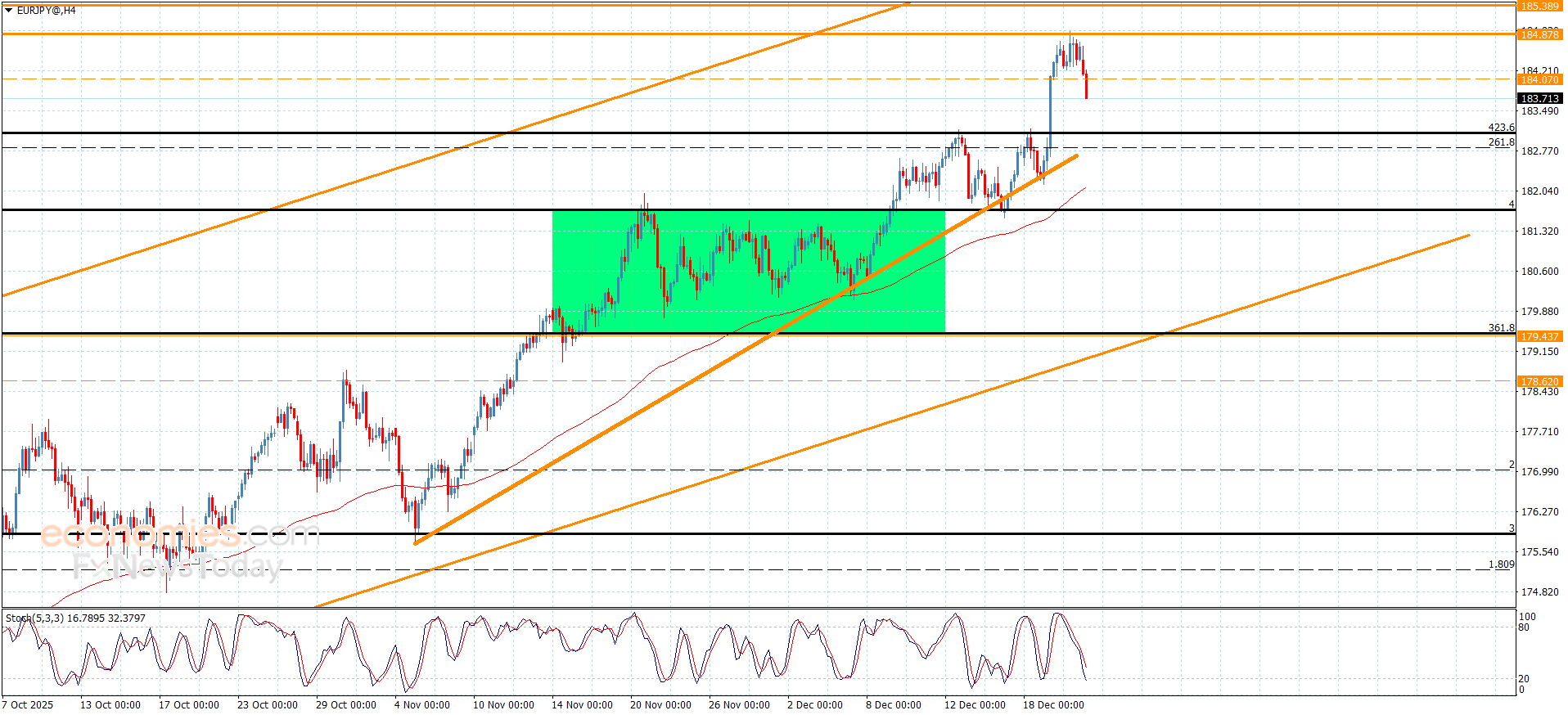
The EURJPY pair reached the main target at 184.90, forming a strong barrier to begin forming bearish corrective waves, to settle near 183.75, announcing the beginning of gathering some gains in the current period trading.
Stochastic is approaching 20 level, to increase the negative pressure, which makes us prefer more corrective trading that might target 183.30 level, reaching key support at 182.80, while stepping above 184.10 again and providing positive close will reinforce the chances of forming new bullish waves, to repeat the pressure on the mentioned barrier.
The expected trading range for today is between 183.30 and 184.10
Trend forecast: Bearish