The main category of All News Articles.
You can use the search box below to find what you need.
[wd_asp id=1]
The main category of All News Articles.
You can use the search box below to find what you need.
[wd_asp id=1]
The GBPJPY pair continued providing negative trading, affected by forming extra barrier at 208.10 level, with the negative momentum that comes from stochastic below 50 level, attacking the support at 206.90 that formed the suggested target in the previous report.
The effect of the temporary sideways bias dominance, however facing the negative pressures that might push it to resume the corrective decline, to target 206.25 and 205.80 level, while renewing the bullish attempts requires forming strong bullish attack, to settle above 208.10 then begin targeting new positive stations by its rally towards 209.15.
The expected trading range for today is between 206.25 and 207.65
Trend forecast: Bearish
CitrusBurn combines zesty citrus flavor with ingredients formulated to support metabolism and energy.
Citrus Burn – Scientific Introduction
Citrus Burn – Burn Fat the Natural Way!
St. Petersburg, Fl, Dec. 15, 2025 (GLOBE NEWSWIRE) — Citrus Burn is a nutraceutical formulation developed to support lipid metabolism, thermogenesis, and energy production. The formulation utilizes bioactive citrus-derived compounds in combination with metabolic cofactors that contribute to increased fatty acid oxidation and enhanced metabolic efficiency. Through the stimulation of thermogenic pathways and support of mitochondrial energy processes, Citrus Burn assists the body in mobilizing stored adipose tissue for energy utilization. Additionally, the formulation includes components that may aid in appetite regulation and glycemic balance, supporting overall metabolic health when used alongside a balanced diet and physical activity.

INTRODUCING CITRUS BURN
Kick-start your metabolism with the power of citrus!
Citrus Burn is specially formulated to help support fat burning, energy, and appetite control using carefully selected citrus extracts and natural ingredients.
✅ Boosts metabolism
✅ Supports fat breakdown
✅ Enhances energy & focus
✅ Helps control cravings
Perfect for anyone looking to support their fitness and weight-management goals.
Citrus Burn Explore It To Know More
Common Citrus Burn Ingredients (Typical)
⚠️ Ingredients may differ by brand
How Citrus Burn Works (General Explanation)
Citrus Burn supplements are typically designed to support fat metabolism, energy, and appetite control. They usually work by:
Natural citrus extracts and stimulants help increase calorie burning.
Ingredients help the body use stored fat as energy.
Mild stimulants reduce fatigue and support workouts.
Some ingredients help control appetite and sugar cravings.
Results are best when combined with exercise and a healthy diet.
Here’s a clear breakdown of the benefits commonly claimed for CitrusBurn (a weight-management supplement) – and how these relate to general citrus-derived health effects. Much of the information about CitrusBurn specifically comes from product marketing rather than independent clinical research, so it should be interpreted cautiously.
CitrusBurn Supplement – Claimed Benefits
1. Boosts Natural Fat-Burning & Metabolism
CitrusBurn’s formula is marketed to stimulate thermogenesis (heat production) and metabolism to help your body burn calories more efficiently.
2. Appetite & Craving Control
The supplement claims to help reduce appetite and cravings, which can support maintaining a calorie deficit for weight loss.
3. Sustained, Clean Energy
Unlike some high-stimulant products, CitrusBurn suggests it provides energy without jitters or crashes.
4. Digestive Support & Blood Sugar Balance
Boosting digestion and supporting stable blood sugar are tied to better overall metabolic function.
5. Hormonal Balance
Balanced hormones can influence appetite, fat storage, and energy – though evidence for this in supplements is limited.
6. Improved Detoxification & Reduced Oxidative Stress
Some CitrusBurn marketing highlights liver support and antioxidant effects, which can help reduce free-radical damage.
7. Reduced Cravings & Better Digestive Health
Stable blood sugar and gut support may help reduce cravings and promote nutrient absorption.
Important: Most of these benefits are based on manufacturer claims. There’s limited independent clinical evidence confirming them, and individual results vary.
General Benefits of Citrus-Derived Nutrients
Even outside the supplement, natural citrus fruits and some compounds found in them have well-documented health effects:
✔️ Rich in Vitamin C & Antioxidants
Citrus fruits provide high vitamin C and flavonoids – powerful antioxidants that support immune health and protect cells from damage.
✔️ Heart & Metabolic Health
Potassium, fiber, and citrus flavonoids can help support heart function, lower cholesterol, and aid digestion.
✔️ Aids Digestion & Hydration
The fiber and water content in whole fruits promote digestive health and hydration.
✔️ Hesperidin & Other Flavonoids
Compounds like hesperidin (in citrus peels) have anti-inflammatory and antioxidant actions, and may help with blood pressure and cholesterol.
Things to Keep in Mind
Citrus Burn (as a fat-burner supplement) was created primarily to meet demand for a stimulant-based weight-loss aid that feels cleaner, more energetic, and better tasting than traditional fat burners.
Here’s the breakdown of why it was created:
1. To Support Fat Loss & Metabolism
Manufacturers design Citrus Burn to:
This is usually done through ingredients like:
⚡ 2. To Improve Energy & Focus
Many people struggle with low energy while dieting. Citrus Burn products aim to:
The citrus flavor profile also psychologically reinforces a “clean energy” feeling compared to harsh chemical-tasting burners.
3. To Be a “Milder” Alternative to Hardcore Fat Burners
Traditional fat burners can cause:
Citrus Burn-style supplements are often marketed as:
4. Market & Branding Reasons
From a business standpoint:
How people usually take it
Since CitrusBurn operates in the dietary supplements / weight-management & metabolism support segment, it’s useful to look at broader markets that relate closely:
Citrus Aurantium (Bitter Orange) Extract Market
This botanical extract-often a key ingredient in thermogenic & fat-burning products-is a sizeable sub-sector of the citrus extract category.
Takeaway: Citrus‐based botanical extracts have broad applications beyond supplements, which strengthens demand fundamentals for ingredient suppliers and formulators.
Citrus Extract Market (Broad)
The broader citrus extract market includes oils, peels, and solvent extracts used across food, personal care, pharmaceuticals, and nutraceuticals.
Related Segments
Other citrus ingredient markets relevant for competitive benchmarking or adjacencies include:
3. Competitive Landscape & Positioning Considerations
Competitive Themes
In the metabolic supplement category where CitrusBurn sits:
Market Dynamics
4. Consumer & Trend Drivers
Health & Wellness Demand
Functional Ingredients Growth
Demographic Segments
5. Risks & Caveats (for Research Reports)
Conclusion: Citrus Burn
CitrusBurn operates within the fast-growing natural weight-management and metabolism support supplement market, leveraging consumer demand for plant-based, clean-label, and stimulant-free solutions. Its positioning around citrus-derived ingredients aligns well with broader industry trends favoring botanical extracts and functional nutrition.
From a market perspective, the outlook is favorable. Growth in citrus extract markets-particularly bitter orange (Citrus aurantium) and peel-based ingredients-provides a strong ingredient-supply foundation and validates sustained consumer interest. The rise of direct-to-consumer e-commerce, aging demographics concerned about metabolic health, and increasing preference for “natural” alternatives further support category expansion.
However, key limitations remain. CitrusBurn’s competitive strength relies more on marketing, formulation synergy, and brand trust than on proprietary clinical validation. Like many supplements in this category, scientific evidence primarily supports individual ingredients rather than the finished product, and regulatory scrutiny-especially around thermogenic compounds-poses an ongoing risk.
Overall, CitrusBurn is well-positioned to benefit from macro health and wellness trends, but its long-term success will depend on:
From an investment, competitive, or strategic standpoint, CitrusBurn represents a moderate-risk, trend-aligned product within a growing but crowded supplement market.
Contact US For Advertising At Low Price
Attachment
CONTACT: Media Contact
Citrus Burn
19655 E 35th Dr #100, Aurora, CO 80011, USA
Phone + 1 (800) 985-7325 (24/7)
Email [email protected].

Solana price trades in a tight consolidation above key support near $120–$130, as market experts watch for a breakout or continuation following its extended 2025 pullback.
Solana price after extended pullback from its 2025 highs is now trading in a tight range, with traders closely monitoring whether the current structure marks a base for recovery or a continuation of consolidation.
Solana current price is $132.50, down 2.97% in the last 24 hours. Source: Brave New Coin
Recent data from Brave New Coin shows Solana trading near $132.50, reflecting modest intraday weakness but continued defense of a broader demand region. While short-term momentum remains mixed, market watchers note that SOL has yet to lose its most important higher-timeframe support, keeping both bullish and bearish scenarios in play as the market waits for confirmation.
Solana’s recent decline pushed price back into the $125–$130 range, an area that has increasingly acted as a short-term balance zone rather than a confirmed breakdown region. While SOL is no longer testing the lower extremes of its macro support, price remains capped within this band, reflecting a market that is consolidating rather than choosing direction.
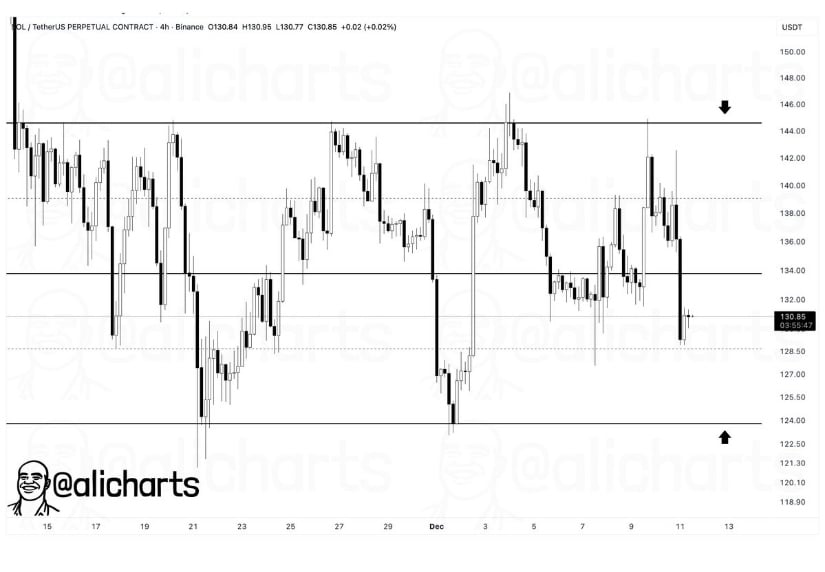
Solana’s range-bound structure signals a decisive move ahead. Source: Ali Martinez via X
A widely shared chart from Ali Martinez highlights the importance of nearby levels, noting that a move above $145 flips the trend bullish, while a loss of $125 would shift the structure lower. His analysis frames the current price action as a neutral compression phase, suggesting that SOL is effectively in wait-and-see mode rather than signaling either continuation or reversal.
From a pure chart-structure perspective, Solana price is beginning to show signs of reversal. Bitcoinsensus recently highlighted a falling wedge breakout on the daily chart. While the breakout has technically occurred, the analyst emphasized that follow-through remains limited, with price still struggling to reclaim the $140 region. Until a daily close above that level is achieved, the structure remains early rather than confirmed.
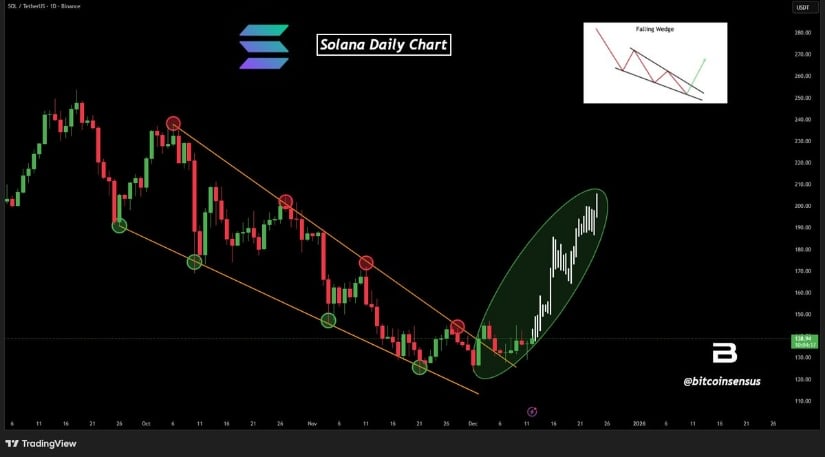
Solana breaks out of a falling wedge as compression tightens. Source: Bitcoinsensus via X
Another perspective comes from CryptoGerla, who frames Solana’s current structure through clearly defined support and resistance zones rather than short-term momentum. His chart highlights $120–$125 as a major long-term demand area, a region that has repeatedly absorbed sell pressure since the sharp correction from the $200 region. On the upside, resistance is layered between $150 and $185, where previous rallies have stalled, and supply has consistently emerged.
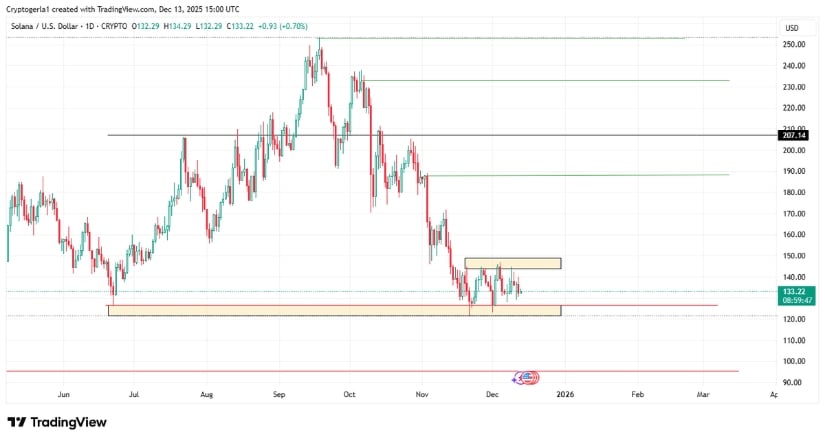
Solana consolidates above long-term demand as key levels define the range. Source: CryptoGerla via X
Within this framework, SOL is not showing signs of structural breakdown. Instead, price action continues to base above support, suggesting absorption rather than aggressive distribution. As long as Solana holds above the $120–$125 band, the broader structure remains constructive, with any sustained push through the $150 zone likely to act as the first signal that a larger recovery phase is starting to take shape.
Market sentiment around Solana price remains cautiously constructive. While short-term traders remain hesitant due to lack of momentum, longer-term analysts continue to point toward structural resilience rather than trend failure.
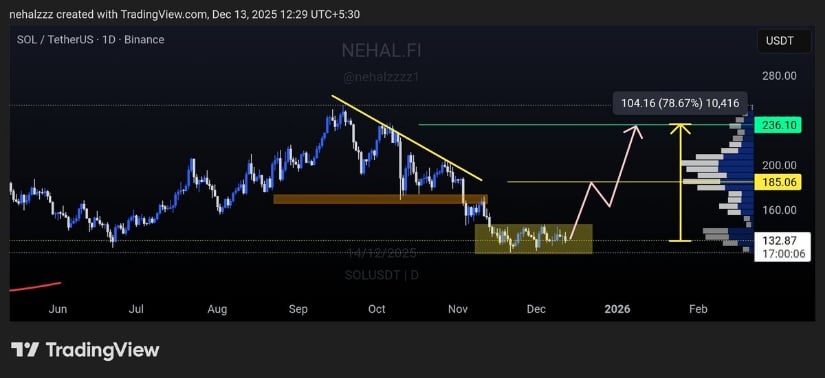
Solana’s macro structure hints at recovery if support holds. Source: Nehal via X
Nehal’s higher-timeframe chart places SOL Solana price inside a broad basing structure following a nearly 78% retracement from its peak, a magnitude historically associated with late-stage corrections rather than early bear phases. His projected recovery path outlines a gradual reclaim of $185, followed by potential expansion towards the $230–$240 region if momentum returns.
Solana price sits at a familiar crossroads. Price continues to respect a long-standing support zone while volatility compresses, suggesting that the market is preparing for a larger move rather than drifting aimlessly. The absence of panic selling, combined with repeated defenses of the $120 region, points towards structural stability rather than breakdown risk.
From a Solana price prediction standpoint, the coming weeks are likely to be decisive. A reclaim of key resistance would shift sentiment rapidly, while failure would extend consolidation.
The GBPJPY pair continued providing negative trading, affected by forming extra barrier at 208.10 level, with the negative momentum that comes from stochastic below 50 level, attacking the support at 206.90 that formed the suggested target in the previous report.
The effect of the temporary sideways bias dominance, however facing the negative pressures that might push it to resume the corrective decline, to target 206.25 and 205.80 level, while renewing the bullish attempts requires forming strong bullish attack, to settle above 208.10 then begin targeting new positive stations by its rally towards 209.15.
The expected trading range for today is between 206.25 and 207.65
Trend forecast: Bearish
GBP/USD traded modestly up as fresh UK labor data showed easing strain in the jobs market. The ILO unemployment rate rose to 5.1% in the three months to October, up from 5.0% previously. The reading met expectations but confirmed a gradual loss of momentum in employment conditions.
–Are you interested in learning more about copy trading platforms? Check our detailed guide-
Meanwhile, claimant counts increased by 20,100 in November, reversing October’s revised decline. Employment change remained negative, with payrolls down by 17,000 in October. While the pace of job losses slowed, the trend still points to weaker labor demand.
Wage growth stayed elevated but showed early signs of cooling. Average earnings excluding bonuses rose 4.6% YoY, slightly below the prior reading. Earnings including bonuses increased 4.7%, beating forecasts but still lower than earlier levels. Pay growth remains well above inflation, yet the direction no longer supports further policy tightening.
Hence, these figures reinforce expectations that the Bank of England will cut rates at its upcoming meeting. Markets now view a policy move as likely, limiting upside pressure on sterling. Traders remain cautious ahead of the decision, especially with recent data failing to justify a hawkish stance.
Attention is now shifting to incoming UK PMI data, which may offer clues on business activity and hiring trends. Still, central bank guidance remains the dominant driver for the pound in the near term.
On the US side, the dollar continues to trade under pressure due to uncertainty around Fed policy. Markets expect deeper rate cuts in 2026 than the Fed has signaled. This gap leaves the dollar vulnerable to sudden repricing.
The upcoming US Non-Farm Payrolls report will play a key role. It will include two months of data and comes after disruptions from a government shutdown. Forecasts point to modest job growth in November, though risks lean to the downside following weak private payroll figures.
Investors will focus less on the unemployment rate and more on payroll gains and wage growth. Average hourly earnings remain the clearest signal for inflation risk and future Fed decisions.

The GBP/USD chart shows a modest rebound from the 1.3350 demand zone, coinciding with the 50-period MA, surging above the 20-period MA near 1.3380. Now the pair is eying the resistance at recent swing high near 1.3440 as the RSI climbs well above the 50.0 level.
–Are you interested in learning more about scalping forex brokers? Check our detailed guide-
On the flip side, any dip below the 1.3350 confluence could alter the pound’s bullish outlook. The pair could dip further down to 1.3300 round number ahead of 100-period MA support at 1.3280.
Looking to trade forex now? Invest at eToro!
68% of retail investor accounts lose money when trading CFDs with this provider. You should consider whether you can afford to take the high risk of losing your money.
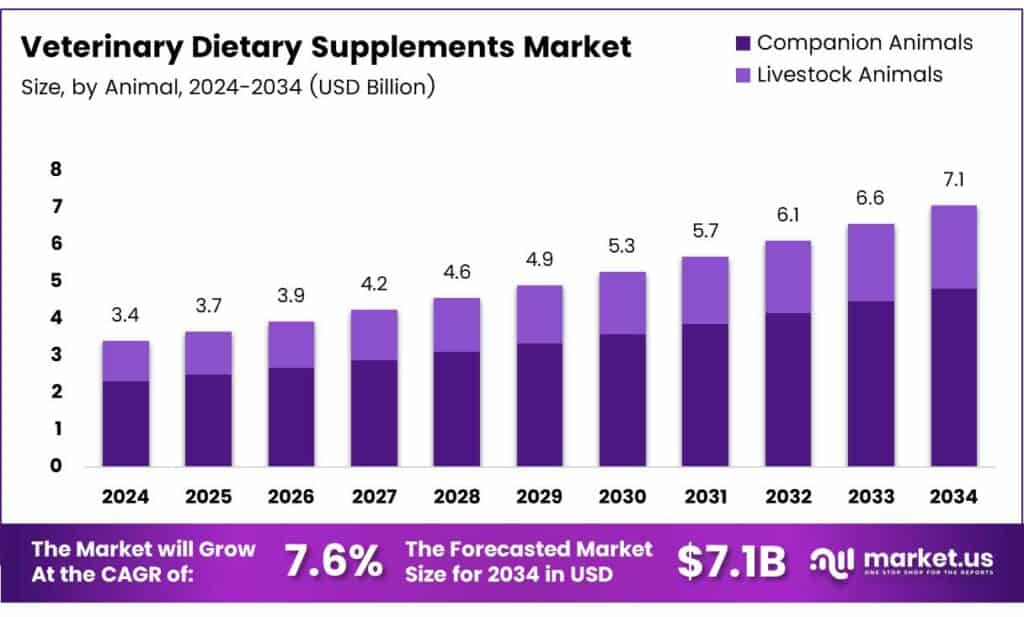
The Global Veterinary Dietary Supplements Market size is expected to be worth around USD 7.1 billion by 2034, from USD 3.4 billion in 2024, growing at a CAGR of 7.6% during the forecast period from 2025 to 2034.
The Veterinary Dietary Supplements Market refers to nutritional products formulated to support animal health beyond regular feed intake. These supplements address immunity, digestion, joint mobility, skin health, and stress management. They are commonly used across companion animals and livestock, aligning preventive care with everyday veterinary nutrition practices.
Veterinary dietary supplements are transitioning from optional add-ons to routine wellness solutions. Pet humanization, rising veterinary awareness, and preventive healthcare thinking continue driving demand. As a result, supplements are increasingly positioned as long-term health investments rather than short-term therapeutic products within veterinary nutrition systems.
The market is regulated through animal health regulations, feed additive approvals, and labeling compliance. Regulatory agencies emphasize safety, dosage transparency, and ingredient traceability. These frameworks encourage standardized manufacturing and create entry barriers that favor quality-driven suppliers, reinforcing credibility and long-term market stability in veterinary supplements.
Companion Animals dominate with 67.3% due to rising pet humanization and preventive care.
Companion Animals held a dominant market position in the By Animal Analysis segment of the Veterinary Dietary Supplements Market, with a 67.3% share. Growth is supported by higher spending on pet wellness, routine supplementation, and increasing awareness of long-term health management among urban pet owners.
Livestock Animals represent a steady demand base, driven by productivity improvement, herd health management, and nutritional balance. Supplements in this segment are commonly linked to immunity, digestion, and stress resistance, supporting consistent usage across dairy, poultry, and meat-producing animals.
Multivitamins and Minerals dominate with 29.7% due to broad nutritional coverage.
Multivitamins and Minerals held a dominant market position in the By Type Analysis segment of the Veterinary Dietary Supplements Market, with a 29.7% share. These products address common nutrient gaps and are widely recommended for daily wellness across animal categories.
Probiotic and Prebiotic supplements support gut balance and digestion. Their adoption is increasing as digestive health gains importance, especially for animals exposed to diet changes, antibiotics, or environmental stress. Protein and Peptides focus on muscle maintenance, recovery, and growth.
Omega-3 Fatty Acids are valued for joint, skin, and cardiovascular support. Usage continues to expand alongside awareness of inflammation management and coat health benefits. CBD supplements remain niche but visible, mainly for calming and discomfort support. Adoption is cautious due to regulatory clarity and veterinarian guidance requirements.
Gummies and Chewables dominate with 34.9% due to ease of administration.
Gummies and Chewables held a dominant market position in the By Form Analysis segment of the Veterinary Dietary Supplements Market, with a 34.9% share. Palatability and convenience strongly influence repeat purchases and compliance.
Tablets and Capsules remain widely used, especially for precise dosing. They are commonly preferred in veterinary-prescribed regimens and multi-nutrient formulations. Powders offer flexible mixing with food and water. This form is popular for digestive and protein supplements used in both pets and livestock.
Liquids support faster absorption and ease for young or aging animals. They are often selected for immunity and metabolic support applications. Others include pastes and gels, addressing specific administration needs and niche therapeutic use cases.
Nutritional Support dominates with 26.6% due to daily wellness usage.
Nutritional Support held a dominant market position in the By Application Analysis segment of the Veterinary Dietary Supplements Market, with a 26.6% share. Daily supplementation drives consistent demand across age groups and animal types.
Joint Health Support addresses mobility concerns and aging-related stiffness. Usage is rising as pet lifespans increase and owners prioritize active living. Calming Stress Anxiety supplements support behavioral balance. Demand is linked to lifestyle changes, travel stress, and noise sensitivity.
Digestive Health applications focus on gut stability and nutrient absorption, especially during dietary transitions or medication use. Immunity Support targets seasonal risks and recovery phases, reinforcing resistance against common infections. Skin and Coat Health supplements enhance appearance and comfort, supporting shedding control and dermatological wellness.
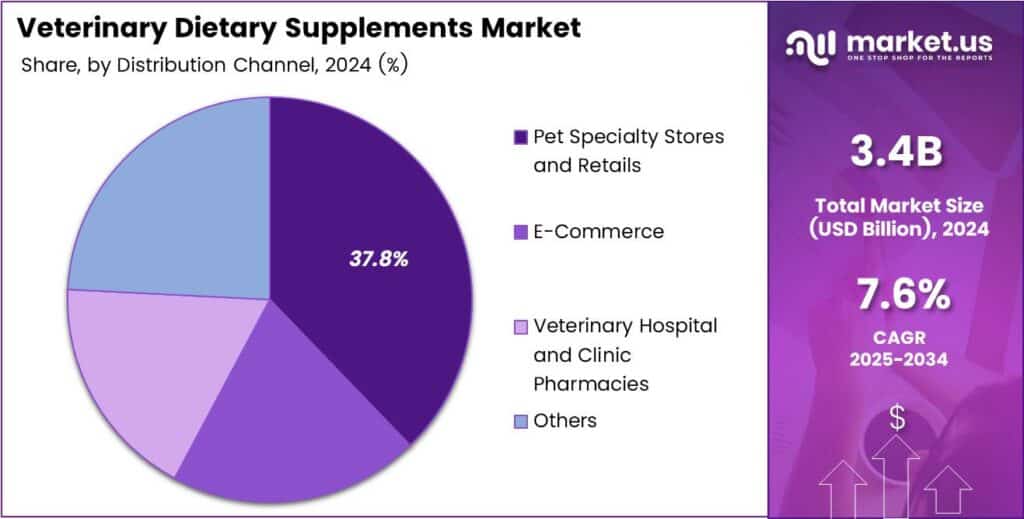
Pet Specialty Stores and Retail dominate with 37.8% due to trust-based purchasing.
Pet Specialty Stores and Retailers held a dominant market position in the By Distribution Channel Analysis segment of the Veterinary Dietary Supplements Market, with a 37.8% share. Personalized guidance and product variety strengthen buyer confidence.
E-Commerce is expanding rapidly, supported by convenience, subscription models, and wider brand access for repeat supplement purchases. Veterinary Hospital and Clinic Pharmacies remain influential for condition-specific recommendations. Professional advice supports credibility and targeted usage.
A key trend in the veterinary dietary supplements market is the shift toward natural and clean-label products. Pet owners increasingly prefer supplements made with herbal extracts, probiotics, and omega-based ingredients. Customization is another growing trend.
Personalized nutrition plans are gaining popularity through veterinary clinics. Innovative product formats such as soft chews, flavored liquids, and gummies are also trending. These improve compliance and ease of feeding, making supplements a regular part of animal care routines.
The veterinary dietary supplements market is strongly driven by the growing humanization of pets. Pet owners increasingly treat dogs and cats as family members and focus on long-term health rather than only treatment. This mindset boosts demand for daily vitamins, joint care, digestive aids, and immunity supplements.
Rising awareness about preventive animal healthcare also supports market growth. Veterinarians now recommend supplements to manage early-stage issues such as arthritis, skin problems, and gut imbalance. This reduces future medical costs and improves animal well-being.
Urban lifestyles and nuclear families further increase supplement usage. Busy owners prefer easy-to-administer chewables and liquids that support overall nutrition. Growth in pet adoption, especially among millennials, continues to expand the consumer base for veterinary dietary supplements.
One major restraint in the veterinary dietary supplements market is the lack of uniform regulations. In many regions, supplements are not regulated as strictly as veterinary medicines. This creates confusion about product quality, safety, and effectiveness.
Price sensitivity is another challenge. Premium supplements can be costly, which restricts use among livestock owners and budget-conscious pet owners. In developing markets, limited awareness and lower spending power further reduce market penetration.
The growing presence of e-commerce platforms presents a major growth opportunity for veterinary dietary supplements. Online channels make products easily accessible and offer a wide variety of choices. Convenience, discounts, and subscription models encourage regular purchases.
Rising investments in veterinary clinics and pet care centers also support market expansion. Modern clinics increasingly offer supplements alongside treatments, creating bundled care solutions. This improves product visibility and trust among consumers.
Product innovation offers another strong opportunity. Companies are developing breed-specific, age-specific, and condition-focused supplements. These targeted solutions address precise health needs, increasing customer satisfaction and market value.
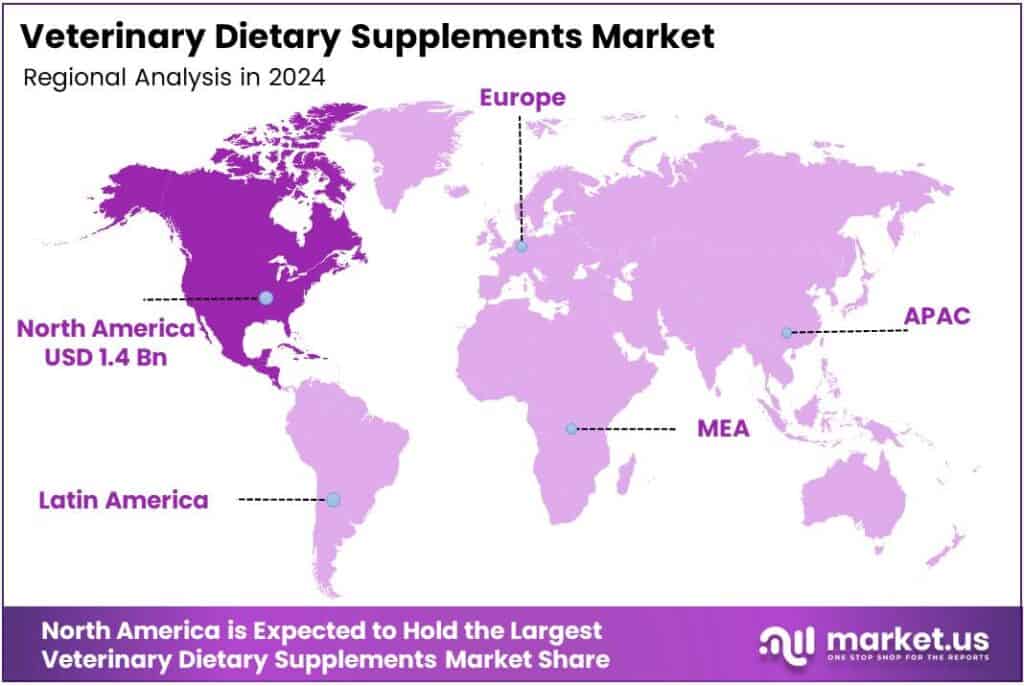
North America leads the veterinary dietary supplements market, supported by strong pet humanization trends and high preventive healthcare spending. In this region, the market held a dominant share of 43.9%, reaching a value of USD 1.4 billion, reflecting mature adoption across companion animals. High awareness among pet owners, regular veterinary consultations, and premium nutrition preferences continue to drive steady demand growth.
Europe represents a well-established market driven by strict animal welfare standards and an increasing focus on preventive pet healthcare. Growing demand for natural, functional, and condition-specific supplements supports consistent market expansion. The region also benefits from strong regulatory frameworks that improve product quality and consumer trust.
Asia Pacific is emerging as a high-growth region due to rising pet ownership, urbanization, and increasing disposable incomes. Awareness of animal nutrition is improving rapidly, especially in developing economies. Expanding veterinary infrastructure and digital pet-care platforms are further accelerating market penetration across the region.
The U.S. plays a critical role within the global market due to advanced pet healthcare practices and strong consumer spending on animal wellness. High acceptance of daily nutritional supplements and preventive care routines supports consistent demand. Innovation in formulations and targeted health solutions continues to shape market evolution.
North America
Europe
Asia Pacific
Latin America
Middle East & Africa
Boehringer Ingelheim continues to shape the 2024 veterinary dietary supplements space by linking supplements with everyday preventive care in companion animals. Its scale in animal health helps it support consistent quality, science-led claims, and wider veterinary acceptance across markets. This positions the company well as pet parents increasingly look for “clinic-trusted” supplement options.
Virbac benefits from a strong veterinary-channel focus, which supports credibility in supplements that target skin, digestion, and general wellness needs. Its brand strength in pet care helps it compete on trust and formulation expertise rather than price alone. This strategy can improve repeat purchase rates where vets influence buying decisions.
AMORVET stands out as a fast-moving player that can adapt product formats and claims to local demand patterns, especially in value-driven markets. It gains traction by offering accessible supplement choices while still emphasizing everyday pet wellness. Its growth outlook is tied to expanding distribution and strengthening practitioner confidence.
Elanco leverages its established animal health footprint to support supplement portfolios that align with long-term pet health and compliance-friendly positioning. In 2024, its advantage comes from broad market reach and the ability to integrate supplements into wider health management conversations. This makes Elanco well placed to capture premium segments where owners prioritize preventive outcomes.
A Fireside Conversation with Joony Koo at YGG Play Summit Philippines
At the YGG Play Summit in the Philippines, Joony Koo of Spacebar provided a candid look at the current state of Web3 gaming, where it stands today, what’s holding it back, and what history suggests about the next breakthrough. In a conversation framed around the similarities between early mobile gaming and today’s blockchain ecosystems, Koo explained why Web3 has yet to experience its “iPhone moment” and what it will take for the industry to truly cross the chasm.
Koo began by drawing parallels to the pre-App Store era, when feature phones dominated, and basic mobile games were notoriously tricky to find.
“You would have to pay a few hundred dollars just to look for what pays out of these 50 bytes,” he recalled, describing the clunky carrier-operated portals and expensive data charges. “The friction on those phones was as hectic as the friction we see in crypto or Web3.”
Just as early mobile users needed different carrier portals for other devices, Koo pointed out that today’s players face a similarly fragmented world:
“If you want to play a new game on a new chain that just popped up yesterday, you’ll probably find yourself making a new wallet, getting an RPC code, and starting everything all over again.”
Due to the difficulty in discovering games, most players in the 2000s ended up using the content that manufacturers pre-installed. Koo noted that this is not unlike today’s blockchain ecosystems, where chains effectively act as gatekeepers.
“For example, if a chain like Monad is launching, they’re curating 20 to 40 games for mainnet. Those are the games most people will end up playing,” he explained. “It’s the same pattern as device manufacturers and carriers controlling discovery back then.”
Koo also emphasized the lack of innovation during the early iPhone era. When the iPhone launched, it didn’t even have an App Store yet, and most developers simply ported existing games from other platforms.
“These games weren’t using native iPhone features at all.. no drag-and-drop, no gyro sensors, no analytics, no in-app purchases,” he said. “And we’re seeing the same thing with Web3. A lot of games are traditional ideas with tokens and NFTs slapped on top.”
He noted that early iPhone success didn’t come from ports, but from developers willing to experiment with entirely new mechanics built specifically for the mobile experience.
One of the major obstacles in Web3 gaming, according to Koo, is the industry’s heavy focus on token economics.
“Most of the games in Web3 are extremely focused on the token economics,” he said. “When you put a token into your game, it creates a vicious cycle of pump-and-dump behavior that the developers or players cannot control.”
He explained that once a token model is implemented, it becomes very difficult to redesign without disrupting the entire economy.
Despite the challenges, Koo emphasized that the solution is not to abandon tokens but to adopt an experimental mindset.
“I’m sitting here without an answer to what a native Web3 game should be,” he admitted. “But you need an experimental mentality. You need seasons and cycles that allow you to try new mechanics, change what doesn’t work, and explore what truly resonates with users in crypto.”
Games that treat blockchain as a creative medium, not merely a monetization layer, are the ones most likely to endure past market cycles.
Koo issued a candid warning to studios that assume the next bull cycle will revive their project.
“When the market goes back up, that doesn’t mean the games that were successful last cycle will take off again,” he said. “There will be new games with new ideas. If a game isn’t experimenting or building something truly native to Web3, it won’t survive the next cycle.”
Perhaps the biggest missing piece of the puzzle is a platform powerful enough to unify the Web3 gaming ecosystem, something equivalent to what the iPhone and the App Store did for mobile.
“There will be a platform that’s very transformative,” Koo said. “That moment hasn’t come for crypto gaming yet.”
Developers today are constantly jumping between chains.. Abstract, Monad, Ronin, and beyond, searching for the right infrastructure.
“Every year, developers ask: ‘Where the hell do we build our game?’ But there’s no de facto Web3 chain, yet that houses everything you need for a great Web3 game.”
Koo believes that when the right platform arrives, it will become obvious, just as the iPhone did in 2007.
Web3 gaming today is full of potential but hampered by friction, fragmentation, over-financialization, and a lack of native design. Yet Koo remains optimistic that a transformational moment is coming.
“We need to keep looking,” he said. “The one ring that moves them all, the platform that changes everything will come. And when it does, that’s when Web3 gaming will finally cross the chasm.”
Watch: How do you define Web3?
Platinum price continued forming strong bullish waves, taking advantage of its stability within the main bullish channel’s levels, besides forming extra support at $1740.00 level, recording new historical gains by hitting 1828.00 level, to record the previously suggested targets.
Note that the continuation of providing positive momentum by the main indicators will motivate the price to resume the rise and record new gains by its rally towards $1847.00 and $1865.00, while reaching below $1740.00 will increase the chances of activating the profit- taking path, to expect reaching $1720.00 and $1675.00.
The expected trading range for today is between $1750.00 and $ 1847.00
Trend forecast: Bullish
EUR/USD struggled to gather directional momentum on Monday and closed the day with marginal gains. The pair stays quiet early Tuesday and continues to move sideways at around 1.1750.
The table below shows the percentage change of Euro (EUR) against listed major currencies this month. Euro was the strongest against the US Dollar.
| USD | EUR | GBP | JPY | CAD | AUD | NZD | CHF | |
|---|---|---|---|---|---|---|---|---|
| USD | -1.28% | -0.89% | -0.81% | -1.47% | -1.24% | -0.76% | -0.85% | |
| EUR | 1.28% | 0.40% | 0.49% | -0.19% | 0.05% | 0.53% | 0.44% | |
| GBP | 0.89% | -0.40% | 0.35% | -0.58% | -0.35% | 0.13% | 0.04% | |
| JPY | 0.81% | -0.49% | -0.35% | -0.68% | -0.47% | 0.02% | -0.07% | |
| CAD | 1.47% | 0.19% | 0.58% | 0.68% | 0.18% | 0.72% | 0.63% | |
| AUD | 1.24% | -0.05% | 0.35% | 0.47% | -0.18% | 0.48% | 0.39% | |
| NZD | 0.76% | -0.53% | -0.13% | -0.02% | -0.72% | -0.48% | -0.09% | |
| CHF | 0.85% | -0.44% | -0.04% | 0.07% | -0.63% | -0.39% | 0.09% |
The heat map shows percentage changes of major currencies against each other. The base currency is picked from the left column, while the quote currency is picked from the top row. For example, if you pick the Euro from the left column and move along the horizontal line to the US Dollar, the percentage change displayed in the box will represent EUR (base)/USD (quote).
Although the US Dollar (USD) had a hard time gathering strength at the beginning of the week, the negative shift seen in risk mood helped it stay resilient against its peers. Early Tuesday, US stock index futures trade deep in negative territory, suggesting that markets remain risk-averse.
In the second half of the day, the US Bureau of Labor Statistics (BLS) will publish Nonfarm Payrolls (NFP) data for October and November. Markets expect the NFP to rise by 40,000 in November and see the Unemployment Rate staying unchanged at 4.4%.
In case the November NFP print offers a significant upside surprise, with a reading at or above 100,000, investors could see that as a factor that could delay Federal Reserve (Fed) rate cuts next year. In this scenario, the USD is likely to stage a decisive rebound with the immediate reaction and cause EUR/USD to turn south. Conversely, a disappointing reading could feed into a January Fed rate cut expectations and open the door for another leg higher in EUR/USD.
According to the CME FedWatch Tool, markets are currently pricing in about a 25% probability of a 25 basis points reduction in the policy rate in January.
The 20-period Simple Moving Average (SMA) climbs above the 50- and 200-period SMAs, with all three rising. Price holds above these measures, keeping the near-term bias upward. The 20 SMA at 1.1737 offers nearby dynamic support. The mid-point of the ascending regression channel also reinforces this support. The Relative Strength Index (RSI) stands at 62.5, bullish but not overbought, with momentum easing slightly from earlier highs.
On the upside, the upper limit of the ascending channel aligns as the first resistance level at 1.1790, followed by 1.1840 (static level). Looking south, the lower limit of the ascending channel and the 50-period SMA form a key support area at 1.1690-1.1680.
The rising trend line from 1.1500 underpins the bullish bias, offering the next support level at 1.1670. Sustained bids above 1.1740 would keep the topside in play toward 1.1840. A drop beneath 1.1690-1.1670 region could open the door for an extended decline toward 1.1620 (static level).
(The technical analysis of this story was written with the help of an AI tool)
Nonfarm Payrolls (NFP) are part of the US Bureau of Labor Statistics monthly jobs report. The Nonfarm Payrolls component specifically measures the change in the number of people employed in the US during the previous month, excluding the farming industry.
The Nonfarm Payrolls figure can influence the decisions of the Federal Reserve by providing a measure of how successfully the Fed is meeting its mandate of fostering full employment and 2% inflation.
A relatively high NFP figure means more people are in employment, earning more money and therefore probably spending more. A relatively low Nonfarm Payrolls’ result, on the either hand, could mean people are struggling to find work.
The Fed will typically raise interest rates to combat high inflation triggered by low unemployment, and lower them to stimulate a stagnant labor market.
Nonfarm Payrolls generally have a positive correlation with the US Dollar. This means when payrolls’ figures come out higher-than-expected the USD tends to rally and vice versa when they are lower.
NFPs influence the US Dollar by virtue of their impact on inflation, monetary policy expectations and interest rates. A higher NFP usually means the Federal Reserve will be more tight in its monetary policy, supporting the USD.
Nonfarm Payrolls are generally negatively-correlated with the price of Gold. This means a higher-than-expected payrolls’ figure will have a depressing effect on the Gold price and vice versa.
Higher NFP generally has a positive effect on the value of the USD, and like most major commodities Gold is priced in US Dollars. If the USD gains in value, therefore, it requires less Dollars to buy an ounce of Gold.
Also, higher interest rates (typically helped higher NFPs) also lessen the attractiveness of Gold as an investment compared to staying in cash, where the money will at least earn interest.
Nonfarm Payrolls is only one component within a bigger jobs report and it can be overshadowed by the other components.
At times, when NFP come out higher-than-forecast, but the Average Weekly Earnings is lower than expected, the market has ignored the potentially inflationary effect of the headline result and interpreted the fall in earnings as deflationary.
The Participation Rate and the Average Weekly Hours components can also influence the market reaction, but only in seldom events like the “Great Resignation” or the Global Financial Crisis.
Gold (XAU/USD) attracts some sellers during the Asian session on Tuesday and extends the overnight pullback from the $4,350 region, or the vicinity of the highest level since October 21, touched last week. The intraday downtick comes amid optimism over the Russia-Ukraine peace deal, which is seen undermining demand for the traditional safe-haven commodity. U.S. President Donald Trump said on Monday that an agreement to end the four-year-long war is closer than ever. Apart from this, some repositioning trade ahead of the delayed release of the US Nonfarm Payrolls (NFP) report for October later today, turns out to be another factor exerting pressure on the bullion.
Given that signs of a weakening US labor market are becoming increasingly evident, the crucial jobs data, along with the US consumer inflation figures on Thursday, will influence the Federal Reserve’s (Fed) policy path in 2026. This, in turn, will play a key role in driving the US Dollar (USD) demand in the near term and determining the next leg of a directional move for the non-yielding Gold. In the meantime, dovish Fed expectations keep the USD depressed near its lowest level since October 6, touched on Monday. According to CME Group’s FedWatch tool, traders are pricing in a nearly 77% probability of a 25-basis-point rate cut by the Fed in January and two rate reductions in 2026.
Furthermore, investors seem convinced that the new Trump-aligned Fed chair will be an uber-dovish and slash interest rates regardless of the economic fundamentals. This has been as a key factor behind the recent USD slump and might continue to act as a tailwind for the Gold. Meanwhile, the defensive mood keeps Asian equity markets under pressure amid valuation concerns and fears of the AI bubble burst. This might contribute to limiting the downside for the XAU/USD, suggesting that any further slide could be seen as a buying opportunity. Hence, it will be prudent to wait for strong follow-through selling before confirming that the bullion’s multi-week-old uptrend has run out of steam.
The overnight failure near the $4,350 area constitutes the formation of a bearish double-top pattern on hourly charts. Moreover, a break and acceptance below the $4,300 mark backs the case for further losses. However, mixed oscillators on the 4-hour chart warrant some caution for aggressive bearish traders. This, in turn, suggests that the Gold price is more likely to find decent support near the $4,260-$4,255 horizontal resistance breakpoint.
The said area could act as a strong base for the XAU/USD pair, which, if broken decisively, might shift the near-term bias in favor of bearish traders. The subsequent decline might then drag the Gold price to the $4,230-4,228 intermediate support en route to the $4,200 round figure and the $4,178-4,177 support.
On the flip side, momentum back above the $4,300-$4,310 region might continue to face a strong hurdle near the $4,350-4,355 zone. Some follow-through buying, however, could allow the Gold price to aim towards challenging the all-time peak, around the $4,380 region, touched in October. This is followed by the $4,400 round figure, which, if cleared, would set the stage for an extension of the recent well-established uptrend.