The main category of All News Articles.
You can use the search box below to find what you need.
[wd_asp id=1]
The main category of All News Articles.
You can use the search box below to find what you need.
[wd_asp id=1]
In the past, Tho Binh Commune (formerly Binh Son Commune) in Thanh Hoa Province was known for its arid hills and poor yields. But today, its rolling green slopes tell a new story – that of a thriving tea-growing region that brings in hundreds of millions of dong for local households each year.
When it comes to Vietnamese tea, people often think first of Thai Nguyen or Phu Tho. But nestled in Thanh Hoa’s rugged hills, Tho Binh has quietly become the province’s new “tea capital,” thanks to the restoration of native varieties and smart community investment.
According to Le Van Thanh, a farmer in Dong Tranh Hamlet, the region’s tea journey began some 30 years ago when a national program encouraged afforestation. Residents started planting tea, but outdated techniques and weak market access led many to abandon the crop.
Lush green tea hills in Tho Binh Commune, Thanh Hoa. Photo: Le Duong
Thanh was one of the few who persisted. He explains that while Binh Son tea is aromatic and of high quality, the lack of buyers long kept profits low. Now, with over 1.5 hectares of tea, Thanh harvests more than 10 tons of fresh tea annually, yielding about 2 tons of dried tea.
By investing in vacuum packaging machines, tea-drying equipment and branded labeling, Thanh has been able to increase product value and earn around USD 16,400 (400 million VND) per year.
In 2016, Le Dinh Tu and several other households formed the Binh Son Agricultural Cooperative, aiming to revive traditional tea branding and implement value-chain production. Today, the cooperative manages nearly 80 hectares of tea – 12 of which meet VietGAP standards. It has 20 official members and over 100 linked households.
Its main products, such as dried loose tea and tea bags, are well-received in the market. In 2019, Binh Son’s dried tea was awarded a 3-star rating under the national OCOP (One Commune, One Product) program, which helped expand the brand’s reach and allowed many members to earn hundreds of millions of dong annually.

Currently, Tho Binh has nearly 400 hectares of tea, with 315 hectares in stable production – making it the largest tea-growing zone in the province. About 400 households are involved in tea cultivation, 100 of which specialize in tea buds, while the rest focus on tea leaves.
According to commune officials, apart from the cooperative – which buys and distributes roughly 20% of the total harvest – there are no major enterprises offering guaranteed purchasing contracts. To adapt, many households have turned their homes into mini-factories, investing in tea-processing equipment, vacuum sealing machines, logo printing, and packaging to enhance quality and market access.
The vast green tea hills not only bring in solid annual incomes but are also sparking ideas for community-based tourism.
“Beyond its economic value, Binh Son tea is opening doors to cultural tourism,” said a local leader. “We are working on community experiences such as tea picking, processing, and tasting to create a new income stream for locals”.
Le Duong
Solana price is trading at multi-month lows, sitting on a key support zone as participants watch closely for early signs of a potential rebound.
Solana price has slipped into a tough spot, and the mood across the market reflects it. What makes this moment stand out isn’t just the price drop, it’s how quickly sentiment has flipped from confidence to caution. With support levels being tested and traders looking for any sign of strength, Solana now enters a phase where even small shifts in momentum could spark a larger reaction.
Solana has now dropped to a three-month low, and this is starting to create visible stress across holders. Recent on-chain data shared by Ted shows that nearly 79.6% of the circulating supply is currently at a loss, a level that usually appears only in deeper corrective phases. The chart highlights how sharply profit supply has flipped in recent weeks, reflecting persistent sell-side pressure.
Solana’s latest downturn has pushed nearly 80% of its supply into loss, underscoring the intense pressure mounting across the market. Source: Ted via X
While this paints a tough picture, these extremes have historically aligned with points where downside momentum begins slowing. Once such a large portion of the supply moves underwater, forced selling usually cools off, giving room for early stabilization attempts.
A separate liquidity map posted by Ted offers a slightly different angle. According to the chart, most of Solana’s downside liquidity has already been taken out, leaving two important upside zones: a strong cluster waiting at $145 to $150 and another around $120. With the lower range already cleared, direction becomes more straightforward if volatility shifts upward.
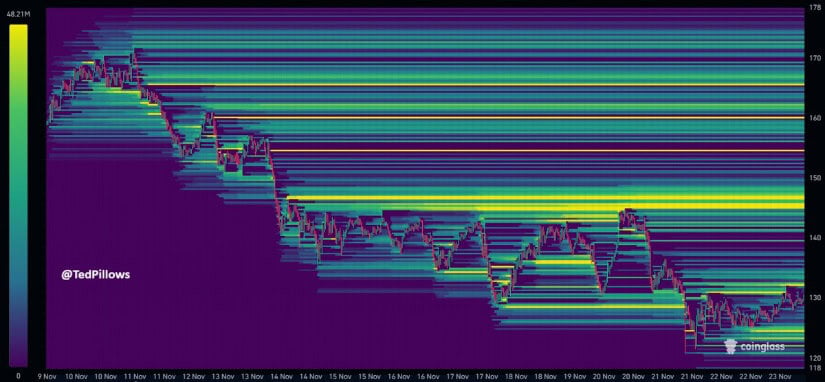
Solana’s liquidity map now shows cleaner upside pockets at $120 and $145–$150, suggesting a smoother path higher if momentum shifts. Source: Ted via X
If Bitcoin manages to bounce, Solana could sweep into these upside pockets rather quickly. Markets frequently gravitate towards untouched liquidity, and this current setup shows a much cleaner path upward than downward.
Momentum-focused traders like Hardy are spotting the first signs of relief forming on Solana’s higher timeframes. The asset is sitting directly at a multi-tested support zone while both the RSI and oscillators are printing early bullish divergences. These usually appear when sellers begin losing steam even before price shows it.
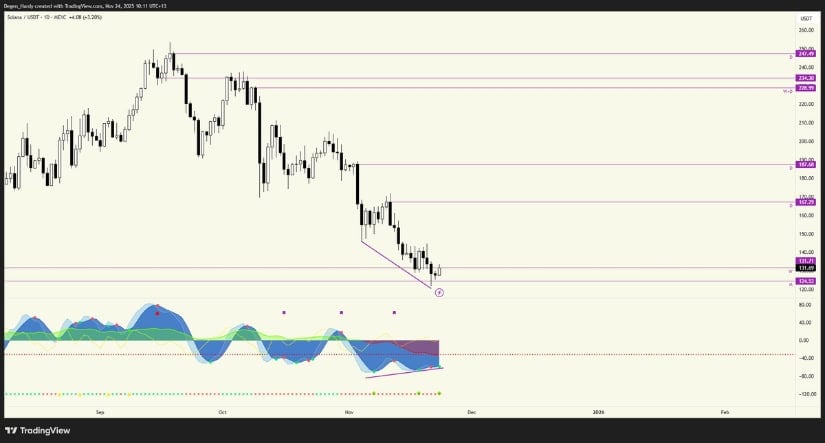
SOL chart highlights fresh bullish divergences and oversold signals, hinting that price may be preparing for a relief bounce. Source: Hardy via X
The SOL chart also shows oversold conditions accumulating at this support. If this level holds, the divergence could help trigger a short-term bounce, especially once volume starts picking up.
A clean descending channel, highlighted by 0xBossman, continues to guide Solana’s short-term outlook. Solana price is currently reacting from the lower boundary around $130, a level that has held multiple times. As long as this base remains intact, the next logical step would be a retest of the channel’s midpoint near $160 to $165.
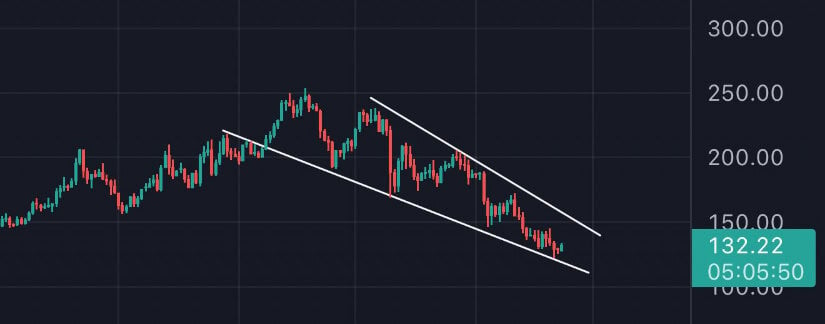
Solana continues to respect its descending channel, with price reacting cleanly from the $130 base and eyeing a potential move towards $160–$165. Source: 0xBossman via X
The upper boundary of the channel sits closer to $200, which 0xBossman believes Solana price could revisit with time. A push above the mid-range would be the first meaningful sign that momentum is shifting back in favor of bulls.
Solana price is clearly under pressure, but moments like this often come before the market starts to settle. With so many holders now at a loss, selling usually begins to slow down, giving the price room to stabilize. If the current support holds, even a small bounce could pull SOL Solana back towards the mid-channel levels.
Still, participants should stay cautious. A lot depends on how Bitcoin moves next, and volatility can pick up quickly. For now, Solana sits at a point where both risk and opportunity are present, and the next few days will decide whether this stress turns into a steady recovery or another leg down.
– Written by
Frank Davies
STORY LINK GBP/USD Forecast: Pound Sterling Steady as Markets Brace for UK Budget
The Pound to Dollar exchange rate (GBP/USD) moved little on Monday, with traders staying cautious ahead of Wednesday’s autumn budget.
At the time of writing, GBP/USD was trading at $1.3095, showing minimal movement since markets opened.
The Pound (GBP) held to a narrow range on Monday, with traders opting for caution as they awaited fresh clarity from Westminster. The absence of new UK data left sentiment largely unchanged, while all eyes turned to Wednesday’s autumn budget.
Chancellor Rachel Reeves is preparing to unveil the government’s fiscal blueprint for the year ahead — a challenging balance between supporting economic growth, maintaining fiscal credibility, and managing competing political pressures within the Labour Party.
With so much riding on Wednesday’s announcement, investors hesitated to reposition Sterling without firmer clues on the government’s direction.
The US Dollar (USD) also traded sideways on Monday, with investors uncertain about how the Federal Reserve will guide policy in the coming months.
The currency drew strong support last week as markets tilted toward a more hawkish Fed outlook. That momentum faded after policymaker John Williams struck a softer tone, prompting the Dollar to relinquish part of its recent gains.
Get better rates and lower fees on your next international money transfer.
Compare TorFX with top UK banks in seconds and see how much you could save.
By Monday, the ‘Greenback’ had stabilised, with traders opting for restraint while awaiting further Fed commentary and upcoming US data releases.
The Confederation of British Industry’s (CBI) distributive trades survey is the sole UK release on Tuesday, and the Pound may struggle if the data disappoints. Sales volumes are expected to fall further in November — from -27 to -30 — signalling ongoing pressure on consumer demand. Any such weakness could lightly weigh on Sterling.
In the US, attention turns to the latest ADP employment change data. Following two consecutive declines, another soft print would reinforce concerns that the labour market is losing momentum. Weakening employment trends typically heighten expectations for Federal Reserve interest rate cuts, which could put pressure on the US Dollar.
However, the ‘Greenback’ may find some support from additional data due on Tuesday. Producer prices for September are forecast to rise, while retail sales are expected to remain in positive territory — both reminders that underlying demand in the US economy remains resilient.
Broader market sentiment will also play a key role. A risk-on shift would tend to support the increasingly risk-sensitive Pound, while any deterioration in confidence could steer investors back toward the safer US Dollar, limiting potential USD losses.

International Money Transfer? Ask our resident FX expert a money transfer question or try John’s new, free, no-obligation personal service! ,where he helps every step of the way,
ensuring you get the best exchange rates on your currency requirements.
TAGS: Pound Dollar Forecasts
In a recent press release, NXT USA disclosed that their ingredient Digexin, has received independent third-party substantiation of their claims from REJIMUS, Inc., which is a US regulatory compliance firm that focuses on dietary supplement marketing language.
REJIMUS’ claims substantiation dossier covers the human research that was performed and discusses the clinical evidence that supports how Digexin, a patented blend of tender okra pods (Abelmoschus esculentus) and winter cherry (Withania somnifera), can help benefit gastrointestinal health and function.
“This is extraordinary for a digestive health product,” said Eric Anderson, Managing Director of NXT USA. “May help with occasional constipation, bloating and gas’ is the province of every probiotic. Digexin is not a probiotic nor a laxative yet assures the consumer that within seven days they will be experiencing physical comfort, regular bowel movements, and overall increased well-being. With 40% of Americans still experiencing all too regular digestive discomfort, Digexin offers a new approach to the category that customers can count on.”
According to the press release, REJIMUS regulatory experts verified the scientific and clinical data such as those involving structure-function claims utilized in dietary finished products in the US market:
“With this independent evaluation, brands formulating with Digexin can market with strong claims backed by human clinical research,” said Anderson. “We’ve invested heavily in comprehensive clinical research—we call it our ‘Four Pillars of Validation’—because consumers deserve products that actually work and brands that they can trust to keep working. And because our science delivers real-world results, our science sells supplements.”
With REJIMUS’s claims substantiation dossier, the firm’s review “provides compliant, ready-to-use claim language for finished products in accordance with the recommended use.”
“Digexin has extensive clinical and scientific evidence that supports the distinct structure-function claims that truly separates this ingredient from all others in the category,” said Brandon Griffin, CEO of REJIMUS. “The clinical studies performed demonstrate significant improvements can begin within 7 days of use. These benefits are reinforced by mechanistic research showing multiple benefits, all contributing to better digestive health and function.”
“This gives supplement companies confidence that they can communicate with consumers in a way that attracts new customers—and keeps them,” said Anderson. “When claims are backed by solid clinical and scientific evidence as well as verified independently, they become a real brand differentiator and the key to boosting consumer loyalty.”
“Our competition isn’t other ingredient suppliers in this category—it’s the mindset of end-consumers thinking that their gut health challenges have limited or no viable self-care solutions,” Anderson explained in the press release. “If the dietary supplement industry wants lasting credibility, brands and their supply-chain partners have to invest in real clinical research and third-party scientific validations. No brand wants an FDA Warning Letter or a class-action lawsuit, and the process we follow for our ingredient development helps ensure our downstream partners can confidently make strong structure-function claims that sell supplements—and genuinely change lives.”
References

Since early October, the cryptocurrency has fallen from $126,000 to below $82,200, though it briefly rebounded to nearly $88,500, gaining 1.8% in a single day, as per a Decrypt report.
Deutsche Bank analysts warned that it’s unclear whether Bitcoin will stabilize after this correction. The bank’s analysts told Decrypt that, “Whether Bitcoin stabilizes after this correction remains uncertain,” as they pointed out that, “Unlike prior crashes, driven primarily by retail speculation, this year’s downturn has occurred amid substantial institutional participation, policy developments, and global macro trends,” as quoted in the report.
The selloff hasn’t been limited to BTC USD. Nearly $5 billion has left Bitcoin and other crypto-linked exchange-traded products, while billions in crypto derivatives contracts have been liquidated as traders sought to ride out the volatility. Overall, the total crypto market has fallen about 24%, or $1 trillion, since its October peak.
While Bitcoin is often compared to safe-haven assets like gold and US Treasuries, Deutsche Bank analysts highlighted that it has yet to behave like a defensive store of value. Meanwhile, gold and treasuries have been steadily outperforming BTC in the past months, as per the report.ALSO READ: Trump’s Obamacare shake-up sends cash straight to consumers, cutting insurers out of the loop – here are details
The analysts wrote that, “Since October, Bitcoin has behaved more like a high-growth tech stock than an uncorrelated store of value. The average daily correlation between Bitcoin and the Nasdaq 100 index in 2025 YTD is 46%, and the correlation with the S&P 500 has risen to 42%,” as quoted by Decrypt. They added that, “Both correlations have sharply risen in recent weeks, reaching levels similar to those observed during the COVID-driven market stress of 2022,” as quoted in the report.
Hopes for a Federal Reserve interest rate cut in December have also faltered. Remarks from Fed Chair Jerome Powell and Governor Lisa Cook have cast doubt on the December reduction, which Deutsche Bank analysts pointed out that it could further pressure Bitcoin.
Deutsche Bank analysts said, “Further uncertainty around the Fed’s interest rate trajectory may continue to spur further declines in Bitcoin’s performance,” adding, “This year to date, Bitcoin’s correlation of returns with Fed interest rates stands at -13%,” as quoted by Decrypt.
Liquidity problems have compounded the challenges. The bank explained that, “The dislocation from the October crash has set the tone for Bitcoin’s performance, creating a negative feedback loop between declining liquidity and falling prices,” and added that the October crash not only affected liquidity that day, but rather that market makers got spooked and have been slow to rebound, as per the report.
Deutsche Bank analysts wrote, “According to data from Kaiko Research, order books across major crypto exchanges declined significantly that day, with ask-side liquidity effectively absent for several minutes,” adding, “This liquidity gap amplified the price impact and reduced market-maker willingness to provide liquidity,” as quoted by Decrypt.
How does Bitcoin compare to gold and US Treasuries?
Bitcoin has underperformed compared to gold and Treasuries, which have been steadier in recent months.
Is this crash the same as previous Bitcoin crashes?
No. Unlike earlier crashes driven mostly by retail speculation, this downturn involves institutions, policy changes, and macroeconomic trends.
The 20-day average has become the centerpiece of recent price action. Prior to last week’s successful defense, three earlier pullbacks briefly undercut the line only to be immediately reclaimed; today’s instant rejection from the converged zone demonstrates progressively stronger demand and a clearly improving structural relationship with this critical benchmark.
With follow-through above today’s low, the $4.59 level will officially register as another higher swing low above last week’s $4.46 low print, extending the textbook series of higher lows that has defined the rally since the October bottom and reinforcing the underlying bullish trends integrity.
Bulls still need strong weekly conviction to deliver a sustained breakout above last week’s $4.81 lower swing high. Clearing that level erases the only bearish blemish on the chart and directly targets the March 2025 trend high near $4.95 alongside the full 88.6% Fibonacci retracement of the entire August-to-March bear move.
A sustained daily decline below the 20-day average and today’s $4.59 low would constitute the clearest bearish warning yet, immediately placing the November $4.46 swing low in jeopardy. Only a decisive break beneath that level would fully invalidate the higher high/higher low sequence and shift the intermediate trend bias.
Monday’s textbook defense of the 20-day/internal trendline confluence strongly favors continuation of the higher-low pattern and keeps buyers firmly in control. Protect the $4.59–$4.54 zone to maintain structural integrity and set up a weekly assault on $4.81 toward $4.95; sustained trade below the 20-day line would redirect attention to the November $4.46 low as the next make-or-break decision point.
For a look at all of today’s economic events, check out our economic calendar.
GBP/USD Year-End 2025 Forecast
Consensus from major banks.
Image © Adobe Images
The pound to dollar exchange rate (GBP/USD) could recover if this week’s budget set-piece does just enough to reassure investors that the UK isn’t facing an imminent debt crisis.
Budget 2026 will see the government lay out tax changes that will aim to generate between £20BN and £30BN, depending on who you ask.
That’s quite the range and opens the door to a host of outcomes that means the day should be an interesting one with the potential to generate notable volatility.
How much are you sending from pounds to dollars?
Your potential USD savings on this GBP transfer:
$318
By using specialist providers vs high street banks
Compare GBP to USD Rates Now →
Free comparison • No commitment required • Takes 2 minutes
One-week risk reversals on the options markets show investors are positioned for intraday volatility of about 1.0%, which is quite significant and tells us that those with pound into dollar payments, and vice versa, should be ready to act quickly on any beneficial moves.
Our partners at Horizon Currency are here to help you set up your pre-budget strategy. Just
The risk for GBP is that Chancellor Rachel Reeves fails the credibility test and that the announced tax hikes are judged by markets to be both inefficient and ineffective.
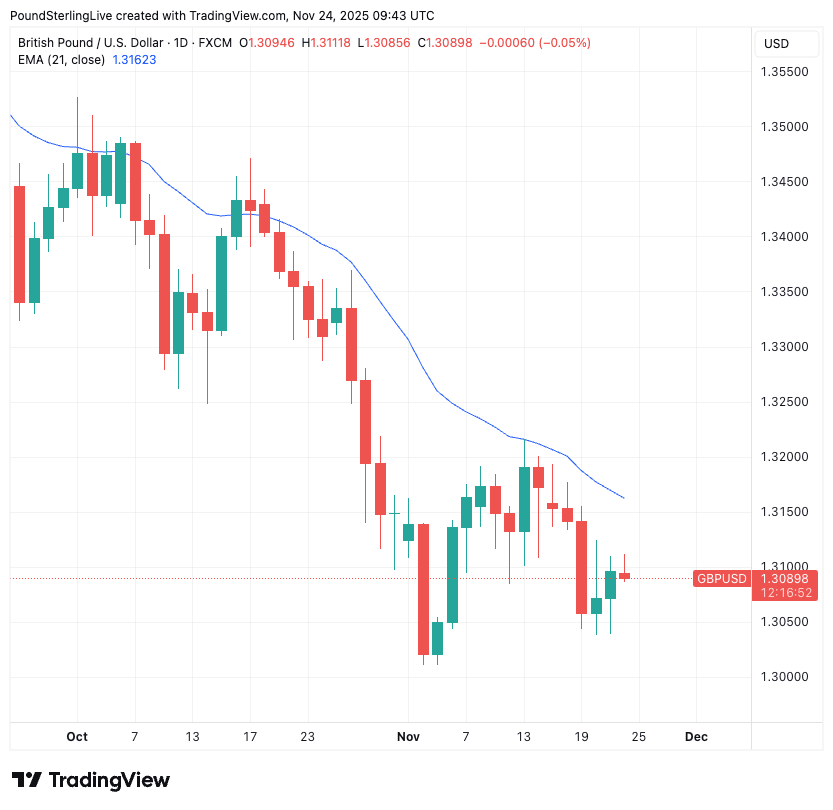
This could push UK bond yields higher and the pound lower, in a sign of distress akin to the Liz Truss mini-budget.
However, markets have sold sterling for weeks now in anticipation of a bad budget, meaning it’s already absorbed a hefty risk premium.
“The GBP has priced in a fiscal risk premium over the past month, with the broader USD rally also contributing to a lower GBPUSD,” says a note from the UBS Chief Investment Office.

GBP/USD fell steadily through September and October, from 1.3650 to a low of 1.3010 on November 04, from where it has entered a sideways consolidation that tops out at 1.32.
With positioning still leaning one-sided against sterling, there’s a good chance (above 50%) that the market actually breathes a sigh of relief once the event has passed.
Just the lifting of uncertainty might be enough to trigger a rebound.
“The Autumn Budget presents a two-sided risk, but we expect the fiscal risk premium to be priced out after the event, supporting GBPUSD toward 1.34 by year-end,” says UBS CIO.
“With heightened market attention, the government’s main priority is to reassure fiscal soundness by adhering to fiscal rules and increasing headroom. We think they will deliver just that, which should translate into the removal of GBP’s risk premium and a boost to GBPUSD,” adds the note.
The Budget: What to Watch
The government heads into the 26 November Autumn Budget with an estimated £20bn deterioration in fiscal headroom against the deficit rule.
Goldman Sachs expects the Chancellor to deliver a £25bn net fiscal consolidation (0.7% of GDP), raising headroom to around £15bn after new measures.
A larger adjustment to household energy bills is now anticipated, costing £4.3bn initially, replacing the previously expected VAT cut.
A freeze in fuel duty and extension of the temporary 5p cut remains expected, costing £3bn in FY2026.
Spending cuts look set to be modest at around £3bn, with departmental budgets broadly unchanged through FY2028.
Welfare changes include around £1bn in savings but also the full lifting of the two-child benefit cap, costing £3.5bn.
This means around £30bn of tax increases will be needed, likely delivered through a package of smaller measures rather than income tax rate rises.
Extending personal tax threshold freezes to 2030 is expected to raise £10bn, with other measures spanning council tax, pensions, CGT and gambling.
New measures are expected to deliver a 0.2% cumulative drag on demand, while energy-related policies should reduce headline inflation by 0.4pp in 2026.
OBR forecasts are likely to show higher CGNCR in FY2025 (+£8bn) but little change in FY2026, with downward revisions later due to lower borrowing and reduced APF losses.
Matcha latte has become a staple in Parisian cafés as a healthy and colorful alternative to coffee. This green tea whipped with milk offers a sweet, energizing, and visually irresistible moment.
It’s hard to miss matcha lattes inParisian cafés and coffee shops . ThisJapanese drink, made from matcha green tea powder whisked into hot or cold milk, has established itself as a chic and healthy alternative to cappuccino and traditional lattes. A real must-try, matcha lattes are as appealing for their bright color as they are for their energizing properties.
Made from finely ground young tea leaves, matcha is known for its high antioxidant content and its ability to provide steady energy without the spikes associated with caffeine. In latte form, it is available with cow’s milk, but also with plant-based milk (oat, almond, soy), which softens its slight natural bitterness.
Its bright green color attracts both lovers of beautiful drinks and natural health enthusiasts. Often slightly sweet, matcha latte can also be served pure for discerning palates! In Paris, it can be found in specialty coffee shops, Japanese tea rooms, and even in some contemporary pastry shops.
More than just a trendy drink, matcha latte offers a comforting break, a touch of gentle exoticism, and a little pleasure to sip throughout the day. Here are the best places in Paris!


 Latte Club, the new seventies coffee shop Paris 12e
We’re off to discover Latte Club, a new coffee shop in Paris’s 12th arrondissement, with a distinctly Seventies ambience. Located on rue du Faubourg Saint-Antoine, it offers gourmet coffee specialties accompanied by sweet treats. [Read more]



 Lancaster Le Café: the couture coffee shop with specialty coffees, matcha and homemade pastries
A new gourmet stopover in Paris: Lancaster Le Café has set up shop just a stone’s throw from the Palais Royal, bringing the coffee shop up to couture standards. Specialty coffees, exceptional matcha, refined teas and homemade pastries parade like “must-haves” on every table from Tuesday to Sunday. [Read more]



 Cult Coffee Shop: a gourmet brunch served all day long
Cult is the trendy coffee shop in Paris’s 9th arrondissement, sure to tantalize your taste buds with a delicious brunch to be enjoyed all day long, even on weekdays! [Read more]



 Journey, café-restaurant and brunch all day long
In the Sentier district, opposite NOIR Coffee Shop, the same team has opened Journey, a sleek and stylish café-restaurant where you can enjoy brunch at any time of day… but not only! [Read more]



 Brown, the Marais coffee shop for specialty coffees
Brown is a coffee shop that has opened its doors in the Marais district, offering organic specialty coffees. Located on rue de la Verrerie, in the 4th arrondissement of Paris, this place offers something for all lovers of good coffee, matcha latte and hot chocolate, accompanied by sweets and fresh waffles. [Read more]



 Ralph’s Coffee: the elegant Ralph Lauren café in Saint-Germain-des-Prés
Ralph Lauren opens a typically American café on Paris’s Boulevard Saint-Germain: Ralph’s Coffee. In the heart of a 17th-century mansion, this address elegantly fuses authentic style and exquisite gourmet treats in a wooded setting, punctuated by touches of tartan and crystal chandeliers, where each tasting transports you to the chic, refined world of the fashion label. [Read more]



 Maurice Sfez Café, Moïse Sfez’s sweet and savoury coffee shop
A new year and a new address for Moïse Sfez, who opens Maurice Sfez Café in the Marais district, a sweet and savory coffee shop where you can wolf down Liège waffles and indecent egg and cheese. [Read more]



 Fu, the coffee shop and brunch pastry shop in the 13th arrondissement, takes you on a journey to Asia
Are you tempted by a new pastry and coffee shop with Asian flavors? Matcha, sesame and pandan, as well as durian and kimchi, enliven the cakes and dishes in this new spot opening in Paris’s 13th arrondissement. From breakfast to lunch and afternoon tea, of course, it’s all about unusual treats and brunch every day. We take you on a discovery tour. [Read more]



 Pingwoo, the restaurant – coffee and flowery brunch with crunchy cat lattes
Pingwoo is the name of a charming little coffee shop worth trying out. A cafe-canteen with a weekend brunch, this flowery place offers real home-style fusion cuisine and gourmet pastries, accompanied by its famous cat lattes. [Read more]



 Blondie: the cool coffee shop and roaster in the 9th arrondissement
Blondie is the new coffee shop and roaster in the 9th arrondissement. Open since May 2023, it’s the perfect place to share a lunch, a sweet break or an afternoon coffee. Drop in for a visit … [Read more]



 Keopi, an unusual, gourmet Korean brunch in a Parisian passageway
Keopi is the name of a restaurant that combines pancakes and bugolgi, avocado toast and kimchi! Head to Passage Verdeau to discover Paris’ first Korean brunch, to be enjoyed every day. [Read more]



 Mousse, influencer Natoo’s coffee shop x hair salon in the Marais district of Paris
Influencer Natoo has opened a unique coffee shop and hair salon in the Marais district of Paris! [Read more]



 Auburn, the gourmet coffee-shop and its quiet terrace nestled in a confidential square in Paris
Auburn is the place to go to enjoy gourmet, simple, healthy cuisine based on the finest produce, as well as fine coffees and teas, all in a relaxing setting on a quiet square in the middle of Paris’s bustling Haussmann district. We take you inside this elegant coffee-shop where you’ll feel right at home. [Read more]



 Crème, the famous London cookies come to the Marais
The cookies that Londoners love are finally coming to Paris with the opening of Crème, the store of pastry chef Damien Leroux, in the Marais! [Read more]



 Yabaï Sando: Walter Ishizuka’s gourmet concept in Paris
If you’re a fan of Japanese street food, especially sando, then head to Paris’s Odeon district and push open the doors of Yabaï Sando. The brainchild of chef Walter Ishizuka, this ultra-gourmet address is sure to tantalize the taste buds of even the most discerning palates. [Read more]



 Used Book Café, the literary coffee shop
The Used Book Café is the coffee shop-library of the Merci Concept Store. A coffee shop like no other, it gives you the chance to read while enjoying a simple, homemade menu. [Read more]



 @unreve, the sublime French-Asian café and tea room
@unreve, that’s the name of the new coffee shop, tea room and pastry shop that has set up shop on Avenue Parmentier in the 11th district of Paris. Imagine a nice marriage between the best of coffee shops and Asian flavors and you are in the tone. [Read more]



 Pop in café, a trendy coffee shop with original creations
Pop in Café is an unusual coffee shop where you can enjoy not only good coffee, but also original fruity homemade sodas and delicious cream cakes. An addictive address. [Read more]



 Tartelettes, the unusual pastry shop for sweet and savory pies in Paris
Tartelettes is an original Parisian patisserie that invites you to discover delicious tarts in both sweet and savory versions. Here’s an address that’s sure to please everyone! [Read more]



 Shodai Matcha: the restaurant-tea shop for matcha lovers in Paris
For matcha lovers, here’s a spot that’s sure to make your head spin. Shodai Matcha is not just a restaurant, but also a tea room that celebrates the famous green tea through pastries and drinks made according to the rules of the art. [Read more]



 Aki Café : the Japanese tea room in Paris
Aki Café is the latest arrival on rue Sainte-Anne. This Japanese Café-Tearoom is the perfect place for an original gourmet break in the heart of Paris! [Read more]
Find the location of all these places by clicking on the map at the bottom of the article.
XRP Price Prediction (https://coinmarketcap.com/cmc-ai/xrp/price-prediction/) keeps resurfacing whenever markets calm down just enough for people to zoom out and think instead of sprinting after every fresh breakout attempt. In that kind of tape, XRP Price Prediction has less to do with shouting one big target and more to do with how price behaves around liquidity pockets, whether funding stays healthy, how options react during stress windows and if spot interest returns after ugly wicks.
Each reclaimed level or failed push quietly tests how much conviction is left in Ripple’s payment story.
Part of why this discussion refuses to disappear is the mix of regulatory headlines around the SEC case (https://www.investopedia.com/sec-vs-ripple-6743752), speculation about potential investment vehicles and slow but ongoing experiments in cross border payment pilots that still use XRP as settlement rail. Macro oriented desks keep one eye on dollar strength and rate chatter because those forces decide how much risk capital is even active, while more aggressive traders stare at funding flips and social noise. Somewhere inside that blend, Pepenode (https://pepenode.io/) begins to show up as a higher beta sidecar for people who want extra torque on the same broad narrative.
How Desks Now Frame XRP Price Prediction
For a lot of teams, XRP (https://www.binance.com/en/academy/articles/what-is-ripple) is no longer treated as a dusty relic from the last mania but as a live test of whether payment focused networks can still attract meaningful flows once regulation stops being pure guesswork. A current XRP Price Prediction usually blends technical work with unglamorous questions like who actually moves size across the network, how settlement metrics evolve quarter by quarter and what big holders tend to do during volatility spikes. Short term traders care about intraday levels and slippage, while swing traders mostly watch for higher lows and rejected breakdowns that hint at stronger hands underneath price.
Day Trading Whipsaws Versus Slow Position Building
Anyone who sits with an XRP order book open during busy sessions quickly sees two very different mindsets shaping price action in real time. Fast intraday players chase crowded trades by tracking funding, liquidation pockets and sudden sentiment swings in public chats, because arriving late to an overstuffed position usually ends badly. Quieter desks pay more attention to realized volatility, depth on both sides of the book and reaction around levels every chart watcher already marked. When those camps briefly align, even modest breakouts can stretch surprisingly far, when they diverge the same setup often sinks back into a choppy range that punishes impatience and leverage.
Metrics That Sit Behind XRP Price Prediction Models
Away from public threads, most serious XRP Price Prediction work lives inside dashboards and spreadsheets that chew through on chain and market structure data instead of slogans. Analysts monitor how much XRP still parks on exchanges, whether active addresses spike around major moves and if known liquidity providers quietly step aside when stress builds. Some traders cross check those reads against aggregator pages to see whether reported volume and depth really improved compared with previous months or if the noise simply feels louder. When circulating supply drifts off exchanges while measured usage trends higher, the underlying backdrop often improves even if the chart still looks miserable to casual observers.
What Full Time Desks Actually Monitor
People who spend their entire day inside trading terminals rarely repeat spectacular XRP Price Prediction headlines, they mostly want to know whether XRP is handling risk better or worse than other large caps in the same environment. They track how XRP behaves during bitcoin led moves, whether it occasionally leads strong sessions or consistently lags when nerves pick up and how spreads react during sudden wicks. Many desks only deploy real size when three ingredients line up, a supportive macro tone, acceptable liquidity and a chart that respects clear levels. The dramatic public calls tend to arrive later, long after those quieter confirmations shaped serious positioning.
Pepenode As The High Beta Companion To XRP
Pepenode (https://pepenode.io/) usually enters the picture once traders feel they understand the basic XRP setup and still want a way to express a similar narrative with more volatility. Rather than trying to replace established payment rails, the project is pitched as a meme tinted companion that still respects basic market logic, from how order books behave during aggressive candles to whether communication remains transparent when the tape turns ugly. Some higher risk desks talk about Pepenode as a way to tap into the mix of humour, community energy and speculative appetite that often pushes meme aligned names harder once core assets start trending again. In that framing it becomes leverage on sentiment rather than a direct competitor to XRP.
Managing Different Risk Tiers In The Same Flow
Because Pepenode does not drag years of courtroom drama, legacy exchange listings or institutional expectations behind it, most traders drop it straight into a high beta bucket instead of pretending it can anchor a portfolio. Updates around the token tend to highlight tokenomics, community milestones and marketing hooks that might matter if liquidity starts cascading down the market cap ladder in a convincing way. For traders who already refresh every new XRP Price Prediction thread, Pepenode can become the name that overreacts once flows reach side plays, although that potential upside usually comes with equally sharp reversals when attention fades. That asymmetric profile is exactly what some desks seek and others refuse to touch.
Scenario Map For XRP Price Prediction And Pepenode
When teams sketch scenarios on whiteboards, they often drop XRP and Pepenode into the same loose payment and speculation cluster but assign very different risk scores and holding periods. In a clearly bullish script, a clean XRP breakout supported by volume and slightly friendlier regulation could redirect fresh attention toward the whole complex and leave room for Pepenode and similar plays to catch overflow from traders hunting for extra torque. A more sideways environment might see XRP grind within a wide band for months while Pepenode prints occasional spikes around listings, marketing pushes or sudden meme waves that appear from nowhere and vanish once traders rotate to the next storyline.
Process Over Heroic XRP Price Prediction Targets
The bearish version that more disciplined XRP Price Prediction frameworks quietly keep on file includes renewed regulatory pressure, a broader risk off phase in crypto or aggressive competition from fresh payment narratives that capture mindshare. In that setup, liquidity usually exits smaller caps first and Pepenode is likely to feel sharper moves than XRP simply because age, listings and brand recognition still lean toward the older asset. Traders who learned the hard way tend to scale entries, size positions conservatively and diversify across narratives instead of marrying one ticker. For that crowd, XRP and Pepenode are flexible tools inside a wider playbook rather than symbols that deserve unwavering loyalty when conditions change.
Closing Remarks On XRP Price Prediction And Pepenode
Right now the market still seems to reward a slower, methodical style where XRP Price Prediction is treated as an ongoing process instead of a single heroic call and Pepenode serves as the louder, more playful way to surf some of the same liquidity currents. XRP remains the name that regulators, banks and more traditional desks watch when they think about payment rails, while Pepenode (https://pepenode.io/) sits in the lane for traders who accept that bigger swings cut both ways. In both cases, any real edge usually comes from basic things, risk management, time horizon, patience and the ability to stay calm when price briefly ignores every scenario drawn on the whiteboard.
Buchenweg, Karlsruhe, Germany
For more information about Pepenode (PEPENODE) visit the links below:
Website: https://pepenode.io/
Whitepaper: https://pepenode.io/assets/documents/whitepaper.pdf
Telegram: https://t.me/pepe_node
Twitter/X: https://x.com/pepenode_io
Disclosure: Crypto is a high-risk asset class. This article is provided for informational purposes and does not constitute investment advice.
CryptoTimes24 is a digital media and analytics platform dedicated to providing timely, accurate, and insightful information about the cryptocurrency and blockchain industry. The enterprise focuses on delivering high-quality news coverage, market analysis, project reviews, and educational resources for both investors and enthusiasts. By combining data-driven journalism with expert commentary, CryptoTimes24 aims to become a trusted global source for emerging trends in decentralized finance (DeFi), NFTs, Web3 technologies, and digital asset markets.
This release was published on openPR.
November is COPD Awareness Month.
At 39, Cyndy Ruess went to the hospital after having trouble breathing. Breathing problems weren’t new for Ruess — she’d had asthma as a child — and her biggest concern at the time was figuring out when she’d be able to get back to work.
A healthcare provider (HCP) gave Ruess more serious news. She might not be able to return to work at all, and her breathing issues were more than just asthma. She had chronic obstructive pulmonary disease — COPD — a condition caused by damage to the lung or the airways. Chronic bronchitis and emphysema are among the most common types of COPD, and people living with the condition often have breathing troubles, a daily cough with mucus and wheezing.
Ruess said she felt guilty and ashamed. She was a smoker, and smoking is the leading cause of COPD, although 1 in 4 people with COPD have never smoked at all.
“The guilt and self-loathing added a bitter taste to the pill that was already hard to swallow,” Ruess said, noting that at one point her kids even told her she was to blame for her condition. “It was the kick in the gut I didn’t expect, but I felt like I deserved it.”
Fear of being judged often prevents patients from seeking care that could help their condition, and many develop mental health issues related to COPD. It’s estimated that up to 4 out of 10 people with COPD experience depression, creating another barrier to seeking help.
Reducing stigma through education
David Mannino, M.D., chief medical officer and co-founder of the COPD Foundation, said reducing stigma while also providing treatment is an important balance HCPs must find when treating patients. Like Ruess, people with COPD can feel a sense of stigma about their diagnoses because of the strong association with smoking. Mannino said he’s heard patients express that “they brought the disease on themselves” or that they “got what they deserved” because of their smoking habits.
“Similar to when a person is diagnosed with lung cancer, one of the first questions people may ask is about smoking,” Mannino said. “This is part of the whole ‘shame and blame’ beliefs that have permeated lung diseases like COPD over the years.”
Mannino said HCPs will always encourage patients to quit smoking to improve their quality of life and help reduce symptoms but should express that they recognize how difficult that task can be because of the addictive nature of tobacco. He also said providers should emphasize that smoking isn’t the only cause of COPD, and that exposure to any lung irritants, like chemicals or other environmental pollutants, can damage lungs.
Outcomes for people living with COPD can also depend on socioeconomic factors. People with lower incomes often fare worse, a correlation related to social determinants that can affect all aspects of health. Poor housing, exposures to pollutants, poor diet, barriers to healthcare and occupational exposures are among the factors that can put people at greater risk for COPD or deliver worse outcomes.
“Combatting stigma is an ongoing struggle,” Mannino said. He pointed out that, in addition to the fact that many people with COPD have never smoked, COPD can also develop and progress after people have stopped smoking. “We simply have to continually remind people about these things.”
Read: Freedom to Breathe: Disparities and COPD >>
Smoking must be stopped for at least six months before a lung transplant and is prohibited with oxygen therapy, but patients who are current smokers still receive standard COPD therapies. HCPs can also help reduce stigma by inviting patients to be involved in shared decision-making, encouraging participation in clinical studies and offering new treatments to those who might still be smoking as well.
Overcoming the stigma of COPD
Patients can also play a role in fighting stigma. Support groups for people with COPD and therapy can help patients improve their mental health and feel stronger when asking for help and better care from HCPs.
For Ruess, battling the stigma has been a journey of close to two decades. Now 57, Ruess has found her voice through advocacy, joining the COPD Foundation’s state captain program. As state captain for California, she’s participated in health fairs to promote COPD awareness, worked to educate patients about COPD and been involved in research opportunities to help improve treatments. Ruess also hopes to collaborate with elected officials to improve COPD policy and appreciates the opportunity to help other people receive the best care possible — no matter the reason for their diagnosis.
This educational resource was created with support from Sanofi, a HealthyWomen Corporate Advisory Council member.
From Your Site Articles
Related Articles Around the Web