The main tag of Forex News Today Articles.
You can use the search box below to find what you need.
[wd_asp id=1]
Bullish Momentum Surges As Pair Secures Ground Above Critical 110.00 Level
The main tag of Forex News Today Articles.
You can use the search box below to find what you need.
[wd_asp id=1]
The GBP/USD pair attracts some dip-buyers near the 1.3175 region during the Asian session on Monday, and for now, seems to have snapped a two-day losing streak. Spot prices climb back above the 1.3200 mark in the last hour, though any meaningful appreciation still seems elusive amid persistent geopolitical uncertainties.
Bloomberg, citing Axios, reported that the US, Iran, and regional mediators are discussing terms for a possible 45-day ceasefire that could lead to an end of fighting. This, in turn, keeps a lid on the safe-haven US Dollar (USD) and offers some support to the GBP/USD pair. However, the risk of a further escalation of the conflict remains in play amid US President Donald Trump’s fresh threat to target Iran’s power plants and bridges if the Strait of Hormuz is not reopened by Tuesday.
From a technical perspective, the near-term bias is mildly bearish as the GBP/USD pair holds well below the 200-period Simple Moving Average (SMA) on the 4-hour chart, which continues to slope lower and cap the broader trend. Adding to this, the momentum has faded after last week’s rebound as the Moving Average Convergence Divergence (MACD) indicator is flattening just under the zero line and showing a marginally negative histogram, suggesting a lack of sustained buying pressure.
Furthermore, the Relative Strength Index (RSI) hovers around 43, below the 50 midline, which reinforces a soft downside tone rather than an oversold extreme. Hence, any further move up is likely to confront immediate resistance at 1.3240, with a stronger cap near 1.3300, where recent swing highs converge, and short-term sellers have reappeared. A sustained move above the latter would be needed to challenge the declining 200-period SMA around 1.3370 and start easing the prevailing bearish bias.
On the downside, immediate support is located at the recent floor around 1.3190, where a break would open the way toward the lower 1.3150 region as the next bearish target.
(The technical analysis of this story was written with the help of an AI tool.)
The Pound Sterling (GBP) is the oldest currency in the world (886 AD) and the official currency of the United Kingdom. It is the fourth most traded unit for foreign exchange (FX) in the world, accounting for 12% of all transactions, averaging $630 billion a day, according to 2022 data.
Its key trading pairs are GBP/USD, also known as ‘Cable’, which accounts for 11% of FX, GBP/JPY, or the ‘Dragon’ as it is known by traders (3%), and EUR/GBP (2%). The Pound Sterling is issued by the Bank of England (BoE).
The single most important factor influencing the value of the Pound Sterling is monetary policy decided by the Bank of England. The BoE bases its decisions on whether it has achieved its primary goal of “price stability” – a steady inflation rate of around 2%. Its primary tool for achieving this is the adjustment of interest rates.
When inflation is too high, the BoE will try to rein it in by raising interest rates, making it more expensive for people and businesses to access credit. This is generally positive for GBP, as higher interest rates make the UK a more attractive place for global investors to park their money.
When inflation falls too low it is a sign economic growth is slowing. In this scenario, the BoE will consider lowering interest rates to cheapen credit so businesses will borrow more to invest in growth-generating projects.
Data releases gauge the health of the economy and can impact the value of the Pound Sterling. Indicators such as GDP, Manufacturing and Services PMIs, and employment can all influence the direction of the GBP.
A strong economy is good for Sterling. Not only does it attract more foreign investment but it may encourage the BoE to put up interest rates, which will directly strengthen GBP. Otherwise, if economic data is weak, the Pound Sterling is likely to fall.
Another significant data release for the Pound Sterling is the Trade Balance. This indicator measures the difference between what a country earns from its exports and what it spends on imports over a given period.
If a country produces highly sought-after exports, its currency will benefit purely from the extra demand created from foreign buyers seeking to purchase these goods. Therefore, a positive net Trade Balance strengthens a currency and vice versa for a negative balance.
BitcoinWorld
USD/JPY Forecast: Critical Momentum Shift as Price Breaks Below Key Average
The USD/JPY currency pair faces a significant technical development as price action slips below crucial short-term moving averages, signaling a potential shift in market momentum for forex traders worldwide. This movement represents more than just routine volatility; it reflects underlying shifts in monetary policy expectations and global risk sentiment. Market participants now closely monitor whether this breach represents a temporary correction or the beginning of a more substantial trend reversal. The 150.00 psychological level previously served as a major battleground between bulls and bears. Consequently, its breach carries substantial implications for international trade flows and central bank interventions.
Technical indicators clearly show the USD/JPY pair losing upward momentum after an extended rally. The price recently crossed below the 20-day simple moving average, which traders widely regard as a short-term trend filter. Furthermore, the 50-day moving average now provides the next significant support level around 148.50. The Relative Strength Index (RSI) retreated from overbought territory above 70 to a more neutral reading near 55. This cooling momentum suggests reduced buying pressure. Meanwhile, trading volume patterns show decreased participation during recent declines. Several key technical levels now demand attention from market participants.
Critical Technical Levels to Watch:
The moving average convergence divergence (MACD) histogram shows declining bullish momentum. Additionally, the Average Directional Index (ADX) indicates a weakening trend strength. These technical developments collectively suggest the pair may enter a consolidation phase. However, fundamental drivers could quickly override these technical signals.
Multiple fundamental factors contribute to the USD/JPY’s recent price action. The Bank of Japan maintains its ultra-accommodative monetary policy stance despite global tightening trends. Conversely, the Federal Reserve signals a more cautious approach to future rate hikes. This policy divergence traditionally supports dollar strength against the yen. However, recent economic data introduces complexity to this narrative. Japanese inflation readings exceeded expectations, reaching 2.8% year-over-year. Meanwhile, U.S. employment figures showed modest cooling. These developments altered interest rate expectations in both economies.
Market participants increasingly speculate about potential Bank of Japan policy adjustments. Governor Kazuo Ueda recently acknowledged the sustainability of inflation trends. This acknowledgment marks a subtle shift from previous communications. The Federal Reserve, meanwhile, emphasizes data-dependent decision-making. Consequently, each economic release now carries amplified importance for currency valuations. The interest rate differential between U.S. Treasuries and Japanese Government Bonds narrowed slightly. This narrowing reduced the dollar’s yield advantage temporarily. Global risk sentiment also influences the pair significantly. During risk-off periods, the yen typically strengthens as a safe-haven currency. Recent geopolitical tensions and equity market volatility contributed to yen buying.
The USD/JPY pair exhibits distinct behavioral patterns during momentum shifts. Historically, breaks below the 20-day moving average preceded consolidation periods approximately 70% of the time. However, sustained breaks below the 50-day moving average often signaled more significant trend reversals. Market psychology around the 150.00 level remains particularly important. Japanese authorities previously intervened when the pair approached 152.00. This intervention memory creates a “fear zone” between 150.00-152.00. Traders now carefully monitor for any official comments from Japan’s Ministry of Finance. The timing of this technical development coincides with seasonal patterns. Japanese fiscal year-end approaches in March, typically increasing repatriation flows. These flows often support yen strength during this period.
Recent Intervention History Table:
| Date | USD/JPY Level | Intervention Type | Market Impact |
|---|---|---|---|
| October 2022 | 151.94 | Direct Intervention | 5% decline in 24 hours |
| September 2022 | 145.90 | Verbal Intervention | 2.5% decline |
| June 2022 | 136.00 | No Intervention | Continued appreciation |
Current market conditions require adjusted trading approaches. Position sizing should account for increased volatility around technical levels. Stop-loss placement becomes particularly crucial below 148.00. Many institutional traders implement wider stops during potential intervention periods. Option market dynamics show increased demand for downside protection. The risk-reward ratio for long positions deteriorated significantly. Meanwhile, short positions face intervention risk above 150.00. This creates a challenging environment for directional traders. Range-bound strategies may prove more appropriate until clearer trends emerge. Correlation analysis reveals changing relationships with other asset classes. The USD/JPY’s correlation with U.S. Treasury yields decreased recently. However, its correlation with the Nikkei 225 index remained strong. Traders must monitor these evolving relationships.
Commitment of Traders (COT) data reveals interesting positioning shifts. Leveraged funds reduced net long positions by 15% last week. Meanwhile, asset managers increased yen exposure through options structures. Order flow analysis shows clustering around technical levels. Large institutional orders concentrate near 148.50 and 151.00. This clustering suggests these levels will likely provide temporary support and resistance. Market depth deteriorated around current prices, indicating reduced liquidity. This reduced liquidity can amplify price movements during news events. Asian session liquidity providers adjusted their quoting behavior. They now maintain wider spreads during Tokyo trading hours. These adjustments reflect increased uncertainty about near-term direction.
The USD/JPY movement occurs within a broader global macroeconomic framework. China’s economic reopening influences regional currency dynamics significantly. A stronger Chinese economy typically supports regional growth and risk appetite. This support often benefits currencies like the Australian dollar more than the yen. European Central Bank policy decisions affect dollar strength indirectly. More hawkish ECB rhetoric could pressure the dollar index, impacting USD/JPY. Commodity price movements, particularly energy, affect Japan’s trade balance substantially. Higher oil prices worsen Japan’s trade deficit, potentially weakening the yen. Global supply chain normalization reduces previous pandemic-related distortions. These reductions allow more traditional currency relationships to reassert themselves. Technological advancements in algorithmic trading also influence price discovery. Machine learning models now process fundamental and technical data simultaneously. This simultaneous processing can create self-reinforcing technical breaks.
The USD/JPY forecast now centers on whether the break below short-term averages represents a meaningful momentum shift or temporary consolidation. Technical indicators suggest reduced bullish momentum, while fundamental factors present a mixed picture. Traders should monitor the 148.50 support level closely, as a break could signal further downside toward 147.30. Conversely, recovery above 151.00 would invalidate the current bearish technical setup. The interplay between Bank of Japan policy signals and Federal Reserve communications will likely determine the next sustained move. Market participants must remain agile, recognizing that intervention risk and seasonal flows add complexity to standard technical analysis. The USD/JPY pair continues to offer compelling trading opportunities, but requires careful risk management amid evolving dynamics.
Q1: What does it mean when USD/JPY breaks below the 20-day moving average?
This technical development typically indicates weakening short-term bullish momentum. It often precedes consolidation periods, though not necessarily major trend reversals. Traders watch for confirmation through subsequent price action and volume patterns.
Q2: How does Bank of Japan policy affect USD/JPY?
The Bank of Japan maintains ultra-low interest rates while other central banks tighten policy. This divergence makes yen-funded carry trades attractive, typically weakening the yen. Any policy normalization signals could significantly strengthen the Japanese currency.
Q3: What key support levels should traders monitor now?
Immediate support resides around 148.50 (50-day MA), followed by 147.30 (200-day MA). The psychological 148.00 level may also provide temporary support. Breaks below these levels would suggest more substantial downside potential.
Q4: How likely is Japanese currency intervention at current levels?
Intervention risk increases significantly above 152.00, based on 2022 precedents. Between 150.00-152.00, verbal intervention becomes more probable. Direct market intervention remains a last-resort tool for Japanese authorities.
Q5: What economic data releases most impact USD/JPY?
U.S. inflation (CPI) and employment data strongly influence Federal Reserve policy expectations. Japanese inflation readings and wage growth data affect Bank of Japan policy outlook. Central bank meeting minutes and speeches from officials also create volatility.
This post USD/JPY Forecast: Critical Momentum Shift as Price Breaks Below Key Average first appeared on BitcoinWorld.
The gold market rallied a bit during the course of the trading week as we find ourselves above the $4,600 level again. Friday was of course Good Friday, so we had only a 4-day week, but ultimately this is a situation where traders are looking at this through the prism of risk appetite and of course rates.
The interest rates out there continue to be a bit of an issue for gold, and I think that could continue to be the case, but it does look like we are trying to turn things around. The market forming a perfect hammer during the previous week from the 50-week EMA is a technically beautiful buy signal.
But we need help from interest rates, and we need them to drop. I am personally keeping an eye on the 10-year yield; if it is below the 4.30 level, I believe at that point gold should do fairly well.
Silver is very much in the same boat here as we are above the $70 level, but it too is very sensitive to interest rates and what they are doing. The 10-year yield again is what I am watching here, with the 4.30% level being one that I am watching very closely and waiting to see whether or not we can get below there and sustain below there.
At that point, I suspect that silver will really start to shine and have its day. Short-term pullbacks should continue to be buying opportunities, and the $70 level is an area that I am watching very closely at as support.
The euro has gone back and forth during the trading week, and we essentially have found ourselves hanging around the middle of the overall range. If the market were to break down from here, the 1.14 level should be supported, with the 1.1650 level above being resistant.
Ultimately, I think this is a scenario where traders will continue to be very cognizant of what the interest rate differential is between the United States and particularly Germany, but the EU on the whole, and of course what the situation is in the Middle East. If the Middle East calms down, that should help the euro and vice versa.
The Bitcoin market has been slightly positive for the week, but we continue to see a lot of noise at the moment, and I think you have to look at this through the prism of a market that is still doing everything it can to build up some type of base.
I also recognize that it is a market that you are going to have to be very patient with. If we can break above the $72,000 level, that would be a very good sign.
The US dollar initially fell against the Japanese yen for the trading week but found a bit of support as we continue to see the interest rate differential continue to be a major driver in this pair. The market initially pulled back just a bit over the last couple of weeks only to find plenty of buyers.
The fact that we have formed 3 hammers in a row suggests that the US dollar is in fact squeezing the Japanese yen to the upside.
The 160¥ level continues to be an area of rather important resistance that I think extends to the 160.40 level. Breaking above there frees this market to go much higher.
The US dollar pulled back against the Mexican peso, but it is still grinding along its path. The question is now that we have a bit of a pullback, will the buyers return or will this thing break down?
I lay this solely at the feet of interest rates and how interest rates behave in the United States, so we will see how that plays out. But I do prefer shorting this pair over buying it.
If we get more of a risk-on type of move, then we have the possibility of a drift towards the 17.50 level. If we break to the upside, we could go as high as 18.50.
The US dollar rallied against the Canadian dollar again on the past week and it looks like we are trying to get to the 1.40 level. That being said, there is a lot of resistance in this area, so I am a little hesitant to get overly aggressive here.
I believe that pullbacks continue to offer buying opportunities as the interest rate differential must certainly favor the US dollar.
It is a little overdone, so a red week might actually be good news.
The Nasdaq 100 has formed a rather bullish candlestick over the last 4 days. Remember, Friday was Good Friday, so therefore the market was closed. If things are relatively calm over the weekend, we could see a situation where Nasdaq continues to recover.
I certainly think there is a lot of interest there and there are a lot of people looking to buy stocks. The question now is whether or not the momentum will keep up.
I am bullish of this market; short-term pullbacks should be buying opportunities as, even though it sold off, considering that the United States is at war with Iran, it’s held up quite well.
BitcoinWorld
USD/JPY Gains Momentum: US Dollar Soars on Risk Aversion and Critical PMI Data
NEW YORK, March 2025 – The USD/JPY currency pair recorded significant gains in recent trading sessions, primarily driven by a stronger US Dollar benefiting from heightened global risk aversion and the latest Purchasing Managers’ Index (PMI) data. Consequently, traders witnessed a notable shift in forex market dynamics, reflecting broader economic uncertainties. This movement underscores the intricate relationship between macroeconomic indicators and currency valuations.
The recent appreciation of the USD/JPY pair stems from two concurrent factors. Firstly, a flight to safety among global investors bolstered demand for the US Dollar. Secondly, newly released PMI figures provided fundamental support for the greenback. Market analysts consistently monitor this currency pair as a key barometer for risk sentiment in the Asia-Pacific region and broader forex markets. Furthermore, the Bank of Japan’s persistent accommodative monetary policy continues to create a yield differential that favors the US Dollar.
Historical data reveals that the USD/JPY pair often exhibits heightened volatility during periods of economic uncertainty. For instance, the pair reacted sharply during previous geopolitical tensions and central bank policy shifts. The current rally aligns with patterns observed when traditional safe-haven assets, like US Treasuries, attract capital flows. Therefore, this movement is not an isolated event but part of a recognizable market behavior.
The Purchasing Managers’ Index serves as a crucial leading indicator for economic health. Stronger-than-expected US PMI data, particularly from the manufacturing and services sectors, signals robust economic activity. This strength directly supports the case for a resilient US Dollar. Conversely, weaker data from other major economies, including Japan, exacerbates the currency divergence.
Economists emphasize the data’s forward-looking nature. A PMI reading above 50 indicates expansion, while a reading below 50 suggests contraction. The latest US data surpassed expectations, reinforcing investor confidence in the underlying economy. This confidence translates into currency strength. Meanwhile, Japan’s latest figures presented a more mixed picture, failing to provide similar support for the Yen.
Financial strategists point to specific catalysts for the recent risk-off mood. Escalating tensions in key geopolitical regions and concerns over global growth projections have prompted investors to seek refuge. “The US Dollar’s role as the world’s primary reserve currency makes it a default destination during market stress,” explains a senior market analyst from a major investment bank. “When you combine this structural demand with positive domestic economic signals from PMIs, the upward pressure on USD/JPY becomes very clear.”
This analysis is supported by fund flow data showing increased allocations to US Dollar-denominated assets. The correlation between equity market declines and USD/JPY gains has strengthened noticeably. The table below summarizes the key data points influencing the recent move:
| Indicator | US Data | Japan Data | Market Impact |
|---|---|---|---|
| Manufacturing PMI | 52.4 (Expansion) | 48.7 (Contraction) | Bullish for USD |
| Services PMI | 54.1 (Strong Expansion) | 51.2 (Modest Expansion) | Bullish for USD |
| Composite PMI | 53.5 | 50.1 | Bullish for USD |
Additionally, interest rate differentials remain a powerful driver. The Federal Reserve’s current policy stance, compared to the Bank of Japan’s, continues to make holding US Dollars more attractive for yield-seeking investors. This dynamic is especially potent in a low-risk-appetite environment where capital preservation becomes paramount.
From a technical perspective, the USD/JPY pair has broken through several key resistance levels. Chart analysts note increased trading volume accompanying the rise, confirming the move’s strength. The next significant resistance zone is now in focus, while support levels have been recalibrated higher. Traders are advised to monitor:
Fundamentally, the outlook hinges on upcoming economic releases and central bank communications. Any shift in the Federal Reserve’s tone or a surprise change from the Bank of Japan could rapidly alter the trajectory. Moreover, a resolution in geopolitical tensions could unwind some of the safe-haven flows supporting the Dollar. Therefore, maintaining a data-dependent view is essential for market participants.
The recent USD/JPY gains illustrate a classic market response to intertwined forces of risk aversion and solid economic data. The US Dollar’s strength, fueled by its safe-haven status and positive PMI readings, presents a clear narrative for forex traders. Moving forward, vigilance on incoming data and central bank policy will be critical for anticipating the next major move in this pivotal currency pair. The interplay between global risk sentiment and domestic economic indicators will continue to dictate the path for USD/JPY.
Q1: What does a rising USD/JPY pair indicate?
A rising USD/JPY indicates the US Dollar is strengthening against the Japanese Yen. This typically occurs when investors favor the Dollar due to positive US economic data, higher US interest rates, or a global ‘risk-off’ environment where the Dollar is seen as a safe haven.
Q2: How does PMI data directly affect currency values?
PMI data acts as a leading indicator of economic health. A strong PMI reading suggests expanding business activity, which can lead to expectations of higher interest rates and stronger economic growth. This attracts foreign investment into that currency, increasing its demand and value.
Q3: Why is the US Dollar considered a safe-haven currency?
The US Dollar is considered a safe haven due to the size and stability of the US economy, the depth and liquidity of its financial markets, and the Dollar’s role as the world’s primary reserve currency. During global uncertainty, investors flock to US Treasury bonds and Dollar assets for perceived safety.
Q4: What other factors could reverse the current USD/JPY trend?
The trend could reverse if geopolitical tensions ease (reducing safe-haven demand), if US economic data weakens significantly, if the Bank of Japan signals a policy shift away from ultra-low rates, or if the Federal Reserve adopts a more dovish monetary policy stance than currently expected.
Q5: How do traders use this information in their strategies?
Traders incorporate this analysis by aligning their positions with the dominant fundamental trend (e.g., long USD/JPY during risk-off periods with strong US data). They use technical analysis to identify precise entry and exit points, manage risk with stop-loss orders, and stay informed through economic calendars for upcoming data releases that could impact the pair.
This post USD/JPY Gains Momentum: US Dollar Soars on Risk Aversion and Critical PMI Data first appeared on BitcoinWorld.
When you trade your FOREX.com account on TradingView.com, you benefit from sharing ideas and custom scripts with their community of over 60 million traders and investors*.
Their industry-leading charts and tools have seen TradingView receive a 4.7 rating for its mobile app with over 10M downloads**, making it one of the top financial platforms.
Whether you are new to trading or a seasoned investor, TradingView delivers on our joint mission to help anyone succeed in financial markets.
*Published by TradingView.
**Based on TradingView App review on Google Play.
BitcoinWorld
EUR/JPY Forecast: Bullish Momentum Builds Toward 184.00 as Critical 100-Day EMA Provides Solid Foundation
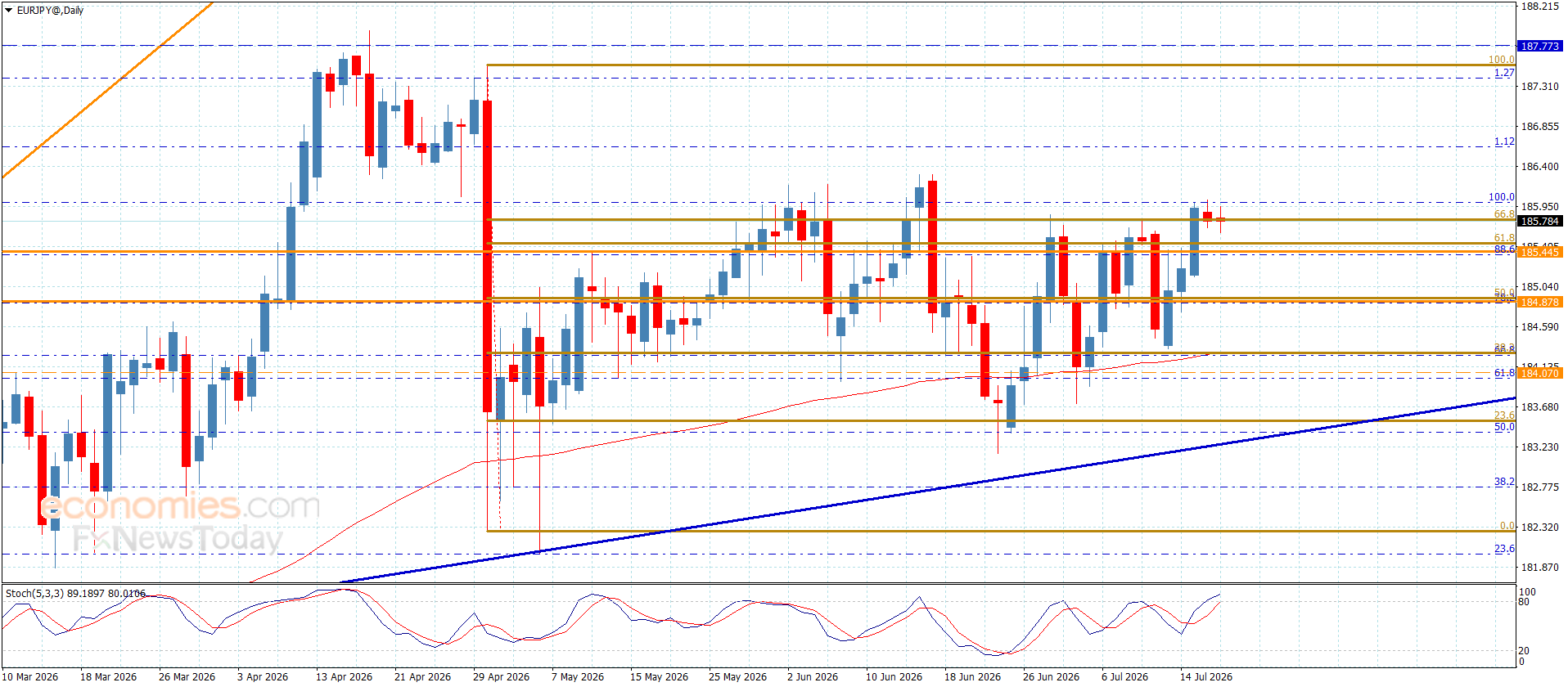
The EUR/JPY currency pair demonstrates remarkable resilience in early 2025 trading sessions, gathering substantial momentum toward the psychologically significant 184.00 resistance level. Market analysts observe sustained buying pressure as the cross maintains its position firmly above the critical 100-day Exponential Moving Average, signaling continued bullish potential for the Euro against the Japanese Yen. This technical configuration emerges against a complex macroeconomic backdrop involving divergent central bank policies between the European Central Bank and the Bank of Japan.
Technical examination reveals the EUR/JPY pair trading at approximately 183.65 during the London session on March 15, 2025. The price action shows consistent higher lows since February, establishing a clear upward trajectory. Furthermore, the 100-day Exponential Moving Average currently sits at 182.40, providing dynamic support that has contained three separate retracement attempts over the past month. Consequently, each test of this moving average has attracted fresh buying interest, reinforcing its technical significance.
Market structure analysis indicates several key resistance levels ahead of the 184.00 target. Specifically, immediate resistance appears at 183.85, corresponding to the February 28 high. A decisive break above this level would likely accelerate momentum toward the primary target. Meanwhile, trading volume patterns show increased activity on upward movements compared to downward corrections, suggesting institutional accumulation. The Relative Strength Index currently reads 62, positioned in bullish territory but not yet overbought, indicating room for additional appreciation.
The following table illustrates key technical indicators supporting the bullish bias:
| Technical Indicator | Current Reading | Bullish/Bearish Signal |
|---|---|---|
| 100-day EMA | 182.40 | Strong Support |
| 50-day EMA | 181.85 | Support |
| 200-day EMA | 180.20 | Major Support |
| Daily RSI (14) | 62 | Bullish Momentum |
| MACD (12,26,9) | +0.45 | Bullish Crossover |
Multiple fundamental factors contribute to the EUR/JPY’s current technical posture. Primarily, the monetary policy divergence between the European Central Bank and the Bank of Japan creates favorable conditions for Euro appreciation. The ECB maintains a relatively hawkish stance compared to its Japanese counterpart, with market participants anticipating potential rate differential expansion through 2025. Additionally, improving Eurozone economic data, particularly from Germany and France, supports Euro strength against most major currencies.
Conversely, the Bank of Japan continues its ultra-accommodative monetary policy framework despite recent inflation readings exceeding targets. Governor Kazuo Ueda’s cautious approach to policy normalization provides ongoing support for the carry trade dynamic benefiting EUR/JPY bulls. Moreover, Japan’s Ministry of Finance has shown limited appetite for aggressive currency intervention at current levels, reducing downside risks for the pair. Global risk sentiment also plays a crucial role, with improving equity markets typically supporting Euro crosses against the traditionally safe-haven Japanese Yen.
The EUR/JPY pair exhibits interesting historical patterns around the 184.00 level. Previously, this area served as significant resistance in November 2024, where the pair reversed from 184.15 to 179.80 over three weeks. However, the current technical structure differs substantially from that period. Specifically, the 100-day EMA now provides support approximately 180 pips below current prices, whereas in November it converged with the price action, offering weaker support. This technical improvement suggests greater sustainability for any breakout above 184.00.
Seasonal analysis reveals that March typically shows positive performance for EUR/JPY, with an average gain of 1.8% over the past decade. This seasonal tendency aligns with the current technical setup, potentially amplifying bullish momentum. Furthermore, options market data indicates increased demand for call options with strikes at 184.00 and 185.00, reflecting institutional positioning for further upside. The risk reversal metric, measuring the premium of calls over puts, shows its most bullish reading since January 2024, confirming positive sentiment.
Despite the constructive technical picture, several risk factors warrant monitoring. First, unexpected hawkish rhetoric from Bank of Japan officials could trigger rapid Yen appreciation, potentially testing the 100-day EMA support. Second, geopolitical tensions affecting European energy security might pressure the Euro disproportionately. Third, a significant deterioration in global risk appetite could revive safe-haven flows into the Japanese Yen. Technical traders should watch for a daily close below the 100-day EMA at 182.40, which would invalidate the current bullish bias and suggest deeper correction potential toward 181.00.
Market participants identify three primary scenarios for EUR/JPY development:
Leading financial institutions provide nuanced views on the EUR/JPY outlook. Goldman Sachs currency strategists note that “carry trade dynamics remain favorable for EUR/JPY, with the interest rate differential likely to widen further in 2025.” Meanwhile, Nomura analysts emphasize technical factors, stating that “the 100-day EMA has provided reliable support since December, with each test attracting increased buying interest.” Bloomberg’s market sentiment indicator shows 68% of surveyed traders maintain bullish EUR/JPY positions, though this represents a decrease from 75% two weeks ago, suggesting some profit-taking has occurred.
For traders considering EUR/JPY positions, several strategic approaches merit consideration. Position traders might establish long positions on dips toward the 100-day EMA, using a break below 182.00 as a stop-loss level. Alternatively, swing traders could await a confirmed breakout above 184.00 with volume confirmation before entering positions. Risk management remains paramount, with position sizing reflecting the pair’s average daily range of approximately 85 pips. Options strategies, including bull call spreads targeting 185.00, offer defined-risk alternatives to outright long positions.
Technical traders should monitor several key developments. First, watch for consolidation patterns near 183.80-184.00 resistance. Second, observe volume patterns on any retest of the 100-day EMA support. Third, track correlation with other Yen crosses, particularly USD/JPY, for confirmation of broader Yen weakness. Finally, monitor bond yield differentials between German Bunds and Japanese Government Bonds, as widening spreads typically support EUR/JPY appreciation.
The EUR/JPY forecast maintains a constructive outlook as the pair gathers strength toward the 184.00 resistance level. The sustained position above the critical 100-day Exponential Moving Average provides technical confirmation of the bullish bias, supported by fundamental monetary policy divergence between the Eurozone and Japan. While several risk factors require monitoring, the current technical structure suggests higher probability of upward resolution. Market participants should watch for a decisive break above 184.00 with accompanying volume, which could open the path toward the 185.50-186.00 resistance zone identified in the EUR/JPY technical analysis.
Q1: What is the significance of the 100-day EMA for EUR/JPY?
The 100-day Exponential Moving Average represents a key dynamic support level that has contained multiple downside attempts since December 2024. A sustained position above this indicator typically signals medium-term bullish momentum, while a break below suggests potential trend reversal.
Q2: What fundamental factors support EUR/JPY strength?
Monetary policy divergence between the ECB and BOJ provides the primary fundamental support, with the Eurozone maintaining higher interest rates. Additionally, improving Eurozone economic data and stable global risk sentiment contribute to Euro strength against the Japanese Yen.
Q3: What are the key resistance levels above 184.00?
Beyond 184.00, technical analysis identifies resistance at 184.50 (November 2024 high), 185.50 (psychological level and Fibonacci extension), and 186.20 (2024 yearly high). Each level represents potential profit-taking zones for bullish positions.
Q4: How does the carry trade affect EUR/JPY?
The positive interest rate differential between Eurozone and Japanese rates creates a carry trade incentive where investors borrow in low-yielding Yen to invest in higher-yielding Euro assets. This dynamic typically supports EUR/JPY appreciation during stable market conditions.
Q5: What would invalidate the current bullish EUR/JPY forecast?
A daily close below the 100-day Exponential Moving Average (currently 182.40) would challenge the bullish structure. Additionally, aggressive Bank of Japan policy normalization or significant deterioration in Eurozone economic data could reverse the current technical bias.
This post EUR/JPY Forecast: Bullish Momentum Builds Toward 184.00 as Critical 100-Day EMA Provides Solid Foundation first appeared on BitcoinWorld.
BitcoinWorld
EUR/JPY Forecast: Bullish Momentum Builds Toward 184.00 as Critical 100-Day EMA Provides Solid Foundation
The EUR/JPY currency pair demonstrates remarkable resilience in early 2025 trading sessions, gathering substantial momentum toward the psychologically significant 184.00 resistance level. Market analysts observe sustained buying pressure as the cross maintains its position firmly above the critical 100-day Exponential Moving Average, signaling continued bullish potential for the Euro against the Japanese Yen. This technical configuration emerges against a complex macroeconomic backdrop involving divergent central bank policies between the European Central Bank and the Bank of Japan.
Technical examination reveals the EUR/JPY pair trading at approximately 183.65 during the London session on March 15, 2025. The price action shows consistent higher lows since February, establishing a clear upward trajectory. Furthermore, the 100-day Exponential Moving Average currently sits at 182.40, providing dynamic support that has contained three separate retracement attempts over the past month. Consequently, each test of this moving average has attracted fresh buying interest, reinforcing its technical significance.
Market structure analysis indicates several key resistance levels ahead of the 184.00 target. Specifically, immediate resistance appears at 183.85, corresponding to the February 28 high. A decisive break above this level would likely accelerate momentum toward the primary target. Meanwhile, trading volume patterns show increased activity on upward movements compared to downward corrections, suggesting institutional accumulation. The Relative Strength Index currently reads 62, positioned in bullish territory but not yet overbought, indicating room for additional appreciation.
The following table illustrates key technical indicators supporting the bullish bias:
| Technical Indicator | Current Reading | Bullish/Bearish Signal |
|---|---|---|
| 100-day EMA | 182.40 | Strong Support |
| 50-day EMA | 181.85 | Support |
| 200-day EMA | 180.20 | Major Support |
| Daily RSI (14) | 62 | Bullish Momentum |
| MACD (12,26,9) | +0.45 | Bullish Crossover |
Multiple fundamental factors contribute to the EUR/JPY’s current technical posture. Primarily, the monetary policy divergence between the European Central Bank and the Bank of Japan creates favorable conditions for Euro appreciation. The ECB maintains a relatively hawkish stance compared to its Japanese counterpart, with market participants anticipating potential rate differential expansion through 2025. Additionally, improving Eurozone economic data, particularly from Germany and France, supports Euro strength against most major currencies.
Conversely, the Bank of Japan continues its ultra-accommodative monetary policy framework despite recent inflation readings exceeding targets. Governor Kazuo Ueda’s cautious approach to policy normalization provides ongoing support for the carry trade dynamic benefiting EUR/JPY bulls. Moreover, Japan’s Ministry of Finance has shown limited appetite for aggressive currency intervention at current levels, reducing downside risks for the pair. Global risk sentiment also plays a crucial role, with improving equity markets typically supporting Euro crosses against the traditionally safe-haven Japanese Yen.
The EUR/JPY pair exhibits interesting historical patterns around the 184.00 level. Previously, this area served as significant resistance in November 2024, where the pair reversed from 184.15 to 179.80 over three weeks. However, the current technical structure differs substantially from that period. Specifically, the 100-day EMA now provides support approximately 180 pips below current prices, whereas in November it converged with the price action, offering weaker support. This technical improvement suggests greater sustainability for any breakout above 184.00.
Seasonal analysis reveals that March typically shows positive performance for EUR/JPY, with an average gain of 1.8% over the past decade. This seasonal tendency aligns with the current technical setup, potentially amplifying bullish momentum. Furthermore, options market data indicates increased demand for call options with strikes at 184.00 and 185.00, reflecting institutional positioning for further upside. The risk reversal metric, measuring the premium of calls over puts, shows its most bullish reading since January 2024, confirming positive sentiment.
Despite the constructive technical picture, several risk factors warrant monitoring. First, unexpected hawkish rhetoric from Bank of Japan officials could trigger rapid Yen appreciation, potentially testing the 100-day EMA support. Second, geopolitical tensions affecting European energy security might pressure the Euro disproportionately. Third, a significant deterioration in global risk appetite could revive safe-haven flows into the Japanese Yen. Technical traders should watch for a daily close below the 100-day EMA at 182.40, which would invalidate the current bullish bias and suggest deeper correction potential toward 181.00.
Market participants identify three primary scenarios for EUR/JPY development:
Leading financial institutions provide nuanced views on the EUR/JPY outlook. Goldman Sachs currency strategists note that “carry trade dynamics remain favorable for EUR/JPY, with the interest rate differential likely to widen further in 2025.” Meanwhile, Nomura analysts emphasize technical factors, stating that “the 100-day EMA has provided reliable support since December, with each test attracting increased buying interest.” Bloomberg’s market sentiment indicator shows 68% of surveyed traders maintain bullish EUR/JPY positions, though this represents a decrease from 75% two weeks ago, suggesting some profit-taking has occurred.
For traders considering EUR/JPY positions, several strategic approaches merit consideration. Position traders might establish long positions on dips toward the 100-day EMA, using a break below 182.00 as a stop-loss level. Alternatively, swing traders could await a confirmed breakout above 184.00 with volume confirmation before entering positions. Risk management remains paramount, with position sizing reflecting the pair’s average daily range of approximately 85 pips. Options strategies, including bull call spreads targeting 185.00, offer defined-risk alternatives to outright long positions.
Technical traders should monitor several key developments. First, watch for consolidation patterns near 183.80-184.00 resistance. Second, observe volume patterns on any retest of the 100-day EMA support. Third, track correlation with other Yen crosses, particularly USD/JPY, for confirmation of broader Yen weakness. Finally, monitor bond yield differentials between German Bunds and Japanese Government Bonds, as widening spreads typically support EUR/JPY appreciation.
The EUR/JPY forecast maintains a constructive outlook as the pair gathers strength toward the 184.00 resistance level. The sustained position above the critical 100-day Exponential Moving Average provides technical confirmation of the bullish bias, supported by fundamental monetary policy divergence between the Eurozone and Japan. While several risk factors require monitoring, the current technical structure suggests higher probability of upward resolution. Market participants should watch for a decisive break above 184.00 with accompanying volume, which could open the path toward the 185.50-186.00 resistance zone identified in the EUR/JPY technical analysis.
Q1: What is the significance of the 100-day EMA for EUR/JPY?
The 100-day Exponential Moving Average represents a key dynamic support level that has contained multiple downside attempts since December 2024. A sustained position above this indicator typically signals medium-term bullish momentum, while a break below suggests potential trend reversal.
Q2: What fundamental factors support EUR/JPY strength?
Monetary policy divergence between the ECB and BOJ provides the primary fundamental support, with the Eurozone maintaining higher interest rates. Additionally, improving Eurozone economic data and stable global risk sentiment contribute to Euro strength against the Japanese Yen.
Q3: What are the key resistance levels above 184.00?
Beyond 184.00, technical analysis identifies resistance at 184.50 (November 2024 high), 185.50 (psychological level and Fibonacci extension), and 186.20 (2024 yearly high). Each level represents potential profit-taking zones for bullish positions.
Q4: How does the carry trade affect EUR/JPY?
The positive interest rate differential between Eurozone and Japanese rates creates a carry trade incentive where investors borrow in low-yielding Yen to invest in higher-yielding Euro assets. This dynamic typically supports EUR/JPY appreciation during stable market conditions.
Q5: What would invalidate the current bullish EUR/JPY forecast?
A daily close below the 100-day Exponential Moving Average (currently 182.40) would challenge the bullish structure. Additionally, aggressive Bank of Japan policy normalization or significant deterioration in Eurozone economic data could reverse the current technical bias.
This post EUR/JPY Forecast: Bullish Momentum Builds Toward 184.00 as Critical 100-Day EMA Provides Solid Foundation first appeared on BitcoinWorld.
BitcoinWorld
EUR/JPY Forecast: Critical Test at Nine-Day EMA Support After Sharp Slide Below 184.00
LONDON, March 21, 2025 – The EUR/JPY currency pair faces a pivotal technical juncture, testing its nine-day Exponential Moving Average (EMA) for support after decisively easing below the psychologically significant 184.00 level. This movement sparks intense scrutiny among forex traders and analysts globally, as the pair’s behavior at this technical level could signal the next directional trend for the Euro against the Japanese Yen. Consequently, market participants are closely monitoring price action for confirmation of either a rebound or a deeper correction.
The recent price decline below 184.00 marks a notable shift in short-term momentum for the EUR/JPY cross. Currently, the pair is probing the nine-day EMA, a widely watched short-term trend indicator. A sustained hold above this moving average often suggests the underlying uptrend remains intact. Conversely, a decisive break below could indicate accelerating selling pressure. Furthermore, traders are examining other key technical levels, including the 50-day Simple Moving Average (SMA) and recent swing lows, to gauge potential support zones. The Relative Strength Index (RSI), a momentum oscillator, is also being monitored for signs of being oversold, which might precede a technical bounce.
Market analysts highlight the importance of volume during this test. For instance, a rebound from the EMA on high volume would carry more conviction than a low-volume move. Additionally, the broader chart pattern, whether the pair is in a consolidation phase or a corrective pullback within a larger trend, provides essential context. This technical confluence makes the current price area a critical battleground between bullish and bearish forces in the forex market.
Beyond the charts, fundamental forces exert significant pressure on the EUR/JPY pair. Primarily, the monetary policy divergence between the European Central Bank (ECB) and the Bank of Japan (BoJ) remains a core driver. The ECB’s path regarding interest rate cuts, inflation data from the Eurozone, and overall economic growth projections directly influence the Euro’s strength. Simultaneously, the BoJ’s ultra-accommodative stance, any subtle shifts in its Yield Curve Control (YCC) policy, and Japan’s own inflation and wage growth data impact the Yen’s valuation.
Global risk sentiment also plays a crucial role. Typically, the Japanese Yen acts as a traditional safe-haven currency. Therefore, during periods of market uncertainty or risk aversion, the Yen often strengthens, putting downward pressure on EUR/JPY. Conversely, a “risk-on” environment can see capital flow out of the Yen, potentially supporting the cross. Recent geopolitical developments and global equity market performance are, therefore, key factors in the pair’s daily fluctuations.
Financial institutions provide continuous analysis on major currency pairs. According to recent research notes from major banks, the focus is on whether the current pullback represents a healthy correction or the start of a more profound trend reversal. Some analysts point to resilient Eurozone economic data as a potential floor for the Euro. Others emphasize the BoJ’s potential to eventually normalize policy, which could provide structural support for the Yen. This expert debate underscores the complexity of forecasting forex movements, where technical signals and fundamental narratives must be weighed together.
The implications are significant for various market participants. For multinational corporations, volatility in EUR/JPY affects hedging costs and international revenue. For retail and institutional traders, clear breaks of key levels like the nine-day EMA often trigger automated trading systems and stop-loss orders, which can amplify short-term moves. Therefore, understanding the technical landscape is not just an academic exercise but a practical necessity for managing exposure and risk in the foreign exchange market.
Placing the current price action in historical context offers valuable perspective. The EUR/JPY pair has experienced considerable volatility over the past decade, influenced by events like the European debt crisis, Abenomics in Japan, and the global pandemic. Comparing the current test of the nine-day EMA to similar historical instances can reveal probabilistic outcomes. For example, data might show that following a break below a round number like 184.00, the pair finds support at the nine-day EMA approximately 60% of the time before resuming its prior trend.
It is also instructive to compare EUR/JPY’s performance to other Yen crosses, such as GBP/JPY or AUD/JPY. If the Yen is strengthening broadly across the board, the move in EUR/JPY is likely part of a wider Yen appreciation story. However, if EUR/JPY is underperforming its peers, the weakness may be more isolated to the Euro itself. This comparative analysis helps traders isolate the primary source of currency movement.
The EUR/JPY forecast hinges on the outcome of the current test at the nine-day EMA support following its decline below 184.00. This technical event sits at the intersection of significant fundamental forces, including central bank policy divergence and global risk sentiment. Traders should monitor for a confirmed bounce or breakdown from this level, supported by volume and momentum indicators, while keeping a close watch on upcoming economic data from both the Eurozone and Japan. The pair’s next sustained move will likely depend on which narrative—technical support or fundamental pressure—ultimately prevails in the forex market.
Q1: What does testing the nine-day EMA mean for EUR/JPY?
The nine-day Exponential Moving Average is a short-term trend indicator. Testing it means the price is interacting with this dynamic support/resistance level. A hold suggests the recent trend may continue, while a break can signal a trend change.
Q2: Why is the 184.00 level psychologically significant?
Round numbers like 184.00 often act as psychological barriers in trading. They are easy reference points where many traders place orders, making them areas of concentrated liquidity and potential increased volatility.
Q3: What fundamental factors most affect the EUR/JPY exchange rate?
The primary drivers are the monetary policy difference between the ECB and BoJ, relative economic growth and inflation in the Eurozone versus Japan, and broader global market risk sentiment.
Q4: How does risk sentiment impact EUR/JPY?
The Japanese Yen is considered a safe-haven currency. In “risk-off” market environments, demand for the Yen typically increases, which can push EUR/JPY lower. In “risk-on” environments, the pair may rise as investors seek higher-yielding assets.
Q5: What should traders watch next after this EMA test?
Traders should watch for a confirmed close above or below the EMA, supported by technical indicators like volume and RSI. They should also monitor upcoming economic calendars for key data releases from both Europe and Japan that could impact central bank policy expectations.
This post EUR/JPY Forecast: Critical Test at Nine-Day EMA Support After Sharp Slide Below 184.00 first appeared on BitcoinWorld.