The main tag of Gold Price Articles.
You can use the search box below to find what you need.
[wd_asp id=1]
The main tag of Gold Price Articles.
You can use the search box below to find what you need.
[wd_asp id=1]
Welcome, my fellow traders! I have prepared a price forecast for the USCrude, XAUUSD, and EURUSD using a combination of the margin zones method and technical analysis. Based on the market analysis, I suggest entry signals for intraday traders.
Gold prices continued to fall today.
The article covers the following subjects:
Oil prices continued to rise yesterday, piercing the Target Zone of 86.82–85.61 and reaching the Gold Zone of 90.05–89.64. Bears are currently holding the Gold Zone, so a downward correction may unfold.
If a correction develops, the price may test the support zone A of 86.71–86.31. Consider long trades near it, with the first target at 88.53 and the second one around 90.75.
Buy near support A of 86.71–86.31. TakeProfit: 88.53, 90.75. StopLoss: 85.28.
Gold prices continued to fall today, reaching the Gold Zone of 4,286–4,276. Bulls defended this zone, and the price began to rise. If this corrective rally continues, the metal will climb to resistance A of 4,395–4,385. Once this zone is tested, consider short trades, with the first target at 4,338 and the second one near today’s low of 4,282.
Sell near resistance A of 4,395–4,385. TakeProfit: 4,338, 4,282. StopLoss: 4,420.
The euro continues to correct lower and is testing support B of 1.1585–1.1572. This support zone is the boundary of the short-term uptrend. If bulls keep the asset above this zone and the price begins to rise, long trades can be considered, with the first target at 1.1642 and the second one around 1.1711.
If the euro price settles below support B, the short-term trend will turn bearish. In this case, consider short trades on the next trading day, targeting the lower Target Zone of 1.1459–1.1434.
Buy near support B of 1.1585–1.1572. TakeProfit: 1.1642, 1.1711. StopLoss: 1.1540.
Would you like to learn more about technical analysis methods and principles? Explore our comprehensive guide.
P.S. Did you like my article? Share it in social networks: it will be the best “thank you” 🙂
Useful links:
The content of this article reflects the author’s opinion and does not necessarily reflect the official position of LiteFinance broker. The material published on this page is provided for informational purposes only and should not be considered as the provision of investment advice for the purposes of Directive 2014/65/EU.
According to copyright law, this article is considered intellectual property, which includes a prohibition on copying and distributing it without consent.
Select market data provided by ICE Data Services. Select reference data provided by FactSet. Copyright © 2026 FactSet Research Systems Inc.Copyright © 2026, American Bankers Association. CUSIP Database provided by FactSet Research Systems Inc. All rights reserved. SEC filings and other documents provided by Quartr.© 2026 TradingView, Inc.
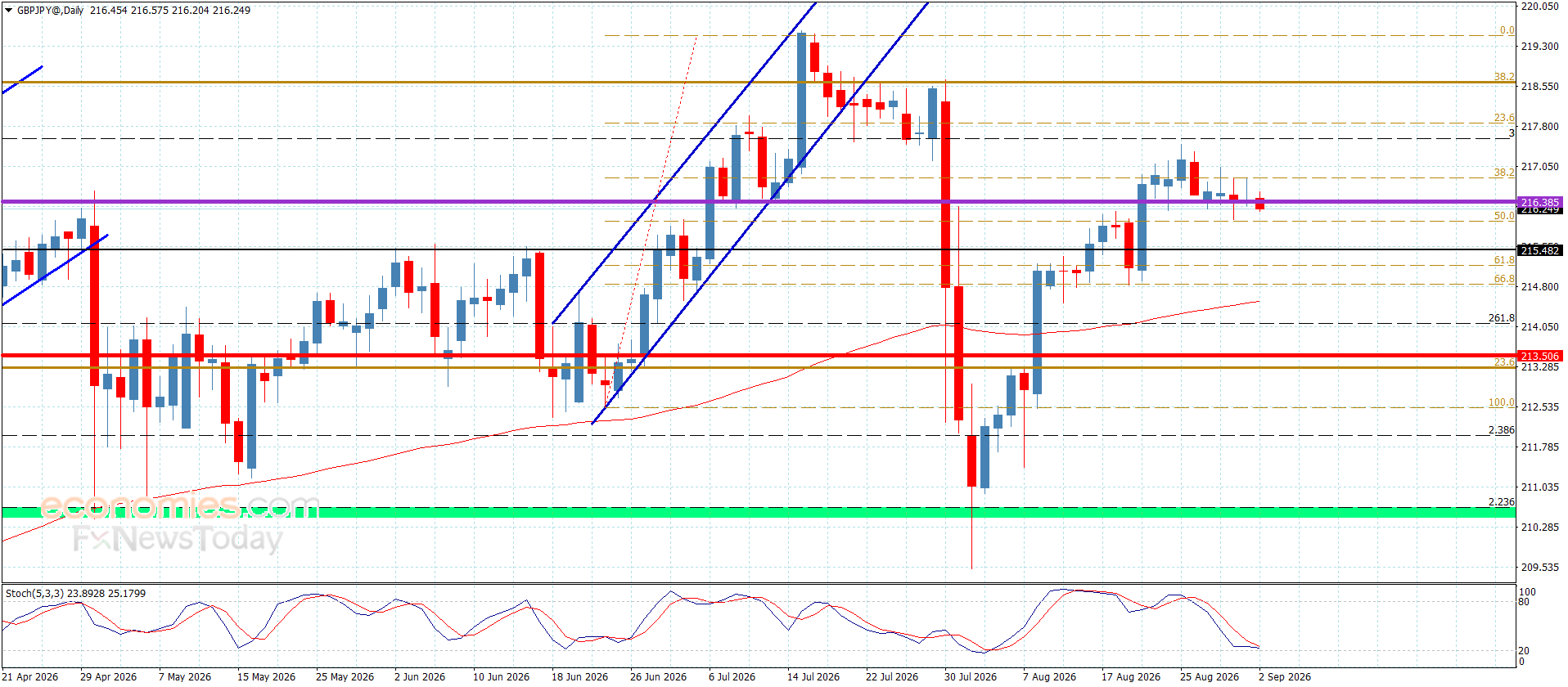
Despite the weakness in the pair’s recent trading, posting further negative closes below the 217.85 barrier supports the continuation of the previously suggested bearish corrective bias. The price has once again slipped below the 216.35 level, signaling its readiness to resume the previously proposed corrective decline.
Moreover, stochastic is providing negative momentum while stabilizing near the 20 level, reinforcing the chances of the price targeting the upcoming corrective levels around 215.55 and 214.95, respectively.
The expected trading range for today is between 214.95 and 216.50
Trend forecast: Bearish
The Platinum Group Metals Ltd stock price fell by -4.03% on the last day (Tuesday, 1st Sep 2026) from $1.49 to $1.43. It has now fallen 3 days in a row. During the last trading day the stock fluctuated 3.50% from a day low at $1.43 to a day high of $1.48. The price has fallen in 6 of the last 10 days but is still up by 0.7% over the past 2 weeks. Volume has increased on the last day by 426 thousand shares but on falling prices. This may be an early warning and the risk will be increased slightly over the next couple of days. In total, 1 million shares were bought and sold for approximately $1.51 million.
The stock lies in the middle of a very wide and weak rising trend in the short term and a further rise within the trend is signaled. Given the current short-term trend, the stock is expected to rise 2.99% during the next 3 months and, with a 90% probability hold a price between $1.30 and $1.69 at the end of this 3-month period.
The Platinum Group Metals Ltd stock holds a sell signal from the short-term Moving Average; at the same time, however, there is a buy signal from the long-term average. Since the short-term average is above the long-term average there is a general buy signal in the stock giving a positive forecast for the stock. On further gains, the stock will meet resistance from the short-term Moving Average at approximately $1.53. On a fall, the stock will find some support from the long-term average at approximately $1.42. A break-up through the short-term average will send a buy signal, whereas a breakdown through the long-term average will send a sell signal. Some negative signals were issued as well, and these may have some influence on the near short-term development. A sell signal was issued from a pivot top point on Friday, August 21, 2026, and so far it has fallen -12.80%. Further fall is indicated until a new bottom pivot has been found. Furthermore, there is currently a sell signal from the 3 month Moving Average Convergence Divergence (MACD). Volume rose on falling prices yesterday. This may be an early warning and the stock should be followed more closely.
Platinum Group Metals Ltd finds support from accumulated volume at $1.41 and this level may hold a buying opportunity as an upwards reaction can be expected when the support is being tested.
This stock has average movements during the day and with good trading volume, the risk is considered to be medium. During the last day, the stock moved $0.0500 between high and low, or 3.50%. For the last week, the stock has had daily average volatility of 5.69%.
Our recommended stop-loss:
$1.36
(-5.14%)
(This stock has medium daily movements and this gives medium risk. There is a sell signal from a pivot top found 7 days ago.)
For the upcoming trading day on Wednesday, 2nd we expect Platinum Group Metals Ltd to open at $1.45, and during the day (based on 14 day Average True Range),
to move between $1.39 and $1.47,
which gives a possible trading interval of +/-$0.0880 (+/-6.35%) up or down from last closing price.
If Platinum Group Metals Ltd takes out the full calculated possible swing range there will be an estimated 6.35% move between the lowest and the highest trading price during the day.
Since the stock is closer to the support from accumulated volume at $1.41 (1.40%)
than the resistance at $1.49 (4.20%),
our systems sees the trading risk/reward intra-day as attractive and believe profit can be made before the stock reaches first resistance..
Platinum Group Metals Ltd holds several negative signals and this should be a sell candidate, but due to the general chance for a turnaround situation it should be considered as a hold candidate (hold or accumulate) in this position whilst awaiting further development.
Current score:
0.633
Hold/Accumulate
Unchanged
Want to trade but not sure how?
Our step-by-step guide can help.
Skip the guide? Open account with our trusted broker* 
*Your capital is at risk
Silver Price Forecast: XAG/USD Holds Above Key $65.50 Support as Traders Await Direction
Silver (XAG/USD) is trading in a narrow range above the critical support level of $65.50 per ounce as of March 26, 2026, with market participants looking for fresh catalysts to determine the next directional move. The precious metal has been consolidating over the past week, caught between support at $65.50 and resistance near $67.00, as investors weigh shifting Federal Reserve rate expectations against ongoing industrial demand from the green energy sector.
Silver prices are being supported by a combination of macroeconomic and industrial factors. On the macro side, the Federal Reserve’s latest projections, released at the March meeting, indicate a slower pace of rate cuts than previously expected, which has kept the US dollar firm and limited upside for precious metals. However, silver’s dual role as both a monetary metal and an industrial input has provided a floor under prices, as global solar panel production continues to expand at a record pace, boosting demand for the metal.
Additionally, exchange-traded fund (ETF) holdings in silver have seen steady inflows over the past month, suggesting that institutional investors are viewing current levels as an attractive entry point. The latest CFTC data shows that net long positioning by managed money has increased by 4.2% from the previous week, reflecting a cautiously optimistic sentiment among speculative traders.
From a technical perspective, the $65.50 level is a confluence of multiple support factors, including the 50-day exponential moving average (EMA) and a trendline extending from the October 2025 low. A decisive break below this zone could open the door to the next support at $63.80, which is the 38.2% Fibonacci retracement of the rally from the October low to the February high. On the upside, the immediate resistance is at $67.00, followed by the psychological $70.00 mark, which has not been tested since early February.
Momentum indicators are currently neutral, with the relative strength index (RSI) hovering near 50 and the MACD showing a flat histogram. This suggests that the market is in a wait-and-see mode, and a breakout in either direction is likely to set the tone for the next leg of the trend. Volume has been relatively subdued, indicating that traders are reluctant to commit before clearer signals emerge.
The $65.50 support level is significant not only from a technical standpoint but also because it aligns with a key psychological round number that many algorithmic trading systems use as a reference point. A sustained move below this level could trigger stop-loss orders, leading to a sharp selloff, while a strong bounce would reinforce the bullish narrative. For short-term traders, this level provides a clear risk-management reference, making it a focal point for intraday strategies.
Looking ahead, the near-term direction for silver will likely be dictated by upcoming US economic data, particularly the core PCE price index due later this week and the nonfarm payrolls report scheduled for early April. Stronger-than-expected inflation or employment data could reinforce the Fed’s hawkish stance, pressuring silver prices, while any signs of economic weakness might revive expectations for rate cuts and boost the metal’s appeal as a hedge.
For longer-term investors, the structural demand story remains intact. The International Energy Agency (IEA) projects that global solar capacity will grow by 20% in 2026, which would require approximately 8,000 tonnes of silver, representing a significant portion of annual mine production. This industrial demand, combined with tight above-ground inventories, suggests that any significant pullback could be viewed as a buying opportunity by those with a multi-year horizon.
Silver is at a pivotal juncture, holding above key support at $65.50 as traders await fresh catalysts. The outcome of upcoming economic data and the Fed’s policy path will likely determine whether the metal breaks higher toward $67.00 or lower toward $63.80. For now, the market remains balanced, with technical levels providing clear guideposts for traders and fundamental drivers supporting a constructive long-term outlook.
Q1: What is the current silver price and why is $65.50 important?
As of March 26, 2026, silver (XAG/USD) is trading just above $65.50 per ounce. This level is significant because it aligns with the 50-day EMA and a trendline from the October 2025 low, making it a key support zone that traders are watching closely.
Q2: What are the main factors influencing silver prices right now?
Silver is being influenced by Federal Reserve monetary policy expectations, US dollar strength, and robust industrial demand, particularly from the solar energy sector. ETF inflows and speculative positioning also play a role in short-term price movements.
Q3: What are the next key resistance and support levels for silver?
The immediate resistance is at $67.00, followed by the psychological $70.00 level. On the downside, if $65.50 breaks, the next support is at $63.80, which corresponds to the 38.2% Fibonacci retracement of the recent rally.
This post Silver Price Forecast: XAG/USD Holds Above Key $65.50 Support as Traders Await Direction first appeared on BitcoinWorld.
Domestic coffee prices today
Coffee prices today in the domestic market have not changed compared to the previous session. According to giacaphe. com, coffee prices on September 1st averaged 95,600 VND/kg.
In Dak Lak, coffee prices were recorded at 95,500 VND/kg, down 1,000 VND/kg after a week.
In Lam Dong, coffee prices are still 95,000 VND/kg. This is the lowest level among the surveyed areas.
In Gia Lai, coffee prices are at 95,500 VND/kg, down 1,000 VND/kg compared to the same time last week.
The old Dak Nong area recorded a level of 95,700 VND/kg. This is the highest level in today’s price list.
After 1 week, the price level is still significantly lower than the area of 97,000-97,700 VND/kg recorded last week.
The USD/VND exchange rate according to Vietcombank is recorded at 25,850 VND/USD.
World coffee prices
In the world market, coffee prices fluctuate in opposite directions.
According to Barchart, the December 2026 Arabica futures contract closed down 1.35 US cents/lb, equivalent to 0.43%, to 311.50 cents/lb. Meanwhile, the September 2026 Robusta futures contract stood still, anchored at the $3,492/ton mark.
Coffee price assessment
According to AFP, Vietnam’s Central Highlands produces about 1/6 of the world’s coffee production, but many farmers are switching from this traditional crop to durian to take advantage of the increasing demand in China for the fruit dubbed the “king of fruits”.
Favored by nature with a tropical climate and fertile basalt soil, the Central Highlands produces a large amount of Robusta coffee. Vietnam is currently only behind Brazil in coffee production.
However, according to the Ministry of Agriculture and Rural Development, the area of durian cultivation in Vietnam has increased more than 5 times, to 200,000 hectares in the past decade.
Vietnam officially accessed the Chinese durian market after signing a trade protocol in 2022. By last year, Vietnam had become the largest durian supplier to China in terms of output, ending nearly 20 years of Thailand dominating this market.
Vietnam’s durian exports are forecast to reach 4 billion USD this year, a sharp increase compared to 180 million USD in 2021. Of which, 90% of the output is exported to the northern neighboring country.
However, in the Central Highlands, increasing concerns are emerging about dependence on the Chinese market, as well as the risk of oversupply as more and more farmers are running after durian trees.
Many people are worried about the recent plunge in durian prices in Malaysia, believed to be due to an unusual bumper crop in this country.
Farmers still maintain coffee area on land leased from coffee companies, thereby contributing to dispersing risks.
Geopolitical risk has once again taken centre stage in crude oil markets as we enter September. Iran and the US traded strikes in the Middle East, pushing Brent crude futures above $90 — right where they started in August.
This recent price increase highlights how quickly crude markets are responding to geopolitical developments. The path towards the psychological price of $100 seems increasingly plausible.
On 1 September, oil prices rose as renewed tensions between the US and Iran in the Middle East heightened concerns over potential supply disruptions from the world’s major crude-producing region.
Brent crude futures increased by 56 cents (0.6%) to $91.05 per barrel, while US West Texas Intermediate (WTI) crude rose by 83 cents (1%) to $86.59 per barrel.
These increases followed strong performances in the previous session, when Brent settled 2.7% higher after reaching its highest level since 25 August. WTI also advanced by 2.8% and briefly reached its highest level since 21 August.
|
Oil benchmark |
September 1, 2026 |
Recent move |
Key level to watch |
|
Brent crude |
$91.05/bbl |
+0.6% |
$100 |
|
WTI crude |
$86.59/bbl |
+1.0% |
$90–$100 |
|
Brent previous-session gain |
— |
+2.7% |
— |
|
WTI previous-session gain |
— |
+2.8% |
— |
In September, US President Donald Trump warned of additional strikes against Iran after the two countries exchanged direct attacks for the first time in a month on Sunday. This development has further escalated tensions in the ongoing conflict, which recently evolved into an economic standoff.
Meanwhile, according to shipping data from Kpler, the number of visible commodity vessels passing through the Strait of Hormuz fell to just five a day over the weekend. Efforts by mediators, including Qatar and Oman, to broker an agreement to reopen the strategic waterway have so far been unsuccessful.
Before the conflict began in late February, the Strait of Hormuz accounted for around one-fifth of global oil supplies. Iran closed the waterway after the United States and Israel launched attacks on the country on 28 February, disrupting a critical route for global energy shipments.
If traffic through the Strait of Hormuz remains severely restricted, the oil market could remain structurally tight even if global demand weakens. The longer the disruption lasts, the greater the probability that Brent will reach $100 or more.
Renewed U.S.-Iran tensions have once again brought Brent crude into the spotlight, raising concerns over the global oil supply. The key question for investors is whether this latest rally can push Brent back above the important psychological threshold of $100 per barrel. The answer is yes, but whether $100 becomes a temporary spike or a sustainable trading level will depend on the duration of the geopolitical disruption.
The strongest bullish catalyst is currently geopolitical supply disruption. The Strait of Hormuz is particularly important as it is a major transit route for global oil flows. According to EIA data, Brent climbed as high as $105 per barrel on 23 July 2026 following renewed tanker attacks and restrictions on shipments through the waterway.
Another bullish factor is the decline in global oil inventories. The IEA reported that global oil supply remained substantially below pre-war levels and that continued disruption to Middle Eastern production and transportation had reduced the 2026 supply outlook.
This creates a scenario in which Brent could quickly return to $100 if physical supply losses accelerate. $100 is now a realistic upside scenario rather than a certain outcome. Before the market could establish a convincing path towards the psychological $100 threshold, Brent would likely need to break and hold above $95.
|
Brent forecast |
Probability |
Implication |
Key driver |
|
Bear case |
$75–$85 |
Lower |
Ceasefire + reopening of Hormuz |
|
Base case |
$85–$95 |
Moderate |
Persistent disruption but partial flows |
|
Bull case |
$95–$110 |
Rising |
Prolonged shipping restrictions |
|
Extreme upside |
$110–$120 |
Low |
Major infrastructure/export disruption |
Prolonged supply disruptions in the Middle East have kept the outlook for crude oil prices elevated. However, market forecasts remain significantly more conservative than the current geopolitical risk premium.
According to a Reuters poll, analysts have maintained forecasts for oil prices above $80 a barrel in 2026, as shipping disruptions linked to the U.S.-Iran conflict drive expectations of reduced supplies, while weak demand in China limits the upside.
In an August survey, 31 economists and analysts predicted an average Brent crude price of $85.08 per barrel and an average U.S. crude price of $80.20 per barrel in 2026, which is roughly in line with July’s forecasts of $85.22 and $80.14, respectively.
TA Securities increased its forecast for the price of Brent crude to US$90 per barrel in 2026, stating that prices could surpass US$100 per barrel in the event of a more severe escalation that disrupts regional oil production or the flow of oil through the Strait of Hormuz.
The research firm maintained its ‘neutral’ outlook on the oil and gas sector, stating that stronger upstream and gas earnings were offset by downstream losses and uncertainty regarding the sustainability of elevated oil prices.
The oil market enters September with an unusually powerful combination of geopolitical and fundamental risks. $100 Brent is achievable, but it is not yet the most likely sustained price level. The next major signal for traders will be whether Brent can decisively break $95 while physical supply disruptions continue. If that happens alongside further inventory draws and worsening tensions around Hormuz, $100–$120 becomes a realistic upside zone. Conversely, a durable ceasefire and reopening of key shipping routes could quickly remove the geopolitical premium and send crude back toward the $75–$85 range.
1. Can oil prices reach $100 per barrel again?
Yes. Brent crude could retest $100 per barrel if U.S.-Iran tensions escalate further, shipping through the Strait of Hormuz remains severely restricted, or major Middle Eastern oil infrastructure is disrupted. Brent was recently trading around $91 per barrel, leaving it roughly 10% below the $100 threshold.
2. Why is oil rising amid Middle East tensions?
The latest rally is primarily driven by concerns about potential disruptions to crude production and transportation, particularly around the Strait of Hormuz. Reuters reported that renewed U.S.-Iran hostilities have revived fears that oil flows through the strategic waterway could remain constrained.
4. Why is the Strait of Hormuz so important for oil prices?
The Strait of Hormuz is one of the world’s most important oil chokepoints and historically handled approximately one-fifth of global oil flows. Any prolonged disruption can tighten physical supply and increase the geopolitical risk premium embedded in crude prices.
5. What could push Brent crude above $100?
The most important bullish catalysts include a prolonged Hormuz disruption, attacks on Middle Eastern energy infrastructure, declining global inventories, and further reductions in Gulf oil exports. A sustained supply shortage would make a move above $100 more likely.
6. What could prevent oil from reaching $100?
A durable U.S.-Iran ceasefire, restoration of Hormuz shipping, recovery of Middle Eastern production and weaker global oil demand could limit the upside. EIA currently expects Brent to average around $85 per barrel in Q3 2026 and gradually decline as production recovers.
Gold Price Forecast: XAU/USD Slips Below $4,400 as Fed Hawkish Repricing Boosts Dollar
Gold price (XAU/USD) has extended its reversal below the $4,400 mark, pressured by a hawkish repricing of Federal Reserve interest rate expectations that has strengthened the US Dollar and pushed Treasury yields higher. As of the latest trading session, spot gold is trading around $4,380, down from recent highs, as markets adjust to the possibility of prolonged higher borrowing costs.
The primary driver behind gold’s decline is the market’s reassessment of the Federal Reserve’s monetary policy path. Recent comments from Fed officials, coupled with resilient economic data, have led traders to trim bets on early rate cuts, boosting the US Dollar and diminishing the appeal of non-yielding assets like gold. The 10-year Treasury yield has climbed to multi-week highs, increasing the opportunity cost of holding bullion.
The Federal Reserve’s stance remains data-dependent, but the market now prices in a higher peak rate and a slower pace of cuts than previously anticipated. This shift has been reflected in the dollar index, which has rallied to a two-month high, directly pressuring gold. According to the CME FedWatch Tool, the probability of a rate cut in March has fallen below 30%, down from over 50% a month ago.
For investors, the current environment suggests that gold may face headwinds in the near term. However, analysts note that physical demand from central banks and safe-haven buying amid geopolitical uncertainties could provide a floor. The key support level to watch is $4,350, while resistance sits at $4,420.
From a technical perspective, gold has broken below its 50-day moving average, signaling further downside potential. The Relative Strength Index (RSI) is hovering near 45, indicating bearish momentum but not yet oversold. If the $4,350 support holds, a rebound toward $4,400 is possible; otherwise, the next target could be $4,280.
Gold’s reversal below $4,400 reflects a broader market shift toward a more hawkish Fed outlook, strengthening the dollar and yields. While the near-term bias remains bearish, underlying demand and geopolitical risks could limit losses. Traders should monitor upcoming US economic data and Fed speeches for further direction.
Q1: What is the current gold price forecast?
As of the latest data, gold is trading around $4,380, with a bearish bias as long as it stays below $4,400. Key support is at $4,350, and resistance is at $4,420.
Q2: How does Federal Reserve policy affect gold prices?
Gold is sensitive to interest rate expectations. When the Fed signals higher rates for longer, the dollar strengthens and yields rise, making gold less attractive and typically pushing prices lower.
Q3: What are the key levels to watch in XAU/USD?
Immediate support is at $4,350, followed by $4,280. On the upside, resistance is at $4,400 and then $4,420. A break above $4,420 could signal a reversal of the current downtrend.
This post Gold Price Forecast: XAU/USD Slips Below $4,400 as Fed Hawkish Repricing Boosts Dollar first appeared on BitcoinWorld.
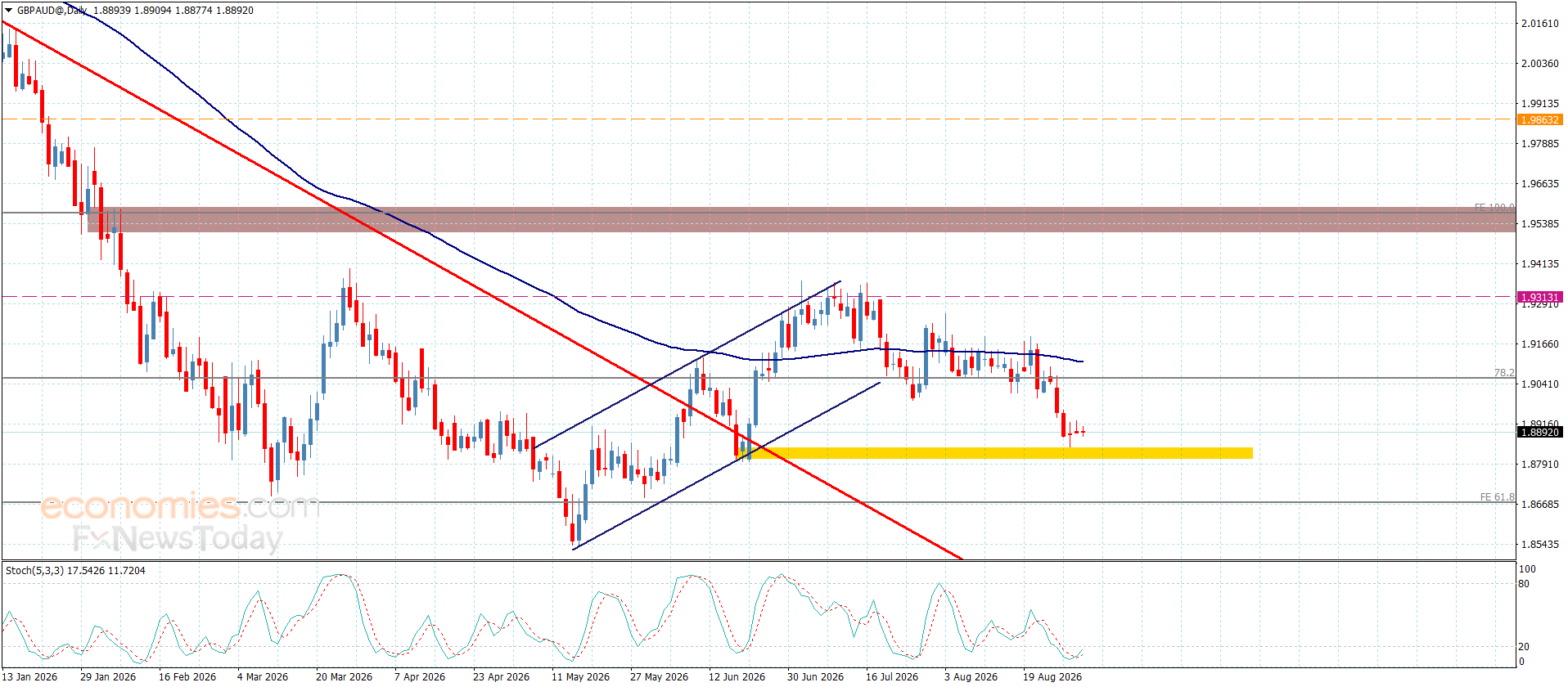
The GBPAUD pair confirmed its ability to withstand negative pressure by posting another positive close above the support level at 1.8815. The pair is currently forming a temporary sideways fluctuation, stabilizing near 1.8890.
stochastic’ attempt to exit oversold territory will give the price a real opportunity to regain positive momentum, making it easier to form bullish waves and begin recording further gains, with the pair expected to advance soon toward 1.8950 and 1.9030.
The expected trading range for today is between 1.8860 and 1.8950
Trend forecast: Bullish
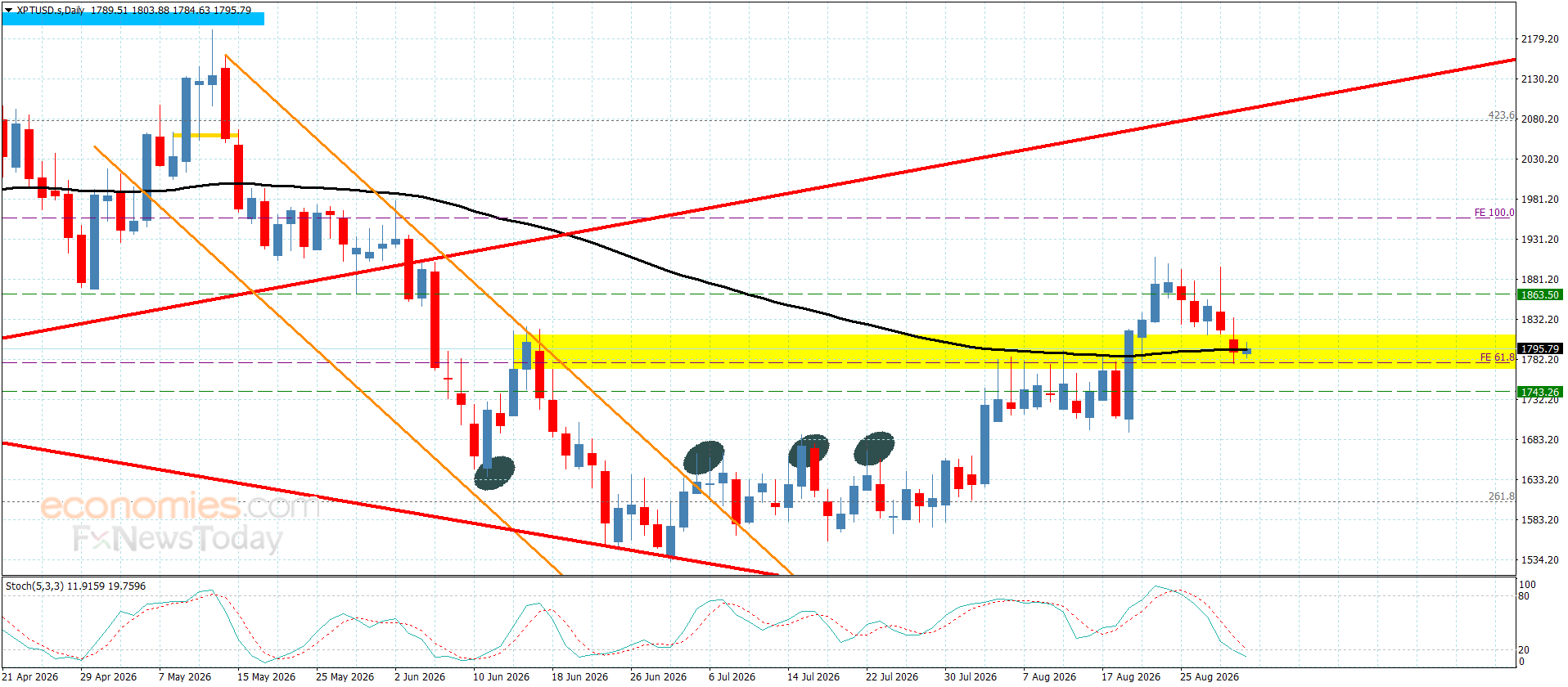
Despite facing negative pressures and suffering some losses by Platinum price reaching $1777.00, it didn’t affect the main bullish trend, depending on its stability above the main support level near $1695.00.
The price needs to gain a new bullish momentum to help it renew the bullish attempts, to expect an attempt to rally towards $1830.00, then attempting to surpass the additional barrier at $1870.00, to confirm its readiness to form extra bullish waves in the upcoming period.
The expected trading range for today is between $1750.00 and $1830.00
Trend forecast: fluctuating within the bullish path