The main tag of Gold Price Articles.
You can use the search box below to find what you need.
[wd_asp id=1]
The main tag of Gold Price Articles.
You can use the search box below to find what you need.
[wd_asp id=1]
Gold (XAU/USD) trades practically flat for the second consecutive day on Friday, with the rejection from three-month highs near $4,700 hit earlier in the week contained at a previous resistance area, just below $4,600. Market volatility remains subdued on Friday, with investors focusing on Federal Reserve Chairman Kevin Warsh’s speech at the Jackson Hole Symposium, due later in the day.
Investors expect Warsh to overcome his distaste for forward guidance and show some hints about the central bank’s near-term policy plans to tame price pressures, amid calls for interest rate hikes from board members.
On Thursday, Kansas Fed President Jeffrey Schmidt said on CNBC that inflation is “still sticky and we’ve got to continue to find ways to break through”, Later on the day, Cleveland Fed President Beth Hammack reiterated that it is “time to act” to bring inflation back to target.
XAU/USD trades at $4,599 with the broader bullish stance in play as spot price holds well above the 200-day Simple Moving Average (SMA), now around $4,525. Momentum indicators in the daily chart endorse the bullish view, with the Relative Strength Index (RSI) at 66.48 after pulling back from overbought extremes, and the Moving Average Convergence Divergence (MACD) holding within positive territory.
Bears remain contained above late-May highs in the $4,590 area so far, closing the path to the mentioned 200-day SMA at $4,527. Below there, the next downside target would be the August 13 high and August 20 low, at the $4,450 area.
Upside attempts remain capped ahead of the $4,700 level (Tuesday’s high), ahead of the May 12 high at $4,773 and April’s peak, near $4,900.
(The technical analysis of this story was written with the help of an AI tool. Know more.)
Gold has played a key role in human’s history as it has been widely used as a store of value and medium of exchange. Currently, apart from its shine and usage for jewelry, the precious metal is widely seen as a safe-haven asset, meaning that it is considered a good investment during turbulent times. Gold is also widely seen as a hedge against inflation and against depreciating currencies as it doesn’t rely on any specific issuer or government.
Central banks are the biggest Gold holders. In their aim to support their currencies in turbulent times, central banks tend to diversify their reserves and buy Gold to improve the perceived strength of the economy and the currency. High Gold reserves can be a source of trust for a country’s solvency. Central banks added 1,136 tonnes of Gold worth around $70 billion to their reserves in 2022, according to data from the World Gold Council. This is the highest yearly purchase since records began. Central banks from emerging economies such as China, India and Turkey are quickly increasing their Gold reserves.
Gold has an inverse correlation with the US Dollar and US Treasuries, which are both major reserve and safe-haven assets. When the Dollar depreciates, Gold tends to rise, enabling investors and central banks to diversify their assets in turbulent times. Gold is also inversely correlated with risk assets. A rally in the stock market tends to weaken Gold price, while sell-offs in riskier markets tend to favor the precious metal.
The price can move due to a wide range of factors. Geopolitical instability or fears of a deep recession can quickly make Gold price escalate due to its safe-haven status. As a yield-less asset, Gold tends to rise with lower interest rates, while higher cost of money usually weighs down on the yellow metal. Still, most moves depend on how the US Dollar (USD) behaves as the asset is priced in dollars (XAU/USD). A strong Dollar tends to keep the price of Gold controlled, whereas a weaker Dollar is likely to push Gold prices up.
Silver Price Forecast: XAG/USD Dips Below $69.00 as Fed Chair Speech Looms
Silver (XAG/USD) slipped below the $69.00 mark during early trading on [Date], as market participants turned cautious ahead of the Federal Reserve Chair’s highly anticipated speech. The precious metal’s decline reflects a broader wait-and-see stance among investors, who are seeking clarity on the future path of U.S. interest rates.
The pullback in silver prices comes as Treasury yields and the U.S. dollar show resilience, driven by expectations that the Fed may maintain a hawkish stance. Higher interest rates typically increase the opportunity cost of holding non-yielding assets like silver, putting downward pressure on prices. As of [Date], XAG/USD was trading at approximately $68.85, down from recent highs above $70.00.
Investors are closely monitoring the Fed Chair’s remarks for any signals regarding the timing of future rate cuts or hikes. The speech, scheduled for [Time] ET, is expected to provide insights into the central bank’s assessment of inflation and economic growth. A hawkish tone could further strengthen the dollar and weigh on silver, while a dovish surprise might trigger a rebound.
From a technical perspective, silver’s immediate support is seen at the $68.50 level, followed by the $68.00 psychological mark. On the upside, resistance is noted at $69.50 and then $70.00. A break above $70.00 could open the door for further gains, while a sustained move below $68.00 might signal deeper correction.
The silver market remains sensitive to global economic data, industrial demand, and geopolitical developments. With the Fed’s policy path uncertain, volatility is likely to persist. Additionally, silver’s dual role as both a precious and industrial metal means that economic growth expectations also play a crucial role in its price dynamics.
Silver’s dip below $69.00 underscores the market’s nervousness ahead of the Fed Chair’s speech. Traders should brace for potential volatility, with key support and resistance levels likely to guide short-term movements. The outcome of the speech will be pivotal in determining whether silver can regain its footing or extend its decline.
Q1: What is driving the silver price today?
The immediate driver is the market’s anticipation of the Fed Chair’s speech, which could signal future interest rate decisions. A stronger dollar and higher yields are also pressuring silver.
Q2: What are the key support and resistance levels for silver?
Immediate support is at $68.50, with stronger support near $68.00. Resistance is at $69.50 and $70.00. A break above $70.00 could trigger further upside.
Q3: How does the Fed’s policy affect silver prices?
Higher interest rates increase the opportunity cost of holding non-yielding assets like silver, typically leading to lower prices. Conversely, expectations of rate cuts can boost silver.
This post Silver Price Forecast: XAG/USD Dips Below $69.00 as Fed Chair Speech Looms first appeared on BitcoinWorld.
At 6:30 a.m. Eastern Time today, oil was priced at $90.55 per barrel with Brent serving as the benchmark (we’ll explain different benchmarks later in this article). That’s a gain of 87 cents compared with yesterday morning and around $22.34 higher than the price one year ago.
It’s impossible to forecast oil prices with detailed precision. Many different elements affect the market, but ultimately it boils down to supply and demand. When worries about economic recession, war, and other large-scale disruptions increase, oil’s path can shift fast.
Gas prices at the pump don’t only track crude oil. They also include what it takes to refine and move that fuel, the taxes layered on top, and the extra markup your local station adds to stay in business.
Since crude oil generally makes up a majority of the per-gallon cost, changes in its price have an outsized impact. When oil surges, gas prices typically rise in tandem. But when oil retreats, gas prices often lag on the way down, a trend sometimes described as “rockets and feathers.”
In case of emergency, the U.S. has a store of crude oil known as the Strategic Petroleum Reserve. Its primary purpose is energy security in case of disaster (think sanctions, severe storm damage, even war). But it can also go a long way toward softening crippling price hikes during supply shocks.
It’s not a long-term answer and is more meant to provide temporary relief, assisting consumers and keeping critical parts of the economy running, like key industries, emergency services, public transportation, etc.
Both oil and natural gas are key sources of the energy we use every day. Because of this, a big change in oil prices can affect natural gas. For example, if oil prices increase, some industries may swap natural gas for some segments of their operations where possible, which increases demand for natural gas.
To gauge oil’s performance, we often turn to two benchmarks:
Between these two, Brent better represents global oil performance because it prices much of the world’s traded crude. And, it’s often the best way to track historical oil performance. In fact, even the U.S. Energy Information Administration now uses Brent as its primary reference in its Annual Energy Outlook.
Looking at the Brent benchmark across several decades, oil has been anything but steady. It’s seen spikes due to factors such as wars and supply cuts, and it’s also seen crashes from global recessions and an oversupply (called a “glut”). For example:
All to say, oil’s historical performance has been anything but smooth. Again, it’s hugely affected by wars, recessions, OPEC whims, evolving energy initiatives and policies, and much more.
Looking to stay up-to-date regarding the latest energy developments? Check out our recent coverage:
The current price of oil per barrel depends largely on supply and demand, including news about potential future supply and demand (geopolitics, decisions made by OPEC+, etc.). In the U.S., prices also move based on how friendly an administration is to drilling, as it can affect future supply. For example, 2025 saw the Trump administration move to reopen more than 1.5 million acres in the Coastal Plain of the Arctic National Wildlife Refuge for oil and gas leasing, reversing the Biden administration’s policy of limiting oil drilling in the Arctic.
The price of oil updates constantly when the “futures” markets are open. A futures market is effectively an auction where people agree to buy or sell oil in the future. As long as people and companies are trading contracts, the oil price is changing.
In short, shale is rock that contains oil and natural gas. Think of shale as energy yet to be tapped. The more shale the U.S. accesses, the more energy we’ll have—and the more easily oil prices can keep from spiking as much thanks to a greater supply.
When oil is expensive, it tends to make everyday items cost more. This can be related to energy (your heating, gas utilities, etc.), but it’s also due to the logistics involved with making those items accessible to you. Shipping, for example, can affect the price of things at the grocery store, as it’s more expensive to get those products from warehouses and farms onto the shelf.
Gold (XAU/USD) extends its gains for the second successive day, trading around $4,610 during the European hours on Friday. The price of the precious metal is remaining within the ascending channel pattern, suggesting a persistent bullish bias.
The XAU/USD pair is retaining a constructive bullish bias as spot holds above both the nine-period and 50-period Exponential Moving Averages (EMAs), keeping the short- and medium-term trends aligned to the upside. The 14-day Relative Strength Index (RSI) stands around 67, hovering in bullish territory but shy of extreme overbought conditions, which suggests upside momentum is still dominant though increasingly stretched.
Gold price may rise toward the three-month high of $4,697.07, reached on August 25. A break above this level would open the doors for the XAU/USD pair to reach the upper boundary of the ascending channel around $4,850.00.
On the downside, the immediate support appears at the nine-day EMA of $4,557.72, followed by the lower boundary of the ascending channel around $4,500. A break below this confluence support zone would weaken the bullish bias and put downward pressure on the Gold price to test the 50-day EMA at $4,336.84, followed by the three-week low of $4311.04, which was recorded on August 14.
Analysts at Deutsche Bank highlight a firmer backdrop in rates and commodities, noting that the “10y US Real Yield @ 2.34 // 2 bp” and “10y US Breakevens @ 2.33 // 1 bp” both edged higher, alongside a rise in “10y German Breakeven @ 2.13 // 2 bp.” Credit markets were broadly steady, with “iTraxx Europe 125 @ 51 // unch,” “CDX 125 @ 50 // unch,” and “CDX EM @ 98.4 // unch,” while financial indices were little moved as “iTraxx Sen Fin @ 54 // unch” and “iTraxx Sub Fin @ 87 // +1” showed only marginal shifts. In commodities and FX, Deutsche Bank points to “WTI Oil^ @ 83.13 // +1.94%” and a slightly softer Euro as “EUR/USD^ @ 1.165 // -0.10%.” Equity sentiment in Asia was constructive, with the “NIKKEI @ 66624 // +0.74%” and “Hang Seng @ 25685 // +0.47%,” while volatility eased as the “VIX @ 14.51 // -0.70” slipped further. Against this backdrop of rising real yields and stronger Oil, the bank notes that “Gold^ @ 4579 // -0.85%” came under pressure.
(The technical analysis of this story was written with the help of an AI tool. Know more.)
Gold has played a key role in human’s history as it has been widely used as a store of value and medium of exchange. Currently, apart from its shine and usage for jewelry, the precious metal is widely seen as a safe-haven asset, meaning that it is considered a good investment during turbulent times. Gold is also widely seen as a hedge against inflation and against depreciating currencies as it doesn’t rely on any specific issuer or government.
Central banks are the biggest Gold holders. In their aim to support their currencies in turbulent times, central banks tend to diversify their reserves and buy Gold to improve the perceived strength of the economy and the currency. High Gold reserves can be a source of trust for a country’s solvency. Central banks added 1,136 tonnes of Gold worth around $70 billion to their reserves in 2022, according to data from the World Gold Council. This is the highest yearly purchase since records began. Central banks from emerging economies such as China, India and Turkey are quickly increasing their Gold reserves.
Gold has an inverse correlation with the US Dollar and US Treasuries, which are both major reserve and safe-haven assets. When the Dollar depreciates, Gold tends to rise, enabling investors and central banks to diversify their assets in turbulent times. Gold is also inversely correlated with risk assets. A rally in the stock market tends to weaken Gold price, while sell-offs in riskier markets tend to favor the precious metal.
The price can move due to a wide range of factors. Geopolitical instability or fears of a deep recession can quickly make Gold price escalate due to its safe-haven status. As a yield-less asset, Gold tends to rise with lower interest rates, while higher cost of money usually weighs down on the yellow metal. Still, most moves depend on how the US Dollar (USD) behaves as the asset is priced in dollars (XAU/USD). A strong Dollar tends to keep the price of Gold controlled, whereas a weaker Dollar is likely to push Gold prices up.
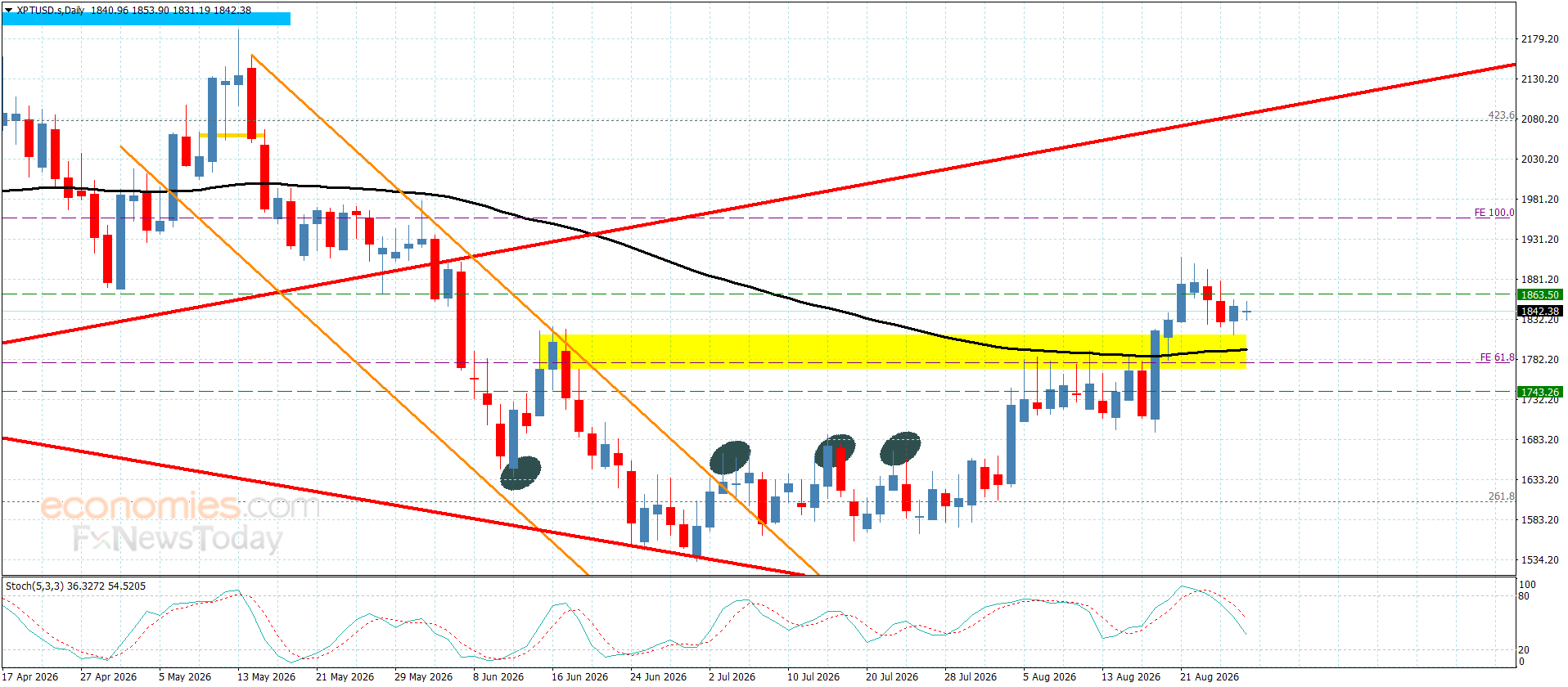
No news for Platinum price as it forms sideways trading and its stability near $1840.00 level, surrendering to the contradiction of the main indicators temporarily, noticing the price attempt to rise above the support level at $1780.00 to increase the chances of gathering positive momentum, to begin forming bullish waves to target $1875.00 level, repeating the pressure on $1905.00 to find an exit for recording new gains in the near and medium period.
The expected trading range for today is between $1820.00 and $1875.00
Trend forecast: fluctuated within the bullish trend
Gold is back in the red below $4,600 early Friday, resuming its corrective decline from 15-week highs of $4,697 earlier this week.
Gold bulls are consolidating the upside, awaiting Federal Reserve (Fed) Chairman Kevin Warsh’s debut at the annual Jackson Hole Symposium.
In doing so, traders are continuing to take profits off the table, following the recent surge to over three-month highs. They keenly await Warsh’s words for fresh hints on whether an interest rate hike remains a possibility at the Fed’s September 16-17 monetary policy meeting.
Despite hot US core Personal Consumption Expenditures (PCE) Price Index data for July, the CME Group’s FedWatch Tool shows the market keeps pricing in a roughly 65% probability that the Fed will keep rates on hold next month.
The headline PCE Price Index increased 0.2% for the month, putting the annual inflation rate at 3.7%, the Commerce Department reported Wednesday. The market forecast was for 0.1% and 3.6%, respectively. Meanwhile, core PCE posted gains of 0.2% and 3.3%, in line with forecasts.
Fading hopes for a September Fed rate hike and the optimism over a potential reopening of the Strait of Hormuz keep the US Dollar (USD) recovery in check, limiting any downside in Gold.
However, Gold’s next major move remains at the mercy of the new Fed Chairman, with markets expecting Kevin Warsh to signal a roadmap for fighting inflation while not just sticking to his rhetoric of watching incoming economic data and restoring price stability.
If Warsh disappoints by offering no hints on the path forward for interest rates or fails to address the recent developments around bond markets, that is unlikely to go down with US Dollar traders. In such a scenario, Gold could see a fresh leg north.
That said, any reaction could be short-lived as attention would quickly turn to next week’s US Nonfarm Payrolls data.
In the daily chart, XAU/USD trades at $4,579.57, holding a clear bullish bias as price stands above the 21-day, 50-day, 100-day and 200-day simple moving averages (SMAs), which all trail beneath the market and reinforce a well-supported uptrend. The Relative Strength Index (14) at 64.55 is in bullish territory but shy of overbought conditions, suggesting positive momentum that still leaves room for further upside before excessive froth becomes a concern.
On the downside, initial support is aligned with the 200-day SMA near $4,527.73, followed by a medium-term demand zone around the 21-day SMA at $4,399.08 and the 100-day SMA at $4,374.69, while the 50-day SMA at $4,208.94 marks a deeper trend-supportive floor. With no nearby technical resistance levels overhead in this dataset, the path of least resistance remains to the upside as long as XAU/USD continues to trade above these stacked moving averages.
(The technical analysis of this story was written with the help of an AI tool. Know more.)
According to TD Securities, Commodity Trading Advisors “remain comfortable with their long positions in gold heading into Jackson Hole,” reflecting a constructive backdrop for the metal. The bank cautions that “a more hawkish tone from Fed Chair Warsh would be a catalyst for some reversal in the yellow metal,” but argues that “the bar is likely high to reverse the improved sentiment in precious metals.” Beyond the Fed’s “willingness to look past an energy-driven inflation shock,” TD Securities highlights that “the re-ignition of the dollar debasement theme has also fueled renewed macro discretionary appetite in precious metals.”
Monetary policy in the US is shaped by the Federal Reserve (Fed). The Fed has two mandates: to achieve price stability and foster full employment. Its primary tool to achieve these goals is by adjusting interest rates.
When prices are rising too quickly and inflation is above the Fed’s 2% target, it raises interest rates, increasing borrowing costs throughout the economy. This results in a stronger US Dollar (USD) as it makes the US a more attractive place for international investors to park their money.
When inflation falls below 2% or the Unemployment Rate is too high, the Fed may lower interest rates to encourage borrowing, which weighs on the Greenback.
The Federal Reserve (Fed) holds eight policy meetings a year, where the Federal Open Market Committee (FOMC) assesses economic conditions and makes monetary policy decisions.
The FOMC is attended by twelve Fed officials – the seven members of the Board of Governors, the president of the Federal Reserve Bank of New York, and four of the remaining eleven regional Reserve Bank presidents, who serve one-year terms on a rotating basis.
In extreme situations, the Federal Reserve may resort to a policy named Quantitative Easing (QE). QE is the process by which the Fed substantially increases the flow of credit in a stuck financial system.
It is a non-standard policy measure used during crises or when inflation is extremely low. It was the Fed’s weapon of choice during the Great Financial Crisis in 2008. It involves the Fed printing more Dollars and using them to buy high grade bonds from financial institutions. QE usually weakens the US Dollar.
Quantitative tightening (QT) is the reverse process of QE, whereby the Federal Reserve stops buying bonds from financial institutions and does not reinvest the principal from the bonds it holds maturing, to purchase new bonds. It is usually positive for the value of the US Dollar.
Silver Price Forecast: XAG/USD Stays Bullish, Dips Capped Above $67.40
Silver (XAG/USD) maintains a bullish technical posture, with downside moves finding support above the $67.40 level, according to the latest market analysis. As of [current date], the precious metal continues to trade within an upward channel, supported by a combination of technical factors and broader market sentiment.
The $67.40 level has emerged as a critical short-term support zone, capping any pullback attempts. This level aligns with the recent consolidation range and represents a pivot point for traders monitoring the pair. On the upside, resistance is seen near recent highs, with a break above that level potentially opening the door for further gains.
Technical indicators, including moving averages and momentum oscillators, remain supportive of the bullish bias. The 50-day and 200-day moving averages are trending higher, reflecting sustained buying interest. Additionally, the Relative Strength Index (RSI) is hovering in bullish territory without being overbought, suggesting room for continued upside.
The bullish outlook for silver is underpinned by a combination of factors, including a softer U.S. dollar, expectations of a more accommodative Federal Reserve, and robust industrial demand. Silver’s dual role as both a precious and industrial metal makes it sensitive to shifts in economic growth and monetary policy.
Recent U.S. economic data has shown signs of cooling inflation, which has fueled speculation that the Fed may begin cutting interest rates later this year. Lower interest rates typically reduce the opportunity cost of holding non-yielding assets like silver, making it more attractive to investors. Additionally, the greenback’s weakness has provided a tailwind for dollar-denominated commodities.
On the supply side, mine production has faced disruptions in key producing regions, while industrial demand—particularly from the solar panel and electronics sectors—remains strong. This supply-demand imbalance adds a fundamental layer to the technical bullish case.
Analysts note that silver’s outlook is also tied to global economic recovery prospects. If growth accelerates, industrial consumption could rise, further supporting prices. Conversely, a sharper-than-expected economic slowdown could dampen demand and pressure prices, although the current technical setup suggests buyers remain in control.
For traders and investors, the $67.40 level is a key line in the sand. As long as silver holds above this support, the short-term bias stays constructive. A daily close below this level would signal a potential shift in momentum and could trigger a deeper correction. Conversely, a sustained move above the next resistance zone would reinforce the bullish trend and could attract additional buying.
As with any market, risk management remains crucial. Stop-loss orders below key support levels and position sizing based on individual risk tolerance are prudent strategies. Market participants should also stay attuned to upcoming economic data releases and central bank communications, which could influence the next directional move.
Silver’s technical picture remains bullish, with dips above $67.40 being bought. The combination of supportive technicals, a softer dollar, and strong industrial demand underpins the positive outlook. However, traders should remain vigilant, as a break below the key support could alter the near-term bias. Monitoring these levels and broader market catalysts will be essential for navigating the precious metals market in the coming sessions.
Q1: What is the significance of the $67.40 level for silver?
The $67.40 level acts as a key short-term support zone. As long as silver holds above it, the bullish technical structure remains intact. A break below could signal a potential trend reversal.
Q2: Why is silver considered bullish despite recent price fluctuations?
The bullish bias is supported by a combination of technical indicators, a weaker U.S. dollar, expectations of Fed rate cuts, and strong industrial demand. These factors collectively favor higher silver prices.
Q3: What are the main risks to the silver price outlook?
The primary risks include a stronger-than-expected U.S. dollar, a more hawkish Federal Reserve, or a sharp global economic slowdown that could reduce industrial demand. A daily close below $67.40 would also be a technical warning sign.
This post Silver Price Forecast: XAG/USD Stays Bullish, Dips Capped Above $67.40 first appeared on BitcoinWorld.
Domestic coffee prices today
Coffee prices today in the domestic market continue to decrease in key areas. According to giacaphe. com, coffee prices on August 27 averaged 96,300 VND/kg, down 800 VND/kg compared to the previous session.
In Dak Lak, coffee prices were recorded at 96. 200 VND/kg, down 800 VND/kg.
In Lam Dong, coffee prices reached 95,770 VND/kg, down 800 VND/kg. This is the lowest level among the surveyed areas.
In Gia Lai, coffee prices are at 96. 200 VND/kg, down 800 VND/kg.
The old Dak Nong area recorded a level of 96,500 VND/kg, down 700 VND/kg. This is the highest level in today’s price list.
After two consecutive declining sessions, the price level has left the area of 98,000 VND/kg and returned close to the area of 96,000 VND/kg.
The USD/VND exchange rate according to Vietcombank was recorded at 25,880 VND/USD, down 10 VND.
World coffee prices
In the world market, coffee prices fell sharply in the most recent session.
According to Barchart, the December 2026 Arabica futures contract closed the session on August 26 down 13.35 US cents/lb, equivalent to 3.98%. In the same session, the November 2026 Robusta futures contract fell 77 USD/ton, equivalent to 2.09%. Coffee prices accordingly fell to the lowest level in about 1 week.
Barchart said coffee prices fell due to increased supply prospects from Brazil, leading to sell-offs in the futures market. Some warehouses in Brazil no longer receive new coffee due to shrinking storage space, increasing expectations that farmers may have to sell more goods to the market.
Coffee price assessment
Domestic coffee prices decreased by 700-800 VND/kg in the context of world prices also going down. After a decrease of 500 VND/kg on August 26, the market continued to lose another 800 VND/kg in the August 27, showing that adjustment pressure has not stopped.
According to Barchart, Robusta is also under pressure as Robusta inventory certified on ICE increased to a 9-month high. In the opposite direction, Arabica inventory certified on ICE is still low, but this factor is not enough to stop the decline of Arabica prices in the recent session.
Domestically, according to the Ministry of Agriculture and Environment, in July, Vietnam exported about 147,600 tons of coffee, worth 639.5 million USD. Accumulated in the first 7 months of the year, coffee exports reached about 1.2 million tons, an increase of 10.8% in volume but turnover decreased by 11.2%, to 5.45 billion USD. This development is mainly due to the average export price decreasing by 19.9% compared to the same period, down to 4,537 USD/ton.
Regarding the weather, the National Center for Hydro-Meteorological Forecasting said that on the day and night of August 27, the Central Highlands area will be cloudy, with showers and thunderstorms in some places; especially in the late afternoon and evening, there will be scattered showers and thunderstorms in some places. In thunderstorms, there is a possibility of tornadoes, lightning and strong gusts of wind.
Gold (XAU/USD) is giving away the mild recovery seen during Thursday’s Asian session and pulls back below $4,600 during the European morning, as the US Dollar Index (DXY) consolidates above 99.00. A cautious market sentiment ahead of the Jackson Hole symposium and the hot US inflation figures seen on Wednesday have provided some support to the US Dollar and are keeping precious metals’ rallies limited.
US data released on Wednesday revealed that the Personal Consumption Expenditures (PCE) Price Index, the Federal Reserve’s (Fed) inflation gauge of choice, remained steady well above the 2% target, adding pressure on the central bank to tighten its monetary policy. Bets for a September rate hike, however, remained practically unchanged, at 36%, according to figures released by the CME Group’s FedWatch Tool.
XAU/USD trades at $4,595, after rejection at the $4.700 area earlier in the week, although the near-term bias remains bullish while above the 200-day Simple Moving Average (SMA). Momentum indicators in the daily chart are well within positive territory, with the Relative Strength Index (14) down to 66, after reaching overbought levels, and the Moving Average Convergence Divergence (MACD) indicator retreating but still above zero, hinting at a moderating bullish momentum rather than a bearish reversal.
Immediate support emerges at Wednesday’s low of $4,583, ahead of the aforementioned 200-day SMA, a very popular indicator for FX traders, which now lies at $4,525. A confirmation below here would give fresh hopes for bears, and would expose the August 20 low near $4,450 and the August 14 low, near $4,310.
On the upside, resistance is at Tuesday’s high near the $4,700 level and the May 12 high, near $4,775.
(The technical analysis of this story was written with the help of an AI tool. Know more.)
Gold has played a key role in human’s history as it has been widely used as a store of value and medium of exchange. Currently, apart from its shine and usage for jewelry, the precious metal is widely seen as a safe-haven asset, meaning that it is considered a good investment during turbulent times. Gold is also widely seen as a hedge against inflation and against depreciating currencies as it doesn’t rely on any specific issuer or government.
Central banks are the biggest Gold holders. In their aim to support their currencies in turbulent times, central banks tend to diversify their reserves and buy Gold to improve the perceived strength of the economy and the currency. High Gold reserves can be a source of trust for a country’s solvency. Central banks added 1,136 tonnes of Gold worth around $70 billion to their reserves in 2022, according to data from the World Gold Council. This is the highest yearly purchase since records began. Central banks from emerging economies such as China, India and Turkey are quickly increasing their Gold reserves.
Gold has an inverse correlation with the US Dollar and US Treasuries, which are both major reserve and safe-haven assets. When the Dollar depreciates, Gold tends to rise, enabling investors and central banks to diversify their assets in turbulent times. Gold is also inversely correlated with risk assets. A rally in the stock market tends to weaken Gold price, while sell-offs in riskier markets tend to favor the precious metal.
The price can move due to a wide range of factors. Geopolitical instability or fears of a deep recession can quickly make Gold price escalate due to its safe-haven status. As a yield-less asset, Gold tends to rise with lower interest rates, while higher cost of money usually weighs down on the yellow metal. Still, most moves depend on how the US Dollar (USD) behaves as the asset is priced in dollars (XAU/USD). A strong Dollar tends to keep the price of Gold controlled, whereas a weaker Dollar is likely to push Gold prices up.