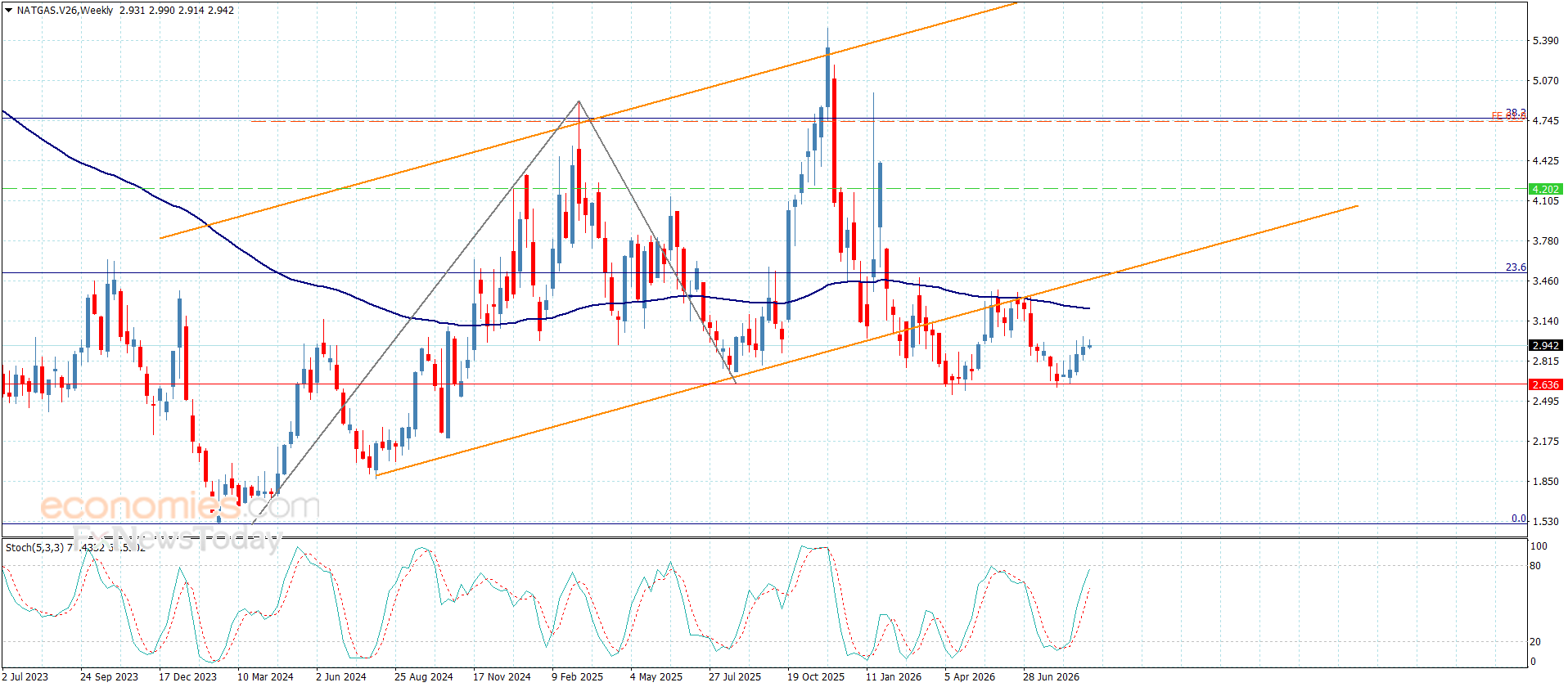
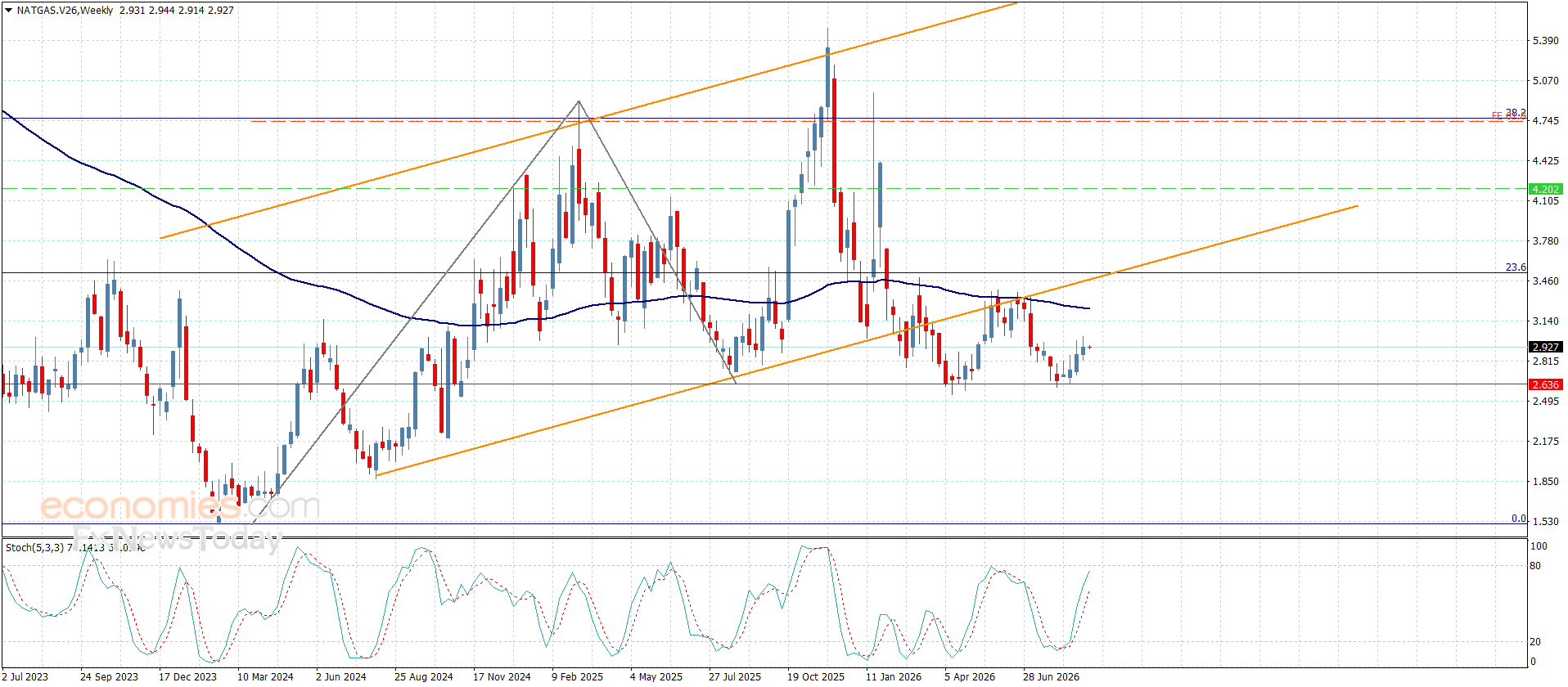
No escape for natural gas price from forming new bullish waves, due to the positive factors that are represented by the stability above the main support level at $2.620, besides providing positive momentum by stochastic in the current period.
And that confirms targeting more positive stations, reaching the initial target at $3.100, attempting to press on the barrier near $3.250 to find an exit for recording extra gains in the upcoming period.
The expected trading range for today is between $2.860 and $3.100
Coffee prices today in the domestic market simultaneously decreased compared to the previous session. According to giacaphe. com, coffee prices on September 8th averaged at 94. 300 VND/kg, down 500 VND/kg.
In Gia Lai and Dak Lak, coffee prices were recorded at 94. 200 VND/kg, down 500 VND/kg.
In Lam Dong, the listed coffee price is at 93.700 VND/kg, down 500 VND/kg.
The old Dak Nong area still maintained the highest price in the whole region, recording a level of 94,500 VND/kg, down 500 VND/kg.
The USD/VND exchange rate according to Vietcombank was recorded at 25,770 VND/USD, down 70 VND/USD.
World coffee prices
In the world market, coffee prices increase and decrease according to each term with different exchanges.
According to Barchart, the September 2026 Robusta contract increased by another 56 USD/ton, anchored at the 3,400 USD/ton mark. In the opposite direction, the November 2026 term was listed at 3,405 USD/ton, down 25 USD/ton. The term from January 2027 to May 2027 saw the largest decrease of 21 USD/ton, down to 3,363 – 3,394 USD/ton.
As of 12:19 PM, Robusta contracts decreased in price for all terms, except for the September 2026 term. Source: Giacaphe. com
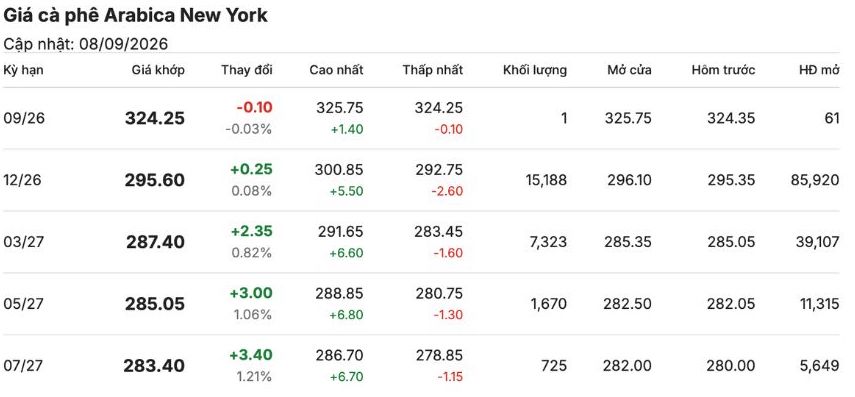
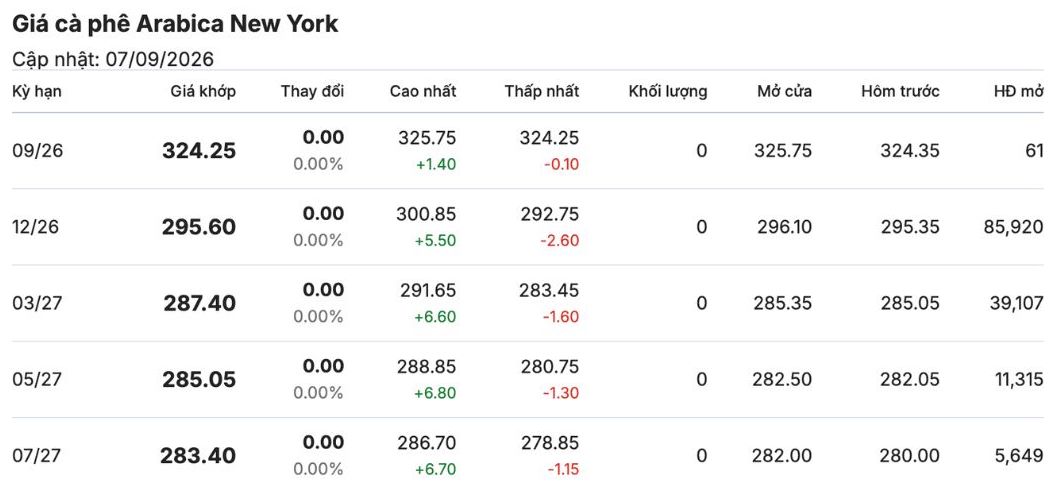
On the other hand, the September 2026 Arabica futures contract slightly decreased by 0.1 cent/lb (equivalent to 0.03%), maintaining at the 324.25 cent/lb mark. The December 2026 term increased slightly by 0.25 cent/lb, keeping the price at 295.60 cent/lb. Further forwards are anchored in the 287.4 – 285.05 cent/lb range.
As of 12:20 PM, Robusta contracts increased again, except for the September 2026 term. Source: Giacaphe. com
Assessments and forecasts
According to the Vietnam Coffee – Cocoa Association (Vicofa), in the first 8 months of 2026, Vietnam’s coffee exports reached nearly 1.7 million tons, worth more than 6 billion USD, an increase of more than 10% in volume, but a decrease of 11.2% in value compared to the same period in 2025 due to reduced export prices.
The EU and the United States continue to be the key export markets for Vietnamese coffee. In addition, some markets in Asia, especially China, are opening up new growth poles for the industry.
According to forecasts, coffee prices tend to increase in the coming time, thanks to the support of many factors such as climate change with heavy rainfall slowing down harvest time in Brazil; El Nino, hot sun, drought will occur in Asia at the end of 2026 and 2027, which may affect coffee production and supply; low inventory.
The biggest downward pressure currently comes from the world’s largest coffee producer, Brazil.
The 2026/27 Arabica crop harvest in this country was almost completed by the end of August thanks to dry weather conditions helping to accelerate progress.
According to the latest forecast from brokerage company StoneX, Brazil’s output this crop year may reach a record level of 77.2 million bags, up 2.6% compared to the forecast in March. Brazil’s export growth also recorded a breakthrough, as the country’s government announced exports in August reached 3.44 million bags, up 45% compared to the same period last year.
Goldman Sachs has raised its Brent and West Texas Intermediate (WTI) crude oil price forecasts by $5 a barrel for December 2026 and 2027, citing expectations that shipping disruptions in the Middle East will persist into next year, Reuters reported.
The bank said Brent crude could rise above $120 a barrel in 2027 if average oil production in the Gulf remains 4 million barrels per day below pre-war levels. That compares with Goldman Sachs’ base-case assumption of a 500,000-barrel-per-day shortfall.
However, the bank also outlined a significantly lower-price scenario. Brent could fall into the $60s a barrel in 2027 if average Gulf oil production rises by 1 million barrels per day above pre-war levels, according to the Reuters report.
Oil prices have recently climbed to a six-week high as renewed conflict in the Middle East heightened concerns over potential supply disruptions. Iran has also threatened the United States with economic retaliation, adding to fears that the conflict could escalate further.
The six-month-old war has been characterised by periods of calm followed by renewed flare-ups, keeping energy markets on edge. Shipping through the Strait of Hormuz has also slowed sharply, with an average of only 10 commodity ships passing through the key waterway each day over the past 10 days, the lowest level since May, shipping data showed on Monday.
Goldman Sachs said the increase in its price forecasts remained relatively modest despite its assumption that shipping disruptions would continue. Reuters reported that the bank pointed to limited drawdowns in OECD commercial oil inventories since the conflict began and its expectation that Middle Eastern producers would continue adapting supply flows.The Strait of Hormuz is a critical route for global energy shipments, and prolonged disruption could tighten crude supplies and put upward pressure on prices. The extent of the impact, however, will depend heavily on the duration of the conflict, the pace at which Gulf production recovers and the ability of producers and traders to redirect supplies.
Goldman Sachs’ scenarios highlight the wide range of possible outcomes for crude prices in 2027, with prolonged supply losses potentially pushing Brent above $120 a barrel, while a stronger-than-expected recovery in Gulf production could send prices down toward the $60s.
TradingKey – As of the Asian session on September 8, WTI crude oil prices (USOIL) continued to fluctuate at high levels, with the latest price trading higher near $92.30, up 1.2% on the day after touching a nearly two-month high of $93.29. Over the past week, WTI has accumulated a gain of nearly 10%. The re-escalation of the US-Iran conflict, shipping restrictions in the Strait of Hormuz, and OPEC+’s pause on further production increases have jointly provided sustained upward momentum for oil prices.
From a fundamental perspective, WTI has continued to climb recently, with the core driver remaining Middle East crude supply risks stemming from the escalating U.S.-Iran conflict. As both sides launch a new round of actions targeting oil tankers and related military targets, market focus has shifted from pure geopolitical tension to whether the conflict will further affect shipping through the Strait of Hormuz and crude oil exports from the Persian Gulf.
Recently, the number of commodity vessels passing through the Strait of Hormuz has dropped noticeably, while safety and insurance risks facing commercial oil tankers have risen in tandem. Given that the Strait of Hormuz handles a substantial portion of global oil transport, if traffic remains persistently below normal levels, even if crude exports are not completely disrupted, the market will need to price in a higher risk premium for potential supply losses.
Meanwhile, OPEC+ decided to maintain its existing production policy unchanged in October, pausing its previous streak of consecutive output increases. This means that amid rising supply uncertainty in the Middle East, the short-term buffer of additional supply from OPEC+ is reduced, providing further support to oil prices.
However, WTI has already risen rapidly from near $80 in late August to above $92, with some geopolitical risk already priced in. Whether oil prices can further challenge $97 or even $100 going forward will depend critically on the actual shipping conditions in the Strait of Hormuz and whether Middle East crude experiences more pronounced supply losses.
If attacks on commercial tankers expand further, or if energy facilities such as major oil fields and export terminals are affected, WTI could still continue to move higher; conversely, if signals of negotiations or a ceasefire emerge between the U.S. and Iran and shipping recovers, the current elevated risk premium could rapidly recede.
Looking at the daily chart of WTI crude oil prices, driven by the escalation of the US-Iran conflict, oil prices recently rose from $80 to a high of $93.29. The short-term candlestick structure shows a distinct pattern of continuously higher highs and higher lows, indicating that the short-term uptrend remains intact. Meanwhile, the 5-day and 10-day moving averages sequentially crossed above the 144-day moving average, forming a golden cross structure and further strengthening short-term bullish momentum.
Currently, oil prices today advanced to just below the July 23 rebound high of $93.50, increasing short-term upside pressure. If oil prices can effectively break through and hold above $93.50, it will open up upside space toward $97.00. Further up, prices could test the $100 mark and even challenge $105.
On the downside, the primary support level to watch below is the $91-$90 range. If oil prices fall below $90, they may further test support near $87.70 down below; if the decline continues, they could test support at the 20-day moving average.
This content was translated using AI and reviewed for clarity. It is for informational purposes only.
Silver (XAG/USD) nudges lower on Monday, hitting session lows in the mid-$65.00s after a reversal from the $68.00 area. Precious metals are struggling on Monday, as US Nonfarm Payrolls (NFP) figures beat expectations last Friday, boosting hopes that the US Federal Reserve (Fed) will hike rates next week, although the market awaits Friday’s Consumer Price Index (CPI) release for confirmation.
US NFP figures showed a 162K increase in net employment in August, well above the 57K forecasted by market analysts, easing concerns about a softening labour market. The data prompted investors to ramp up bets on a Fed rate hike at the September 15-16 monetary policy meeting to a 58% chance, from around 50% before the release, according to data from the CME FedWatch Tool.
Analysts at ING point to Friday’s August CPI release as the main focus this week, where they see “month-on-month readings at 0.4% and 0.2% for headline and core (inflation) should be enough to sway the Fed towards a 25bp rate hike on 16 September,” a move they note is “just priced with a 58% probability at the moment.”
Technical Analysis: The neckline of a H&S formation lies around $63.30
XAG/USD trades at $65.79, keeping a bearish near-term tone as it holds well below the 200-day simple moving average (SMA). Friday’s reversal from $68.00 looks like the second shoulder of a bearish Head & Shoulders (H&S) formation, while momentum indicators in the daily chart highlight growing bearish pressure.
The 14-period Relative Strength Index (RSI) is hovering near a neutral 52 zone, and the Moving Average Convergence Divergence (MACD) stays in negative territory, which suggests that upside attempts could remain capped.
On the downside, the pair might find support at Friday’s low near $64.75, although the key level is the September 2 low, at $63.30, which would confirm the H&S pattern and add pressure toward the August 6 low, near $61.00.
On the topside, initial resistance emerges at a previous support area around $67.50, which held bulls on Friday. Further up, the mid-June highs around $71.60 and the 200-day SMA at $72.90 are likely to pose a significant challenge for bulls.
(The technical analysis of this story was written with the help of an AI tool. Know more.)
Silver FAQs
Silver is a precious metal highly traded among investors. It has been historically used as a store of value and a medium of exchange. Although less popular than Gold, traders may turn to Silver to diversify their investment portfolio, for its intrinsic value or as a potential hedge during high-inflation periods. Investors can buy physical Silver, in coins or in bars, or trade it through vehicles such as Exchange Traded Funds, which track its price on international markets.
Silver prices can move due to a wide range of factors. Geopolitical instability or fears of a deep recession can make Silver price escalate due to its safe-haven status, although to a lesser extent than Gold’s. As a yieldless asset, Silver tends to rise with lower interest rates. Its moves also depend on how the US Dollar (USD) behaves as the asset is priced in dollars (XAG/USD). A strong Dollar tends to keep the price of Silver at bay, whereas a weaker Dollar is likely to propel prices up. Other factors such as investment demand, mining supply – Silver is much more abundant than Gold – and recycling rates can also affect prices.
Silver is widely used in industry, particularly in sectors such as electronics or solar energy, as it has one of the highest electric conductivity of all metals – more than Copper and Gold. A surge in demand can increase prices, while a decline tends to lower them. Dynamics in the US, Chinese and Indian economies can also contribute to price swings: for the US and particularly China, their big industrial sectors use Silver in various processes; in India, consumers’ demand for the precious metal for jewellery also plays a key role in setting prices.
Silver prices tend to follow Gold’s moves. When Gold prices rise, Silver typically follows suit, as their status as safe-haven assets is similar. The Gold/Silver ratio, which shows the number of ounces of Silver needed to equal the value of one ounce of Gold, may help to determine the relative valuation between both metals. Some investors may consider a high ratio as an indicator that Silver is undervalued, or Gold is overvalued. On the contrary, a low ratio might suggest that Gold is undervalued relative to Silver.
Coffee prices today in the domestic market simultaneously unexpectedly remained unchanged compared to the previous session. According to giacaphe. com, the average coffee price on September 7 remained at 94,800 VND/kg.
In Gia Lai and Dak Lak, coffee prices were recorded at 94,700 VND/kg.
In Lam Dong, the listed coffee price is at 94. 200 VND/kg.
The old Dak Nong area still maintained the highest price in the whole region, recording 95,000 VND/kg.
The USD/VND exchange rate according to Vietcombank was recorded at 25,840 VND/USD, down 5 VND/USD.
World coffee prices
In the world market, coffee prices fluctuated in the same direction as all terms did not adjust.
According to Barchart, the September 2026 Robusta contract remained unchanged, anchored at the $3,344/ton mark. The November 2026 term was listed at $3,430/ton. The term from January 2027 to May 2027 saw an increase from $55-57/ton, to $3,383 – $3,415/ton.
Robusta contracts remain unchanged for all terms. Source: Giacaphe. com
Similarly, the September 2026 Arabica futures contract closed the session at 324.25 cents/lb. The December 2026 term held the price at 295.60 cents/lb. Further forwards were anchored in the 287.4 – 283.4 cents/lb range.
Developments of the Arabica contract on September 7. Source: Giacaphe. com
Assessments and forecasts
The London and New York exchanges entered the first trading session of the new week with the foundation being a slight technical recovery from the previous week’s closing session. The 3,400 USD/ton zone of Robusta for November 2026 futures temporarily played a good role as a short-term psychological support level.
Meanwhile, weather factors continue to dominate the New York Stock Exchange. The rainfall diễn biến in Minas Gerais and São Paulo (Brazil) states in the early days of September is still not thick enough to completely relieve concerns about drought for the main flowering stage. This helps New York limit the deep decline, fluctuating accumulation around the 295 cent/lb mark.
Supply and demand keep domestic pepper prices stable above the 94,000 VND/kg mark. According to statistics, the volume of coffee exports in the first 8 months of 2026 reached about 1.3 million tons with a value of 6 billion USD, an increase of 13.1% in volume but a decrease of 9.1% in value compared to the same period in 2025. The average export price reached 4,538 USD/ton, down 19.7%, showing that price decreases are significantly impacting turnover even though export volume is increasing.
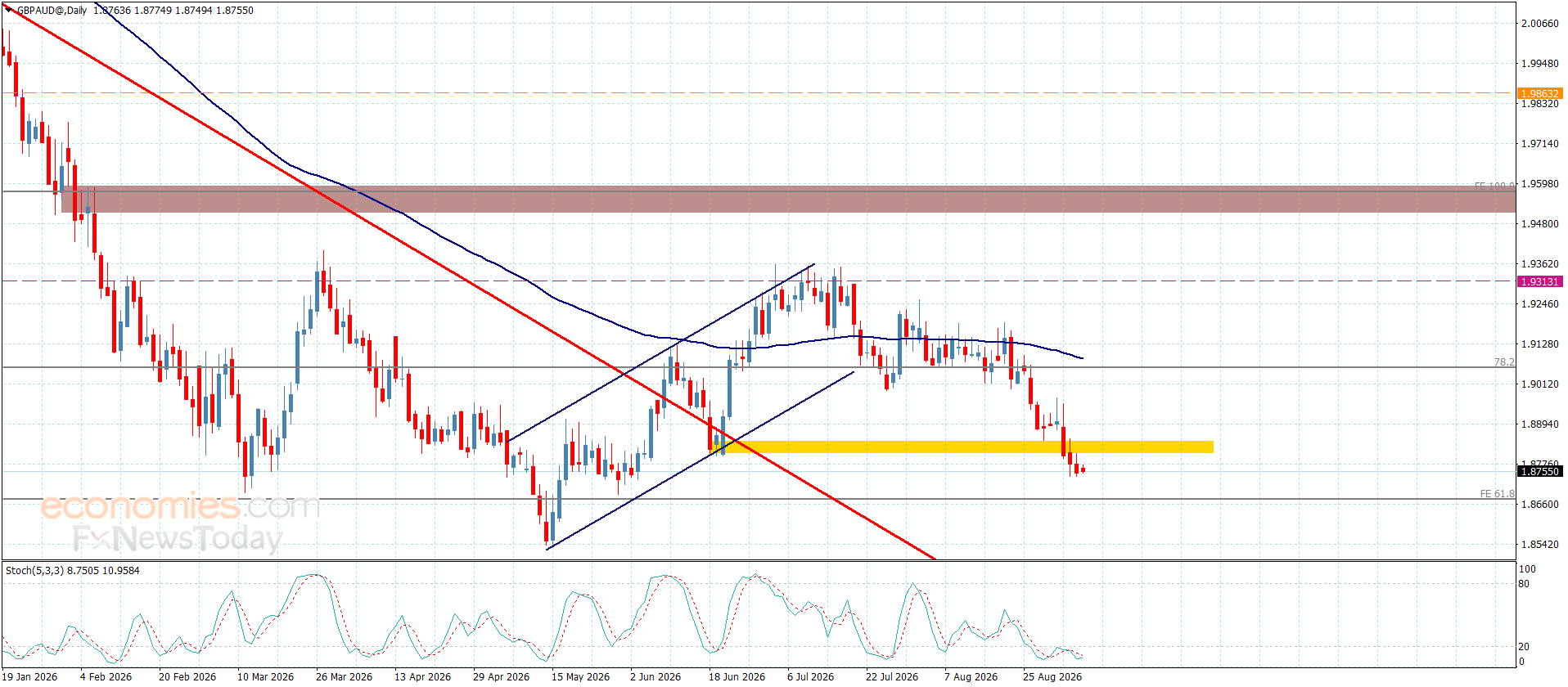
GBPAUD faced new bearish pressures due to the stability of stochastic stability within the oversold level, to push it to break the support level at 1.8830 and providing negative closes, to suffer new losses by reaching 1.8740 level.
The stability below the broken support will increase the efficiency of the bearish scenario in the near trading, to expect reaching 1.8675 and surpassing this barrier might extend the trading towards the next station that is represented by 1.8585.
The expected trading range for today is between 1.8675 and 1.8810
The Ethereum price (ETHUSD) edged higher during its latest intraday trading, as it attempts to break above the pivotal and stubborn resistance at $2,500, while continuing its short-term sideways movement, supported by its continued trading above EMA50, which provides the price with a dynamic support base that enhances the chances of a breakout over the coming period. On the other hand, negative signals are beginning to emerge from the relative strength indicators after reaching extremely overbought levels, which may hinder the pair’s chances of a rapid recovery, to relieve these overbought conditions.
Despite the weakness of the last weak trading by its fluctuations near $2.920 level, it will not affect the previously suggested bullish scenario, depending on its stability above $2.620 level.
The continuation of providing bullish momentum by stochastic will increase the efficiency of the bullish corrective trend, which might target $3.100 level reaching 55 moving average at $2.240.
The expected trading range for today is between $2.860 and $3.100
Today (September 6), the coffee market ended a week of alternating increases and decreases, currently the purchase price fluctuates in the range of 94,200 – 95,000 VND/kg, down 300 – 800 VND/kg compared to the price range at the beginning of the week. The average purchase price of coffee in the Central Highlands provinces today is 94,800 VND/kg.
The old Dak Nong area is still the province with the highest coffee purchasing price in the Central Highlands region, differing from the average price by about 200 VND/kg. Compared to the closing price last weekend, the coffee price in this area decreased by 300 VND/kg, bringing it to the market at 95,000 VND/kg.
In Dak Lak and Gia Lai, coffee prices decreased by 800 VND/kg, down to 94,700 VND/kg.
Similarly, Lam Dong also decreased by 700 VND/kg, currently trading at a price of 94,600 VND/kg.
World coffee prices
On the London and New York exchanges, the coffee market diễn biến in the same direction in all terms.
On the online trading floor Robusta, the September 2026 futures contract on the London exchange was traded at 3,344 USD/ton, up 46 USD/ton compared to the previous session. The November 2026 contract increased by 1.66% (about 56 USD/ton), to 3,430 USD/ton.
On the New York Stock Exchange, the price of arabica coffee for September 2026 delivery was almost unchanged when it only decreased by 0.03% (0.1 US cent/lb), reaching 324.25 US cent/lb. The December 2026 contract increased by 0.08% (0.25 US cent/lb), reaching 295.6 US cent/lb.
Market outlook
Robusta coffee prices have interrupted a series of consecutive declines, rebounding strongly, while Arabica coffee prices have increased less.
Arabica coffee contracts are under pressure due to the increase in coffee exports from Brazil, the leading producer. Along with that, the return of rain is a positive sign for the flowering phase, a factor that plays a decisive role in the output of next year’s coffee crop.
In the first 8 months of 2026, Vietnam exported 1.33 million tons of coffee, up 13.7% compared to the same period last year. Coffee export revenue in this period decreased by 8.6% to 6 billion USD. In August alone, Vietnam exported 132,000 tons of coffee, up 13.7% compared to the same period last year.
The prospects for the Robusta crop 2027-2028 are also quite positive. Robusta coffee trees have completed the flowering process and if weather conditions are favorable, the next crop output may be equivalent to or even exceed the record level of the 2025-2026 crop year.