The main tag of Gold News Today Articles.
You can use the search box below to find what you need.
[wd_asp id=1]

7 04, 2026

Platinum price repeats the pressure on the moving average– Forecast today – 7-4-2026

By |2026-04-07T08:48:58+02:00April 7, 2026|Forex News, News|0 Comments


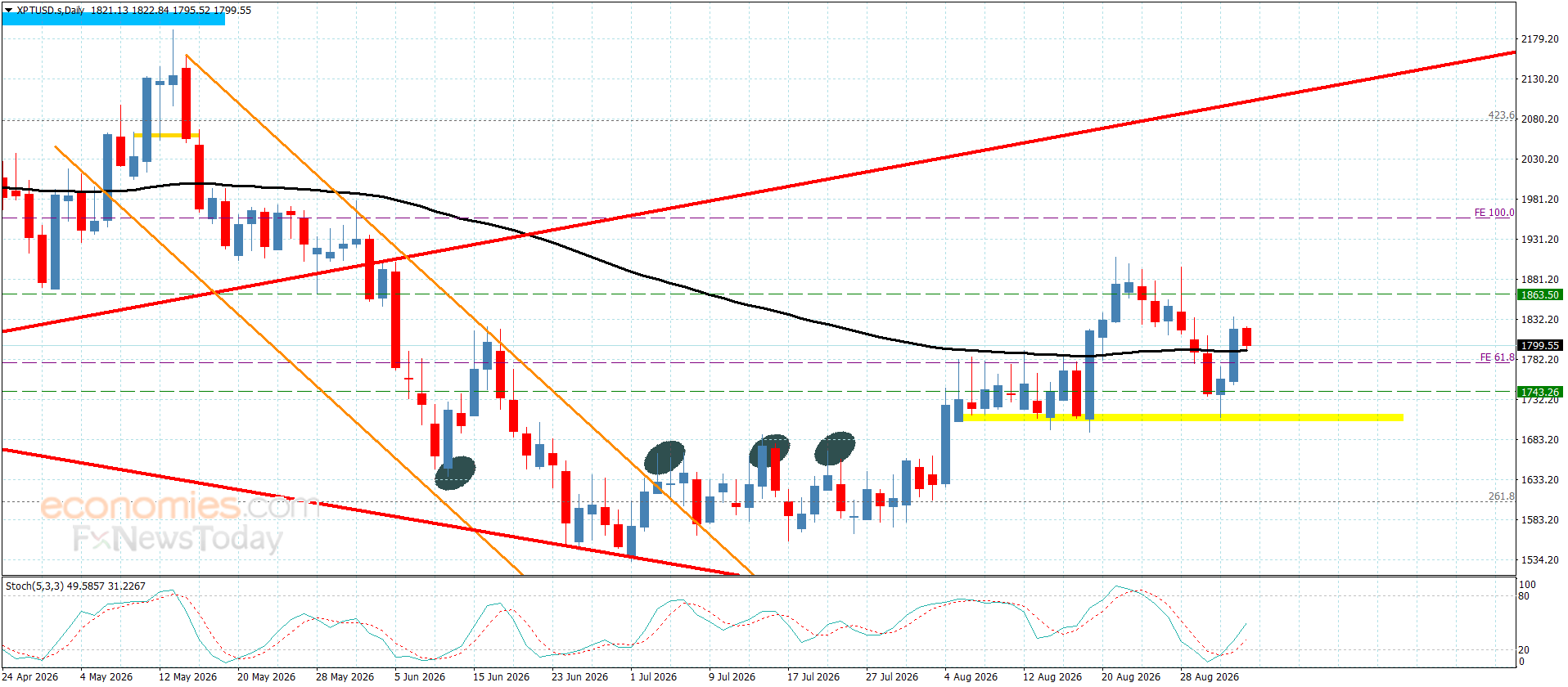
Platinum price attempted to form several bullish waves in the previous period, moving away from the support at $1860.00, providing strong pressures on the moving average 55, which keeps forming a key barrier at $1980.00.


The positive attempts get advantage of the stability above the previously mentioned support, which makes us wait for breaching the moving average 55 and holding above it to pave the way for achieving extra gains that might begin at $2070.00 and $2130.00, while breaking the support will push the price to provide new bearish trading, to reach $1170.00.


The expected trading range for today is between $1905.00 and $2070.00


Trend forecast: Bullish


Source link

7 04, 2026

XAG/USD consolidates below key $73 hurdle

By |2026-04-07T04:48:05+02:00April 7, 2026|Forex News, News|0 Comments


Silver (XAG/USD) extends its sideways consolidative price move for the second straight day and holds steady around the $73.00 mark during the Asian session on Tuesday. Traders now seem reluctant to place aggressive directional bets and opt to move to the sidelines ahead of US President Donald Trump’s deadline for Iran to reopen the Straight of Hormuz amid fading hopes for a ceasefire.

From a technical perspective, the near-term bias is mildly bearish as the XAG/USD holds below the 100-period Simple Moving Average (SMA) on the 4-hour chart, while that average continues to trend lower and cap rebounds. Furthermore, the Moving Average Convergence Divergence (MACD) indicator (12, 26, 9) recovers from recent negative readings but remains subdued, hinting at fading downside momentum rather than a clear upside shift.

Adding to this, the Relative Strength Index (RSI) around 52 reinforces a neutral momentum backdrop, suggesting that sellers retain a slight advantage while directional conviction stays limited. Hence, any further strength beyond the 100-period SMA at $73.22 might confront resistance aligning with the 38.2% Fibonacci retracement of the March downfall, at $74.69. A sustained break above that band would open the door toward the 50.0% retracement at $78.89.

On the downside, initial support sits near $72.00, ahead of the 23.6% retracement at $69.50, which marks the first notable floor within the current corrective phase. A clear drop through $69.50 would expose the broader support area toward $61.11, where the measured advance began.

(The technical analysis of this story was written with the help of an AI tool.)

XAG/USD 4-hour chart

Silver FAQs

Silver is a precious metal highly traded among investors. It has been historically used as a store of value and a medium of exchange. Although less popular than Gold, traders may turn to Silver to diversify their investment portfolio, for its intrinsic value or as a potential hedge during high-inflation periods. Investors can buy physical Silver, in coins or in bars, or trade it through vehicles such as Exchange Traded Funds, which track its price on international markets.

Silver prices can move due to a wide range of factors. Geopolitical instability or fears of a deep recession can make Silver price escalate due to its safe-haven status, although to a lesser extent than Gold’s. As a yieldless asset, Silver tends to rise with lower interest rates. Its moves also depend on how the US Dollar (USD) behaves as the asset is priced in dollars (XAG/USD). A strong Dollar tends to keep the price of Silver at bay, whereas a weaker Dollar is likely to propel prices up. Other factors such as investment demand, mining supply – Silver is much more abundant than Gold – and recycling rates can also affect prices.

Silver is widely used in industry, particularly in sectors such as electronics or solar energy, as it has one of the highest electric conductivity of all metals – more than Copper and Gold. A surge in demand can increase prices, while a decline tends to lower them. Dynamics in the US, Chinese and Indian economies can also contribute to price swings: for the US and particularly China, their big industrial sectors use Silver in various processes; in India, consumers’ demand for the precious metal for jewellery also plays a key role in setting prices.

Silver prices tend to follow Gold’s moves. When Gold prices rise, Silver typically follows suit, as their status as safe-haven assets is similar. The Gold/Silver ratio, which shows the number of ounces of Silver needed to equal the value of one ounce of Gold, may help to determine the relative valuation between both metals. Some investors may consider a high ratio as an indicator that Silver is undervalued, or Gold is overvalued. On the contrary, a low ratio might suggest that Gold is undervalued relative to Silver.


Source link

7 04, 2026

Natural gas price moves slowly– Forecast today – 2-4-2026

By |2026-04-07T00:47:10+02:00April 7, 2026|Forex News, News|0 Comments


The EURJPY pair continued forming mixed trading, due to the continuation of the main indicators’ contradiction, delaying the negative attack in the current trading by its rally towards 184.25 yesterday, to open this morning trading with new negativity, to notice targeting 183.60.


In general, the bearish scenario will remain valid depending on the stability below 184.80 resistance, forming an extra barrier at 184.20 level will support the chances of gathering the negative momentum, to ease the mission of targeting negative levels, which might begin at 183.10 and 182.20.


The expected trading range for today is between 182.20 and 184.20


Trend forecast: Bearish


Source link

6 04, 2026

Today’s Platinum Price in Guntur – Live Platinum Rate per Gram & Kg

By |2026-04-06T20:45:16+02:00April 6, 2026|Forex News, News|0 Comments


Price movements in platinum are often sharper than gold or silver due to its limited availability and reliance on a few global mining regions. Automotive regulations, global production levels, and technology usage influence the platinum price today. As platinum becomes more relevant in clean energy applications, its daily rate has gained importance for both buyers and investors.


Source link

6 04, 2026

Market goes sideways, oversupply pressure from Brazil is still present

By |2026-04-06T16:43:58+02:00April 6, 2026|Forex News, News|0 Comments


Domestic coffee prices

The domestic coffee market this morning, April 6th, did not record any new price fluctuations compared to the weekend holiday. Agents in the Central Highlands region are currently purchasing around an average of 89.2 million VND/kg.

Detailed purchase prices in key localities:

In Dak Nong province (old): Continue to maintain the highest price in the region at 89,300 VND/kg.

In Dak Lak province: The purchase price stands at 89. 200 VND/kg.

In Gia Lai province: Trading is stable at the 89. 200 VND/kg mark.

In Lam Dong province: Currently, the lowest price in the region is 88,700 VND/kg.

Looking back at the price history, the current level has dropped very deeply compared to the peak of 96,600 VND/kg set exactly one month ago (March 7).

World coffee prices

At the end of the most recent trading session, both London and New York exchanges closed in red due to pressure from a strong USD and positive crop reports from South America.

London Stock Exchange (Robusta): May 2026 delivery term closed at $3,448/ton. Although Robusta inventories on the ICE floor hit a 3.5-month low of 4,0093 lots, export pressure in the first 2 months of the year from Vietnam (up 14% to 360,000 tons) is still a major barrier curbing prices.

New York Stock Exchange (Arabica): May 2026 futures closed at 295.40 cents/lb. Arabica inventories monitored by ICE reached their highest level in more than 6 months (585.621 bags) continuing to put pressure on this exchange.

Market outlook

The coffee market is currently facing great supply pressure from Brazil as international organizations continuously raise their forecast for record production. Marex Group Plc estimates Brazil’s 2026/27 crop output to reach a record 75.9 million bags (up 15.5% y/y), while Sucafina and StoneX forecast at 75.4 million bags and 75.3 million bags respectively. However, supporting factors are still present as tensions in the Strait of Hormuz increased logistics costs and rainfall in Brazil last week only reached 47% of the historical average.

In the new trading week, domestic coffee prices are likely to continue to struggle and accumulate in the 88,500 – 90,000 VND/kg range. Farmers should closely monitor the diễn biến of the USD and the sea transport situation through the Strait of Hormuz to be more proactive in sales plans.

The actual price may differ depending on the quality of the seeds and the transaction agreement in each locality.


Source link

6 04, 2026

German THE Natural Gas Daily Financial Futures (ICIS) (01 May 2026) Trade Ideas — ICEENDEX:TGN01K2026 — TradingView

By |2026-04-06T12:43:04+02:00April 6, 2026|Forex News, News|0 Comments


Source link

6 04, 2026

XAG/USD wobbles around $72.50 in countdown to Trump’s ultimatum

By |2026-04-06T08:42:00+02:00April 6, 2026|Forex News, News|0 Comments


Silver price (XAG/USD) trades 0.7% lower to near $72.50 in the late Asian trade on Monday, but is broadly consolidating in a limited range. The white metal turns sideways as investors await Iran’s response to United States (US) President Donald Trump’s ultimatum.

Over the weekend, US President Trump threatened to attack Iranian power plants and bridges if the nation doesn’t free the Strait of Hormuz by Tuesday, 9:00 PM Eastern time (ET).

Latest comments from the Iranian foreign ministry signal that the Middle East nation won’t reopen the Hormuz and has warned of reciprocal attacks. “Iran will reciprocate attacks on its infrastructure and target similar infrastructure owned by the US or related,” a spokesperson from Iran’s foreign ministry said.

Meanwhile, there are some reports from Axios, reported by Bloomberg, claiming that the US and Iran are discussing a 45-day ceasefire, a scenario that could result in a landmark de-escalation in the Middle East war if it gets approved, and would be favorable for the Silver price.

Theoretically, signs of easing geopolitical tensions diminish demand for precious metals, being the safe-haven assets. However, escalating global inflation projections due to the ongoing war, leading to hawkish monetary policy guidance from central banks, have battered their appeal, being non-yielding assets.

This week, investors will focus on the US Federal Open Market Committee (FOMC) minutes of the March policy meeting, which will be released on Wednesday.

Silver technical analysis

XAG/USD trades almost flat at around $72.50 as of writing. The near-term bias is mildly bearish as spot holds below the 20-day Exponential Moving Average (EMA), capping recovery attempts. The recent sequence of lower closes from the mid-$90s underscores a downside structure, while the RSI at 43 shows momentum remaining on the weak side without reaching oversold territory, suggesting persistent selling pressure but no capitulation.

Immediate resistance aligns with the 20-day EMA near $75.20, and a daily close above this area would be needed to ease the current bearish tone and open the way toward the $80.00 region. On the downside, initial support emerges around $70.00, guarding the path toward the late swing low near $66.70, where failure would expose the next bearish extension toward the March 23 low around $61.00.

(The technical analysis of this story was written with the help of an AI tool.)

Silver FAQs

Silver is a precious metal highly traded among investors. It has been historically used as a store of value and a medium of exchange. Although less popular than Gold, traders may turn to Silver to diversify their investment portfolio, for its intrinsic value or as a potential hedge during high-inflation periods. Investors can buy physical Silver, in coins or in bars, or trade it through vehicles such as Exchange Traded Funds, which track its price on international markets.

Silver prices can move due to a wide range of factors. Geopolitical instability or fears of a deep recession can make Silver price escalate due to its safe-haven status, although to a lesser extent than Gold’s. As a yieldless asset, Silver tends to rise with lower interest rates. Its moves also depend on how the US Dollar (USD) behaves as the asset is priced in dollars (XAG/USD). A strong Dollar tends to keep the price of Silver at bay, whereas a weaker Dollar is likely to propel prices up. Other factors such as investment demand, mining supply – Silver is much more abundant than Gold – and recycling rates can also affect prices.

Silver is widely used in industry, particularly in sectors such as electronics or solar energy, as it has one of the highest electric conductivity of all metals – more than Copper and Gold. A surge in demand can increase prices, while a decline tends to lower them. Dynamics in the US, Chinese and Indian economies can also contribute to price swings: for the US and particularly China, their big industrial sectors use Silver in various processes; in India, consumers’ demand for the precious metal for jewellery also plays a key role in setting prices.

Silver prices tend to follow Gold’s moves. When Gold prices rise, Silver typically follows suit, as their status as safe-haven assets is similar. The Gold/Silver ratio, which shows the number of ounces of Silver needed to equal the value of one ounce of Gold, may help to determine the relative valuation between both metals. Some investors may consider a high ratio as an indicator that Silver is undervalued, or Gold is overvalued. On the contrary, a low ratio might suggest that Gold is undervalued relative to Silver.


Source link

6 04, 2026

Gold struggles below $5,200 despite geopolitical tensions

By |2026-04-06T04:40:37+02:00April 6, 2026|Forex News, News|0 Comments


Gold (XAU/USD) struggles to capitalize on its modest intraday gains and remains below the $5,200 mark through the first half of the European session on Wednesday. Investors remain concerned about a prolonged conflict in the Middle East and its impact on the global economy amid an already uncertain environment. In fact, US President Donald Trump said that the US military operation in Iran could take four to five weeks, and more strikes would continue for as long as necessary. This continues to weigh on investors’ sentiment, which is evident from a generally weaker tone around the equity markets and underpins demand for the safe-haven bullion.

Meanwhile, the closure of the Strait of Hormuz – one of the world’s most critical energy chokepoints – led to the recent surge in Crude Oil prices to the highest level since June 2025. Moreover, Iran has targeted infrastructure critical to the world’s energy production as part of its retaliation and warned that it will not allow a single drop of oil to leave the region. This has raised fears of a fresh energy crisis that could ramp up inflation and force the US Federal Reserve (Fed) to slow or scale back its plan to cut interest rates further. The outlook assists the US Dollar (USD) to hold steady below the year-to-date high and contributes to keeping a lid on the non-yielding Gold.

The aforementioned fundamental backdrop makes it prudent to wait for a sustained strength and acceptance above the $5,200 mark before positioning for any further intraday appreciating move. Market participants now look forward to the US economic docket – featuring the release of the ADP report on private-sector employment and ISM Services PMI. The data might do little to provide any meaningful impetus to the buck or the Gold price, as the focus remains glued to developments surrounding the ongoing US-Israel-Iran war.

XAU/USD 4-hour chart

Gold bulls seem hesitant amid mixed technical setup

The near-term bias turns cautiously bearish after the Gold price slipped back from the upper boundary of the ascending channel that has guided gains since early February, now trading just above the channel’s lower band near $5,025. The Relative Strength Index (14) recovers toward 43 after briefly approaching oversold territory, which suggests fading but still-present downside momentum. The Moving Average Convergence Divergence (MACD) line holds below its signal line and has retreated toward the zero line, reinforcing a loss of bullish conviction after the rejection above $5,380.

The XAU/USD pair trades only marginally above the rising 200-period Simple Moving Average (SMA) on the 4-hour chart around $5,030, indicating that the broader uptrend remains intact but under pressure in the short term. Initial support emerges in the $5,140–$5,130 band, with a break lower exposing the 200-period SMA and channel floor clustered around $5,030, followed by a deeper cushion near $4,980.

On the upside, immediate resistance stands near $5,210, where recent intraday rebounds stalled, followed by $5,260 and then the recent swing area around $5,320. A sustained recovery above $5,260 would ease the current bearish tone and open the way back toward the $5,380 region, while failure to defend $5,030 would signal a more decisive corrective phase within the broader ascending structure.

(The technical analysis of this story was written with the help of an AI tool.)

Fed FAQs

Monetary policy in the US is shaped by the Federal Reserve (Fed). The Fed has two mandates: to achieve price stability and foster full employment. Its primary tool to achieve these goals is by adjusting interest rates.
When prices are rising too quickly and inflation is above the Fed’s 2% target, it raises interest rates, increasing borrowing costs throughout the economy. This results in a stronger US Dollar (USD) as it makes the US a more attractive place for international investors to park their money.
When inflation falls below 2% or the Unemployment Rate is too high, the Fed may lower interest rates to encourage borrowing, which weighs on the Greenback.

The Federal Reserve (Fed) holds eight policy meetings a year, where the Federal Open Market Committee (FOMC) assesses economic conditions and makes monetary policy decisions.
The FOMC is attended by twelve Fed officials – the seven members of the Board of Governors, the president of the Federal Reserve Bank of New York, and four of the remaining eleven regional Reserve Bank presidents, who serve one-year terms on a rotating basis.

In extreme situations, the Federal Reserve may resort to a policy named Quantitative Easing (QE). QE is the process by which the Fed substantially increases the flow of credit in a stuck financial system.
It is a non-standard policy measure used during crises or when inflation is extremely low. It was the Fed’s weapon of choice during the Great Financial Crisis in 2008. It involves the Fed printing more Dollars and using them to buy high grade bonds from financial institutions. QE usually weakens the US Dollar.

Quantitative tightening (QT) is the reverse process of QE, whereby the Federal Reserve stops buying bonds from financial institutions and does not reinvest the principal from the bonds it holds maturing, to purchase new bonds. It is usually positive for the value of the US Dollar.


Source link

6 04, 2026

Dutch TTF Natural Gas Daily Futures (May 26 D01) Trade Ideas — NYMEX:TTD01K2026 — TradingView

By |2026-04-06T00:38:43+02:00April 6, 2026|Forex News, News|0 Comments


Source link

5 04, 2026

Copper price faces new resistance– Forecast today – 2-4-2026

By |2026-04-05T20:37:34+02:00April 5, 2026|Forex News, News|0 Comments


Copper price failed to confirm its stability above$5.5100 level, after facing new resistance near $5.6200 level, which forces it to end the bullish attempts and return to fluctuate near $5.5100 again.


The stability below the current resistance makes us wait for gathering the negative momentum, to begin forming strong bearish waves, to reach $5.2700 to attempt to press on $4.9500 barrier.


The expected trading range for today is between $5.2700 and $5.6200


Trend forecast: Bearish


Source link

Go to Top