The main tag of GoldPrice Articles.
You can use the search box below to find what you need.
[wd_asp id=1]
The main tag of GoldPrice Articles.
You can use the search box below to find what you need.
[wd_asp id=1]
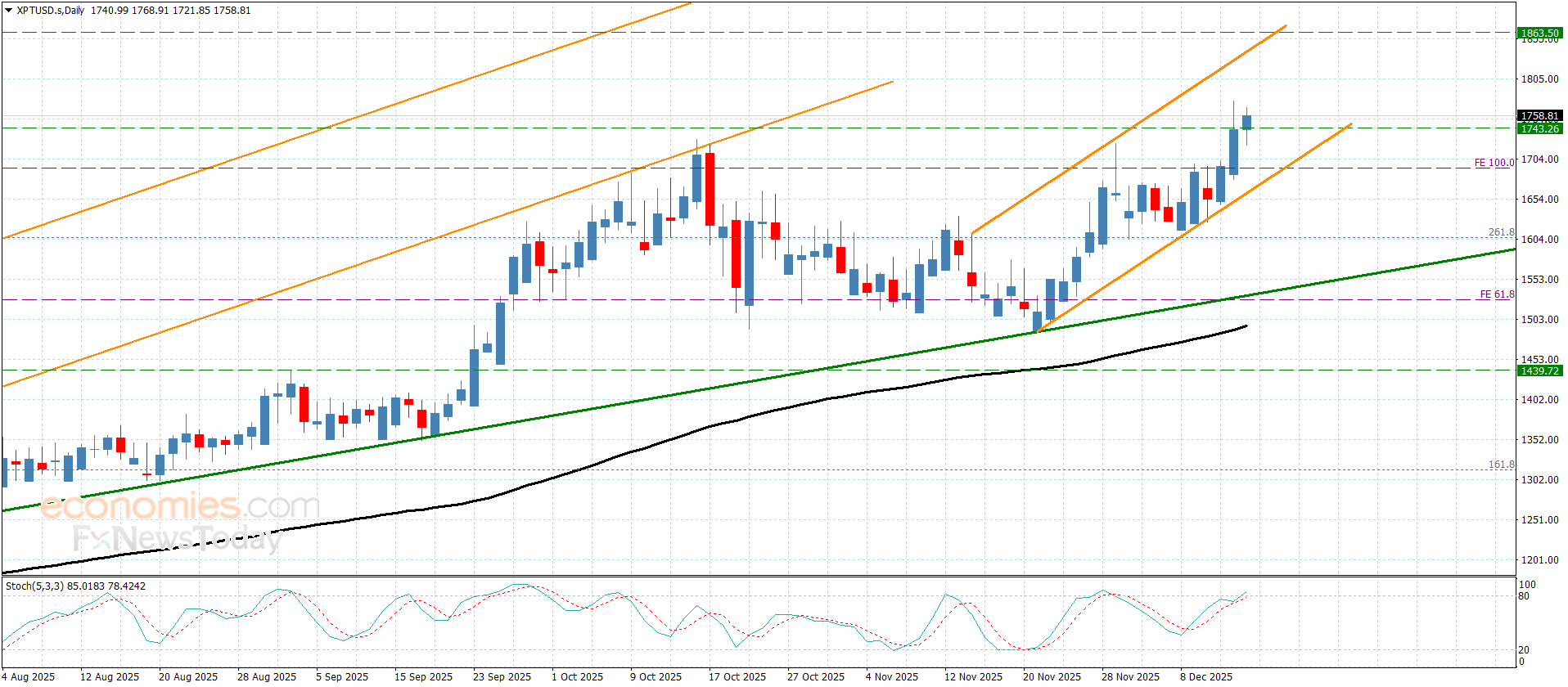
Copper price ended Friday’s trading by providing new bullish close above $5.1300 level, confirming the continuation of the bullish scenario in the near and medium period, attacking the barrier at $5.3200.
The price needs a new bullish momentum to confirm breaching the obstacle, recording new gains that might extend towards $5.5000, if the next main target in the positive trading, while the decline below $5.1300 and providing negative close will push it to form strong corrective waves, suffering several losses by reaching $4.9500.
The expected trading range for today is between $5.2000 and $5.5000
Trend forecast: Bullish
Silver (XAG/USD) attracts fresh buyers at the start of a new week and reverses a part of Friday’s retracement slide from the all-time peak, around the $64.65 region. The white metal trades above mid-$62.00s during the Asian session, up 1.25% for the day, and seems poised to prolong its recent well-established uptrend.
From a technical perspective, the XAG/USD finds decent support and bounces off the 100-hour Simple Moving Average (SMA). The subsequent move back above the $62.00 round figure validates the positive outlook. However, neutral oscillators on the 1-hour chart and a slightly overbought Relative Strength Index (RSI) on the daily chart warrant some caution for aggressive bullish traders.
This, in turn, suggests that any further move up is more likely to face some barrier near the $63.00 mark. A sustained strength beyond, however, could lift the XAG/USD towards the next relevant hurdle near the $63.80 area. Some follow-through buying beyond the $64.00 round figure will reaffirm the constructive outlook and allow bulls to challenge the record high, around the $64.65 region.
On the flip side, weakness below the $62.00 mark might still be seen as a buying opportunity near the 100-hour SMA, currently pegged near the $61.45 region. A convincing break below, however, could drag the XAG/USD below the $61.00 round figure, towards the $60.80 zone, or Friday’s swing low. The latter should act as a key pivotal point, which, if broken, should pave the way for deeper losses.
Silver is a precious metal highly traded among investors. It has been historically used as a store of value and a medium of exchange. Although less popular than Gold, traders may turn to Silver to diversify their investment portfolio, for its intrinsic value or as a potential hedge during high-inflation periods. Investors can buy physical Silver, in coins or in bars, or trade it through vehicles such as Exchange Traded Funds, which track its price on international markets.
Silver prices can move due to a wide range of factors. Geopolitical instability or fears of a deep recession can make Silver price escalate due to its safe-haven status, although to a lesser extent than Gold’s. As a yieldless asset, Silver tends to rise with lower interest rates. Its moves also depend on how the US Dollar (USD) behaves as the asset is priced in dollars (XAG/USD). A strong Dollar tends to keep the price of Silver at bay, whereas a weaker Dollar is likely to propel prices up. Other factors such as investment demand, mining supply – Silver is much more abundant than Gold – and recycling rates can also affect prices.
Silver is widely used in industry, particularly in sectors such as electronics or solar energy, as it has one of the highest electric conductivity of all metals – more than Copper and Gold. A surge in demand can increase prices, while a decline tends to lower them. Dynamics in the US, Chinese and Indian economies can also contribute to price swings: for the US and particularly China, their big industrial sectors use Silver in various processes; in India, consumers’ demand for the precious metal for jewellery also plays a key role in setting prices.
Silver prices tend to follow Gold’s moves. When Gold prices rise, Silver typically follows suit, as their status as safe-haven assets is similar. The Gold/Silver ratio, which shows the number of ounces of Silver needed to equal the value of one ounce of Gold, may help to determine the relative valuation between both metals. Some investors may consider a high ratio as an indicator that Silver is undervalued, or Gold is overvalued. On the contrary, a low ratio might suggest that Gold is undervalued relative to Silver.
Gold (XAU/USD) attracts buyers for the fifth straight day and climbs to the $4,330 region during the Asian session on Monday. The commodity remains well within striking distance of its highest level since October 21, touched on Friday, and seems poised to appreciate further amid a supportive fundamental backdrop. Traders, however, might opt to wait for this week’s important US macro releases, which would shape expectations about the Federal Reserve’s (Fed) rate-cut path and drive demand for the non-yielding yellow metal.
The delayed US Nonfarm Payrolls (NFP) report for October and Retail Sales are scheduled for release on Tuesday, along with the provisional manufacturing and services PMIs. This will be followed by the US consumer inflation figures on Thursday. Apart from this, speeches from influential FOMC members will determine the near-term trajectory for the US Dollar (USD). Investors this week will further take cues from the Bank of England (BoE) rate decision and the European Central Bank (ECB) meeting on Thursday, and the Bank of Japan (BoJ) policy update on Friday. This should provide a fresh directional impetus to the Gold price.
In the meantime, dovish US Federal Reserve (Fed) expectations fail to assist the USD to register any meaningful recovery from a two-month low, touched last Thursday, and continue to underpin the yellow metal. In a widely expected move, the US central bank lowered borrowing costs by 25 basis points (bps) at the end of a two-day policy meeting last Wednesday and projected one more rate cut in 2026. Investors, however, remain hopeful about two more rate cuts next year in the wake of Fed Chair Jerome Powell’s remarks, saying that the central bank does not want its policy to push down on job creation amid downside risks to the labor market.
Meanwhile, US President Donald Trump said last Friday that he was leaning toward choosing either former Fed Governor Kevin Warsh or National Economic Council Director Kevin Hassett to lead the US central bank next year. Market participants seem convinced that the new Trump-aligned Fed chair will be an uber-dovish and slash interest rates regardless of the economic fundamentals. This has been another factor behind the recent USD decline and suggests that the path of least resistance for the Gold price remains to the upside. Moreover, the emergence of dip-buying at the start of a new week and acceptance above the $4,300 mark validate the positive outlook.
Last week’s breakout through the $4,245-4,255 supply zone was seen as a key trigger for the XAU/USD bulls. Moreover, short-term moving averages slope higher, keeping the intraday bias pointing north. The broader setup remains supportive as dips attract demand around dynamic supports. The Moving Average Convergence Divergence (MACD) histogram stays positive but has been contracting from recent peaks, suggesting fading bullish momentum; the MACD line holds above the Signal line and above the zero line. RSI (14) prints 68 (near overbought), easing from earlier extremes and hinting that upside could be capped until momentum resets.
If buyers reassert control and the MACD histogram re-expands, the advance could extend towards retesting the all-time peak, while a further contraction accompanied by an RSI roll-over from the high-60s would favor consolidation. A sustained hold above rising short-term moving averages would preserve the bullish tone, whereas a close beneath these dynamic supports would open the door to a deeper pullback. Overall, momentum remains positive but stretched, which could translate into choppy trade before a decisive break emerges.
(The technical analysis of this story was written with the help of an AI tool)
Gold price (XAU/USD) climbs to seven-week highs above $4,325 during the Asian trading hours on Monday. The precious metal extends its upside amid the prospect of interest rate cuts by the US Federal Reserve (Fed) next year. Lower interest rates could reduce the opportunity cost of holding Gold, supporting the non-yielding precious metal. Additionally, uncertainty and the risk-off sentiment could boost the safe-haven flows, benefiting the yellow metal price.
Nonetheless, hawkish remarks from Fed officials last week could lift the US Dollar (USD) and weigh on the USD-denominated commodity price. Traders will take more cues from the speeches by Fed Governor Stephen Miran and New York Fed President John Williams later on Monday.
The US employment report for October and November will take center stage on Tuesday, including Nonfarm Payrolls (NFP), Average Hourly Earnings and Unemployment Rate. These reports could provide more clarity on the labor market’s health and likely influence expectations for the Fed’s January meeting.
Gold price trades in positive territory on the day. According to the four-hour timeframe, the positive outlook of the precious metal remains in play as the price holds above the key 100-day Exponential Moving Average. The Bollinger Band widens, suggesting a strong bullish trend. Furthermore, the upward momentum is reinforced by the 14-day Relative Strength Index (RSI), which stands above the midline near 68.75. This displays the bullish momentum for the yellow metal.
On the bright side, the first upside barrier to watch is in the $4,345-$4,355 zone, representing the upper boundary of the Bollinger Band and the high of December 12. Sustained upside momentum could take XAU/USD back up to an all-time high of $4,381. Further north, the next resistance level is located at the $4,400 psychological mark.
On the downside, the initial support level for the yellow metal is seen at the low of December 12 at $4,257. More bearish candlesticks reflect a continuation of downside pressure, possibly dragging the price down to the next bearish target at $4,200, the 100-day EMA. The next contention level emerges at $4,166, the lower limit of the Bollinger Band.
In the world of financial jargon the two widely used terms “risk-on” and “risk off” refer to the level of risk that investors are willing to stomach during the period referenced. In a “risk-on” market, investors are optimistic about the future and more willing to buy risky assets. In a “risk-off” market investors start to ‘play it safe’ because they are worried about the future, and therefore buy less risky assets that are more certain of bringing a return, even if it is relatively modest.
Typically, during periods of “risk-on”, stock markets will rise, most commodities – except Gold – will also gain in value, since they benefit from a positive growth outlook. The currencies of nations that are heavy commodity exporters strengthen because of increased demand, and Cryptocurrencies rise. In a “risk-off” market, Bonds go up – especially major government Bonds – Gold shines, and safe-haven currencies such as the Japanese Yen, Swiss Franc and US Dollar all benefit.
The Australian Dollar (AUD), the Canadian Dollar (CAD), the New Zealand Dollar (NZD) and minor FX like the Ruble (RUB) and the South African Rand (ZAR), all tend to rise in markets that are “risk-on”. This is because the economies of these currencies are heavily reliant on commodity exports for growth, and commodities tend to rise in price during risk-on periods. This is because investors foresee greater demand for raw materials in the future due to heightened economic activity.
The major currencies that tend to rise during periods of “risk-off” are the US Dollar (USD), the Japanese Yen (JPY) and the Swiss Franc (CHF). The US Dollar, because it is the world’s reserve currency, and because in times of crisis investors buy US government debt, which is seen as safe because the largest economy in the world is unlikely to default. The Yen, from increased demand for Japanese government bonds, because a high proportion are held by domestic investors who are unlikely to dump them – even in a crisis. The Swiss Franc, because strict Swiss banking laws offer investors enhanced capital protection.
Copper is closing out 2025 with the kind of price action usually reserved for crisis commodities: sharp rallies, sudden air pockets, and a market that looks tight in some places and oddly comfortable in others. Midway through December, London Metal Exchange (LME) copper is still trading at historically elevated levels after repeatedly printing new highs this month—supported by supply disruptions, policy-driven shifts in global inventory, and a fresh narrative that “AI infrastructure is the new mega-demand driver.” [1]
So what’s the most realistic copper price forecast for December 2025—not next year, not “the decade of electrification,” but the final stretch of this month?
Based on the latest price signals, inventory movements, and the newest forecasts and analyst notes published over the past several days, the most defensible view is this: copper prices are likely to remain high and volatile through the rest of December 2025, with a market bias to hold above $11,000/ton—unless a risk-off shock or a sudden reversal of U.S.-centric stockpiling breaks the spell. [2]
The latest day-delayed LME three-month closing price shows copper at $11,515 per metric ton (down 3.01% on the day shown). [3]
But the bigger signal for December is the ceiling copper has been testing: Reuters reported LME three-month copper touched $11,952/ton in intraday trading this month, keeping the market within reach of the psychologically important $12,000 threshold that traders and procurement desks watch closely. [4]
Shanghai has been reinforcing the bullish tone. Reuters also reported the most-traded Shanghai Futures Exchange (SHFE) copper contract hit fresh records around 94,570 yuan/ton during the same rally, highlighting that the bid isn’t purely a London or U.S. story. [5]
What this means for a December 2025 forecast: the market has already proven it can trade in the high-$11,000s and flirt with $12,000. The real question is whether it can stay there into month-end as liquidity thins and macro headlines hit.
Copper’s late-2025 strength isn’t a single narrative. It’s a triangle: (1) supply disruptions, (2) tariff-driven stock movements, and (3) demand stories that are bigger than construction.
Recent analysis from ING points to a year of disruptions tightening the near-term balance, naming major incidents and outages at key global operations (including Indonesia’s Grasberg, the DRC’s Kamoa-Kakula, and Chile’s El Teniente), while also flagging broader issues like declining ore grades and operational setbacks in top-producing regions. [6]
The market takeaway: even when demand is debated, supply uncertainty is real—and it’s being priced like a risk premium.
One of the most important December 2025 dynamics is that the copper market is tight outside the United States—while U.S. exchange inventories have swelled.
Reuters commentary described a “market fracture” where the U.S. has become a magnet for copper due to lingering tariff uncertainty and pricing distortions between COMEX and the LME—encouraging physical metal to flow into U.S. warehouses. [7]
In parallel, Reuters reporting this month highlighted that COMEX stocks now account for a large share of exchange-traded copper, reinforcing the idea that a significant slice of “visible inventory” has been effectively ring-fenced in the U.S. system. [8]
ING’s latest note adds more color: it argues that tariff risk and arbitrage have distorted global flows, leaving ex-U.S. inventories low, and warns that if tariff expectations change, stock could flow back out—potentially flipping the price dynamic quickly. [9]
Reuters’ latest round-up on the copper rally explicitly linked the move toward $12,000 to surging demand tied to AI-powered data centers and power infrastructure, alongside renewable energy and electrification themes. [10]
At the same time, the “Doctor Copper” signal is complicated: manufacturing data in several regions has not been uniformly strong, yet copper is behaving as if demand is roaring—because the market is also pricing future infrastructure buildouts and near-term supply risk. [11]
No December copper forecast is credible without a China reality check—because China remains the world’s dominant copper consumer and a major force in refined metal flows.
Two recent developments matter:
Those signals can coexist: China can be price-sensitive at the margin (imports dip) while still exporting or repositioning refined metal when arbitrage windows open.
On the policy side, sentiment got a lift after Chinese leaders signaled continued support for fiscal policy heading into 2026—news that Reuters said helped propel both SHFE and LME copper during the latest leg higher. [14]
Bottom line for December: China is unlikely to be a straight-line demand story. For the rest of the month, traders will watch whether policy optimism translates into sustained buying—or whether high prices keep triggering demand resistance.
Here’s a forecast framework that matches what markets are signaling right now—and what the latest analyst notes suggest about support, upside, and the risks that could break the trend.
Forecast range:$11,000–$11,900 per ton for LME three-month copper into late December
Most likely month-end zone:mid-to-high $11,000s, assuming no major macro shock
Why this is the base case:
Forecast range:$11,900–$12,400 per ton (with brief spikes possible)
Catalysts that could trigger the bull case before month-end:
Forecast range:$10,700–$11,200 per ton
Bear-case triggers:
A key feature of December 2025 is that forecasters are not aligned. Some see this as the start of a multi-year supercycle move. Others see a near-term peak that will cool once stockpiling fades and surplus asserts itself.
Over the past week, multiple bullish forecasts have been circulating:
Even if those are primarily 2026 forecasts, they matter for December 2025 because the market trades forward: when banks raise targets and deficits are discussed, it can keep dips shallow into year-end.
Goldman Sachs Research published a more cautious view in the last few days:
Why this matters for December 2025: if traders begin to believe the “surplus” framing into year-end, rallies can fade faster—especially during thin holiday liquidity.
When copper prices surge, miners get pressured to secure long-life, high-quality assets. This month’s deal headlines are reinforcing the market’s long-term conviction—even if they don’t change December spot balances overnight:
For the December 2025 forecast, M&A is mostly a sentiment factor—but sentiment matters when the market is already stretched near records.
If you’re tracking copper prices through the remainder of December 2025, these are the catalysts that can realistically shift the market within days—not quarters.
Copper’s December 2025 setup is unusual: it’s bullish for reasons that are partly fundamental (real supply disruptions, tightness outside the U.S.) and partly structural/policy-driven (tariff uncertainty and inventory relocation). [36]
That mix typically produces two things:
Putting it together, the most realistic forecast for the remainder of December 2025 is a high but choppy market, with $11,000/ton as the key support area and $12,000/ton as the level that defines whether copper ends 2025 in full breakout mode—or in consolidation. [37]
This article is for informational purposes only and does not constitute investment advice.
1. www.lme.com, 2. think.ing.com, 3. www.lme.com, 4. www.tradingview.com, 5. www.tradingview.com, 6. think.ing.com, 7. www.reuters.com, 8. www.reuters.com, 9. think.ing.com, 10. www.reuters.com, 11. www.reuters.com, 12. www.reuters.com, 13. www.reuters.com, 14. www.tradingview.com, 15. think.ing.com, 16. www.lme.com, 17. www.tradingview.com, 18. www.reuters.com, 19. think.ing.com, 20. energynews.oedigital.com, 21. www.reuters.com, 22. think.ing.com, 23. www.tradingview.com, 24. www.tradingview.com, 25. www.northernminer.com, 26. www.fastmarkets.com, 27. www.goldmansachs.com, 28. www.goldmansachs.com, 29. www.reuters.com, 30. www.reuters.com, 31. www.reuters.com, 32. think.ing.com, 33. www.reuters.com, 34. think.ing.com, 35. energynews.oedigital.com, 36. think.ing.com, 37. think.ing.com
Oil prices are limping into the final weeks of 2025 with Brent crude hovering just above $60 a barrel and traders fixated on one word: oversupply. As of Friday, December 12, Brent settled at about $61.12 per barrel and WTI at $57.44, both benchmarks down more than 4% for the week and sitting near their lowest levels in several years. [1]
At the same time, big agencies and Wall Street banks are rolling out fresh forecasts that increasingly point to sub‑$60 oil in 2026, even as OPEC insists the market will be roughly balanced next year. [2]
This article pulls together the latest December 2025 data, forecasts and analysis to sketch out a near‑term oil price forecast for December 2025, and what it might mean for 2026.
In short, December 2025 oil prices are weak, but not collapsing: Brent is holding around the low $60s, yet sentiment is sharply bearish because of what’s happening in supply, demand and inventories.
The IEA’s December 2025 Oil Market Report paints a clear picture:
That imbalance is now showing up in stockpiles:
That’s why recent IEA forecasts of a glut have become one of the main downward forces on prices this month.
A big part of the story is where the barrels are sitting. The IEA highlights a surge in oil on water — crude in transit or temporarily floating — as sanctioned barrels struggle to find buyers and long‑haul shipments from the Americas to Asia jump. [11]
Private‑sector and media analysis has picked this up and sharpened it:
Taken together, the narrative going into December is clear: there is simply too much oil around, and it’s increasingly visible in both inventories and shipping data.
The latest U.S. Energy Information Administration (EIA) Short‑Term Energy Outlook, released on December 9, 2025, explicitly bakes falling prices into its forecast: [14]
Those numbers don’t give a precise December 2025 point forecast, but they send a strong signal: in the EIA’s baseline, the path of least resistance for prices is lower from here, not higher.
It’s important to note that demand itself is not in freefall. The IEA has actually revised its 2025 and 2026 demand growth estimates up slightly, helped by a brighter macro outlook and a weaker U.S. dollar. It now expects:
Cheaper crude and a softer dollar typically support consumption, especially in emerging markets. But when supply growth is running more than double demand growth, as 2025’s numbers suggest, the demand side simply can’t absorb all the new barrels.
Even as the market leans bearish, there is no unified view on just how oversupplied 2026 will be — and that’s crucial context for any December 2025 oil price forecast.
The IEA’s December update trimmed its 2026 surplus estimate for the first time since May, but it still expects global supply to exceed demand by about 3.84 million bpd in 2026, close to 4% of world consumption. [17]
This forecast, heavily publicised in recent days, has weighed on prices throughout December by reinforcing expectations of:
OPEC strongly disputes the idea of a huge oversupply:
OPEC+ has also said it will pause further production increases in the first quarter of 2026, citing widespread predictions of oversupply and signalling that it is prepared to defend prices if needed. [20]
Banks and market surveys sit somewhere between these two poles – but skewing bearish:
In other words, the centre of gravity for 2026 forecasts has shifted into the high‑50s to low‑60s range for Brent, with significant disagreement about how quickly, and from what level, prices will get there.
Major agencies don’t typically publish a day‑by‑day December 2025 oil price forecast, but combining their latest projections with current market behaviour allows us to sketch plausible trading ranges and scenarios for the remainder of the month.
Recent weekly coverage shows a market that reacts more to glut headlines than to geopolitical risk:
Against that backdrop, here’s a scenario‑based December 2025 oil price outlook centred on Brent, with WTI typically trading a few dollars lower.
Important note: The ranges below are analytical scenarios, not guarantees, and are based on current information as of mid‑December 2025. They are not investment advice.
Probability: High | Indicative range (rest of December): Brent ~$60–65, WTI ~$56–61
In this scenario, the narrative that has dominated early December continues:
In this base case, December 2025 looks like a transition month:
Probability: Moderate | Indicative range: Brent ~$55–60, WTI ~$51–57
Here, the glut narrative intensifies just as liquidity thins into year‑end:
Under these conditions, it would not be surprising to see:
The main factor that could limit the downside in this scenario is the growing concern that WTI in the $50–60 range is at or below breakeven for many new U.S. shale wells, which could eventually choke off supply growth. [31]
Probability: Lower | Indicative range: Brent ~$65–72, WTI ~$61–68
For a meaningful rally this month, several things would probably have to line up at once:
Even then, the substantial 2026 surplus projected by the IEA and the sub‑$60 averages envisioned by many banks suggest that any December rally would likely face heavy selling into the high $60s–low $70s, as traders view it as an opportunity to re‑establish shorts or hedge. [35]
Lower crude prices are already filtering through to refined products:
For households and fuel‑intensive businesses, a December spent in the low‑$60s for Brent solidifies expectations of relief at the pump in 2026.
For producers, the December trend is far more uncomfortable:
If December closes near current levels, it will reinforce the idea that 2024–2025’s high‑price era is over, and that oil companies must compete in a lower‑price, transition‑driven environment.
Several near‑term catalysts could still sway oil prices before year‑end:
Pulling all of this together, the most reasonable oil price forecast for December 2025 is:
The balance of evidence from the IEA, EIA, OPEC, Wall Street banks and independent analysts points toward lower average prices in 2026, with many forecasts clustering around mid‑$50s to low‑$60s for Brent and a somewhat cheaper WTI benchmark. [42]
That makes December 2025 less about spectacular price moves and more about setting the baseline for a new phase in the oil market — one defined less by scarcity and more by abundance, rising inventories and the growing weight of the energy transition.
Disclaimer: This article is for informational purposes only and does not constitute investment, trading, or financial advice. Oil markets are volatile, and prices can move sharply on new information.
1. www.reuters.com, 2. www.eia.gov, 3. www.reuters.com, 4. www.reuters.com, 5. tradingeconomics.com, 6. www.iea.org, 7. www.iea.org, 8. www.iea.org, 9. www.iea.org, 10. www.iea.org, 11. www.iea.org, 12. www.ft.com, 13. markets.financialcontent.com, 14. www.eia.gov, 15. www.eia.gov, 16. www.reuters.com, 17. www.reuters.com, 18. www.reuters.com, 19. www.reuters.com, 20. www.reuters.com, 21. www.reuters.com, 22. www.reuters.com, 23. www.reuters.com, 24. oilprice.com, 25. www.reuters.com, 26. www.reuters.com, 27. www.reuters.com, 28. www.eia.gov, 29. www.iea.org, 30. www.ft.com, 31. oilprice.com, 32. www.reuters.com, 33. www.iea.org, 34. www.iea.org, 35. www.eia.gov, 36. www.eia.gov, 37. markets.financialcontent.com, 38. www.reuters.com, 39. markets.financialcontent.com, 40. www.reuters.com, 41. www.reuters.com, 42. www.eia.gov
Yes. Atmospheric G2 projects widespread warmth across the western, central, and southern U.S. between December 17–26. That shift has quickly unwound last week’s rally to a nearly three-year high. Lower-48 gas demand on Friday was estimated at 110.6 bcf/day, down 3.4% year-over-year, showing the direct impact of weaker weather-driven consumption.
Strongly. U.S. dry gas production hit 112.5 bcf/day on Friday, up 7.1% from a year ago, according to BNEF. The EIA also raised its 2025 production forecast to 107.74 bcf/day. While the active rig count slipped by 2 to 127, it remains just below a 2.25-year high. Robust supply in the face of weak demand continues to pressure prices lower.
Limited. The EIA reported a -177 bcf draw for the week ending December 5—larger than both consensus and the five-year average—but inventories remain 2.8% above seasonal norms and flat year-over-year. European storage sits at 71% capacity, well below its five-year average of 81%, but LNG flows to U.S. terminals fell 3% week-over-week to 18.1 bcf/day.
Bearish. With warmer forecasts extending through late December and long liquidation still in play, sellers remain in control. While some technical indicators may be signaling oversold conditions—raising the risk of a short-covering rally—any bounce must be evaluated carefully.
Traders need to distinguish between technical retracements and rallies tied to a meaningful bullish shift in the weather outlook. Continued guessing will be punished, as fundamentals will ultimately prevail. Unless forecasts turn colder or prices find firm support near $3.913, the downside bias remains intact.
More Information in our Economic Calendar.
The most notable development last week was the move in U.S. Treasurys. The 10-year yield rallied to 4.186%, its highest level since September 2025, closing up 0.047 on the week.
That rise would typically act as a headwind for bullion, and it likely contributed to gold pausing just below last week’s peak. Traders noted that the Fed’s divided vote on its third consecutive rate cut raised questions about the pace of easing in 2026, and the market responded by pushing yields higher rather than lower.
With the 10-year sitting just off multi-month highs, any further firming this week could temporarily slow gold’s upside attempts.
Despite the rise in yields, the U.S. dollar moved in the opposite direction, slipping to multi-month lows and offering consistent support for gold. The disconnect between stronger yields and a weaker dollar gave traders a unique setup: gold faced pressure from the bond market but continued to attract demand from overseas buyers taking advantage of favorable currency conditions.
As long as the dollar stays soft, gold retains a tailwind even in the face of elevated Treasury yields.
This week’s data will shape how traders interpret the Fed’s next steps. Payrolls are expected to show flat hiring in October and a modest 50,000 increase in November, with unemployment edging up to 4.5%.
Silver prices surged above $60 and hit a record $64.64 this week, powered by Fed cuts, a global supply squeeze, and booming industrial demand. Here’s the latest news, key drivers, and a 2026 forecast outlook for silver (XAG/USD).
Published: Dec. 14, 2025
Silver just delivered one of the most dramatic weeks in modern precious-metals trading: a clean break above $60/oz, a sprint to fresh all-time highs near $64–$65, and then a sharp, late-week pullback as traders took profits into the weekend.
From December 8 to December 14, 2025, the story of silver prices has been equal parts macro (a Federal Reserve rate cut and a softer U.S. dollar), micro (tight physical availability and inventory shifts), and structural (multi‑year supply deficits colliding with relentless industrial demand—from solar and EVs to the accelerating build-out of AI infrastructure). [1]
Below is a detailed recap of the week’s key developments, the most-cited forecasts and analyst views published in the Dec. 8–14 window, and the price levels investors are watching next.
Monday, Dec. 8: Silver started the week softer as markets waited for the Fed. Spot silver was reported around $57.98/oz, after having hit $59.32 the prior Friday. [2]
Tuesday, Dec. 9: The psychological barrier broke. Spot silver jumped above $60 and printed a new all-time high around $60.74/oz, with Reuters citing “supply constraints” and strong multi‑year demand expectations. [3]
Wednesday, Dec. 10: After the Fed’s decision, the rally extended. Reuters reported silver hitting a new record near $61.85/oz, with prices up roughly 113% year-to-date at that point and supported by industrial demand, falling inventories, and silver’s U.S. “critical mineral” designation. [4]
Thursday, Dec. 11: Momentum accelerated. Reuters reported spot silver up near $64.22/oz, hovering close to a record high around $64.31/oz, as the U.S. dollar weakened and investors digested the Fed’s cut and outlook. [5]
Friday, Dec. 12: A blow-off top — and a reality check. Reuters reported silver hitting an all-time high of $64.64/oz, then falling nearly 3% to about $61.7/oz as profit-taking set in. Reuters also noted silver was up nearly 5% on the week and up about 112% in 2025. [6]
Weekend, Dec. 13–14: With major markets closed, analysis shifted to sustainability and local-market spillovers. In India, The Economic Times reported MCX silver futures crossed Rs 2,00,000, with the March contract touching Rs 2,01,615 on Dec. 12, before a correction—underscoring how global dollar moves and domestic currency dynamics can amplify volatility. [7]
For a futures-market snapshot, Investing.com’s silver futures historical data shows a sharp climb into the week’s peak and a lower close into Friday (Dec. 12). [8]
The week’s biggest macro catalyst was the Federal Reserve’s quarter‑point rate cut and the market’s attempt to interpret what comes next.
Reuters coverage across the week emphasized that lower rates tend to favor non‑yielding precious metals, and that the U.S. dollar’s decline helped support silver’s rally as the metal became cheaper for non‑U.S. buyers. [9]
But the tone wasn’t purely “dovish.” Reuters also highlighted policy uncertainty and internal division, a reminder that silver can react violently if rate expectations reprice. [10]
Why it matters for silver: Unlike gold, silver is both a monetary and an industrial asset. When easing financial conditions coincide with strong manufacturing and electrification demand, silver often behaves like a “high-beta” precious metal—moving more than gold in both directions. [11]
A critical theme running through Dec. 8–14 commentary: the physical market looks tight, even when headline inventories appear large.
The takeaway: Silver’s rally isn’t only a paper-market story. When participants worry about the ability to source deliverable metal—or fear import frictions—prices can overshoot quickly.
Silver’s “dual-use” identity is front and center in this rally.
Reuters reported that the Silver Institute expects industrial demand to be driven higher through 2030 by sectors including solar energy, EVs and their infrastructure, and data centers and artificial intelligence. [14]
Business Insider amplified the AI angle, arguing silver has become increasingly tied to the AI infrastructure build-out (data centers, advanced chips, and next‑gen electronics), citing commentary from strategists and industry research. [15]
Why the market cares right now: When investors believe demand is “structural” (not just cyclical), they often pay up for scarce materials—and silver’s supply pipeline is notoriously difficult to ramp quickly. [16]
Several widely shared notes this week described a market dynamic where silver is no longer simply “following gold”—it is increasingly leading.
Reuters quoted analysts noting speculative flows into silver as a “more levered play” within the precious-metals complex. [17]
ING also pointed to renewed investor interest and a sharply lower gold/silver ratio (a sign of silver outperformance). [18]
That’s a powerful cocktail: strong fundamentals + macro tailwinds + momentum traders.
It is also why pullbacks can be sharp.
This week’s forecasts largely converge on one message: the long-term setup is constructive, but near-term volatility risk is rising.
By Friday, as silver fell from the highs, Reuters cited a CMZ note saying the move had become “excessive,” calling for caution even while maintaining a positive longer-term view tied to industrial demand. [19]
Technical analysts echoed that. FXStreet’s Dec. 12 coverage described silver as overbought, highlighting RSI readings and warning signals that often show up near short-term peaks. [20]
Monex (publishing an excerpt from CPM Group’s advisory) similarly said the medium-term view remains constructive, but flagged the possibility of a pause and retracement after a very fast move. [21]
Among the clearest longer-horizon calls in the Dec. 8–14 window:
Other outlets framed the same outlook with different emphasis:
Even long-term fundamental stories trade through short-term levels. For the week ending Dec. 14, technical coverage repeatedly highlighted a few zones:
Interpretation: The market just proved it can trade above $60. The next question is whether it can hold above $60 after the first major profit-taking wave.
Even the most bullish outlooks published this week carried explicit warnings. The key risks highlighted across Dec. 8–14 analysis include:
Reuters repeatedly pointed to upcoming U.S. data—including the non‑farm payrolls report due Dec. 16—as a near-term catalyst for rate expectations. If the dollar rebounds and real yields rise, silver can give back gains quickly. [32]
ING’s analysis warned the primary risk is industrial: a sharper global slowdown (electronics/manufacturing) could cool silver’s momentum. It also noted higher prices can eventually trigger demand destruction. [33]
Tariff fear can tighten markets, but any policy clarity that reduces friction can also unwind squeezes. FT and ING both described how policy uncertainty has influenced physical flows and inventory positioning. [34]
ING calls silver “gold on steroids”—it tends to move more than gold in percentage terms. That’s great in a melt-up and painful in a drawdown. [35]
With the Fed decision behind the market and the weekend pause in trading, attention shifts to:
Between Dec. 8 and Dec. 14, 2025, silver’s breakout above $60 and sprint to $64.64 crystallized a new market reality: silver is no longer trading as a sleepy cousin of gold. It’s trading as a strategically important industrial metal and a macro-sensitive monetary asset—meaning it can rally explosively when the dollar weakens and physical tightness meets a surge in demand narratives. [41]
But the same ingredients that powered the move—momentum, positioning, and tightness—also raise the odds of sharp retracements. Most Dec. 8–14 forecasts converge on a balanced view: well-supported longer-term fundamentals, with elevated near-term volatility. [42]
Note: This article is for informational purposes and does not constitute investment advice.
1. www.reuters.com, 2. www.reuters.com, 3. www.reuters.com, 4. www.reuters.com, 5. www.reuters.com, 6. www.reuters.com, 7. m.economictimes.com, 8. www.investing.com, 9. www.reuters.com, 10. www.reuters.com, 11. think.ing.com, 12. www.ft.com, 13. think.ing.com, 14. www.reuters.com, 15. www.businessinsider.com, 16. think.ing.com, 17. www.reuters.com, 18. think.ing.com, 19. www.reuters.com, 20. www.fxstreet.com, 21. www.monex.com, 22. think.ing.com, 23. www.ft.com, 24. www.marketwatch.com, 25. m.economictimes.com, 26. www.fxstreet.com, 27. www.fxstreet.com, 28. www.fxstreet.com, 29. www.fxstreet.com, 30. www.fxstreet.com, 31. www.fxstreet.com, 32. www.reuters.com, 33. think.ing.com, 34. www.ft.com, 35. think.ing.com, 36. www.reuters.com, 37. www.reuters.com, 38. think.ing.com, 39. www.reuters.com, 40. m.economictimes.com, 41. www.reuters.com, 42. www.reuters.com
Natural gas price succeeded in resuming the bearish corrective attack, targeting extra support level at $4.200, reminding you that monitoring the price behavior now to confirm the expected targets in the upcoming trading.
The stability above this support will push it to begin forming bullish waves, to target $4.550 level reaching 38.2%Fibonacci correction level near $4.750, while breaking the current support will ease the mission of pressing on the bullish channel’s support at $3.950, increasing the chances of moving to the negative scenario in the upcoming period trading.
The expected trading range for today is between $4.200 and $4.550
Trend forecast: Bullish