About Editorial team of BIPNs

Main team of content of bipns.com. Any type of content should be approved by us.
21 12, 2025

XRP Price Prediction: XRP Defies Japan Rate Shock While Spot ETF Inflows Strengthen Bullish Structure

By |2025-12-21T00:25:47+02:00December 21, 2025|Crypto News, News|0 Comments

In recent trading sessions, XRP has shown notable resilience, holding near the $1.90–$1.95 range despite macroeconomic headwinds, including Japan’s recent interest rate adjustment.

During Asian trading hours, the token briefly dipped toward $1.80 but recovered swiftly, reflecting both retail and institutional support. As of December 20, the XRP price today hovered around $1.92–$1.94, with market participants closely monitoring whether renewed liquidity and sustained inflows can support a broader recovery phase.

XRP Price Today Holds Firm Despite Macro Pressure

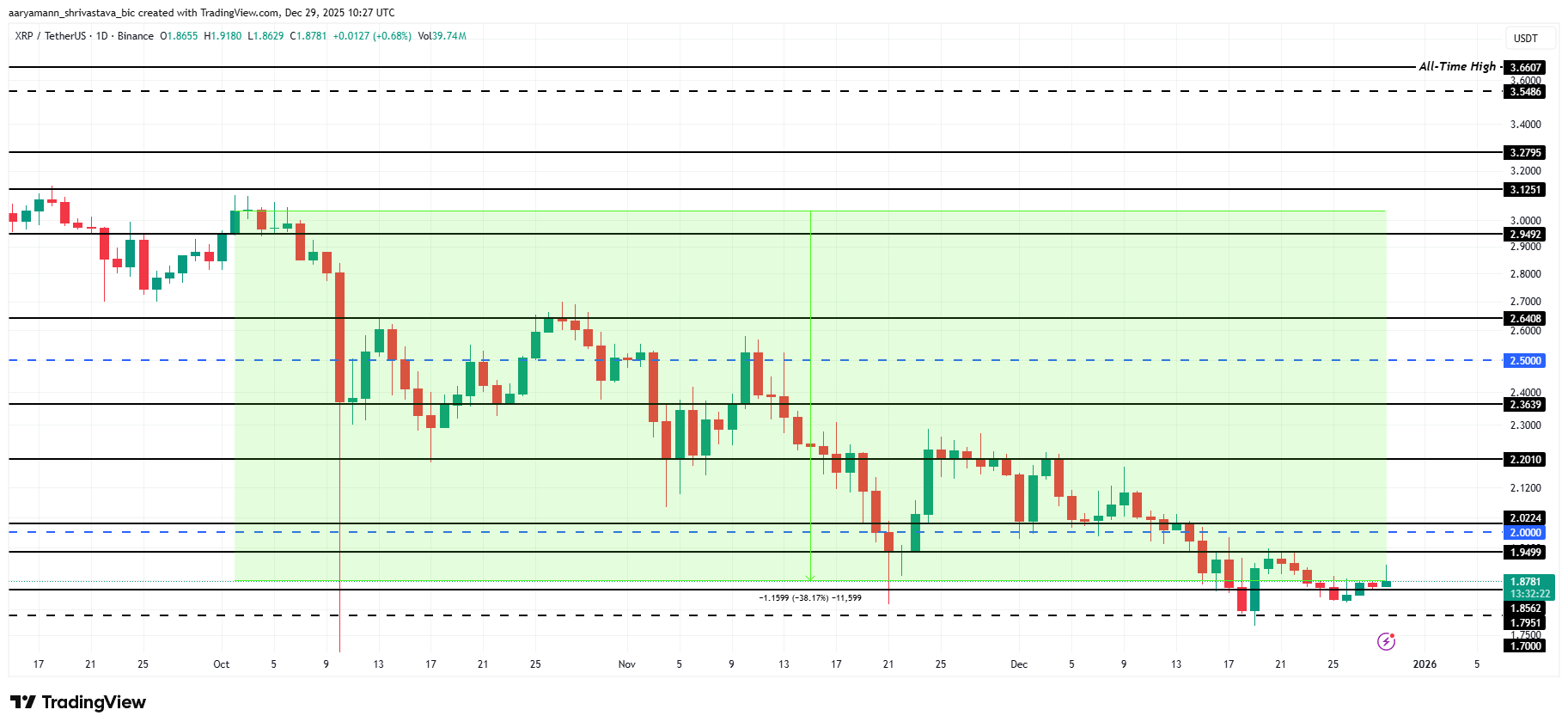
The Japanese rate hike briefly weighed on risk assets across Asia, yet XRP crypto demonstrated relative strength compared with some peers. TradingView analyst subhikarkar55, who tracks short-term liquidity zones, noted that XRP recovered quickly following the policy move: “XRP today has recovered even though Japan has raised rates,” he said, adding that short-term volatility could still push the price toward $1.8577 before liquidity-driven upside resumes.

XRP recovers to $1.92 despite Japan’s rate hike, with a potential dip to $1.8577 before bouncing toward $2.07. Source: subhikarkar55 on TradingView

From a technical perspective, XRP charts suggest that buyers continue to defend the mid-$1.80 zone. The analyst identified $2.0735 as a near-term recovery level if liquidity conditions improve, aligning with broader observations of improving market depth.

XRP Spot ETF Inflows Highlight Institutional Accumulation

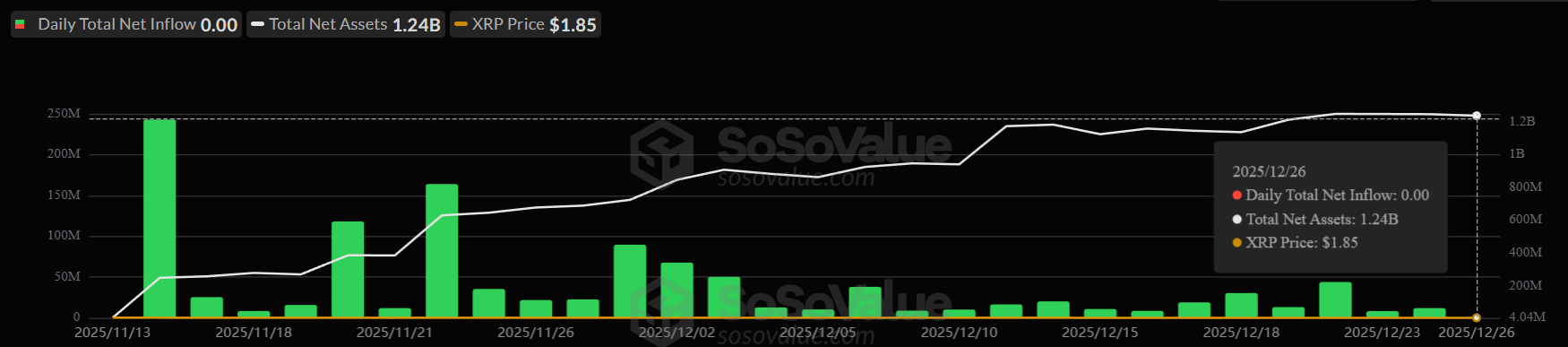
Institutional activity around XRP spot ETFs has been a key driver of market attention. According to SoSoValue data shared by technical analyst ChartNerd, six consecutive weeks of net inflows pushed total net assets to approximately $1.14 billion.

XRP Price Prediction: XRP Defies Japan Rate Shock While Spot ETF Inflows Strengthen Bullish Structure

XRP shows a hidden bullish divergence as 6 weeks of Spot ETF inflows push total net assets to $1.14B. Source: @ChartNerdTA via X

“The uncommon divergence between the declining price and the vertical climb in total net assets is what we would call a hidden bullish divergence,” ChartNerd explained.

ETF inflows are often viewed as a proxy for institutional positioning rather than retail speculation. While short-term price movements remain range-bound, this trend may indicate longer-term interest and structural support for XRP.

2017 Comparisons Resurface as XRP Community Sentiment Improves

Renewed optimism has also emerged within the XRP community, with visual comparisons drawn between current price structures and XRP’s historic 2017 breakout. Crypto commentator Steph Is Crypto highlighted similarities between past and present consolidation phases: “$XRP is about to explode, just like it did in 2017. Buckle up!”

2017 Comparisons Resurface as XRP Community Sentiment Improves

XRP may surge again, echoing its 2017 breakout; traders are gearing up for potential explosive momentum. Source: @Steph_iscrypto via X

The comparison references XRP’s surge from fractions of a cent to its all-time high near $3.84 during the 2017 bull cycle. However, market structure, liquidity conditions, and regulatory clarity today differ significantly from those of that period. Ripple’s resolution of SEC tensions has provided more confidence to institutional investors, but risks remain.

Final Thoughts

XRP’s recent price action reflects a market attempting to balance improving structural signals with ongoing macro uncertainty. Steady XRP spot ETF inflows, relative resilience after Japan’s rate move, and support near the mid-$1.80 range suggest longer-term interest in XRP remains intact. Analysts emphasize that short-term XRP price movements continue to depend heavily on liquidity conditions, Bitcoin trends, and broader macro developments.

Final Thoughts

XRP was trading at around 1.94, up 3.17% in the last 24 hours at press time. Source: XRP price via Brave New Coin

While comparisons to past bull cycles and institutional accumulation provide a constructive backdrop, XRP price forecasts remain cautious rather than conclusive. The near-term focus is on whether XRP can hold above the $1.85–$1.90 support zone and attract sufficient volume to challenge levels above $2. Until clearer confirmation emerges, market participants continue weighing data-driven signals against the inherent volatility of the crypto market.

Source link

20 12, 2025

XAU/USD Holds Near $4,338 as Big Banks Lift 2026 Targets Toward $5,000

By |2025-12-20T23:13:45+02:00December 20, 2025|Forex News, News|0 Comments


Gold prices are ending 2025 in rare territory: near record highs, up roughly two-thirds year-to-date, and with Wall Street forecasts increasingly clustering around the $4,500–$5,000 zone for 2026. As of Saturday, December 20, spot gold (XAU/USD) is hovering around $4,338 per ounce after Friday’s close, with the latest daily range showing buyers defending dips toward the $4,300 handle and sellers leaning against the mid-$4,350s. [1]

That near-term “pause” masks a bigger story: gold is being pulled between a firmer U.S. dollar and higher yields on one side, and rate-cut expectations, central-bank demand, and persistent geopolitical uncertainty on the other—an unusually supportive mix that has kept pullbacks shallow in late December trading. [2]

Where the gold price stands on 20.12.2025

  • Spot gold (XAU/USD): about $4,338.55 (latest quoted level following Friday’s session). [3]
  • Recent resistance zone:$4,350–$4,355, where multiple attempts have stalled. [4]
  • Key psychological support:$4,300 (a level repeatedly referenced in late-week trading commentary and technical setups). [5]
  • 2025 record high: around $4,381/oz (October peak), which remains the main “line in the sand” for breakout watchers into year-end. [6]

Friday’s session capped a steady week: Reuters reported spot gold around $4,347/oz late Friday in New York trading, with U.S. gold futures settling higher and gold posting a weekly gain. [7]

What’s driving gold right now

1) The Fed pivot narrative is still the backbone of the rally

Gold’s 2025 surge has been closely tied to expectations that U.S. policy rates will continue to ease and that real rates will be less restrictive in 2026. Reuters noted that traders have been leaning toward at least two 25-basis-point cuts next year, and recent U.S. data has kept that debate alive. [8]

Even within thin year-end conditions, gold has stayed resilient as investors digest softer inflation and a cooling jobs backdrop referenced in market coverage this week. [9]

2) A firmer dollar is a headwind—but not (yet) a deal-breaker

A stronger U.S. dollar typically makes gold more expensive for non-dollar buyers. Late-week reporting highlighted that the dollar recovered toward short-term highs, adding friction to gold’s attempts to push cleanly beyond the mid-$4,350s. [10]

FXStreet also flagged that holiday conditions can reduce liquidity and magnify swings—often producing sharp, headline-driven moves that do not always reflect a true change in trend. [11]

3) Central banks are still seen as the “anchor” bid

The most important structural element underpinning gold into 2026 is official-sector buying. Reuters’ mid-December outlook framed it plainly: central banks have been diversifying reserves away from dollar assets, providing a foundation for prices even when investor positioning becomes stretched. [12]

In the same Reuters report, J.P. Morgan’s metals strategy team estimated that to keep prices flat, the market needs roughly 350 tonnes per quarter of central bank and investment demand—and they forecast that buying could average 585 tonnes per quarter in 2026. [13]

That “official bid” theme is also colliding with politics. For example, Reuters reported that an Italian parliamentary committee backed language asserting that the Bank of Italy’s gold reserves “belong to the people,” a politically charged move that drew criticism from the European Central Bank over central bank independence. [14]

4) ETF demand and speculative positioning matter again

Gold’s 2025 rally has not been purely a central-bank story. The World Gold Council’s 2026 outlook highlighted that investment demand—especially through gold ETFs—has been a major driver during the current bull run. It cited about $77 billion of inflows this year, adding more than 700 tonnes to ETF holdings, and noted that total holdings are up by roughly 850 tonnes since May 2024. [15]

Meanwhile, a World Gold Council weekly monitor noted that increased ETF buying and rising bullish positioning in derivatives were among the forces pushing gold higher into December. [16]

5) Physical demand is shifting, not disappearing

High prices are changing the composition of consumer demand—especially in price-sensitive regions.

A Dec. 20 report in The Economic Times, citing the World Gold Council’s India commentary, said India’s gold consumption is projected to fall to 650–700 tonnes in 2025 from 802.8 tonnes in 2024, reflecting how the price surge has crimped volume demand even as investment buying remains comparatively firm. [17]

This matters for the 2026 outlook because softer jewellery volumes can reduce one source of baseline demand. But it can also reinforce gold’s shift from “consumer good” toward “financial asset,” especially when investment flows are strong.

Gold price forecast roundup: the $4,500–$5,000 debate for 2026

A striking feature of late-December research notes is how many major institutions now see gold staying elevated in 2026—though they disagree on how quickly it gets there and how volatile the path may be.

Here are the most widely cited targets and ranges circulating as of Dec. 20:

  • Goldman Sachs: base-case $4,900/oz by December 2026, citing structurally high central bank demand and cyclical support from Fed rate cuts (with upside risk if private-investor diversification broadens). [18]
  • Morgan Stanley: expects gold to reach $4,800/oz by Q4 2026, even if gains slow versus 2025; drivers include rate cuts, a weaker dollar, and Chinese retail demand. [19]
  • Deutsche Bank: raised its 2026 forecast to $4,450/oz, projecting a $3,950–$4,950 trading range next year and maintaining a $5,150 view for 2027. [20]
  • HSBC: sees a possible spike to $5,000/oz in the first half of 2026, while also warning of volatility and potential moderation later in 2026. [21]
  • Reuters’ mid-December survey-style outlook: cited analysts at J.P. Morgan, Bank of America and Metals Focus seeing $5,000/oz in 2026; it also reported J.P. Morgan expecting average prices above $4,600 in Q2 2026 and above $5,000 in Q4 2026, while Macquarie was more conservative at an average $4,225 in 2026. [22]

The common thread across these forecasts is that the “old” gold playbook—rates down, dollar down, gold up—has been joined by a newer structural narrative: reserve diversification, geopolitical fragmentation, and persistent tail risks that keep gold strategically relevant even when inflation is not spiking.

World Gold Council’s 2026 scenarios: what would push gold higher—or pull it back?

Rather than offering a single point forecast, the World Gold Council mapped out scenario-based ranges for 2026 performance (and explicitly described them as hypothetical illustrations rather than firm forecasts).

Key scenarios it outlined include: [23]

  • Macro consensus: roughly rangebound performance (about -5% to +5%).
  • “A shallow slip” (moderate slowdown / defensive rotation): gold could rise 5% to 15%.
  • “The doom loop” (deeper synchronized slowdown + higher geopolitical stress): gold could rise 15% to 30%, with ETF demand a key driver.
  • “Reflation return” (stronger growth + higher yields + stronger dollar): gold could fall 5% to 20% as opportunity cost rises and risk-on sentiment returns.

What makes these scenarios useful for investors and readers right now is that they translate the 2026 gold debate into a simple framework:

  • If rates fall faster than expected or risk appetite deteriorates, gold has a credible path to another leg higher. [24]
  • If yields stay high and the dollar strengthens materially, gold’s opportunity cost rises—and the market becomes vulnerable to a more meaningful correction. [25]

Technical and market analysis: why $4,300 is the level to watch

Late-December technical commentary has converged around a familiar structure: consolidation below resistance with buyers stepping in on dips.

  • FXStreet described gold as “treading water” between roughly $4,300 and $4,355, with price action consistent with consolidation rather than capitulation. [26]
  • A World Gold Council weekly monitor also referenced a triangle continuation pattern, noting that gold cleared resistance around $4,245/oz to confirm the pattern’s continuation in its review of the week. [27]

What that means in practical terms:

  • A sustained move above $4,355–$4,381 would refocus attention on record territory and reinforce breakout narratives. [28]
  • A break below $4,300 would not automatically end the bull market, but it would increase the odds of a deeper reset toward lower support zones that technicians have been monitoring beneath the triangle structure. [29]

Also worth noting: multiple market commentaries emphasized that late-December trading can be distorted by holiday liquidity, which can produce exaggerated moves around key levels like $4,300 and $4,350. [30]

Other gold-linked headlines in the mix

While macro drivers dominate, several policy and supply-side developments are also feeding into the broader gold narrative:

  • Italy’s gold reserves and central bank independence: Reuters reported that Italy’s parliamentary budget committee approved language saying the central bank’s gold reserves belong to “the people,” despite ECB objections. The Bank of Italy’s gold stockpile is 2,452 tonnes, valued at about $300 billion, per Reuters. [31]
  • Zimbabwe’s mining royalties: Reuters reported Zimbabwe reversed plans to double its gold royalty to 10%, keeping the 5% rate for prices between $1,200 and $5,000/oz, with the 10% rate applying only above $5,000/oz—a reminder that governments are watching the “$5,000 gold” narrative closely. [32]
  • India’s demand adjustment: As noted, India’s consumption outlook suggests volume pressure from high prices, even as investment demand holds up. [33]

These aren’t day-to-day price drivers the way U.S. rates are, but they help explain why gold is increasingly treated as a strategic asset class—intertwined with reserves, fiscal debates, and policy decisions.

What to watch next week for gold (and why it matters)

With markets reopening after the weekend, gold traders are likely to focus on three near-term themes:

  1. Fed expectations vs. dollar strength
    Gold can rally with a firm dollar for short stretches (safe-haven demand can overwhelm FX), but persistent dollar strength tends to cap upside. [34]
  2. Central bank and ETF flow signals
    The 2026 outlooks from major banks and the World Gold Council repeatedly circle back to the same idea: gold is most powerful when official buying and ETF investment demand reinforce each other. [35]
  3. Year-end liquidity and volatility risk
    Thin liquidity can turn routine moves into sharp spikes—especially around the obvious magnets: $4,300 support and $4,350–$4,380 resistance. [36]

Bottom line: gold enters 2026 expensive—but still structurally supported

As of Dec. 20, 2025, gold is consolidating near $4,338/oz after an extraordinary year. [37] The market is no longer just trading inflation headlines; it is pricing a broader set of forces—rate paths, reserve diversification, ETF demand, and geopolitics—that many forecasters believe can keep gold elevated into 2026. [38]

The key question for the months ahead is not whether gold remains important, but which driver dominates: a softer growth/risk-off backdrop that fuels the next leg higher—or a stronger dollar/higher-yield regime that finally forces a deeper reset after a historic run. [39]

References

1. www.investing.com, 2. www.fxstreet.com, 3. www.investing.com, 4. www.fxstreet.com, 5. www.fxstreet.com, 6. www.reuters.com, 7. www.reuters.com, 8. www.reuters.com, 9. www.reuters.com, 10. www.fxstreet.com, 11. www.fxstreet.com, 12. www.reuters.com, 13. www.reuters.com, 14. www.reuters.com, 15. www.gold.org, 16. www.gold.org, 17. m.economictimes.com, 18. www.reuters.com, 19. www.reuters.com, 20. www.reuters.com, 21. www.reuters.com, 22. www.reuters.com, 23. www.gold.org, 24. www.gold.org, 25. www.gold.org, 26. www.fxstreet.com, 27. www.gold.org, 28. www.fxstreet.com, 29. www.fxstreet.com, 30. www.fxstreet.com, 31. www.reuters.com, 32. www.reuters.com, 33. m.economictimes.com, 34. www.fxstreet.com, 35. www.reuters.com, 36. www.fxstreet.com, 37. www.investing.com, 38. www.reuters.com, 39. www.gold.org


Source link

20 12, 2025

MATIC Price Prediction: $0.45-0.52 Target Within 6 Weeks as Polygon Eyes $0.58 Resistance Break

By |2025-12-20T22:24:46+02:00December 20, 2025|Crypto News, News|0 Comments


Timothy Morano
Dec 20, 2025 13:33

MATIC price prediction suggests 18-37% upside potential to $0.45-$0.52 range if Polygon breaks key $0.58 resistance, with critical support holding at $0.35 level.


MATIC Price Prediction: Polygon Poised for Recovery Despite Mixed Signals

Polygon (MATIC) finds itself at a critical juncture as technical indicators paint a complex picture for the layer-2 scaling solution. Trading at $0.38, MATIC sits 70% below its 52-week high of $1.27, presenting both opportunity and risk for investors seeking clear direction.

MATIC Price Prediction Summary

MATIC short-term target (1 week): $0.41 (+8%) – Testing EMA resistance
Polygon medium-term forecast (1 month): $0.45-$0.52 range (+18-37%)
Key level to break for bullish continuation: $0.58 resistance
Critical support if bearish: $0.35 immediate, $0.33 strong support

Recent Polygon Price Predictions from Analysts

The latest MATIC price prediction from analysts reveals a striking divergence in market sentiment. MEXC News analysts project a medium-term Polygon forecast targeting $0.45-$0.52, representing potential gains of 18-37% within 4-6 weeks. This optimistic outlook hinges on MATIC’s ability to break above the crucial $0.58 resistance level while maintaining support above $0.35.

Contrasting sharply, WEEX Crypto News presents a bearish MATIC price prediction, forecasting a decline to $0.095450 in the short term. This represents a potential 75% drop from current levels, driven by persistent bearish sentiment and a Fear & Greed Index reading of 26, indicating extreme fear in the market.

Long-term projections from KuCoin analysts suggest a more ambitious Polygon forecast, with MATIC price targets ranging from $0.75-$1.25, potentially reaching $1.00 by late 2025. This bullish scenario depends heavily on increased layer-2 adoption and favorable regulatory developments.

MATIC Technical Analysis: Setting Up for Consolidation Break

Current Polygon technical analysis reveals MATIC trading below all major moving averages except the 7-day SMA ($0.37). The price sits at $0.38, just above the 52-week low of $0.37, suggesting strong support in this region. The RSI reading of 38.00 indicates neutral momentum, neither oversold nor overbought, providing room for movement in either direction.

The MACD histogram at -0.0045 shows bearish momentum, though the relatively small negative value suggests weakening selling pressure. MATIC’s position within the Bollinger Bands at 0.29 indicates the price is closer to the lower band ($0.31) than the upper band ($0.56), suggesting potential for mean reversion toward the middle band at $0.43.

Volume analysis shows $1.07 million in 24-hour trading on Binance, relatively modest for MATIC, indicating consolidation rather than decisive directional moves. The daily ATR of $0.03 reflects contained volatility, typical of accumulation phases.

Polygon Price Targets: Bull and Bear Scenarios

Bullish Case for MATIC

The optimistic MATIC price prediction scenario targets the $0.45-$0.52 range, aligning with analyst projections. For this Polygon forecast to materialize, MATIC must first reclaim the $0.42-$0.43 zone (EMA 26 and SMA 20), establishing it as support rather than resistance.

A successful break above $0.45 (SMA 50) would open the path toward the critical $0.58 resistance level. This MATIC price target represents the make-or-break point for bulls, as clearing this level could trigger momentum toward the Bollinger Band upper limit at $0.56 and potentially higher.

The bullish case strengthens if Bitcoin and Ethereum maintain stability, as layer-2 solutions like Polygon often benefit from increased network activity during crypto market recoveries.

Bearish Risk for Polygon

The bearish MATIC price prediction centers on a break below the $0.35 support level, which could trigger rapid descent toward $0.33 and potentially the extreme target of $0.095450 suggested by pessimistic analysts.

Key risk factors include continued macro headwinds, regulatory uncertainty affecting layer-2 protocols, and potential competition from emerging scaling solutions. A break below the 52-week low at $0.37 would invalidate the current consolidation pattern and suggest deeper correction ahead.

Should You Buy MATIC Now? Entry Strategy

Based on current Polygon technical analysis, a scaled entry approach appears prudent. Consider initial positions near current levels ($0.38) with additional accumulation on any dips toward $0.35 support.

Entry Strategy:
Conservative entry: $0.35-$0.36 range (support zone)
Aggressive entry: Current levels around $0.38
Stop-loss: $0.32 (below strong support at $0.33)
Target 1: $0.45 (medium-term MATIC price target)
Target 2: $0.52 (optimistic scenario)

Risk management remains crucial given the mixed signals. Position sizing should reflect the medium confidence level in current predictions, with stops placed below key support levels to limit downside exposure.

MATIC Price Prediction Conclusion

Our MATIC price prediction leans cautiously optimistic for the medium term, targeting the $0.45-$0.52 range within 4-6 weeks, representing 18-37% upside potential. This Polygon forecast assumes successful defense of the $0.35 support and eventual break above $0.43 resistance.

The key question for whether to buy or sell MATIC hinges on the $0.58 resistance level. A decisive break above this threshold would validate the bullish MATIC price prediction, while failure to hold $0.35 support would favor the bearish scenario.

Confidence Level: Medium – Mixed technical signals and divergent analyst views suggest cautious optimism while monitoring key levels for confirmation. The timeline for this prediction spans the next 4-6 weeks, with critical inflection points expected around year-end as crypto markets establish 2026 trends.

Image source: Shutterstock


Source link

20 12, 2025

Henry Hub Volatility, Europe’s TTF Moves, LNG Prices and 2026 Forecasts

By |2025-12-20T21:12:45+02:00December 20, 2025|Forex News, News|0 Comments


December 20, 2025 — Natural gas markets are closing out the week with a familiar winter tug-of-war: weather forecasts softening near-term heating demand, while LNG export pull and policy shifts keep longer-term supply anxiety alive. Friday’s last traded levels (with weekend markets largely closed) show a market that’s no longer panicking about immediate shortages—but also not comfortable enough to price in a smooth ride through 2026.

Below is a comprehensive roundup of the key natural gas news, forecasts, and analyses in circulation on 20.12.2025, spanning the U.S. Henry Hub benchmark, Europe’s TTF, and global LNG pricing—plus what major outlooks imply for 2026. [1]

Key takeaways driving natural gas prices right now

  • U.S. natural gas futures swung sharply as warmer weather outlooks through early January weighed on heating demand, even as LNG feedgas flows stayed near record highs. [2]
  • Europe’s gas market is balancing lower-than-last-year storage against a strong LNG inflow backdrop, while wind generation volatility continues to move day-to-day pricing. [3]
  • Asian spot LNG prices slid to around a 20‑month low as demand stayed muted and supply remained ample—an important signal for where “global clearing prices” may sit as new LNG capacity ramps up. [4]
  • For 2026, forecasts diverge—but the debate is clear: LNG export growth vs. production response will decide whether Henry Hub settles closer to $4… or pushes toward $5. [5]

U.S. natural gas prices: Henry Hub ends the week whipsawing

The U.S. benchmark (NYMEX) January Henry Hub contract ended Friday’s session higher at $3.984/MMBtu, with Reuters noting the move was supported by near-record LNG export flows even as the broader weather narrative stayed bearish. [6]

But the session’s headline was volatility. Another Reuters update circulating on Dec. 20 described futures easing toward a seven-week low near $3.879/MMBtu as forecasts turned warmer—before prices later firmed into the close. [7]

That intraday push-pull matters because it reveals what traders are currently pricing:

  • Warmth (bearish): Meteorologists’ outlooks showed much of the U.S. warmer than normal through Jan. 3, typically reducing residential and commercial heating demand. [8]
  • Exports (bullish): Feedgas flows to the eight major U.S. LNG plants averaged ~18.5 Bcf/d so far in December, above November’s prior record pace, according to LSEG data cited by Reuters. [9]
  • Output (bearish): Lower 48 production has been holding around 109.6 Bcf/d, matching November’s record-high monthly average, again per LSEG figures cited by Reuters. [10]

Storage and the “widow-maker” spread are flashing a comfort signal

One of the most telling signals right now isn’t the front-month contract—it’s the shape of the curve.

Reuters reporting highlighted that the March–April 2026 premium (a spread traders watch to express late-winter risk) was trading at an ultra-thin ~1 cent—a record low in that update. In industry slang, this March/April position is called the “widow-maker” because violent weather-driven moves have historically wiped out leveraged bets. [11]

When that spread compresses, it usually implies the market is less worried about end-of-winter scarcity—at least given current information. That doesn’t mean winter can’t surprise; it does mean the curve is currently pricing more “manageable winter” than “crisis.” [12]

On fundamentals, the U.S. Energy Information Administration’s weekly update (released Dec. 18, covering the week ending Dec. 17) also documented a 167 Bcf net storage withdrawal for the week ending Dec. 12, leaving total working gas stocks at 3,579 Bcf—about 1% above the five-year average but 2% below year-ago levels. [13]

LNG is still the center of gravity—and the headlines prove it

Even on days when weather models dominate U.S. price action, the LNG complex keeps “pulling” on the balance sheet.

U.S. LNG feedgas near records despite small plant fluctuations

Reuters noted that feedgas gains came despite small flow declines at Venture Global’s Calcasieu Pass and Plaquemines facilities in Louisiana in recent days (as described by analysts in that report). [14]

Meanwhile, the EIA weekly update recorded 33 LNG vessels departing U.S. ports between Dec. 11 and Dec. 17 with a combined capacity of 126 Bcf, underscoring how strong the shipping cadence has been heading into year-end. [15]

Major project development news: Energy Transfer pauses Lake Charles LNG

In one of the week’s most closely watched corporate signals, Energy Transfer said it was suspending development of its Lake Charles LNG export project in Louisiana, citing capital allocation priorities toward pipelines and concerns around the economics of an increasingly crowded LNG buildout cycle. Reuters reported the proposed facility was expected to have 16.45 mtpa of liquefaction capacity. [16]

Why this matters for prices: a pause or cancellation doesn’t change tomorrow’s molecule flows, but it alters the market’s long-run “oversupply” assumptions—especially if it becomes a pattern rather than a one-off. [17]

LNG shipping rates slide, changing arbitrage math

Another “plumbing” indicator moved this week: Atlantic LNG shipping rates fell below $100,000/day. LNG Prime reported Spark’s Atlantic freight assessment at $92,000/day (down $23,750 week-on-week), with Pacific rates also lower. [18]

Freight doesn’t just affect shipping companies—it can widen or narrow netbacks and influence whether marginal cargoes flow toward Europe or Asia when price spreads are thin. [19]

Europe natural gas: TTF edges up as wind fades—while storage stays the real story

Europe’s gas market has been trading a different narrative than the U.S.: less about one country’s weather model and more about the system-wide resilience of storage, LNG inflows, and power-sector swings.

A Reuters update republished on Dec. 20 reported the Dutch TTF front-month up around €0.70 to ~€28.05/MWh, with prices supported by weaker wind power output, which can increase gas-fired generation needs. [20]

Europe’s storage is lower than last year—yet targets were relaxed

A widely circulated ING analysis (also dated Dec. 20) emphasized that the EU entered the 2025/26 heating season below the original 90% storage target by Nov. 1—but crucially, it also noted the Commission’s earlier move to relax storage rules, reducing the pressure to buy “at any cost.” Storage peaked around 83% in mid-October, and by early December had fallen to about 75%, below both the five-year average and last year’s ~85% at that point. [21]

This is the key European tension:

  • Lower storage increases vulnerability to cold spells or supply disruptions. [22]
  • Relaxed targets and strong LNG imports reduce “panic bidding.” [23]

Complementing that view, LNG Prime cited Gas Infrastructure Europe (GIE) data showing EU storage at about 68.24% full on Dec. 17, down from 71.29% a week earlier and 77.10% on the comparable date in 2024. [24]

Speculators are heavily short TTF—setting up a squeeze risk

ING’s analysis flagged positioning as a risk factor: it said investment funds moved from net long 292 TWh in February to net short 50 TWh by end-November, with gross shorts at a reported record high in that dataset. The implication is straightforward: if Europe gets a true cold shock—or a major outage—short covering could amplify price spikes. [25]

Russian gas phase-out: Europe is legislating a long-term LNG dependence

While day-to-day prices may hinge on wind and temperature, Europe’s longer-term story is policy-driven.

On Dec. 17, Reuters reported the European Parliament approved the EU plan to phase out Russian gas imports by late 2027, with the agreement specifying a halt to Russian LNG imports by end‑2026 and pipeline gas by end‑September 2027 (pending final approval steps). [26]

This matters because it structurally increases Europe’s reliance on LNG—especially from the U.S.—even if the region continues adding renewables and trying to curb demand. [27]

Asia spot LNG: prices slide to a 20‑month low as demand stays soft

In global LNG, Asia is often the swing buyer. Right now, the swing looks… restrained.

A Reuters market wrap republished by Business Recorder reported spot LNG for February delivery into Northeast Asia around $9.50/MMBtu, described as roughly a 20‑month low, citing ample supply and subdued demand. [28]

The same update also pointed to a narrowing spread between Asia’s JKM and European pricing, with Europe’s LNG marker cited near $8.881/MMBtu in that report—tight spreads that reduce the incentive to chase the “best basin” and instead emphasize logistics, freight, and regas capacity. [29]

The China question is hanging over every 2026 LNG model

ING’s Dec. 20 analysis argued that China is “driving the weakness” in Asian LNG demand in 2025, citing factors including industrial softness, higher domestic production growth, and rising pipeline gas imports. [30]

Even if you disagree with every datapoint, the strategic point is hard to ignore: pipeline gas growth can displace LNG demand, and that changes global clearing prices when new LNG export trains arrive. [31]

The 2026 natural gas forecast debate: $4 or $5 for Henry Hub?

If 2025 was the year the market re-learned winter risk, 2026 is shaping up as the year of a new argument: how tight does the U.S. balance get once incremental LNG demand arrives—and how quickly does production respond?

EIA (STEO): Henry Hub averages about $4.01 in 2026

In the U.S. Energy Information Administration’s Short-Term Energy Outlook, the EIA forecasts Henry Hub at $4.01/MMBtu on average in 2026, with dry natural gas production around 109.11 Bcf/d and LNG exports averaging 16.3 Bcf/d. [32]

EIA also projects end-of-winter (end of March 2026) storage around 2,000 Bcf, reflecting an overall balance that is tighter than the ultra-loose periods of the last decade—but not necessarily “crisis tight.” [33]

Bernstein: “faith in five” and a $5 equilibrium thesis

A Bernstein outlook distributed via Investing.com on Dec. 20 argued it still “has faith in five,” framing $5/mcf Henry Hub as the new equilibrium after years nearer ~$3.50. The note emphasized demand growth led by LNG exports and power generation, claiming current U.S. LNG volumes are at record levels and “around 5 Bcf/d above a year ago.” [34]

On supply, Bernstein highlighted producer restraint—especially in Haynesville—arguing that depressed rig activity and lags between drilling and output mean much of 2026 supply is already “set” at lower levels, while Permian horizontal rig counts were noted as down about 20% from early-2025. [35]

Goldman Sachs: $4.60 in 2026 for U.S. gas; €29/MWh for TTF

In a separate 2026 commodities outlook, Reuters reported Goldman forecasts U.S. natural gas at $4.60/MMBtu for 2026 (and $3.80 for 2027), while projecting TTF at €29/MWh for 2026 (and €20 for 2027). [36]

Even though this was published Dec. 18, it’s still part of the active “current outlook stack” being referenced in market commentary on Dec. 20. [37]

The global macro overlay: trade flows and geopolitics are shifting the map

Two additional developments—while not Saturday headlines—remain directly relevant to price formation as of Dec. 20:

  • Eastern Mediterranean supply: Reuters reported Israel approved a major gas supply deal to Egypt, describing up to $35 billion in gas supply from Leviathan to Egypt through 2040 (or until contract values are fulfilled), a flow that could influence Egypt’s LNG import needs over time. [38]
  • Asia–U.S. LNG trade: Reuters columnist Clyde Russell reported Asia’s LNG imports from the U.S. are on track to fall in 2025 (to ~19.08 million tons from ~29.78 million in 2024), with China’s U.S. LNG imports down sharply—highlighting that geopolitics and tariffs can reroute cargoes even when “global gas” looks fungible on paper. [39]

What to watch next: the catalysts that can still move natural gas fast

Even with the curve signaling near-term comfort, natural gas remains one of the most headline-sensitive commodities. Here are the catalysts most likely to move prices coming out of Dec. 20:

  1. Weather model risk (U.S., Europe, Northeast Asia)
    A shift from “mostly warmer than normal” to sustained cold can quickly flip demand expectations—especially in late December and January. [40]
  2. LNG plant uptime and feedgas volatility
    With feedgas near record territory, even “small declines” can become big narratives if they persist—or if an outage hits a major facility during a cold snap. [41]
  3. Storage trajectory into late winter
    The market is watching not just weekly withdrawals, but where inventories may land by March—because that determines the refill burden for summer 2026. [42]
  4. Europe’s policy-driven demand for LNG
    Europe’s Russian gas phase-out timeline is becoming more defined, which raises the structural LNG “call” even if spot prices remain calm. [43]
  5. Positioning and potential squeezes (TTF especially)
    Heavy speculative shorts can be tinder; all it takes is a spark—cold, outage, or geopolitical surprise. [44]

Bottom line for Dec. 20, 2025

As of 20.12.2025, the natural gas market is sending a mixed but coherent message:

  • Near-term: Warmth and record output are keeping U.S. prices from breaking higher, even with LNG demand humming. [45]
  • Mid-term (2026): Forecasts cluster around $4+ Henry Hub, but a credible camp is arguing for a structurally higher equilibrium closer to $5, especially if LNG growth keeps arriving faster than production responds. [46]
  • Global: Asia’s weak spot LNG prices are currently acting as a cap on global gas exuberance, while Europe’s storage and policy path keep a risk premium lurking beneath the surface. [47]

References

1. www.tradingview.com, 2. www.hellenicshippingnews.com, 3. www.hellenicshippingnews.com, 4. www.brecorder.com, 5. www.eia.gov, 6. www.tradingview.com, 7. www.hellenicshippingnews.com, 8. www.hellenicshippingnews.com, 9. www.hellenicshippingnews.com, 10. www.hellenicshippingnews.com, 11. www.hellenicshippingnews.com, 12. www.hellenicshippingnews.com, 13. www.eia.gov, 14. www.hellenicshippingnews.com, 15. www.eia.gov, 16. www.reuters.com, 17. www.reuters.com, 18. lngprime.com, 19. lngprime.com, 20. www.hellenicshippingnews.com, 21. www.hellenicshippingnews.com, 22. www.hellenicshippingnews.com, 23. www.hellenicshippingnews.com, 24. lngprime.com, 25. www.hellenicshippingnews.com, 26. www.reuters.com, 27. www.reuters.com, 28. www.brecorder.com, 29. www.brecorder.com, 30. www.hellenicshippingnews.com, 31. www.hellenicshippingnews.com, 32. www.eia.gov, 33. www.eia.gov, 34. www.investing.com, 35. www.investing.com, 36. www.reuters.com, 37. www.reuters.com, 38. www.reuters.com, 39. www.reuters.com, 40. www.hellenicshippingnews.com, 41. www.hellenicshippingnews.com, 42. www.eia.gov, 43. www.reuters.com, 44. www.hellenicshippingnews.com, 45. www.hellenicshippingnews.com, 46. www.eia.gov, 47. www.brecorder.com


Source link

20 12, 2025

XRP Rebounds Toward $2 as Spot XRP ETFs Reach $1.2B AUM

By |2025-12-20T20:23:42+02:00December 20, 2025|Crypto News, News|0 Comments

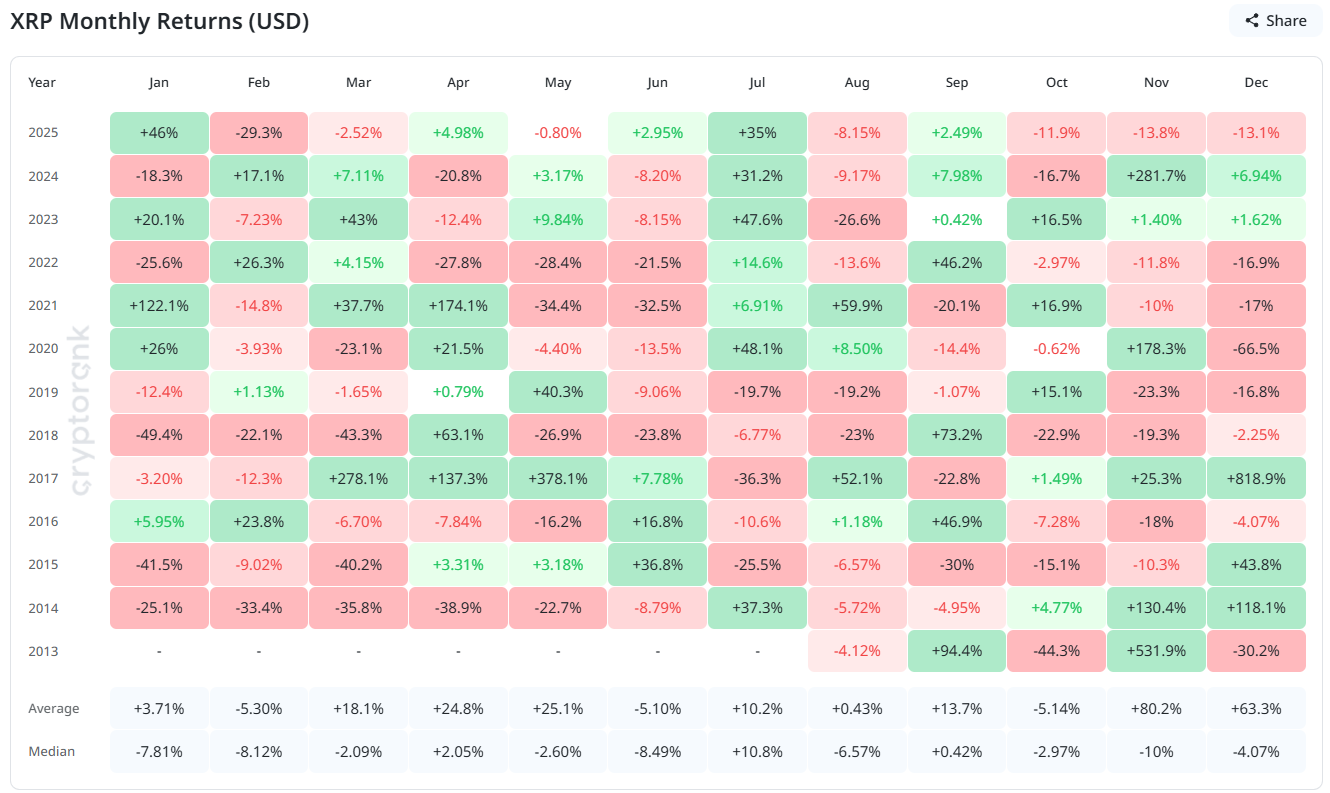
December 20, 2025 — XRP is attempting to claw back the psychologically important $2.00 level after a volatile week for crypto markets, with traders weighing steady U.S. spot XRP ETF inflows against signs that large holders may still be selling into strength.

As of this morning in the U.S., XRP was trading around $1.94 with roughly $1.90 billion in 24-hour trading volume, according to CoinDesk’s price tracker. [1]

XRP price today: where the market stands on December 20

XRP’s price action over the last 48 hours has been defined by a sharp dip, a quick rebound, and a renewed fight just under $2.00:

  • Current level: roughly $1.9–$2.0, depending on venue and timestamp. [2]
  • Key reference point: Friday saw XRP trade as low as around $1.77 before stabilizing. [3]
  • Today’s range: market data sources show XRP hovering in the high-$1.8s to mid-$1.9s, with $2.00 acting as the near-term ceiling. [4]

That puts XRP in a familiar posture for December: “close enough” to $2.00 to keep breakout traders interested, but not convincingly above it long enough to force broad repositioning.

The big XRP headlines published today

Several themes dominated XRP coverage on December 20, 2025, and they point to the same underlying tension: strong institutional-style demand signals, but a spot market that still struggles to trend.

Spot XRP ETFs: assets climb to roughly $1.2 billion

A key story today is that U.S. XRP exchange-traded funds have continued to attract inflows, pushing combined assets to about $1.2 billion, per Crypto Briefing’s aggregation of issuer and tracker data. [5]

That matters for two reasons:

  1. It keeps XRP in the “institutional narrative” lane at a time when risk appetite has been inconsistent.
  2. It provides a steady bid—but not necessarily a guaranteed price rally, especially if other holders use strength as an exit.

The “ETF vs real usage” debate intensifies

A separate analysis today argued that while ETF flows have been impressive, real adoption signals—payments volume, on-chain settlement, and Ripple’s ecosystem growth—may be more important to sustained upside than ETF headlines alone. [6]

The takeaway: ETFs can amplify demand, but they don’t automatically solve the bigger question—whether XRP’s role as a payments/liquidity asset is expanding fast enough to absorb supply when rallies appear.

Short-term technical outlook: resistance just under $2.00

Technical coverage published today highlighted local resistance around $1.96 and suggested that a close near that area could increase the odds of a push to $2.00. [7]

In other words, the chart watchers are aligned on a simple framework: reclaim $2.00 decisively or risk another fade back into the mid-$1.8s.

Why XRP can’t hold $2 even with ETF inflows

The most important “why” behind XRP’s current price behavior may be this: demand and supply can both be strong at the same time.

  • ETFs add consistent demand, especially if they’re seeing uninterrupted inflows. [8]
  • But other market participants can sell into that demand—profit-takers, legacy holders, or large wallets reducing exposure.

Some market commentary today explicitly points to selling pressure from large holders as a key reason the price hasn’t responded more aggressively. [9]
Even if you discount the most sensational takes, the broader point holds: ETF inflows don’t exist in a vacuum.

There’s also a practical market-structure issue: when $2.00 becomes a “magnet” level, it can attract short-term trading, not just long-term accumulation—meaning rallies can be sold quickly if conviction is weak.

Macro backdrop: inflation data sparked a bounce, but confidence remains fragile

XRP’s December moves aren’t happening in isolation. This week’s crypto rebound has been tied to shifting expectations around inflation and rate cuts—but commentary from mainstream market coverage has stressed that the reaction has been erratic.

Barron’s reported that crypto—including XRP—bounced after U.S. inflation data, but analysts cautioned that sellers still appeared to be in control and macro uncertainty remained elevated. [10]

That matters for XRP because:

  • In risk-on conditions, capital often rotates into liquid alts.
  • In risk-off conditions, traders tend to reduce exposure or concentrate in fewer assets—sometimes leaving XRP more range-bound even when headlines improve.

The XRP regulatory narrative: clearer than before, but still a market driver

Even in late 2025, XRP remains unusually sensitive to regulation and “market access” stories, for one simple reason: those headlines directly influence who can buy and how they can buy.

SEC–Ripple case: largely resolved in 2025

Reuters reported earlier this year that the SEC and Ripple agreed to end the long-running lawsuit, leaving a $125 million fine intact and concluding one of crypto’s most watched legal battles. [11]

That legal clarity has been widely treated as a structural positive for XRP’s U.S. accessibility.

Spot XRP ETFs: the access point that changed the conversation

Multiple reports in recent weeks described U.S. spot XRP ETFs as a major milestone, with coverage noting a first approval and launch in November 2025. [12]

By December 20, the market’s key question isn’t whether ETFs exist—it’s whether ETF demand can outpace the supply being sold into rallies.

Ripple and U.S. banking integration: trust bank charter approvals

Another Ripple-related regulatory development came from the banking side. Reuters reported on December 12, 2025 that Ripple was among crypto firms receiving preliminary approval from the OCC to establish national trust banks, a move viewed as further integrating digital assets into the U.S. financial system. [13]

While not an “XRP price catalyst” by itself, the story reinforces the broader theme: institutional rails are expanding, which tends to keep XRP in institutional watchlists.

XRP technical levels traders are watching right now

Today’s analysis across outlets converges on a few straightforward levels and signals:

  • Resistance zone: around $1.96 to $2.00, with $2.00 the headline level. [14]
  • Key support area: the $1.80 region has mattered recently, with markets reacting strongly when XRP dipped into the high-$1.7s. [15]

One risk for bulls is that XRP’s rebound is occurring alongside comments that trading activity/volume can fade even as price rises, which can make breakouts less durable. [16]

XRP price forecast: what predictions and outlooks say on December 20

Forecasting XRP is inherently uncertain—especially after a year marked by sharp swings. Still, today’s forecast landscape has two clear layers: algorithmic short-term projections and narrative-driven longer-term outlooks.

Short-term forecasts stay modest

Several widely used prediction pages show XRP expectations clustered close to current levels over the next few days/weeks—generally small moves rather than explosive targets:

  • Binance’s prediction table for late December keeps XRP in the mid-$1.9s range. [17]
  • CoinCodex similarly shows near-term forecasts around the high-$1.8s to mid-$1.9s. [18]

These models may be useful as sentiment indicators, but they are not guarantees—and different methodologies often disagree.

2026 outlooks focus more on catalysts than price targets

Mainstream investing commentary published today emphasized themes rather than precise numbers, pointing to:

  • The potential for spot XRP ETF growth to gradually increase demand as more investors gain regulated access. [19]
  • Continued efforts to expand XRP-linked infrastructure and tokenization initiatives as possible tailwinds for 2026. [20]

The gap between these “catalyst outlooks” and the relatively flat short-term model forecasts captures the market’s current mood: investors may believe the long-term story is improving, but they still want price confirmation.

What matters next for XRP price

For readers tracking XRP into year-end, the most important near-term signals are straightforward:

  1. Does XRP reclaim and hold $2.00? This remains the psychological and technical pivot that dominates commentary. [21]
  2. Do spot XRP ETFs keep adding assets at the current pace? Today’s $1.2B AUM figure is a major reference point heading into late December. [22]
  3. Is selling pressure from larger holders fading or persisting? This is the variable that could determine whether ETF demand translates into a sustained trend. [23]
  4. Does macro sentiment stabilize? Crypto’s reaction to inflation and rate expectations has been choppy, and that volatility can cap rallies. [24]

References

1. www.coindesk.com, 2. www.coindesk.com, 3. www.investing.com, 4. www.investing.com, 5. cryptobriefing.com, 6. cryptoslate.com, 7. u.today, 8. cryptobriefing.com, 9. coinpedia.org, 10. www.barrons.com, 11. www.reuters.com, 12. finance.yahoo.com, 13. www.reuters.com, 14. u.today, 15. www.investing.com, 16. u.today, 17. www.binance.com, 18. coincodex.com, 19. www.fool.com, 20. www.nasdaq.com, 21. u.today, 22. cryptobriefing.com, 23. coinpedia.org, 24. www.barrons.com

Source link

20 12, 2025

Trend vs. tradition: Matcha’s revival takes hold in Indonesia – Food

By |2025-12-20T18:28:39+02:00December 20, 2025|Dietary Supplements News, News|0 Comments


atcha, the traditional Japanese green tea powder, has seen a new resurgence in 2025 with matcha bars popping up in Jakarta and other big cities in Indonesia offering matcha lattes as well as bakeries and pastry shops offering matcha-infused confectioneries.

The drink, with its iconic deep green color and frothy foam, has taken the internet by storm by popping up on social media such as Instagram reels or TikTok videos.

The viral trend seems to be backed by real-life data as well, as according to Google’s Year in Search 2025 recipes for matcha is the first among top ten searches for recipes in Indonesian language, although Google did not fully disclose the number of searches.

A recent YouGov poll hints at the impact of matcha to drinking trends in Southeast Asia, specifically Indonesia, Singapore and Thailand, as people leaned more to teas than coffee, with 64 percent of Indonesians say they drink both tea and coffee, 17 percent drink only tea, compared to 12 percent only drinking coffee and 7 drinking neither according to a poll of 2,036 Indonesians polled online by YouGov on May 8-12.

Around half of Indonesians, 53 percent, say they are familiar with matcha drinks and desserts, although over half of Indonesians, 59 percent, are also unaware of the ongoing matcha shortage, which is driven by soaring global demand and severe heatwaves.

The trend is also seen worldwide as according to the Japanese Tea Production Association, in 2024 Japan produced 5,336 tonnes of tencha (dried tea leaves) used for the making of matcha, a nearly 2.7-fold increase from ten years earlier.

Japan’s green tea exports, including matcha, also rose 25 percent by value to 36.4 billion yen (US$252 million) in 2024, according to Japanese government data.


Source link

20 12, 2025

BTCUSD Rockets to Over $88,000: Is $92,000 the Next Target?

By |2025-12-20T18:22:21+02:00December 20, 2025|Crypto News, News|0 Comments

Bitcoin (BTCUSD) surged to $88,092.65 today, marking a significant 3.08% increase and highlighting its potential march towards $92,000. Let’s delve into the factors driving this upward momentum and analyze the technical indicators to predict what might come next.

Recent Price Movement and Volume Analysis

Bitcoin’s current price of $88,092.65 represents an increase of $2,632.63 or 3.08% in just one day. The volume stood at 709,215,822, surpassing the average of 598,293,187, indicating heightened trading activity. This sharp rise positions BTCUSD steadily towards the psychological barrier of $92,000.

Technical Indicators Insight

Analyzing the technical indicators, Bitcoin’s RSI is at 36.33, suggesting it’s approaching oversold conditions. Meanwhile, the MACD shows a histogram of 90.94, indicating bullish momentum. With an ADX of 39.19, the current trend strength is solid. Importantly, the Bollinger Bands show resistance levels at the upper limit of $94,762.08, offering a target for bullish traders.

Market Sentiment and Forecasts

Market forecasts suggest a potential monthly target of $91,771.03, with quarterly predictions reaching as high as $137,052.42. These forecasts, however, emphasize caution due to possible macroeconomic shifts or regulatory changes that could affect market conditions. Meyka AI provides these insights, showcasing how AI analytics contribute to precise market predictions.

Comparative Analysis with Historical Peaks

Looking back, Bitcoin’s yearly high was $126,296. Current momentum reflects an 18.43% increase year-to-date, highlighting a recovery trajectory since its annual low of $74,420.69. Despite historical volatility, BTCUSD’s current recovery phase appears robust.

Final Thoughts

Bitcoin’s recent surge brings it within striking distance of $92,000. However, cautious optimism is advised given potential market fluctuations. Keep an eye on volume and trend indicators for potential shifts, and remember, forecasts can change due to macroeconomic conditions or unexpected events in the crypto space.

FAQs

What is the current BTCUSD price?

The current BTCUSD price is $88,092.65, reflecting a 3.08% increase today with a change of $2,632.63 from the previous close of $85,460.02. BTCUSD

What are key technical indicators for BTCUSD right now?

Key indicators include an RSI of 36.33, a MACD histogram of 90.94, and an ADX of 39.19, suggesting a strong trend and potential for further growth toward the Bollinger upper band of $94,762.08.

What are the BTCUSD price forecasts?

Monthly forecasts suggest a price of $91,771.03, with quarterly predictions reaching $137,052.42. However, these forecasts are subject to change based on macroeconomic conditions and developments in the crypto market.

How has BTCUSD performed over the past year?

BTCUSD has increased by 18.43% year-to-date, recovering from a yearly low of $74,420.69 to current levels near $88,000, reflecting ongoing strength despite past volatility.

What factors could impact Bitcoin’s price movement?

Factors include macroeconomic shifts, regulatory changes, and unexpected global events that may alter market conditions. It’s essential to track these elements as they can significantly sway Bitcoin’s price trajectory.

Disclaimer:


Cryptocurrency markets are highly volatile. This content is for informational purposes only.
The Forecast Prediction Model is provided for informational purposes only and should not be considered financial advice.
Meyka AI PTY LTD provides market data and sentiment analysis, not financial advice.
Always do your own research and consider consulting a licensed financial advisor before making investment decisions.


Source link

20 12, 2025

Gold (XAU/USD) Price Forecast: Six-Day Tight Range – Low Volatility Consolidation Persists

By |2025-12-20T17:10:33+02:00December 20, 2025|Forex News, News|0 Comments


Expected Support Test

Given recent low volatility, a pullback to test support near the 10-day average at $4,282 and rising, before a decisive advance, wouldn’t be surprising. Resistance has been seen near the completion of a 100% measured move at $4,356, which matches the price advance in the first measured move as marked on the chart. A failure of the 20-day average could see a test of support near the 20-day average, now at $4,234.

Upside Breakout Requirements

If the short-term trend high from this week can be exceeded, then a breakout to a new record high above $4,381 becomes a possibility. A 127.2% measured move projection first targets $4,454. Then, a 127.2% extension of the more recent bearish correction in October points to a potential initial upside target of $4,516. The extension target carries more weight as it is derived from a larger pattern.

Weekly Perspective

On the weekly timeframe, a weekly breakout triggered this week above last week’s high of $4,353, but it will not confirm today as the weekly close will likely be below that weekly high. This is consistent with the lack of bullish momentum and sideways movement recently, showing a lack of strong conviction from buyers.

Outlook

Gold’s multi-week uptrend stays intact above rising averages and trendlines, but persistent low volatility and an unconfirmed weekly breakout highlight absent buyer conviction. Expect a likely dip to the 10-day $4,282 or 20-day $4,234 before resolution; clearance of $4,375–$4,381 unlocks $4,454–$4,516, while loss of the 10-day raises short-term seller risk.

For a look at all of today’s economic events, check out our economic calendar.


Source link

20 12, 2025

M&A Update: Better Being Co. AcquireD

By |2025-12-20T16:27:34+02:00December 20, 2025|Dietary Supplements News, News|0 Comments


Salt Lake City, UT—A syndicate of global investors have agreed to acquire Better Being Co., the vertically integrated manufacturer, marketer, and distributor of branded dietary supplements and personal care products including Solaray, Zhou Nutrition, KAL, Dynamic Health, ZAND, NutraBiogenesis, Heritage Store, and Lifeflo. Led by growth equity and buyout firm, Snapdragon Capital Partners, LLC, with a financing solution provided by funds managed by Strategic Value Partners, LLC (together, “SVP”) and its affiliates, full ownership was obtained through the purchase of stock owned by HGGC, LLC.

“SVP is pleased to join Snapdragon in supporting Better Being in its next phase of growth,” said Brian Himot, Managing Director and Head of Structured Capital at SVP. “We see excellent potential in Better Being’s vertically integrated platform and believe that its consistent focus on product quality and innovation will collectively serve to differentiate its products further to meet evolving consumer wellness needs.”

Ushering in a new era

Snapdragon’s investment in the natural products company began in 2019 and with its latest acquisition, marks the end of HGGC’s ownership stake in Better Being, which started in 2017. “Since we first partnered with Better Being in 2017, the Company has made tremendous strides in its evolution into the globally competitive wellness platform it is today,” said HGGC. “We are proud of all that we have achieved together through our collaboration and look forward to watching the continued success of the entire Better Being team as they build on this strong progress in the years ahead.”

Under the supervision of lead financial advisor William Blair, co-financial advisor William Hood & Company, and legal counsel of Kirkland & Ellis LLP, Better Being was able to secure a committed financial reserve, agreed to between management, investors, and lenders to provide additional capital for near-term acquisitions that will expand the brand portfolio and global consumer reach. 

“Since Snapdragon’s minority investment in Better Being in 2019, our conviction in the businesses has only grown, and we see this transaction as the natural next step in our partnership,” shared Mark Grabowski, Managing Partner of Snapdragon. “Better Being has seen two years of explosive growth led by the Company’s flagship Solaray brand, now sold in over 85 countries. We’re excited to support Better Being’s exceptional management team as they continue to execute against their vision of building a truly global platform for health and wellness products.”

Better Being CEO Brian Slobodow expressed his gratitude for HGGC’s eight-year commitment to the company and expressed optimism for what’s to come for the organization and its employees. “Today’s announcement is an important milestone for the nearly 1,000 Better Being team members and the generations of consumers that have trusted our brands to meet their wellness needs every day. We could not be more appreciative to our former investment partners, HGGC, for their years of guidance and support. We are equally appreciative of our new investment syndicate for the commitment they have shown to our winning strategy and the management team behind it. We have been operating with focus and discipline since I partnered with President and Chief Commercial Officer Kyle Garner to take the Company forward. We are a values-driven organization demonstrating a focus on respect, wellness, accountability, transparency, collaboration, and heritage-driven leadership. We’re excited to work with our new partners on this next phase of growth.”

RelatedM&A Update: Carbyne Equity Partners Acquires SuanNutra

Church & Dwight to Sell Vitamin, Minerals, and Supplements Business to Piping Rock


Source link

20 12, 2025

Will MATIC’s Remarkable Surge Reach $1?

By |2025-12-20T16:21:37+02:00December 20, 2025|Crypto News, News|0 Comments

BitcoinWorld

Polygon Price Prediction 2025-2030: Will MATIC’s Remarkable Surge Reach $1?

As the cryptocurrency market continues to evolve, investors are eagerly watching Polygon (MATIC) and wondering about its future trajectory. With the Polygon network establishing itself as a leading Layer 2 scaling solution for Ethereum, the question on everyone’s mind is: Will MATIC price surge to $1 and beyond in the coming years? This comprehensive analysis provides detailed Polygon price predictions from 2025 through 2030, examining the fundamental drivers that could propel MATIC’s remarkable growth.

What is Polygon and Why Does MATIC Price Matter?

Polygon, formerly known as Matic Network, has transformed from a simple scaling solution into a full-fledged multi-chain ecosystem. The Polygon network addresses Ethereum’s scalability challenges by providing faster and cheaper transactions while maintaining security. MATIC serves as the native utility token powering this ecosystem, used for governance, staking, and paying transaction fees. Understanding the Polygon price prediction requires examining both technical fundamentals and market dynamics.

Current MATIC Price Analysis and Market Position

Before diving into future predictions, let’s examine MATIC’s current market position. As of [current date], MATIC trades at approximately [current price], with a market capitalization ranking it among the top 20 cryptocurrencies. The Polygon network has demonstrated impressive growth metrics:

  • Over 1 million daily active addresses
  • Thousands of decentralized applications built on the platform
  • Strategic partnerships with major companies including Meta (formerly Facebook) and Stripe
  • Consistent development activity and protocol upgrades

Key Factors Influencing Polygon Price Prediction

Several critical elements will determine whether MATIC price reaches $1 and beyond. These factors provide the foundation for our Polygon price prediction analysis:

Factor Impact on MATIC Price Timeframe
Ethereum Ecosystem Growth High Positive Correlation Long-term
Polygon Network Adoption Direct Price Driver Medium to Long-term
Cryptocurrency Market Cycles Significant Influence All Timeframes
Regulatory Developments Variable Impact Ongoing
Technical Upgrades (Polygon 2.0) Potential Catalyst 2024-2025

Detailed MATIC Price 2025 Prediction

Our MATIC price 2025 prediction considers both bullish and conservative scenarios. By 2025, the Polygon network is expected to have fully implemented its Polygon 2.0 vision, creating what developers call the “Value Layer of the Internet.” This ambitious upgrade could significantly impact MATIC’s valuation:

  • Bullish Scenario: $1.20 – $1.80 (Requires strong crypto bull market and massive Polygon network adoption)
  • Base Scenario: $0.80 – $1.20 (Assumes steady growth and successful Polygon 2.0 implementation)
  • Conservative Scenario: $0.50 – $0.80 (Accounts for market volatility and potential challenges)

The key to achieving higher MATIC price levels in 2025 will be widespread adoption of Polygon’s zkEVM technology and expansion into new use cases beyond DeFi and NFTs.

MATIC Future Price: 2026-2030 Long-term Outlook

Looking beyond 2025, our MATIC future price analysis becomes increasingly dependent on macro trends in the cryptocurrency investment landscape. The period from 2026 to 2030 could see Polygon either cement its position as a leading blockchain infrastructure provider or face increased competition from emerging Layer 2 solutions.

2026 Polygon Price Prediction

By 2026, the full effects of Polygon 2.0 should be evident in network metrics. If successful, this could push MATIC price to:

  • Potential Range: $1.50 – $2.50
  • Key Drivers: Enterprise adoption, interoperability features, DeFi 2.0 growth

2028-2030 Long-term Forecast

The 2028-2030 period represents the most speculative part of our Polygon price prediction. By this time, blockchain technology may have achieved mainstream adoption, potentially positioning Polygon as critical internet infrastructure:

  • 2030 Optimistic Target: $5.00 – $8.00
  • Realistic Range: $2.50 – $4.00
  • Conservative Estimate: $1.50 – $2.50

These long-term MATIC future price projections assume continued technological innovation and growing recognition of Polygon’s value proposition in the broader cryptocurrency investment ecosystem.

Will MATIC Reach $1? Critical Analysis

The question “Will MATIC reach $1?” dominates discussions among investors. Based on our analysis, MATIC has a strong probability of reaching and potentially exceeding $1 during the 2025-2026 timeframe, provided these conditions are met:

  1. The broader cryptocurrency market enters a sustained bull cycle
  2. Polygon maintains its competitive advantage in Layer 2 scaling
  3. Network activity continues growing at current or accelerated rates
  4. Successful implementation of Polygon’s roadmap, particularly Polygon 2.0

Historical price action shows MATIC previously reached an all-time high near $2.92 in December 2021, demonstrating the token’s potential during favorable market conditions.

Risks and Challenges for Polygon Network Growth

While our Polygon price prediction presents optimistic scenarios, investors must consider potential risks:

  • Competition: Emerging Layer 2 solutions and Ethereum’s own scaling improvements
  • Regulatory Uncertainty: Changing global cryptocurrency regulations
  • Technology Risks: Potential vulnerabilities in complex blockchain systems
  • Market Volatility: Cryptocurrency’s inherent price fluctuations
  • Adoption Hurdles: Slower-than-expected enterprise and consumer adoption

Investment Strategies for MATIC Price Movements

For those considering Polygon as a cryptocurrency investment, several strategies can help navigate potential MATIC price movements:

  • Dollar-Cost Averaging: Regular investments regardless of price fluctuations
  • Staking MATIC: Earning rewards while supporting network security
  • Portfolio Diversification: Limiting Polygon exposure to appropriate risk levels
  • Technical Analysis: Monitoring key support and resistance levels
  • Fundamental Research: Staying informed about Polygon network developments

FAQs About Polygon Price Prediction

What is the highest price MATIC can reach by 2025?
Based on our MATIC price 2025 prediction, the highest realistic price target ranges between $1.50 and $1.80 in a strong bull market scenario.

How does Polygon compare to other Layer 2 solutions?
Polygon offers a more comprehensive ecosystem than many competitors, with multiple scaling solutions including PoS chain, zkEVM, and Supernets. The network’s partnership with Ethereum and support from Coinbase through its Base network collaboration strengthens its position.

Who are the key people behind Polygon?
Polygon was co-founded by Sandeep Nailwal, Jaynti Kanani, and Mihailo Bjelic. The project has attracted notable advisors including Anatoly Yakovenko, co-founder of Solana.

What companies are building on Polygon?
Major companies building on Polygon include Meta (for digital collectibles), Stripe (for crypto payments), Reddit (for community points), and Instagram (for NFT integrations).

Is MATIC a good long-term investment?
MATIC presents compelling long-term potential as a cryptocurrency investment due to Polygon’s established position in the Layer 2 ecosystem, active development, and growing adoption. However, like all cryptocurrencies, it carries significant risk and volatility.

Conclusion: The Future of Polygon and MATIC Price Trajectory

Our comprehensive Polygon price prediction analysis suggests MATIC has legitimate potential to reach $1 and possibly exceed this milestone in the coming years. The Polygon network’s technological advantages, growing ecosystem, and strategic positioning within the Ethereum landscape create a strong foundation for future growth. However, investors should approach MATIC price predictions with balanced perspective, recognizing both the remarkable opportunities and inherent risks in cryptocurrency investment.

The journey toward higher MATIC price levels will depend on continued execution of Polygon’s vision, broader market conditions, and the network’s ability to maintain its competitive edge. As the blockchain space evolves, Polygon’s adaptability and innovation will ultimately determine whether our MATIC future price predictions materialize.

To learn more about the latest cryptocurrency markets trends, explore our article on key developments shaping Polygon, Ethereum, and other major blockchain projects in the evolving landscape of institutional adoption and technological innovation.

This post Polygon Price Prediction 2025-2030: Will MATIC’s Remarkable Surge Reach $1? first appeared on BitcoinWorld.


Source link

Go to Top