The main category of Forex News.
You can use the search box below to find what you need.
[wd_asp id=1]
The main category of Forex News.
You can use the search box below to find what you need.
[wd_asp id=1]
Natural gas price reached $6.150 level yesterday, facing strong negative pressures, which forces it to lose its gains by surpassing the bullish channel’s levels and its stability below $4.100 support.
All that confirms that the price enters a state of instability, to suggest the neutrality until confirm the main trend in the upcoming trading, note that the price attempt to decline below $3.450 level might force it to suffer new losses by targeting 61.8%Fibonacci corrective level at $3.030, while regaining the bullish bias requires providing a new daily close above $4.220 level.
The expected trading range for today is between $3.450 and $4.250
Trend forecast: Neutral
Copper price reached $5.9700 level yesterday to settle below it, affected by the continuation of the contradiction between the main indicators, especially by stochastic exit from the overbought level, which forces it to fluctuate in sideways range by its stability near $5.8300.
We expect the price to be affected by a state of instability due to the ongoing divergence of the main indicators, despite the presence of an opportunity to edge toward $5,720.00. However, exposure to negative pressure may force it to retest the solid support near $5,510.00, while surpassing this level and holding above it will reinforce the chances of recording new gains that might extend towards $6.1200 and $6.2400.
The expected trading range for today is between $5.7500 and $6.000
Trend forecast: Fluctuating
Copper price reached $5.9700 level yesterday to settle below it, affected by the continuation of the contradiction between the main indicators, especially by stochastic exit from the overbought level, which forces it to fluctuate in sideways range by its stability near $5.8300.
We expect the price to be affected by a state of instability due to the ongoing divergence of the main indicators, despite the presence of an opportunity to edge toward $5,720.00. However, exposure to negative pressure may force it to retest the solid support near $5,510.00, while surpassing this level and holding above it will reinforce the chances of recording new gains that might extend towards $6.1200 and $6.2400.
The expected trading range for today is between $5.7500 and $6.000
Trend forecast: Fluctuating
Copper price reached $5.9700 level yesterday to settle below it, affected by the continuation of the contradiction between the main indicators, especially by stochastic exit from the overbought level, which forces it to fluctuate in sideways range by its stability near $5.8300.
We expect the price to be affected by a state of instability due to the ongoing divergence of the main indicators, despite the presence of an opportunity to edge toward $5,720.00. However, exposure to negative pressure may force it to retest the solid support near $5,510.00, while surpassing this level and holding above it will reinforce the chances of recording new gains that might extend towards $6.1200 and $6.2400.
The expected trading range for today is between $5.7500 and $6.000
Trend forecast: Fluctuating
Silver (XAG/USD) price rallies sharply more than 8% on Monday, as geopolitical tensions and broad US Dollar weakness push the grey metal to record highs, past $110.00, hitting a record high of $117.74, shy of challenging the $120.00 mark. At the time of writing, XAG/USD trades at $112.40.
The non-yielding metal remains upward biased even though the Relative Strength Index (RSI) is overbought, yet it remains shy of reaching the most extreme conditions. Nevertheless, the more volatile and vertical upward moves in Silver increase the chances for a pullback.
If XAG/USD clears $120.00 per troy ounce, this opens the door for challenging the $130.00 mark. On further strength, $150.00 is up next. Conversely, initial support is seen at $100.00. If cleared, the next demand zone would be the January 23 daily low of $96.14, before Silver’s dives toward the $90.00 region.
Silver is a precious metal highly traded among investors. It has been historically used as a store of value and a medium of exchange. Although less popular than Gold, traders may turn to Silver to diversify their investment portfolio, for its intrinsic value or as a potential hedge during high-inflation periods. Investors can buy physical Silver, in coins or in bars, or trade it through vehicles such as Exchange Traded Funds, which track its price on international markets.
Silver prices can move due to a wide range of factors. Geopolitical instability or fears of a deep recession can make Silver price escalate due to its safe-haven status, although to a lesser extent than Gold’s. As a yieldless asset, Silver tends to rise with lower interest rates. Its moves also depend on how the US Dollar (USD) behaves as the asset is priced in dollars (XAG/USD). A strong Dollar tends to keep the price of Silver at bay, whereas a weaker Dollar is likely to propel prices up. Other factors such as investment demand, mining supply – Silver is much more abundant than Gold – and recycling rates can also affect prices.
Silver is widely used in industry, particularly in sectors such as electronics or solar energy, as it has one of the highest electric conductivity of all metals – more than Copper and Gold. A surge in demand can increase prices, while a decline tends to lower them. Dynamics in the US, Chinese and Indian economies can also contribute to price swings: for the US and particularly China, their big industrial sectors use Silver in various processes; in India, consumers’ demand for the precious metal for jewellery also plays a key role in setting prices.
Silver prices tend to follow Gold’s moves. When Gold prices rise, Silver typically follows suit, as their status as safe-haven assets is similar. The Gold/Silver ratio, which shows the number of ounces of Silver needed to equal the value of one ounce of Gold, may help to determine the relative valuation between both metals. Some investors may consider a high ratio as an indicator that Silver is undervalued, or Gold is overvalued. On the contrary, a low ratio might suggest that Gold is undervalued relative to Silver.
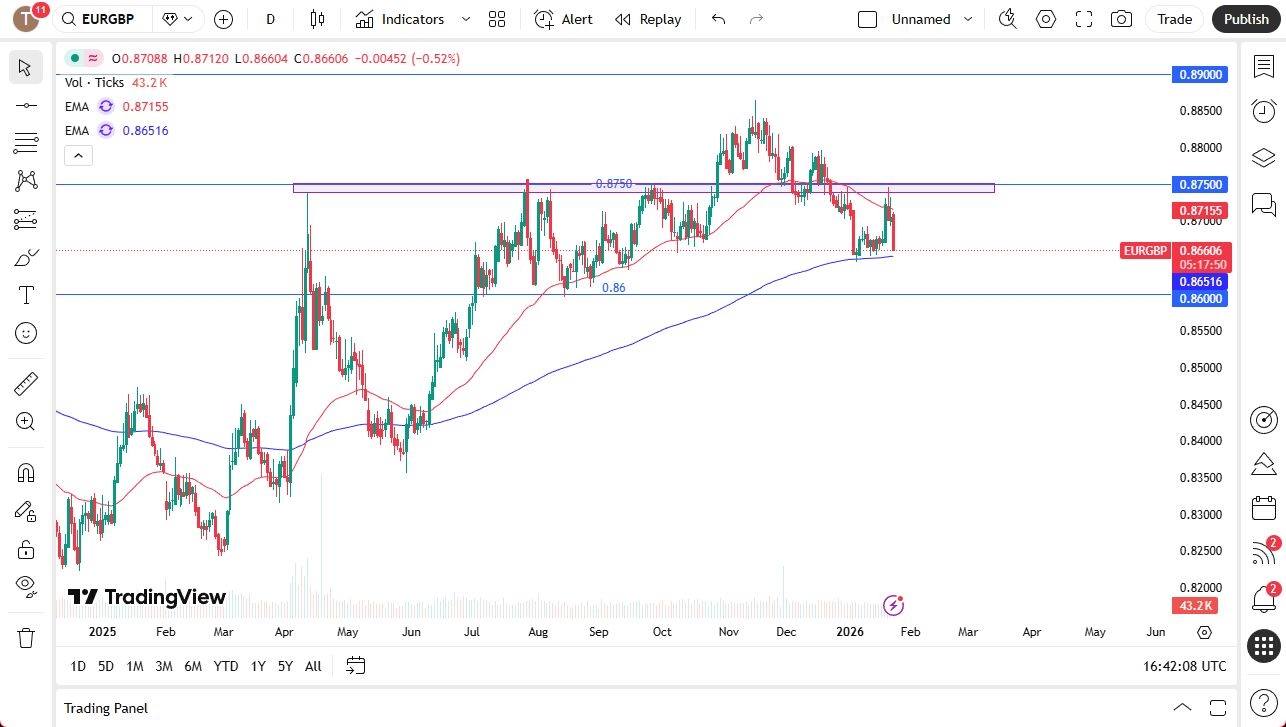
The Euro has been extraordinarily negative against the British pound on Friday, as the economic figures in the United Kingdom continue to impress, suggesting a hesitant Bank of England.
The Euro has been extraordinarily negative against the British pound during the trading session on Friday, knocking back some of the previous Euro strength as the retail sales in the United Kingdom came out much hotter than anticipated, along with the manufacturing PMI forward-looking numbers. So, it does look like inflation is going to stick around a bit in the United Kingdom, and that keeps the Bank of England perhaps thinking about keeping rates higher for longer.
It is a very similar situation to what we see at the Federal Reserve at the moment, although the Federal Reserve has become a little bit more cautious as of late. But for three years now, I have been hearing about the Fed getting ready to cut drastically, and it is yet to happen. Maybe the United Kingdom is in the same position. The European Central Bank, of course, is where it needs to be, and it is going to stay flat. So, I think that is part of what is driving this.

But when you look at the longer-term chart, we had just pulled back from a major resistance barrier going back multiple years. So now, the next thing I am watching is the 200-day EMA, currently sitting at the 0.8652 level. If we break down below there, then 0.86 is your next target, followed by 0.8450.
I do think it eventually does break down. It makes a lot of sense to me. That doesn’t mean that it is easy, and it doesn’t mean that it happens quickly. But quite frankly, I don’t see why it won’t. The central bank divergence and economic numbers alone should make that a real thing.
Ready to trade our daily forecast and analysis? Here’s a list of some of the top forex brokers UK to check out.
Christopher Lewis has been trading Forex and has over 20 years experience in financial markets. Chris has been a regular contributor to Daily Forex since the early days of the site. He writes about Forex for several online publications, including FX Empire, Investing.com, and his own site, aptly named The Trader Guy. Chris favours technical analysis methods to identify his trades and likes to trade equity indices and commodities as well as Forex. He favours a longer-term trading style, and his trades often last for days or weeks.
Spot Gold kept rallying into unexplored territory on Monday, briefly surpassing the $5,100 threshold before pulling back some. The XAU/USD pair is comfortable around $5,090 at the time of writing, paring gains amid the good performance of Wall Street.
The US Dollar (USD) collapsed at the weekly opening on headlines indicating that the United States (US) Federal Reserve (Fed) was asking New York banks about the USD/JPY’s exchange rate. Financial markets understood such an action as a first step into a US-Japan intervention of the Japanese Yen (JPY). The pair plummeted and resulted in a widespread USD sell-off, with the battered American currency also affected by persistent geopolitical drama and uncertainty.
On the one hand, market participants await the US President Donald Trump’s nominee to run the Fed once Jerome Powell’s mandate finalizes in May. Given that the Fed is scheduled to announce its decision on monetary policy next Wednesday, investors lifted bets on a soon-to-come announcement from President Trump to overshadow the Fed’s announcement, largely expected to be no changes to the current interest rate.
On the other hand, tensions between the US and Europe remain the same, despite Trump announcing the framework of a deal over Greenland. The EU has paused the approval of a trade deal with the US, and there has been mounting speculation that the Old Continent can use its Anti-Coercion Instrument (ACI), a mechanism that enables restrictions on the physical imports and exports of goods across EU borders, which could even be extended to services. Additionally, the EU holds about $8 trillion of US Treasury bonds, which can be used as leverage against Trump threats.
In an uncertain world, buying Gold is the number one defense.
In the 4-hour chart, XAU/USD is poised to extend its advance. The 20-period Simple Moving Average (SMA) rises above the 100 and 200 SMAs, with all three trending higher, underscoring the positive bias. The 20 SMA at $4,949.47 offers dynamic support. At the same time, the Momentum indicator holds above its midline but has lost strength, while the Relative Strength Index (RSI) indicator has flattened around 81. Extreme near-term overbought conditions are likely to be ignored by market players, with another leg north likely after a period of consolidation.
In the daily chart, XAU/USD is up for a sixth consecutive day. From a technical perspective, the risk skews to the upside, as technical indicators advance far above their midlines, without signs of upward exhaustion. At the same time, the 20-day SMA heads north almost vertically, far above the 100- and 200-day SMA, while way below the current level.
(The technical analysis of this story was written with the help of an AI tool.)
– Written by
David Woodsmith
STORY LINK GBP/USD Forecast: Pound Sterling Near Six-Month Best Exchange Rate
The Pound to US Dollar exchange rate (GBP/USD) opened the new week on strong footing, pushing to a fresh six-month high as broad-based selling pressure continued to undermine the US Dollar.
At the time of writing, GBP/USD was trading close to $1.3671, representing a gain of around 0.3% compared with Monday’s opening levels.
The US Dollar (USD) remained on the back foot at the start of the week, extending a sell-off that dragged the currency to multi-month lows in the previous session.
Fresh pressure on the Greenback followed renewed tariff threats from US President Donald Trump, who warned of imposing 100% tariffs on Canada should it strike a trade agreement with China. Trump argued such a deal would effectively turn Canada into a gateway for Chinese goods entering the US market.
These remarks have heightened investor unease around US trade and foreign policy, with markets increasingly unsettled by the unpredictability of the Trump administration.
Adding to the negative tone for the Dollar were renewed concerns over a potential US government shutdown, after Senate Democrats pledged to block funding for the Department of Homeland Security following the death of another US citizen at the hands of federal agents over the weekend.
Despite its strength against the US Dollar, the Pound (GBP) struggled to generate notable gains against other major currencies.
Get better rates and lower fees on your next international money transfer.
Compare TorFX with top UK banks in seconds and see how much you could save.
Sterling traded in a relatively narrow range amid a quiet UK economic calendar, following a week packed with high-profile data releases.
Investor caution was also fuelled by lingering domestic political uncertainty, with speculation over internal Labour Party tensions weighing on broader confidence in the UK outlook.
Looking ahead, attention is likely to centre on the anticipated announcement of Donald Trump’s nominee to succeed Jerome Powell as Chair of the Federal Reserve, a development that could drive significant volatility in GBP/USD.
Should the chosen candidate be viewed as supportive of more aggressive interest rate cuts, the US Dollar may face renewed selling pressure.
Conversely, a nomination perceived as safeguarding Federal Reserve independence could help the Greenback recover some of its recent losses.
In the meantime, with little in the way of major UK data releases scheduled, movement in the Pound is expected to remain closely tied to global risk appetite and broader market dynamics.

International Money Transfer? Ask our resident FX expert a money transfer question or try John’s new, free, no-obligation personal service! ,where he helps every step of the way,
ensuring you get the best exchange rates on your currency requirements.
TAGS: Pound Dollar Forecasts
Important DisclaimersFXEmpire is owned and operated by Empire Media Network LTD., Company Registration Number 514641786, registered at 7 Jabotinsky Road, Ramat Gan 5252007, Israel. The content provided on this website includes general news and publications, our personal analysis and opinions, and materials provided by third parties. This content is intended for educational and research purposes only. It does not constitute, and should not be interpreted as, a recommendation or advice to take any action, including making any investment or purchasing any product. Before making any financial decision, you should conduct your own due diligence, exercise your own discretion, and consult with competent advisors. The content on this website is not personally directed to you, and we do not take into account your individual financial situation or needs. The information contained on this website is not necessarily provided in real time, nor is it guaranteed to be accurate. Prices displayed may be provided by market makers and not by exchanges. Any trading or other financial decision you make is entirely your own responsibility, and you must not rely solely on any information provided through the website. FXEmpire does not provide any warranty regarding the accuracy, completeness, or reliability of any information contained on the website and shall bear no responsibility for any trading losses you may incur as a result of using such information. The website may include advertisements and other promotional content. FXEmpire may receive compensation from third parties in connection with such content. FXEmpire does not endorse, recommend, or assume responsibility for the use of any third-party services or websites. Empire Media Network LTD., its employees, officers, subsidiaries, and affiliates shall not be liable for any loss or damage resulting from your use of the website or reliance on the information provided herein.Risk DisclaimersThis website contains information about cryptocurrencies, contracts for difference (CFDs), and other financial instruments, as well as about brokers, exchanges, and other entities trading in such instruments. Both cryptocurrencies and CFDs are complex instruments and involve a high risk of losing money. You should carefully consider whether you understand how these instruments work and whether you can afford to take the high risk of losing your money. FX Empire encourages you to conduct your own research before making any investment decision and to avoid investing in any financial instrument unless you fully understand how it works and the risks involved.
Important DisclaimersFXEmpire is owned and operated by Empire Media Network LTD., Company Registration Number 514641786, registered at 7 Jabotinsky Road, Ramat Gan 5252007, Israel. The content provided on this website includes general news and publications, our personal analysis and opinions, and materials provided by third parties. This content is intended for educational and research purposes only. It does not constitute, and should not be interpreted as, a recommendation or advice to take any action, including making any investment or purchasing any product. Before making any financial decision, you should conduct your own due diligence, exercise your own discretion, and consult with competent advisors. The content on this website is not personally directed to you, and we do not take into account your individual financial situation or needs. The information contained on this website is not necessarily provided in real time, nor is it guaranteed to be accurate. Prices displayed may be provided by market makers and not by exchanges. Any trading or other financial decision you make is entirely your own responsibility, and you must not rely solely on any information provided through the website. FXEmpire does not provide any warranty regarding the accuracy, completeness, or reliability of any information contained on the website and shall bear no responsibility for any trading losses you may incur as a result of using such information. The website may include advertisements and other promotional content. FXEmpire may receive compensation from third parties in connection with such content. FXEmpire does not endorse, recommend, or assume responsibility for the use of any third-party services or websites. Empire Media Network LTD., its employees, officers, subsidiaries, and affiliates shall not be liable for any loss or damage resulting from your use of the website or reliance on the information provided herein.Risk DisclaimersThis website contains information about cryptocurrencies, contracts for difference (CFDs), and other financial instruments, as well as about brokers, exchanges, and other entities trading in such instruments. Both cryptocurrencies and CFDs are complex instruments and involve a high risk of losing money. You should carefully consider whether you understand how these instruments work and whether you can afford to take the high risk of losing your money. FX Empire encourages you to conduct your own research before making any investment decision and to avoid investing in any financial instrument unless you fully understand how it works and the risks involved.