The main category of Forex News.
You can use the search box below to find what you need.
[wd_asp id=1]
The main category of Forex News.
You can use the search box below to find what you need.
[wd_asp id=1]
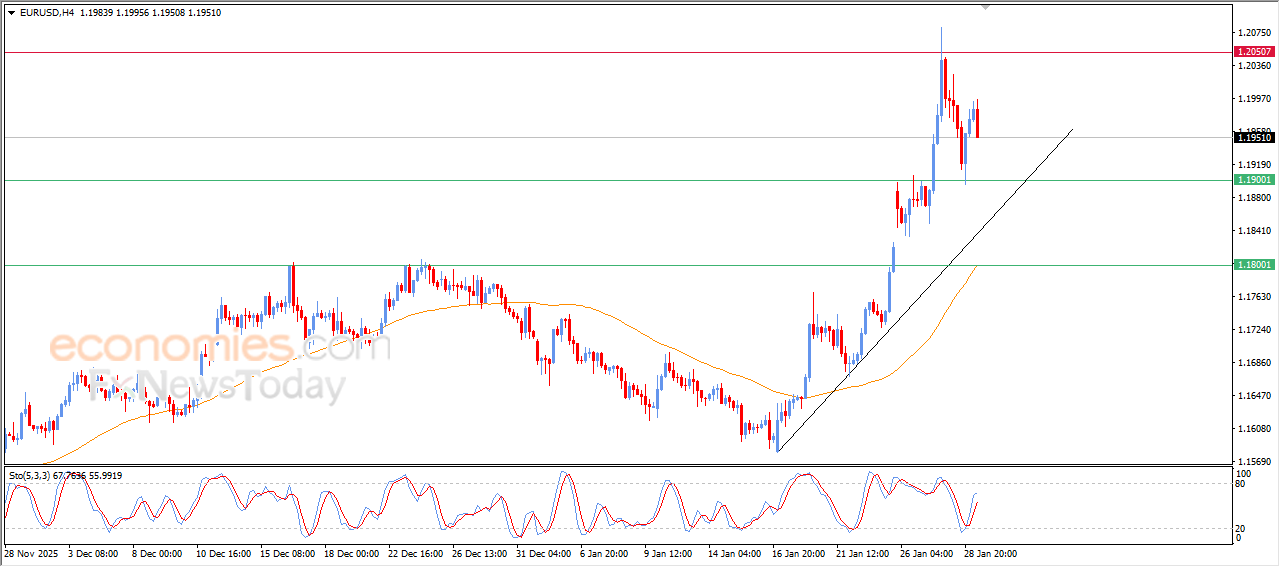
The EUR/USD pair attracts fresh sellers following the previous day’s good two-way price swings and retests sub-1.1900 levels during the Asian session on Friday. Spot prices, however, recover around 25 pips from the daily low and currently trade around the 1.1920-1.1925 region, down 0.35% for the day.
The US Dollar (USD) gains some positive traction and looks to build on its recovery from a four-year low, touched earlier this week. Meanwhile, the European Central Bank (ECB) flagged growing concerns over the Euro’s (EUR) quick appreciation against the USD, which turns out to be another factor exerting some pressure on the EUR/USD pair.
From a technical perspective, intraday weakness below the 100-hour Simple Moving Average (SMA) could be seen as a fresh trigger for the EUR/USD bears. Spot prices, however, showed resilience below the 1.1900 mark and bounced off the 38.2% Fibonacci retracement level of the latest leg up from the monthly swing low, touched last week.
Meanwhile, the Moving Average Convergence Divergence (MACD) line slips below the Signal line in negative territory, with a small negative histogram suggesting fading upside momentum. The Relative Strength Index (RSI) sits at 42, reinforcing a consolidative tone and warranting caution before positioning for deeper EUR/USD losses.
The 38.2% Fibo. retracement at 1.1892 offers initial support, with the 50% retracement at 1.1832 below. A recovery could target the 23.6% retracement at 1.1967, whereas a break under the initial support would risk extending the pullback from the 1.2080-1.2085 region, or the highest level since June 2021, touched earlier this week.
(The technical analysis of this story was written with the help of an AI tool.)
The table below shows the percentage change of US Dollar (USD) against listed major currencies today. US Dollar was the strongest against the Australian Dollar.
| USD | EUR | GBP | JPY | CAD | AUD | NZD | CHF | |
|---|---|---|---|---|---|---|---|---|
| USD | 0.25% | 0.32% | 0.46% | 0.16% | 0.55% | 0.39% | 0.29% | |
| EUR | -0.25% | 0.06% | 0.22% | -0.10% | 0.30% | 0.14% | 0.03% | |
| GBP | -0.32% | -0.06% | 0.15% | -0.16% | 0.24% | 0.07% | -0.03% | |
| JPY | -0.46% | -0.22% | -0.15% | -0.31% | 0.08% | -0.09% | -0.19% | |
| CAD | -0.16% | 0.10% | 0.16% | 0.31% | 0.39% | 0.22% | 0.13% | |
| AUD | -0.55% | -0.30% | -0.24% | -0.08% | -0.39% | -0.16% | -0.27% | |
| NZD | -0.39% | -0.14% | -0.07% | 0.09% | -0.22% | 0.16% | -0.11% | |
| CHF | -0.29% | -0.03% | 0.03% | 0.19% | -0.13% | 0.27% | 0.11% |
The heat map shows percentage changes of major currencies against each other. The base currency is picked from the left column, while the quote currency is picked from the top row. For example, if you pick the US Dollar from the left column and move along the horizontal line to the Japanese Yen, the percentage change displayed in the box will represent USD (base)/JPY (quote).

Why are oil and copper prices rising to record highs and will they increase further or fall down is driven by a mix of geopolitical risk, currency movement, and investor activity. Oil prices moved higher due to concerns over possible supply disruption linked to Iran and Middle East tensions. Copper prices climbed to record levels as speculative funds increased positions, supported by expectations of higher spending on power, data centres, and energy transition projects. A weak US dollar made commodities cheaper for global buyers. Future price direction depends on geopolitical developments, actual demand trends, supply responses, and whether speculative interest continues or fades.
Why are oil prices rising to record highs is mainly linked to fears of supply disruption from Iran, one of the largest OPEC producers. Reports of potential US military action and new European Union sanctions raised concerns over oil flows through the Strait of Hormuz. At the same time, the US dollar stayed weak, supporting oil demand. Oil prices also gained support from expectations that interest rates may stay steady, which can support economic activity and fuel consumption in major economies.
The oil prices are rising to record highs due to oil market fears. Oil prices climbed about 4% after reports said the United States may take action against Iran. Iran is a major OPEC producer.
Brent crude rose to $70.90 per barrel. WTI rose to $65.56 per barrel. Both reached levels last seen months ago. Markets fear Iran may respond by targeting regional oil flows. The Strait of Hormuz carries about 20 million barrels per day.
The European Union also imposed sanctions on Iran. It targeted officials and entities linked to protest crackdowns. The EU also designated Iran’s Revolutionary Guards as a terrorist group. This raised supply risk concerns.
Why are oil and copper prices rising to record highs and will they increase further or fall down also depends on supply changes. Russia may increase exports if peace talks with Ukraine progress. Russia is one of the top oil producers.
Kazakhstan said Chevron will restore full production at the Tengiz field soon. Venezuela lawmakers are discussing oil reforms. These steps may raise future supply and ease prices.
Analysts say current prices include a geopolitical risk premium. Any easing in tensions may reduce oil prices.
Why are oil and copper prices rising to record highs and will they increase further or fall down is also linked to the dollar. The dollar is near multi-year lows. A weak dollar makes oil cheaper for global buyers.
The Federal Reserve signaled rates may stay steady. Lower borrowing costs can support demand. Brent’s premium over WTI rose above $5. This may increase US crude exports.
Why are oil and copper prices rising to record highs and will they increase further or fall down includes copper market forces. Copper rose above $14,000 per ton. Speculative funds led buying, mainly in China.Copper is used in power, construction, and energy systems. Investors expect higher spending on data centers and power grids. A weak dollar also supported prices.
However, physical demand in China remains weak. Exchange inventories remain high. Analysts warn prices may not match supply and demand conditions.
Why are oil and copper prices rising to record highs and will they increase further or fall down depends on geopolitics and demand. Oil may fall if Iran tensions ease or supply rises. Copper may correct if speculation slows and demand stays weak.
What should investors do is a key question as oil and copper prices trade near record levels. Investors should track geopolitical developments linked to Iran and the Middle East, as headlines can shift prices quickly. They should also watch supply signals from OPEC, Russia, Kazakhstan, and Venezuela. For copper, investors should monitor physical demand data from China and inventory levels on exchanges. Price moves are being driven by speculation and currency trends, so risk management is important. Investors may consider avoiding overexposure and staying prepared for sharp corrections if conditions change.
Why are oil and copper prices rising to record highs and will they increase further or fall down now?
Oil prices rose due to Iran risks and dollar weakness. Copper prices rose due to speculation and growth expectations. Future moves depend on geopolitics, demand data, and currency trends.
Will oil and copper prices fall after hitting record levels?
Prices may fall if Middle East tensions ease, supply increases, or speculative trading slows. Weak physical demand and high inventories may also pressure copper and oil prices.
– Written by
David Woodsmith
STORY LINK GBP/USD Forecast: Pound Sterling Reclaims Ground Above $1.38
The Pound to US Dollar exchange rate (GBP/USD) edged higher on Thursday, with the pairing moving back towards the four-year high reached earlier in the week.
At the time of writing, GBP/USD was trading near $1.3844, up roughly 0.2% from the start of Thursday’s session.
The US Dollar (USD) remained on the back foot at the beginning of European trade on Thursday, extending a late-session retreat from the previous day.
After enduring sustained selling pressure for much of the past fortnight, the greenback had shown tentative signs of stabilising ahead of the Federal Reserve’s latest policy announcement on Wednesday.
As expected, the Fed left interest rates unchanged at its first meeting of 2026 and adopted a relatively firm tone, reinforcing expectations that borrowing costs will also remain on hold through at least March and April.
However, rather than restoring confidence in the currency, the decision appeared to underscore the Dollar’s current vulnerability. Investors continued to view the USD through a pessimistic lens, allowing selling pressure to resume.
Although Sterling managed to advance against the US Dollar, it failed to build similar gains versus other major currencies on Thursday.
Get better rates and lower fees on your next international money transfer.
Compare TorFX with top UK banks in seconds and see how much you could save.
The Pound remained rangebound, with thin trading conditions persisting amid a continued lack of impactful UK economic releases.
Looking ahead, the Pound to US Dollar exchange rate could see heightened volatility towards the end of the week if President Trump reveals his nominee to succeed Jerome Powell as Fed Chair.
Earlier comments from Trump suggested an announcement could come ‘soon’, alongside claims that interest rates will ‘come down a lot’ once his preferred candidate takes charge.
If no announcement materialises, attention is likely to shift to the latest US producer price index, where signs of easing factory gate inflation could apply fresh pressure to the US Dollar.
Meanwhile, in the continued absence of meaningful UK data, the Pound may struggle to develop a clear directional bias as the week draws to a close.

International Money Transfer? Ask our resident FX expert a money transfer question or try John’s new, free, no-obligation personal service! ,where he helps every step of the way,
ensuring you get the best exchange rates on your currency requirements.
TAGS: Pound Dollar Forecasts
Copper price succeeded in activating the bullish attack by surpassing $5.9700 barrier, to begin recording clear gains by reaching $6.2300, recording extra suggested target in the previous report.
Note that the stability above $5.9700 level might form an important support, besides providing bullish momentum by the main indicators, these factors support resuming the bullish attack, to expect targeting new stations that might begin at $6.4100.
The expected trading range for today is between $6.0700 and $6.4100
Trend forecast: Bullish
The Japanese yen has staged a strong comeback in the past few days as investors focused on its potential intervention and the latest actions by the Federal Reserve. The USD/JPY pair was trading at 153, down by 4% from its highest level this year.
The USD/JPY exchange rate has been in focus in the past few weeks as concerns about the Japanese economy continued. It crashed last week after media reports suggested that Donald Trump’s administration was willing to help Japan intervene.
The pair then rose slightly this week after Scott Bessent announced that the US will not intervene. This is notable as Bessent is a well-known figure in the forex industry because of his role in collapsing the British pound in the early 1990s.
Market participants are concerned on whether Japan will succeed in going solo in intervening in the forex market. In a note, an analyst from CBA said:
“Without US involvement, any intervention by the Ministry of Finance alone would be far less effective in countering downward pressure on the yen, meaning any post-intervention gains are likely to fade quickly.”
The Japanese yen has been in a freefall in the past few months, with the USD/JPY exchange rate soaring from a low of 139 in April last year to a high of 160 this year.
This performance accelerated after Sanae Takaichi became the prime minister and embraced Shinzo Abe-like policies. Her initial policy was a large stimulus program that she aimed at solving the inflation situation. She now plans more stimulus, including tax cuts if she wins the election in February.
Takaichi also took a more hawkish stance on China, a top trading partner. She vowed that her government would step in to help Taiwan if Beijing attacked, a move that infuriated Beijing.
The Japanese yen has crashed despite the ongoing divergence between the Federal Reserve and the Bank of Japan (BoJ). The BoJ has embraced a more hawkish tone and hiked interest rates to the highest level in three decades. It has hinted its willingness to continue hiking rates this year.
The Federal Reserve, on the other hand, left interest rates unchanged on Wednesday, and analysts believe that its next move will be lower. Besides, Donald Trump will soon announce the potential Jerome Powell replacement. He has maintained that the potential replacement will be one who will be willing to cut rates aggressively.

The daily timeframe chart shows that the USD/JPY exchange rate has suffered a harsh reversal in the past few days, moving from a high of 159.40 to 153 today. It remains below the crucial support level at 154.3, its lowest level in December last year.
The pair has crashed below the 23.6% Fibonacci Retracement level. It also moved below the 50-day and 100-day Exponential Moving Averages, and is now in the process of forming a bearish flag or pennant pattern.
Therefore, the most likely scenario is where it continues falling, potentially to the 50% retracement level at 150.
The post USD/JPY forecast: What next for the soaring Japanese yen? appeared first on Invezz
Silver price (XAG/USD) continues its winning streak that began on January 22, trading around $117.70 per troy ounce during the Asian hours on Thursday. Silver price surged to a fresh record high of $119.42 earlier, supported by persistent safe-haven demand amid economic and geopolitical uncertainty. The grey metal has climbed more than 65% so far this month.
Investor appetite for precious metals, including Silver remained strong despite a rebound in the US Dollar (USD), highlighting robust hedging demand against currency risks. US Treasury Secretary Scott Bessent reiterated the US commitment to a strong dollar policy, while the Federal Reserve left interest rates unchanged at its January meeting, citing still-elevated inflation and resilient economic growth.
Fed Chair Jerome Powell said job gains have cooled and the unemployment rate is stabilising, adding that the Fed is “well positioned” to assess data meeting by meeting and is not on a preset path for future rate decisions.
Safe-haven demand for precious metals, including Silver, strengthened against the backdrop of global trade frictions. Renewed protectionist rhetoric ahead of the US election has heightened concerns over tariffs, supply-chain disruptions, and inflationary pressures. Market sentiment was further dampened by fears of a potential US government shutdown, which could delay key economic data releases.
Geopolitical risks remained elevated amid escalating Middle East tensions. US President Donald Trump urged Iran on Wednesday to return to negotiations over its nuclear programme, warning that any future US attack would be far more severe. Tehran responded by threatening retaliation against the US, Israel, and their allies, per Reuters.
At the same time, solid industrial demand from renewable energy and electronics sectors continued to tighten supply, reinforcing Silver’s upward momentum. Prices have also been supported by investors seeking cheaper alternatives to Gold, alongside supply constraints and momentum-driven buying.
Silver is a precious metal highly traded among investors. It has been historically used as a store of value and a medium of exchange. Although less popular than Gold, traders may turn to Silver to diversify their investment portfolio, for its intrinsic value or as a potential hedge during high-inflation periods. Investors can buy physical Silver, in coins or in bars, or trade it through vehicles such as Exchange Traded Funds, which track its price on international markets.
Silver prices can move due to a wide range of factors. Geopolitical instability or fears of a deep recession can make Silver price escalate due to its safe-haven status, although to a lesser extent than Gold’s. As a yieldless asset, Silver tends to rise with lower interest rates. Its moves also depend on how the US Dollar (USD) behaves as the asset is priced in dollars (XAG/USD). A strong Dollar tends to keep the price of Silver at bay, whereas a weaker Dollar is likely to propel prices up. Other factors such as investment demand, mining supply – Silver is much more abundant than Gold – and recycling rates can also affect prices.
Silver is widely used in industry, particularly in sectors such as electronics or solar energy, as it has one of the highest electric conductivity of all metals – more than Copper and Gold. A surge in demand can increase prices, while a decline tends to lower them. Dynamics in the US, Chinese and Indian economies can also contribute to price swings: for the US and particularly China, their big industrial sectors use Silver in various processes; in India, consumers’ demand for the precious metal for jewellery also plays a key role in setting prices.
Silver prices tend to follow Gold’s moves. When Gold prices rise, Silver typically follows suit, as their status as safe-haven assets is similar. The Gold/Silver ratio, which shows the number of ounces of Silver needed to equal the value of one ounce of Gold, may help to determine the relative valuation between both metals. Some investors may consider a high ratio as an indicator that Silver is undervalued, or Gold is overvalued. On the contrary, a low ratio might suggest that Gold is undervalued relative to Silver.
Natural gas price continued providing weak sideways trading, affected by the contradiction between the main indicators besides forming a significant obstacle against the attempts to renew the bullish attack, fluctuating near $3.850.
There is a chance for forming new bearish waves, to press on the moving average 55 at $3.450, and surpassing it might extend the losses towards $3.050, facing the extension of historical support, while the price success in surpassing $4.000 level and holding above it will allow it to renew the bullish attempts, to expect targeting $4.220 and $4.450 level.
The expected trading range for today is between $3.450 and $4.050
Trend forecast: Bearish
Meanwhile, Silver is also seeing strong gains, trading at $119.13 with a 1.96% rise, as safe-haven demand grows amid global uncertainties and US dollar weakness.
On the geopolitical front, concerns about US tariffs have returned after Germany, the Eurozone’s largest economy, lowered its growth forecasts for this year and next. Meanwhile, the tension is also rising in the Middle East, as US President Donald Trump warned Iran to come to the table on nuclear weapons, or face stronger attacks. Iran fired back, threatening the US, Israel, and their allies.
Meanwhile, Russia keeps hitting Ukrainian cities, with a recent drone strike on a passenger train killing five people. All this uncertainty, along with some selling of the US dollar, is keeping Gold in demand.
On the US front, the Federal Reserve kept interest rates unchanged after its two-day meeting, as most expected. Two Fed officials, Stephen Miran and Christopher Waller, wanted a small cut instead. Fed Chair Jerome Powell said inflation is still higher than the 2% target, but markets barely reacted. Meanwhile, worries are growing that the Fed may not be fully independent, with a DOJ investigation into Powell and efforts to remove Governor Lisa Cook raising concerns about political pressure.
For now, traders expect rates to stay steady through this quarter and possibly until Powell’s term ends in May, though two cuts are priced in for 2026. This outlook is keeping the US Dollar from gaining much and giving Gold a boost, as investors favor the safe-haven metal. All eyes are now on Thursday’s jobless claims data for fresh market movement.
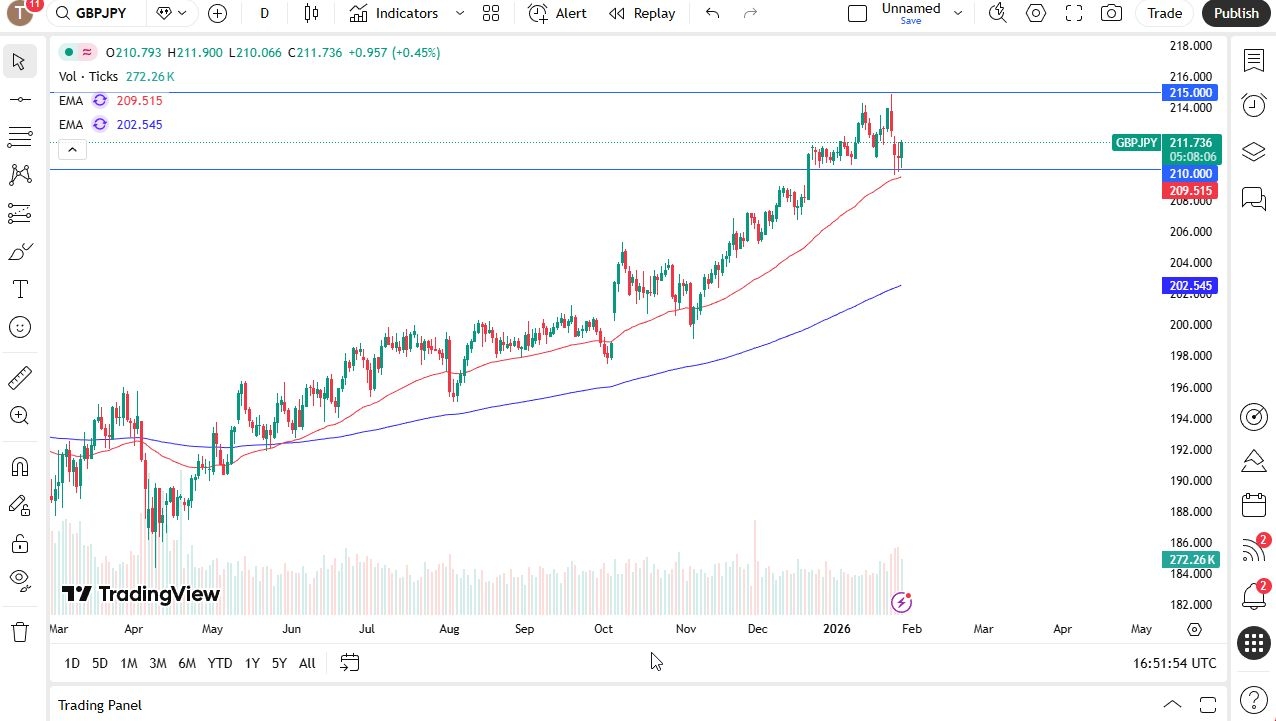
The British pound initially fell a bit during the trading session on Wednesday but continues to see the 210 yen level as an area of support. I like this pair a lot, and I do think that it is probably only a matter of time before we start buying again.
Short-term pullbacks offer enough value that I definitely like watching for a bounce that I can take advantage of the continued longer-term uptrend. The 215-yen level is an area I would be watching as well.
As a side note, the United States government has come out and explicitly denied any intervention in the Japanese yen, so we will see how that plays out. The US dollar against the Japanese yen has been hammered, but in that same time frame, we have only seen the British pound test the bottom of the recent consolidation.
I think this is a sign that this pair is going to remain rather resilient. The 50-day EMA sits just below the 210-yen level as well, so I think all of this comes together to offer value each and every time we drop.
If we can break above the 215-yen level, that really gets this pair going, but I think in the short term, this is a buy the dip, maybe sell the rip type of situation where we take advantage of a well-defined 500-point range. If we were to break down below the 50-day EMA, then we might have to reset closer to 208. This is a level that I would be very interested in as well.
Begin trading our daily forecasts and analysis. Here is a list of Forex brokers in Japan to work with.
Christopher Lewis has been trading Forex and has over 20 years experience in financial markets. Chris has been a regular contributor to Daily Forex since the early days of the site. He writes about Forex for several online publications, including FX Empire, Investing.com, and his own site, aptly named The Trader Guy. Chris favours technical analysis methods to identify his trades and likes to trade equity indices and commodities as well as Forex. He favours a longer-term trading style, and his trades often last for days or weeks.
Natural gas price continued providing weak sideways trading, affected by the contradiction between the main indicators besides forming a significant obstacle against the attempts to renew the bullish attack, fluctuating near $3.850.
There is a chance for forming new bearish waves, to press on the moving average 55 at $3.450, and surpassing it might extend the losses towards $3.050, facing the extension of historical support, while the price success in surpassing $4.000 level and holding above it will allow it to renew the bullish attempts, to expect targeting $4.220 and $4.450 level.
The expected trading range for today is between $3.450 and $4.050
Trend forecast: Bearish