The main category of All News Articles.
You can use the search box below to find what you need.
[wd_asp id=1]
The main category of All News Articles.
You can use the search box below to find what you need.
[wd_asp id=1]
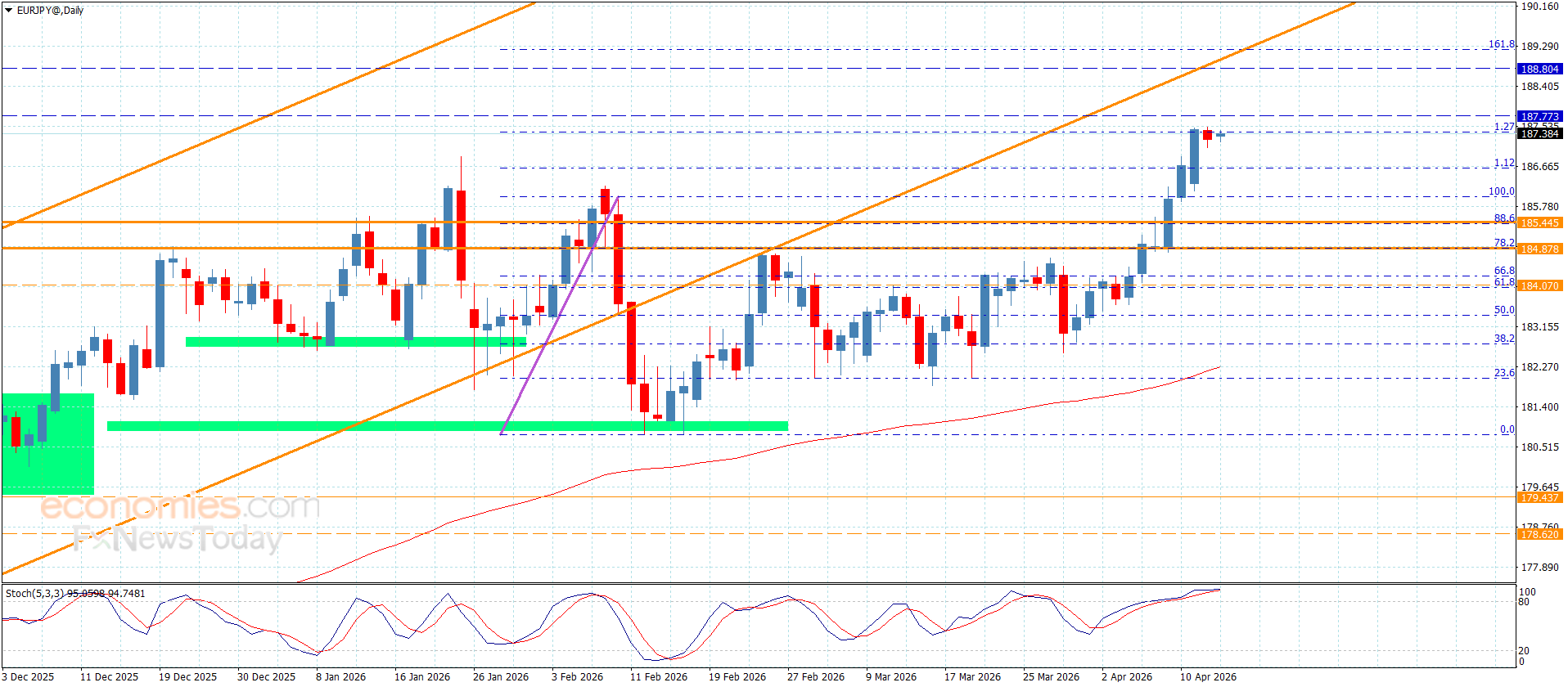
The GBPJPY pair forced it to provide sideways trading by its stability near 215.50 level, affected by stochastic exit from the overbought levels, the price might be forced to provide some bearish corrective trading, however it couldn’t affect the main bullish track, depending on forming extra support level at 214.15 level.
Therefore, we will keep our main bullish scenario, to gather extra positive momentum, to ease the mission of reaching extra positive stations that might begin at 216.20 and 217.00.
The expected trading range for today is between 214.55 and 216.20
Trend forecast: Bullish
Brent crude oil is holding lower during its recent intraday trading, under the dominance of a short-term corrective downward wave, while moving along a trendline that supports this bearish path. Negative pressure continues as the price trades below EMA50, which reduces the chances of recovery in the near term.
This comes alongside negative signals from relative strength indicators after the price managed to ease its oversold condition, which further supports the bearish outlook.
– Written by
Ben Hughes
STORY LINK Pound Sterling to Dollar Forecast: GBP Hits 2-Month Best as US Stocks Surge
The Pound to Dollar exchange rate (GBP/USD) surged to two-month highs above 1.3580, with Sterling emerging as a best buy amid a rally in global equities and improving confidence over easing Middle East tensions.
Improving risk appetite has boosted GBP demand while the dollar remains under pressure, although markets are cautious that resistance around 1.36–1.37 could limit further gains.
The Pound to Dollar (GBP/USD) exchange rate hit a 2-month peak just above 1.3580 on Tuesday before a limited correction to near 1.3550.
The Pound continued to demonstrate resilience while the dollar lost ground again as markets anticipated a resolution to the Iranian conflict with oil prices posting significant losses. A key element will be whether this optimism is justified and whether the dollar will continue to weaken.
According to UoB; “Further GBP strength would not be surprising, but given the overbought short-term conditions, the next technical target at 1.3645 may not come into view so soon.”
Scotiabank is broadly positive over the GBP/USD outlook; “We see limited resistance between current levels and the mid-Feb peaks around 1.37 and now look to support below 1.3450.”
Get better rates and lower fees on your next international money transfer.
Compare TorFX with top UK banks in seconds and see how much you could save.
There are hopes that US and Iran will hold another round of talks as pressure on Iran and the US continues to build.
IG market analyst Tony Sycamore commented; “There is a growing expectation that the standoff will soon be resolved, allowing the U.S. administration to pivot towards declaring victory, before stimulating the economy ahead of the midterms.”
ING added; “Markets have grown more confident that the Middle East crisis is moving toward a resolution, with the US and Iran arranging a second round of talks, and Tehran seemingly willing to halt shipments to avoid testing the US naval blockade.”
The bank still expressed significant caution; “Given how unsuccessful the first round of negotiations was last weekend, these dollar levels seem to embed a fair amount of premature optimism. As such, the balance of risks is increasingly skewed to the upside for USD.”
MUFG considers that underlying dollar sentiment has deteriorated; “The failure of the US dollar to advance as much as we expected since the start of the conflict and the emerging signs of increased appetite for selling is an indication of the poor fundamental backdrop for the dollar ahead of the start of the conflict.”
Underlying economic trends will also be an important element and feed into the dollar narrative.
The US NFIB small business confidence index dipped to 95.8 for March from 98.8 previously. According to the NFIB; “the dramatic spike in oil prices has spooked consumers and owners alike.”

Fed Chair nominee Warsh’s Senate confirmation hearing is scheduled for April 21st.
At this stage, markets are not pricing in a Fed rate hike with around a 30% chance of at least one cut before year-end. Comments from Warsh will be important for market pricing and a dovish stance would hurt the US currency.
International Money Transfer? Ask our resident FX expert a money transfer question or try John’s new, free, no-obligation personal service! ,where he helps every step of the way,
ensuring you get the best exchange rates on your currency requirements.
TAGS: Pound Dollar Forecasts
BitcoinWorld
Silver Price Forecast: XAG/USD Tests Critical Channel Resistance Near One-Month Highs – Crucial Technical Analysis
The silver market presents a compelling technical picture as XAG/USD tests crucial channel resistance near one-month highs on the 4-hour chart, signaling potential volatility ahead for precious metals traders. This development occurs against a complex macroeconomic backdrop that includes shifting central bank policies, industrial demand fluctuations, and geopolitical uncertainties affecting commodity markets globally. Consequently, market participants closely monitor these technical levels for directional clues about silver’s next significant move.
Currently, the XAG/USD pair demonstrates clear technical patterns on the 4-hour timeframe that professional traders analyze for strategic positioning. The price action shows silver testing the upper boundary of a well-defined ascending channel that has contained movements since early November. Moreover, this resistance zone coincides with horizontal price levels that previously acted as support during October’s consolidation phase. Therefore, this confluence of technical factors creates a critical juncture for silver’s near-term trajectory.
Market analysts observe several key technical indicators that provide context for this resistance test. First, the Relative Strength Index (RSI) approaches overbought territory near the 65-70 level, suggesting potential for a short-term pullback. Second, trading volume patterns show increased activity around these resistance levels, indicating heightened market interest. Finally, moving average alignments reveal the 50-period and 200-period averages providing dynamic support below current prices.
Examining historical price action reveals important context for understanding current resistance significance. Throughout 2024, silver faced similar technical challenges at comparable price levels, with previous resistance tests leading to varied outcomes. For instance, in September, a similar resistance test resulted in a 3.2% correction before renewed buying emerged. However, in July, a breakthrough at comparable levels triggered a sustained 8.5% rally over subsequent weeks.
The table below illustrates recent silver resistance tests and their outcomes:
| Date | Resistance Level | Outcome | Subsequent Move |
|---|---|---|---|
| September 15, 2024 | $24.85 | Rejection | -3.2% over 5 days |
| July 22, 2024 | $25.10 | Breakout | +8.5% over 3 weeks |
| May 6, 2024 | $24.60 | Consolidation | Sideways for 2 weeks |
Beyond technical patterns, fundamental factors significantly influence silver’s price dynamics as XAG/USD approaches resistance. Industrial demand remains robust, particularly from renewable energy sectors where silver serves as a critical component in solar panel manufacturing. Additionally, monetary policy expectations continue to evolve, with market participants adjusting positions based on anticipated interest rate trajectories from major central banks.
Several macroeconomic developments warrant attention for silver traders:
Furthermore, exchange-traded fund (ETF) holdings provide insight into institutional sentiment toward silver. Recent data shows modest inflows into silver-backed ETFs, suggesting cautious but growing institutional interest. Meanwhile, COMEX futures positioning indicates that managed money accounts maintain net-long positions, though at reduced levels compared to earlier in the year.
The ascending channel pattern on the 4-hour chart offers clear framework for evaluating potential price movements. This technical structure features parallel trendlines connecting successive higher lows and higher highs since early November. Currently, the upper channel line presents immediate resistance, while the lower channel line provides dynamic support approximately 3.5% below current levels.
Market technicians typically consider three primary scenarios when prices test channel boundaries:
Each scenario carries distinct trading implications and risk parameters. For instance, a successful breakout above channel resistance would target previous swing highs from October, representing approximately 4.2% upside potential. Conversely, rejection at resistance could see silver retreat toward the channel’s lower boundary, representing potential downside of 3-4%.
Professional traders emphasize the importance of confirmation signals when evaluating resistance tests. Specifically, breakout validity typically requires supporting volume expansion and momentum confirmation. Current volume analysis shows moderate increases during recent approach to resistance, though not yet at levels typically associated with decisive breakouts. Momentum indicators, including the MACD histogram, show positive but decelerating momentum as prices near resistance.
Additionally, market breadth within the precious metals complex provides contextual information. Gold’s correlation with silver remains elevated at approximately 0.82 on 30-day rolling basis, suggesting coordinated movements across precious metals. Platinum and palladium prices show mixed signals, with platinum demonstrating relative strength while palladium continues its longer-term downtrend.
As XAG/USD tests critical technical levels, prudent risk management becomes paramount for market participants. Position sizing should account for increased volatility typically associated with resistance tests, while stop-loss placement requires careful consideration of channel structure. Many technical traders utilize the channel’s opposite boundary or recent swing points for stop-loss reference levels.
Key risk management principles for current market conditions include:
Furthermore, traders should consider upcoming economic events that could influence silver prices. The Federal Reserve’s December meeting minutes release, upcoming inflation data, and manufacturing PMI reports all represent potential catalysts for precious metals markets. These events may provide fundamental justification for technical breakouts or reversals.
Historical analysis reveals that similar technical setups in silver have produced varied outcomes depending on broader market context. During 2023, silver experienced seven comparable resistance tests at channel boundaries on 4-hour charts, with four resulting in breakouts and three leading to rejections. The average magnitude of successful breakouts measured 5.8%, while rejected tests saw average declines of 3.9% before finding support.
Seasonal factors also merit consideration in silver price analysis. Historically, December and January have shown mixed seasonal tendencies for silver, with no strong directional bias. However, the first quarter often brings increased industrial demand projections as companies finalize annual budgets and production plans. This fundamental backdrop may provide underlying support even if technical resistance initially holds.
Market analysts offer varied perspectives on silver’s technical situation. Some emphasize the importance of dollar strength as primary determinant of precious metals pricing, noting that DXY index levels near 104.50 create headwinds for dollar-denominated commodities. Others highlight silver’s dual nature as both monetary metal and industrial commodity, suggesting that industrial demand fundamentals may ultimately override technical resistance.
Technical analysts at major financial institutions generally agree on the significance of current resistance levels but differ on probable outcomes. Several firms publish resistance and support clusters rather than single price levels, recognizing that markets often test zones rather than precise numbers. The current resistance zone for XAG/USD spans approximately $25.00 to $25.30, with particular attention to the $25.15 level where multiple technical factors converge.
The silver price forecast remains at critical juncture as XAG/USD tests channel resistance near one-month highs on the 4-hour chart. This technical development occurs within broader context of evolving macroeconomic conditions and shifting market sentiment toward precious metals. Traders should monitor confirmation signals including volume patterns, momentum indicators, and related market movements when evaluating potential breakout or rejection scenarios. Ultimately, the resolution of this technical test will provide important information about silver’s near-term trajectory and broader precious metals market dynamics.
Q1: What does it mean when silver tests channel resistance?
When silver tests channel resistance, the price approaches the upper boundary of a defined trading range or trend channel. This represents a potential turning point where the market may either break through to higher prices or reverse direction.
Q2: How significant are one-month highs for silver pricing?
One-month highs represent important psychological and technical levels where previous selling may have emerged. These levels often attract attention from both technical traders and institutional investors, potentially increasing volatility as prices approach them.
Q3: What time frame is most relevant for silver traders?
Silver traders typically monitor multiple time frames simultaneously. While the 4-hour chart shows intermediate-term trends, traders often reference daily charts for primary direction and hourly charts for entry timing. The 4-hour chart effectively balances noise reduction with timely signals.
Q4: How does XAG/USD differ from silver spot pricing?
XAG/USD represents the forex pair for trading silver against the US dollar, while silver spot price typically refers to the current market price for immediate delivery. In practice, they track closely, though XAG/USD may incorporate forex market dynamics and leverage availability differences.
Q5: What confirmation signals should traders watch during resistance tests?
Traders should monitor volume expansion, momentum indicator confirmation, price action on higher time frames, and movements in correlated markets like gold and the US dollar. Multiple confirming signals increase confidence in breakout validity or rejection strength.
This post Silver Price Forecast: XAG/USD Tests Critical Channel Resistance Near One-Month Highs – Crucial Technical Analysis first appeared on BitcoinWorld.
The USD/JPY pair once again shows some resilience below the 200-period Simple Moving Average (SMA) on the 4-hour chart and edges higher during the Asian session on Wednesday. Spot prices, however, lack bullish conviction and struggle to capitalize on the strength beyond the 159.00 mark.
Despite the optimism over Iran diplomacy, economic concerns stemming from the instability in the Strait of Hormuz hold back traders from placing bullish bets around the Japanese Yen (JPY). This, along with a modest US Dollar (USD) recovery from its lowest level since early March, turns out to be another factor lending some support to the USD/JPY pair. However, the optimism over continued US-Iran peace talks and diminishing odds for a rate hike by the US Federal Reserve (Fed) caps the upside for the currency pair.
From a technical perspective, the USD/JPY pair retains a mildly bullish near-term bias as it remains above the 158.30-158.25 horizontal support. Moreover, the Moving Average Convergence Divergence (MACD) indicator is slightly negative and flat below the zero line, suggesting waning bearish pressure rather than a strong directional impulse for now. That said, the Relative Strength Index (RSI) around 46 hints at only modest downside momentum. This, in turn, warrants caution before positioning for further gains.
Meanwhile, the 200-period SMA on the 4-hour chart near 158.76 might continue to protect the immediate downside. A sustained break would weaken the constructive tone and open the door to a deeper correction. As long as USD/JPY holds above this moving average, dips are likely to attract buyers, though the lack of bullish conviction implies that the near-term trajectory will have to be defined on the basis of forthcoming price action rather than the existing mixed technical setup.
(The technical analysis of this story was written with the help of an AI tool.)
The table below shows the percentage change of Japanese Yen (JPY) against listed major currencies today. Japanese Yen was the strongest against the Canadian Dollar.
| USD | EUR | GBP | JPY | CAD | AUD | NZD | CHF | |
|---|---|---|---|---|---|---|---|---|
| USD | 0.07% | 0.01% | 0.13% | 0.06% | -0.15% | 0.03% | 0.07% | |
| EUR | -0.07% | -0.06% | 0.07% | -0.02% | -0.15% | -0.04% | -0.00% | |
| GBP | -0.01% | 0.06% | 0.11% | 0.09% | -0.10% | -0.01% | 0.05% | |
| JPY | -0.13% | -0.07% | -0.11% | -0.06% | -0.21% | -0.12% | -0.07% | |
| CAD | -0.06% | 0.02% | -0.09% | 0.06% | -0.13% | -0.04% | -0.01% | |
| AUD | 0.15% | 0.15% | 0.10% | 0.21% | 0.13% | 0.10% | 0.14% | |
| NZD | -0.03% | 0.04% | 0.00% | 0.12% | 0.04% | -0.10% | 0.04% | |
| CHF | -0.07% | 0.00% | -0.05% | 0.07% | 0.00% | -0.14% | -0.04% |
The heat map shows percentage changes of major currencies against each other. The base currency is picked from the left column, while the quote currency is picked from the top row. For example, if you pick the Japanese Yen from the left column and move along the horizontal line to the US Dollar, the percentage change displayed in the box will represent JPY (base)/USD (quote).
Ethereum (ETHUSD) declined in its latest intraday trading as the price attempts to establish a higher low that could serve as a base for regaining bullish momentum and resuming its recovery. During this move, the asset has managed to unwind previous overbought conditions on the relative strength indicators, which have now entered oversold territory relative to price action, suggesting the potential for renewed upward momentum.
This comes within the context of a dominant short-term uptrend, with price action moving along a supportive ascending trendline. In addition, continued dynamic support from EMA50 reinforces the chances of near-term recovery.
The GBPJPY pair ended the last bullish rally by reaching 215.77 level, to face %100 Fibonacci extension level, which might form an intraday obstacle against the bullish attempts, to force it form some mixed trading before resuming the bullish trend, and there is a chance for retesting 214.55 level.
While breaching the barrier and holding above it will open the way for targeting more positive stations, to reach 216.20 directly by providing positive momentum that might lead it to reach the next main target near 217.50.
The expected trading range for today is between 214.85 and 216.20
Trend forecast: Bullish
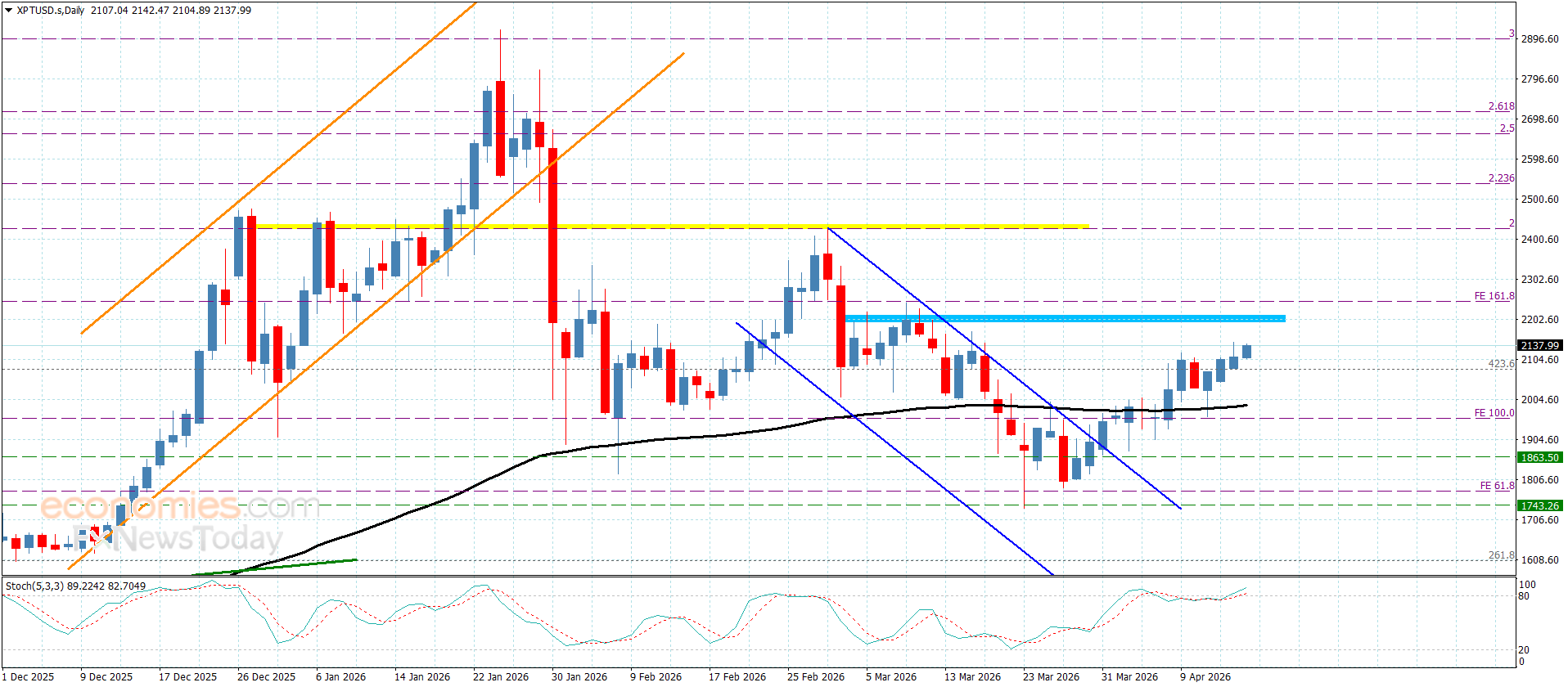
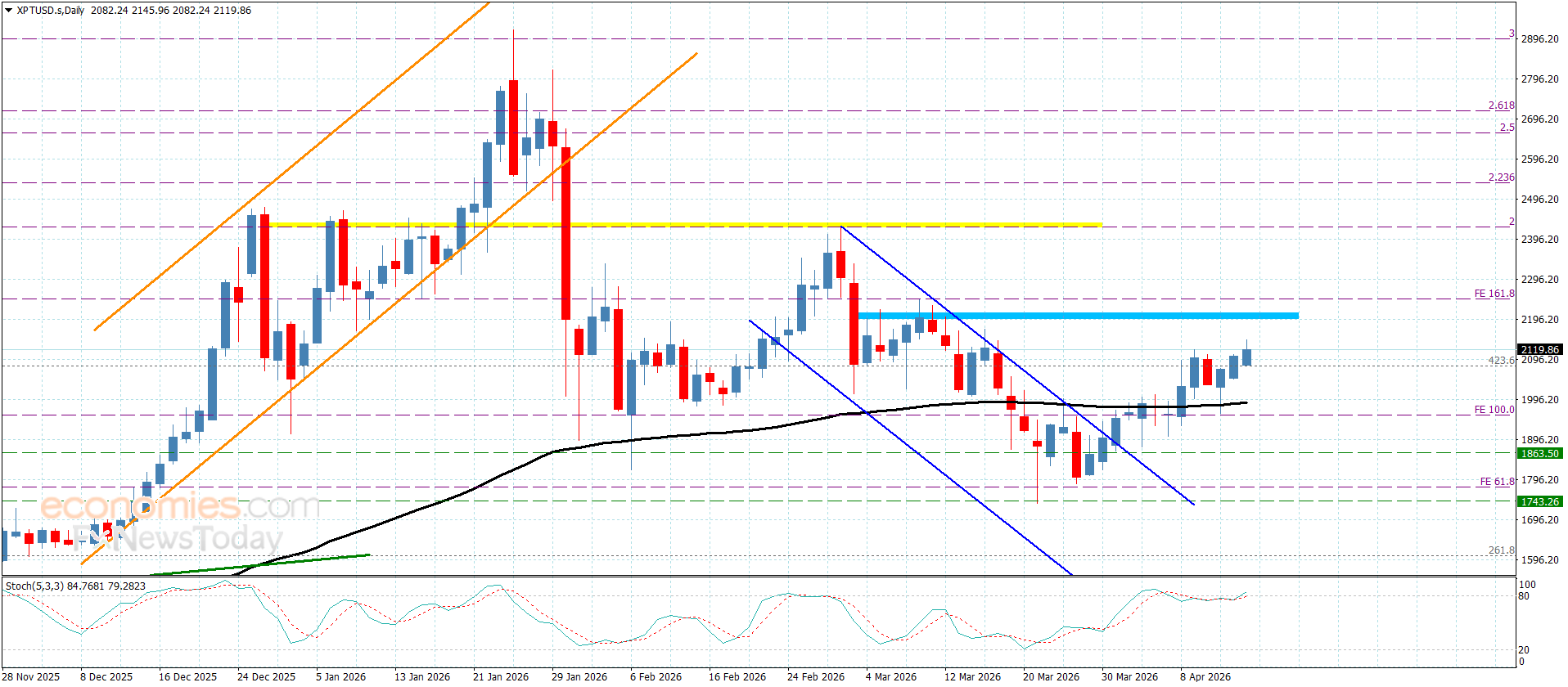
Platinum price confirmed its surrender to the bullish scenario by its stability yesterday above $2070.00 level, to form a new bullish rally and recording some previously suggested gains by reaching $2145.00 level.
The repeated stability above the moving average 55 near 1995.00, by the continuation of providing positive momentum by the main indicators will increase the chances of recording new gains, to reach $2205.00, which might form a new obstacle against the bullish rally, while surpassing this obstacle will ease the mission of achieving extra gains that might extend towards $2290.00 initially.
The expected trading range for today is between $2070.00 and 22205.00
Trend forecast: Bullish
Platinum price confirmed its surrender to the bullish scenario by its stability yesterday above $2070.00 level, to form a new bullish rally and recording some previously suggested gains by reaching $2145.00 level.
The repeated stability above the moving average 55 near 1995.00, by the continuation of providing positive momentum by the main indicators will increase the chances of recording new gains, to reach $2205.00, which might form a new obstacle against the bullish rally, while surpassing this obstacle will ease the mission of achieving extra gains that might extend towards $2290.00 initially.
The expected trading range for today is between $2070.00 and 22205.00
Trend forecast: Bullish
Silver price (XAG/USD) struggles to extend recovery above $81.00 during the European trading session on Wednesday. The white metal ticks down as the US Dollar (USD) strives to gain ground after a seven-day losing streak.
As of writing, the US Dollar Index (DXY), which tracks the Greenback’s value against six major currencies, edges up to near 98.10, but is close to its almost seven-week low of 98.00.
Technically, a higher US Dollar makes the Silver price a favorable risk-reward bet for investors. However, the outlook of the Silver price has improved amid growing expectations that the United States (US) and Iran could reach a permanent ceasefire soon.
US President Donald Trump has expressed confidence that Washington and Iran could reach a permanent ceasefire in the next two days. Trump said in an interview with ABC News that he doesn’t believe it will be necessary to extend the two-week ceasefire, adding, “I think you’re going to be watching an amazing two days ahead. I really do.”
Theoretically, signs of easing geopolitical tensions diminish demand for safe-haven assets, such as Silver; however, its demand has increased as Iran optimism has weighed heavily on the oil price.
Higher energy prices amid intensified attacks in the Middle East had de-anchored global inflation expectations, which also forced traders to raise bets supporting interest rate hikes by the Federal Reserve (Fed) for the year, a scenario that diminishes demand for non-yielding assets, such as Silver.
However, easing oil prices have anchored inflation projections again, and are supporting the Silver price. According to the CME FedWatch tool, there is 65% chance that the Fed will not make any monetary policy adjustment this year.
XAG/USD trades subduedly around $79.50 after facing selling pressure near $81.00. The near-term trend of the spot remains bullish as it holds above the 20-day Exponential Moving Average (EMA) at $75.91. The overall trend appears to be neutral as the Silver price trades inside the Ascending Triangle formation on a daily timeframe.
The Relative Strength Index (14) wobbles inside the 40.00-60.00 range, reflecting a sharp volatility contraction.
On the downside, initial technical support is seen at the 20-day EMA near $75.91, ahead of the rising trend-line region clustered around $74.51, where buyers have repeatedly emerged in recent weeks. On the upside, the Silver price could jump towards the $85 mark if it manages to break above the horizontal resistance around $81.00.
(The technical analysis of this story was written with the help of an AI tool.)
Silver is a precious metal highly traded among investors. It has been historically used as a store of value and a medium of exchange. Although less popular than Gold, traders may turn to Silver to diversify their investment portfolio, for its intrinsic value or as a potential hedge during high-inflation periods. Investors can buy physical Silver, in coins or in bars, or trade it through vehicles such as Exchange Traded Funds, which track its price on international markets.
Silver prices can move due to a wide range of factors. Geopolitical instability or fears of a deep recession can make Silver price escalate due to its safe-haven status, although to a lesser extent than Gold’s. As a yieldless asset, Silver tends to rise with lower interest rates. Its moves also depend on how the US Dollar (USD) behaves as the asset is priced in dollars (XAG/USD). A strong Dollar tends to keep the price of Silver at bay, whereas a weaker Dollar is likely to propel prices up. Other factors such as investment demand, mining supply – Silver is much more abundant than Gold – and recycling rates can also affect prices.
Silver is widely used in industry, particularly in sectors such as electronics or solar energy, as it has one of the highest electric conductivity of all metals – more than Copper and Gold. A surge in demand can increase prices, while a decline tends to lower them. Dynamics in the US, Chinese and Indian economies can also contribute to price swings: for the US and particularly China, their big industrial sectors use Silver in various processes; in India, consumers’ demand for the precious metal for jewellery also plays a key role in setting prices.
Silver prices tend to follow Gold’s moves. When Gold prices rise, Silver typically follows suit, as their status as safe-haven assets is similar. The Gold/Silver ratio, which shows the number of ounces of Silver needed to equal the value of one ounce of Gold, may help to determine the relative valuation between both metals. Some investors may consider a high ratio as an indicator that Silver is undervalued, or Gold is overvalued. On the contrary, a low ratio might suggest that Gold is undervalued relative to Silver.