The main category of All News Articles.
You can use the search box below to find what you need.
[wd_asp id=1]
The main category of All News Articles.
You can use the search box below to find what you need.
[wd_asp id=1]
The Pound US Dollar (GBP/USD) exchange rate traded in a narrow range on Thursday as markets adopted a cautious tone amid uncertainty over the durability of the US-Iran ceasefire.
DAILY RECAP:
The US Dollar (USD) was relatively muted as investors weighed conflicting signals surrounding the US-Iran ceasefire.
While the agreement initially sparked a strong improvement in market sentiment, signs of strain quickly emerged, leaving traders cautious.
Markets appeared caught between optimism that the ceasefire would hold and concerns that tensions could escalate again.
This uncertainty kept demand for the safe-haven US Dollar contained, resulting in limited movement.
Meanwhile, the increasingly risk-sensitive Pound (GBP) was also subdued.
A lack of UK economic data left Sterling without a clear catalyst, while the cautious market mood discouraged strong directional positioning.

As a result, GBP/USD remained rangebound through the session.
Looking forward, high-impact US economic data could influence the Pound US Dollar exchange rate.
The key release is the US consumer price index for March, which will provide insight into inflation dynamics.
Markets expect headline inflation to rise, which could support the US Dollar by dampening expectations for Federal Reserve interest rate cuts.
Attention will also turn to the University of Michigan’s preliminary consumer sentiment index.
Meanwhile, developments in the Middle East will remain a key driver, with shifts in risk appetite likely to influence the direction of GBP/USD.
Important DisclaimersFXEmpire is owned and operated by Empire Media Network LTD., Company Registration Number 514641786, registered at 7 Jabotinsky Road, Ramat Gan 5252007, Israel. The content provided on this website includes general news and publications, our personal analysis and opinions, and materials provided by third parties. This content is intended for educational and research purposes only. It does not constitute, and should not be interpreted as, a recommendation or advice to take any action, including making any investment or purchasing any product. Before making any financial decision, you should conduct your own due diligence, exercise your own discretion, and consult with competent advisors. The content on this website is not personally directed to you, and we do not take into account your individual financial situation or needs. The information contained on this website is not necessarily provided in real time, nor is it guaranteed to be accurate. Prices displayed may be provided by market makers and not by exchanges. Any trading or other financial decision you make is entirely your own responsibility, and you must not rely solely on any information provided through the website. FXEmpire does not provide any warranty regarding the accuracy, completeness, or reliability of any information contained on the website and shall bear no responsibility for any trading losses you may incur as a result of using such information. The website may include advertisements and other promotional content. FXEmpire may receive compensation from third parties in connection with such content. FXEmpire does not endorse, recommend, or assume responsibility for the use of any third-party services or websites. Empire Media Network LTD., its employees, officers, subsidiaries, and affiliates shall not be liable for any loss or damage resulting from your use of the website or reliance on the information provided herein.Risk DisclaimersThis website contains information about cryptocurrencies, contracts for difference (CFDs), and other financial instruments, as well as about brokers, exchanges, and other entities trading in such instruments. Both cryptocurrencies and CFDs are complex instruments and involve a high risk of losing money. You should carefully consider whether you understand how these instruments work and whether you can afford to take the high risk of losing your money. FX Empire encourages you to conduct your own research before making any investment decision and to avoid investing in any financial instrument unless you fully understand how it works and the risks involved.

Oil price today is moving rapidly because markets are reacting to real-time geopolitical risks. Brent crude jumped over 12% within just 24 hours recently. WTI crude followed with similar sharp gains across trading sessions. These moves are rare and usually tied to supply shocks or war-like conditions.
The earlier ceasefire announcement briefly cooled prices and triggered a sharp correction. However, renewed doubts erased those gains almost instantly. Oil price today is now driven by uncertainty, not stability. Traders are aggressively pricing in worst-case scenarios.
Volatility is also amplified by algorithmic trading and hedge fund positioning. Large institutions are increasing exposure to oil futures as a hedge against conflict escalation. Oil price today is therefore reacting faster than traditional fundamentals would suggest.
Oil price today is approaching a critical psychological threshold near $100. Historically, once prices stabilize near this level, further spikes become more likely. Brent crude crossing $110 is now a realistic scenario if tensions escalate.
Oil prices surged rapidly, climbing nearly $1 per hour since early trading hours. This sharp rally pushed US crude close to $103 per barrel, marking a dramatic rebound of over 12% within just 24 hours. The sudden move reflects growing skepticism about the durability of the ceasefire announced earlier this week.
The announcement by Donald Trump initially calmed markets, sending oil prices plunging nearly 16%. However, that relief proved short-lived. Fresh geopolitical developments quickly reversed sentiment, driving crude prices back toward triple-digit levels.Investors are now pricing in a significant risk premium. Markets fear that any further breakdown in negotiations could disrupt global oil supply chains, especially through critical shipping routes.
The situation has become more alarming due to restrictions in the Strait of Hormuz. Iran has reportedly limited passage to just 15 vessels per day. This represents only about 10% of normal traffic levels before the conflict escalated.
The Strait of Hormuz is one of the world’s most vital oil transit corridors. Nearly one-fifth of global oil supply passes through this narrow waterway. Any disruption here sends immediate shockwaves across energy markets.
Despite earlier claims of a “complete and immediate” reopening, the reality on the ground suggests otherwise. The restricted flow is tightening global supply expectations and pushing oil prices higher.
Geopolitical tensions intensified after reports of fresh military actions in the region. Strikes in Lebanon have added another layer of uncertainty. Iran has warned it is “on the verge” of responding to alleged ceasefire violations.
Diplomatic efforts, including intervention by Pakistan, have so far prevented immediate escalation. However, the situation remains highly volatile.
Markets are reacting not just to actual disruptions but also to the risk of escalation. Even the possibility of conflict spreading further is enough to push oil prices higher.
The surge in oil prices has begun to ripple across global financial markets. Futures for major indices, including the S&P 500 and NASDAQ Composite, slipped ahead of market open.
Investors are growing cautious as rising energy costs threaten corporate margins and consumer spending. Higher oil prices often act as a tax on the global economy, slowing growth and increasing inflationary pressures.
Despite earlier gains following the ceasefire announcement, market sentiment has turned mixed. Traders are now balancing optimism about diplomacy with fears of renewed conflict.
An interesting trend has emerged in recent weeks. Oil prices and the US dollar are moving closely together. This correlation has reached near-record levels, reflecting the dominant role of energy markets in shaping global financial conditions.
As the world’s largest oil producer, the US benefits from higher crude prices through increased exports. This dynamic strengthens the dollar, especially during periods of geopolitical stress.
At the same time, the dollar remains the primary currency for global oil trade. This reinforces the link between oil prices and currency movements, particularly during volatile periods.
The return of oil prices near the $100 mark is a significant psychological milestone. It signals a shift back to high-volatility conditions that defined earlier phases of the conflict.
Markets are now bracing for further fluctuations. If tensions escalate or supply disruptions worsen, oil prices could easily move beyond current levels.
On the other hand, any meaningful progress in diplomatic talks could stabilize prices. However, given the current trajectory, volatility is likely to remain elevated.
Rising oil prices have far-reaching consequences beyond energy markets. They impact transportation costs, manufacturing, and consumer prices worldwide. For emerging economies, the impact can be even more severe.
Higher crude prices often lead to increased inflation. Central banks may be forced to maintain tighter monetary policies, slowing economic growth. This creates a challenging environment for both policymakers and investors.
In addition, industries heavily dependent on fuel, such as aviation and logistics, face rising operational costs. This could lead to higher prices for goods and services globally.
The future direction of oil prices will largely depend on geopolitical developments. The fragile ceasefire between the US and Iran remains the key factor driving market sentiment.
If negotiations fail and conflict escalates, oil prices could surge well beyond $100 per barrel. Conversely, a stable agreement could ease supply concerns and bring prices down.
For now, markets are in a wait-and-watch mode. Traders, policymakers, and consumers alike are closely monitoring every development.
One thing is clear: oil prices are once again at the center of global economic attention. And as uncertainty persists, volatility is likely here to stay.
Oil prices are climbing rapidly due to rising doubts over the fragile United States–Iran ceasefire and renewed geopolitical risks. Supply concerns have intensified as restrictions in the Strait of Hormuz limit global oil flow significantly. Markets are also adding a risk premium, anticipating possible escalation, which is pushing crude prices back toward triple-digit levels.
The Strait of Hormuz is a critical route handling nearly 20% of global oil supply, making any disruption highly impactful. Iran’s move to restrict vessel movement has tightened supply expectations, directly fueling the surge in oil prices worldwide. This disruption is also increasing volatility across stock markets, currencies, and inflation outlooks globally.
The Euro to Dollar (EUR/USD) exchange rate proved resilient early this week amid elevated uncertainty and jumped to highs just above 1.17 on Wednesday following the announcement of a 2-week cease-fire between the US and Iran.
CIBC expects a net EUR/USD advance to 1.19 by the end of this year as the dollar loses traction amid lower US yields.
Inevitably there is still a high degree of uncertainty over the Middle East situation and whether there will be a durable easing of tensions and a resumption of shipping through the Strait of Hormuz.
The bank notes the potential for fresh dollar gains if the Iran situation deteriorates again, but also considers that the US currency is overvalued at current levels.
Importantly, CIBC considers that the economic impact already seen will reinforce its expectations that yields will move in favour of European currencies during the course of this year.
The bank expects that the ECB will be more willing to raise interest rates to combat any second-round inflation effects. In contrast, it does not expect the Federal Reserve will hike rates and, at this stage, is still backing two rate cuts by the end of this year.
Spot Gold shows some signs of life on Thursday, after temporarily reviving buyers’ enthusiasm on war headlines. The XAU/USD pair topped $4,857 after United States (US) President Donald Trump announced a two-week ceasefire in the Middle East war, claiming diplomatic talks were underway. The ceasefire included Israel, but did not include Lebanon. Continued attacks between the latter and Israel somehow brought back risk aversion, providing support to the US Dollar.
The mood flipped again, turning positive in the current American session, on headlines indicating that Israeli Prime Minister Benjamin Netanyahu had opened negotiations with Lebanon. The Greenback turned south, and XAU/USD approaches the aforementioned weekly high.
Additionally, the US released some discouraging figures. The final estimate of the Q4 Gross Domestic Product (GDP) showed real GDP expanded at an annual rate of 0.5%, down from the preliminary estimate of 0.7% and the previous 4.4%. Weekly unemployment claims, in the meantime, increased to 219K for the week ending April 4, worse than the 210K expected and higher than the previous week’s print of 203K. The dismal numbers added to the broad USD weakness.
Attention remains on war-related headlines, while investors await the release of the US March Consumer Price Index (CPI) scheduled for Friday. Inflation, as measured by the CPI, is forecast to rise 3.3% YoY, up from the 2.4% posted in February. The expected reading is likely to sound some alarms and fuel speculation of an upcoming rate hike in the US.
The near-term picture for XAU/USD is bullish. In the 4-hour chart, the metal holds comfortably above its 20-, 100-period simple moving averages (SMAs), keeping the near-term bias tilted to the upside as the shorter 20-period SMA at roughly $4,725 reinforces immediate trend support. The Momentum indicator remains above its midline, but lacks directional strength, while the Relative Strength Index (RSI) indicator hovers near 60, reflecting buyers’ dominance without confirming another leg north.
On the downside, initial support is at the 20-period SMA around $4,725, which could guide a deeper pullback toward the 100-period SMA near $4,619. Beyond the weekly peak, a significant roof emerges at the 200-period SMA near $4,888.
The wider picture also skews the risk to the upside. In the daily chart, XAU/USD holds above all its moving averages, with the 20-day SMA near $4,690.73, and the 100-day SMA around $4,674.29. Far below, the 200-day SMA stands close to $4,171.91. At the same time, the RSI indicator advances near 51, while the 14-day Momentum indicator has turned modestly positive, hinting at recovering bullish pressure as long as price stays above nearby dynamic supports.
(The technical analysis of this story was written with the help of an AI tool.)
The Pound (GBP) is trading higher against a weak Japanese Yen (JPY), extending its rally for the fourth consecutive day, with pullbacks finding support in the lower 212.00s and March highs in the 213.30 area still on the bulls’ radar.
The GBP has shown greater resilience than the Yen to the war in Iran. Investors’ concerns about the economic consequences of the Oil shock in major crude importers, such as Japan, have been a significant headwind to any JPY rally since the war began.
The strong Japanese Labour Cash Earnings data witnessed earlier this week boosted speculation of a near-term interest rate hike by the Bank of Japan (BoJ). This posibility was endorsed by former board member Seiji Adachi on Tuesday, and the Yen bounced up from lows on Wednesday, but the rally was short-lived.
GBP/JPY maintains its near-term bullish bias intact. The Relative Strength Index (RSI) stays in positive territory after pulling back from overbought levels, and the Moving Average Convergence Divergence (MACD) histogram remains slightly positive, suggesting that upside momentum is present but not yet exhausted.
Bulls were halted on Wednesday at 213.15, a few pips below the March top of 213.31. Further up, the next target would be the February 9 high, in the 214.00 area.
Support is at Wednesday’s low, near 212.20, ahead of the April 1 high, at 211.44, and the April 2 and 5 lows around 210.50.
(The technical analysis of this story was written with the help of an AI tool.)
(This story was corrected on April 9 at 09:00 GMT to say that the 214.00 area is the February 9 high, and not an early-February high, as previously reported.)
The table below shows the percentage change of British Pound (GBP) against listed major currencies today. British Pound was the strongest against the Japanese Yen.
| USD | EUR | GBP | JPY | CAD | AUD | NZD | CHF | |
|---|---|---|---|---|---|---|---|---|
| USD | 0.04% | 0.03% | 0.24% | 0.09% | 0.20% | -0.18% | -0.05% | |
| EUR | -0.04% | 0.02% | 0.20% | 0.08% | 0.16% | -0.19% | -0.07% | |
| GBP | -0.03% | -0.02% | 0.19% | 0.06% | 0.15% | -0.21% | -0.08% | |
| JPY | -0.24% | -0.20% | -0.19% | -0.15% | -0.04% | -0.43% | -0.28% | |
| CAD | -0.09% | -0.08% | -0.06% | 0.15% | 0.12% | -0.27% | -0.14% | |
| AUD | -0.20% | -0.16% | -0.15% | 0.04% | -0.12% | -0.35% | -0.23% | |
| NZD | 0.18% | 0.19% | 0.21% | 0.43% | 0.27% | 0.35% | 0.12% | |
| CHF | 0.05% | 0.07% | 0.08% | 0.28% | 0.14% | 0.23% | -0.12% |
The heat map shows percentage changes of major currencies against each other. The base currency is picked from the left column, while the quote currency is picked from the top row. For example, if you pick the British Pound from the left column and move along the horizontal line to the US Dollar, the percentage change displayed in the box will represent GBP (base)/USD (quote).
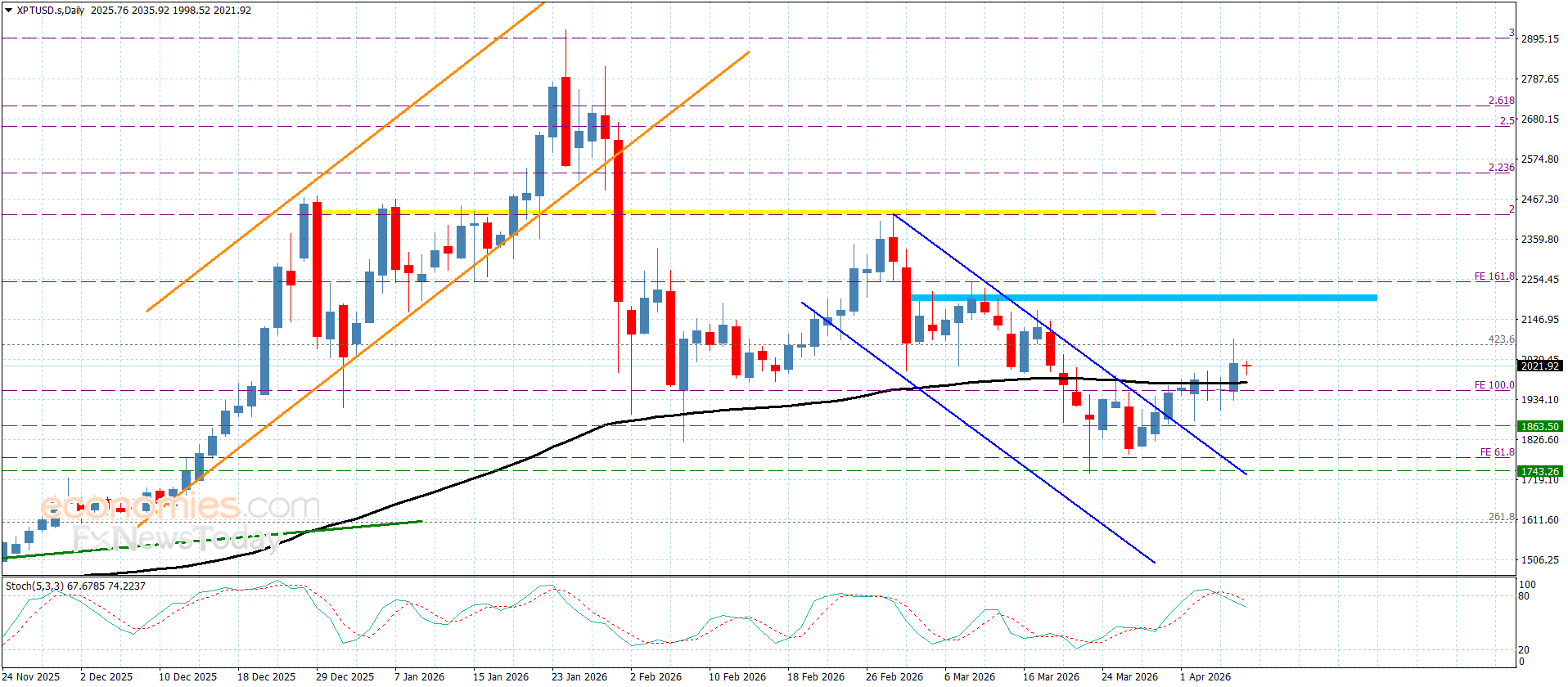
Platinum price forced to provide mixed trading after reaching $2093.00 level, due to the contradiction of the main indicators, specifically by stochastic exit from the overbought level, however, this won’t affect the bullish scenario due to its stability above the moving average 55, reinforcing the stability of the extra support at $1950.00.
Gathering extra positive momentum is important for breaching $2080.00 barrier, to begin targeting new positive stations that might begin at $2130.00 reaching the next resistance at $2205.00.
The expected trading range for today is between $1970.00 and $2130.00
Trend forecast: Bullish
EUR/JPY rebounds after registering little losses in the previous day, trading around 185.30 during the European hours on Thursday. The daily chart’s technical analysis indicates the currency cross is trending higher within an ascending channel, signaling a bullish bias.
The near-term bias is bullish as the EUR/JPY cross holds above both the nine-day period and 50-period Exponential Moving Averages (EMAs), respectively. The alignment of the shorter EMA above the longer one suggests an underlying upward trend, while the Relative Strength Index (RSI) at 61.38 points to firm but not yet overstretched bullish momentum as the pair edges toward overhead levels.
The EUR/JPY cross may retest immediate resistance near the upper boundary of the ascending channel around 185.70. A break above the channel would reinforce the bullish outlook and open the door toward the all-time high of 186.88, recorded on January 23.
On the downside, initial support is seen at the nine-day EMA of 184.52. A move below this level could weaken the bullish bias, exposing the 50-day EMA at 183.64, followed by the channel’s lower boundary around 183.00.
(The technical analysis of this story was written with the help of an AI tool.)
The table below shows the percentage change of Euro (EUR) against listed major currencies today. Euro was the strongest against the Japanese Yen.
| USD | EUR | GBP | JPY | CAD | AUD | NZD | CHF | |
|---|---|---|---|---|---|---|---|---|
| USD | 0.03% | 0.03% | 0.21% | 0.06% | 0.20% | -0.23% | -0.06% | |
| EUR | -0.03% | 0.02% | 0.20% | 0.06% | 0.16% | -0.24% | -0.09% | |
| GBP | -0.03% | -0.02% | 0.17% | 0.02% | 0.14% | -0.27% | -0.10% | |
| JPY | -0.21% | -0.20% | -0.17% | -0.16% | -0.03% | -0.46% | -0.28% | |
| CAD | -0.06% | -0.06% | -0.02% | 0.16% | 0.14% | -0.29% | -0.12% | |
| AUD | -0.20% | -0.16% | -0.14% | 0.03% | -0.14% | -0.40% | -0.24% | |
| NZD | 0.23% | 0.24% | 0.27% | 0.46% | 0.29% | 0.40% | 0.16% | |
| CHF | 0.06% | 0.09% | 0.10% | 0.28% | 0.12% | 0.24% | -0.16% |
The heat map shows percentage changes of major currencies against each other. The base currency is picked from the left column, while the quote currency is picked from the top row. For example, if you pick the Euro from the left column and move along the horizontal line to the US Dollar, the percentage change displayed in the box will represent EUR (base)/USD (quote).
Silver price (XAG/USD) trades calmly near $74.00 during the late Asian trading session on Thursday. The white metal struggles for direction amid uncertainty surrounding the first round of talks on a permanent ceasefire between the United States (US) and Iran in Pakistan on Saturday.
On late Wednesday, White House press secretary Karoline Leavitt stated that US President Donald Trump will send Vice President (VP) JD Vance-led team in Pakistan on Saturday to discuss the 10-point peace proposal shared by Iran as demands for a permanent ceasefire.
Ahead of US-Iran talks, Iran’s parliament speaker and chief negotiator, Mohammad Bagher Qalibaf has criticized the US, through a post on X, for violating three clauses of the 10-point proposal. Qalibaf alleged the US for attacking Lebanon, referring the first clause, which is “an immediate ceasefire everywhere, including Lebanon and other regions, effective immediately”.
The Silver price remained under pressure in the past few weeks, as oil prices gained sharply due to the closure of the Strait of Hormuz by Iran, as part of retaliation against military actions from the US and Israel.
Higher oil prices had prompted traders to raise hawkish bets for global central banks; however, they have eased significantly, following the announcement of the two-week ceasefire between the US and Iran.
According to the CME FedWatch tool, traders see a 76.4% chance that the Fed will keep interest rates steady this year, a sharp turnaround from expectations of two interest rate hikes built during the war.
Rising hopes of tight monetary conditions by the Fed bode poorly for non-yielding assets, such as Silver.
XAG/USD trades almost flat at around $74.00 as of writing, maintaining a bearish near-term bias as it holds beneath the 20-period Exponential Moving Average (EMA) at $74.89. The metal continues to consolidate near recent lows, with the modestly soft 14-day Relative Strength Index (RSI) around 46 suggesting subdued bullish momentum and leaving the path of least resistance tilted to the downside while price remains capped by the overhead EMA.
On the topside, initial resistance is defined by the 20-period EMA at $74.89, and a sustained break above this level would be needed to ease immediate downside pressure and open the way for a more meaningful recovery toward the April 2 high of $81.13. But until price reclaims the EMA, rallies are likely to be viewed as corrective within a weak short-term structure.
Looking down, the psychological level of $70.00 is the key support for the price, followed by the March 26 low of $66.70.
(The technical analysis of this story was written with the help of an AI tool.)
Silver is a precious metal highly traded among investors. It has been historically used as a store of value and a medium of exchange. Although less popular than Gold, traders may turn to Silver to diversify their investment portfolio, for its intrinsic value or as a potential hedge during high-inflation periods. Investors can buy physical Silver, in coins or in bars, or trade it through vehicles such as Exchange Traded Funds, which track its price on international markets.
Silver prices can move due to a wide range of factors. Geopolitical instability or fears of a deep recession can make Silver price escalate due to its safe-haven status, although to a lesser extent than Gold’s. As a yieldless asset, Silver tends to rise with lower interest rates. Its moves also depend on how the US Dollar (USD) behaves as the asset is priced in dollars (XAG/USD). A strong Dollar tends to keep the price of Silver at bay, whereas a weaker Dollar is likely to propel prices up. Other factors such as investment demand, mining supply – Silver is much more abundant than Gold – and recycling rates can also affect prices.
Silver is widely used in industry, particularly in sectors such as electronics or solar energy, as it has one of the highest electric conductivity of all metals – more than Copper and Gold. A surge in demand can increase prices, while a decline tends to lower them. Dynamics in the US, Chinese and Indian economies can also contribute to price swings: for the US and particularly China, their big industrial sectors use Silver in various processes; in India, consumers’ demand for the precious metal for jewellery also plays a key role in setting prices.
Silver prices tend to follow Gold’s moves. When Gold prices rise, Silver typically follows suit, as their status as safe-haven assets is similar. The Gold/Silver ratio, which shows the number of ounces of Silver needed to equal the value of one ounce of Gold, may help to determine the relative valuation between both metals. Some investors may consider a high ratio as an indicator that Silver is undervalued, or Gold is overvalued. On the contrary, a low ratio might suggest that Gold is undervalued relative to Silver.
– Written by
Ben Hughes
STORY LINK Pound Sterling to Dollar Forecast: GBP’s “Sentiment-driven Gains” see 1% Rally
The Pound to Dollar exchange rate (GBP/USD) surged above 1.3400 after a ceasefire agreement in the US-Iran conflict triggered a sharp drop in oil prices and a rebound in global risk appetite.
While the weaker dollar has boosted Sterling in the short term, analysts warn that uncertainty remains high and gains could face resistance near the 1.35 level.
The Pound to Dollar (GBP/USD) exchange rate jumped above the 1.3400 level in Asia on Wednesday following the announcement of a ceasefire in the US-Iran conflict.
Just ahead of President Trump’s deadline, a deal brokered by Pakistan secured a 2-week ceasefire. In return, Iran pledged to allow transit to resume through the Strait of Hormuz.
Oil prices dropped sharply and there was a surge in risk appetite with a 2.0% gain for the FTSE 100 index while the dollar posted sharp losses with the dollar index (DXY) around 98.80 from close to 100 on Tuesday.
A dip in energy prices and a decline in bond yields will alleviate pressure on the UK economy, although both metrics are worse than before the conflict started.
Get better rates and lower fees on your next international money transfer.
Compare TorFX with top UK banks in seconds and see how much you could save.
UoB commented; “While the short-term rally appears overdone, there is scope for GBP to rise to 1.3480.” There is also likely to be tough resistance on any approach to the 1.3500 area.
ING noted the importance of energy prices; “Risk assets are rallying as combatants in Iran pull back from the brink. The most impactful news overnight has been Iran’s announcement that it will allow safe passage for traffic through the Strait of Hormuz during this ceasefire.”
MUFG commented; “There are a lot of uncertainties that will persist but having said that, this of course is a step in the right direction and we see this as reducing considerably, over the short-term at least, the risk of a major risk-off and with it a strengthening of the dollar.
It added; “This outcome is a clear bearish outcome for the US dollar.”
According to National Australia Bank head of FX strategy Ray Attrill; “If the strategic waterway is reopened, we could be able to consolidate the risk-on rally that we’re seeing.”
He added; “But a lot has to happen in the next 14 days. Markets still need to proceed with a degree of scepticism.”
ING commented on the dollar; DXY rallied just over 3% through March. It has gapped lower today, and a further sell-off to 98.50 looks possible. However, there remains too much uncertainty to expect a full unwind of the March rally, and it is therefore premature to call for a break under 98.00.”

Rabobank noted the wide range of potential outcomes; “In terms of our macro and market scenarios, the latest news leans towards our base case of fighting being over by mid-April with a slow Hormuz reopening – and on US terms. Obviously, if this pause instead leads to more fighting, we move towards our other, more damaging scenarios.”
ING added; “Don’t expect a complete reversal of March trends, however.”
International Money Transfer? Ask our resident FX expert a money transfer question or try John’s new, free, no-obligation personal service! ,where he helps every step of the way,
ensuring you get the best exchange rates on your currency requirements.
TAGS: Pound Dollar Forecasts