The main category of All News Articles.
You can use the search box below to find what you need.
[wd_asp id=1]
The main category of All News Articles.
You can use the search box below to find what you need.
[wd_asp id=1]
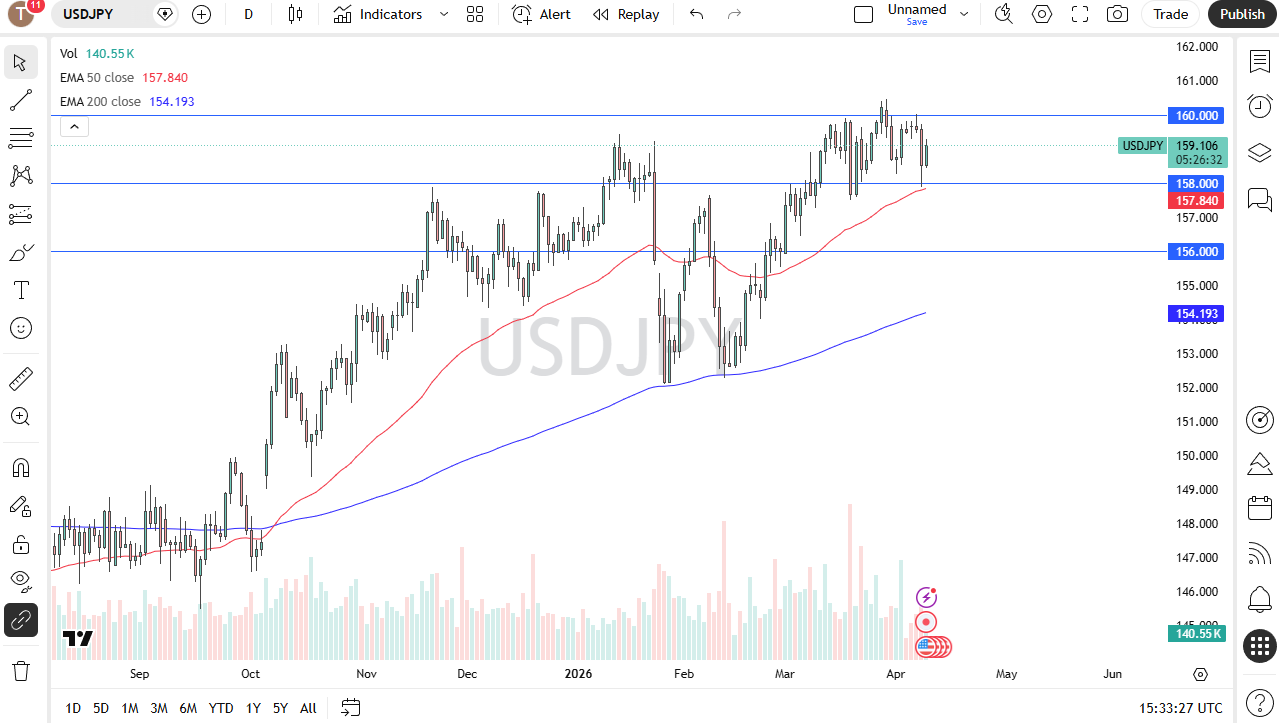
The US dollar continues to bounce against the yen, waiting to see if we can break higher.
The US dollar has rallied a bit against the Japanese yen during trading on Thursday as we continue to see a lot of noise in the interest rate environment.
The 158-yen level on the bottom of the range and the 160-yen level on the top is how I see the market right now.
Obviously, there is a lot going on that could greatly influence what happens next, not the least of which of course would be any ceasefire talks in the Middle East, but I would also watch very closely the 10-year yield in both countries, but specifically the United States.
The longer it stays above 4.3% the more likely it is the US dollar breaks out. It has fallen back below there during this session so we will see how that plays out. I suspect probably what you are going to see more than anything else is a lot of volatility over the next couple of days because we have those ceasefire talks on Friday in Islamabad, so we will have to see how that plays out.
It certainly looks like the USD/JPY market is pricing in some type of good news when I look at other assets. So, I anticipate that the US dollar may weaken a bit but ultimately this is a market that I also pay close attention to the 160.4-yen level because that would be an area that if we could break above it could really spell serious trouble for the Japanese yen.
That is a 1990 high that the US dollar made against the Japanese yen and if we were to break that, things could get ugly really fast. All things being equal, I do think this is a scenario where traders are going to have to be very patient, but I do think it also remains a buy-on-the-dip type of scenario as clearly the interest rate differential will continue to favor the US dollar.

Again, I think the 158-yen level continues to be a major support for the greenback right now and I do like the idea of buying closer to that, in fact I did overnight. But you can see just how noisy this market might end up being and with that being the case you do have to be somewhat cautious with your position sizing, but ultimately, I believe this is a market that will threaten that 160.4-yen level which is so important.
If we were to break down below the 50-day EMA then that obviously would be a major breakout just waiting to happen and, in that way, the Japanese yen probably strengthens across the board for not only moving against US dollar but maybe other currencies. The 156-yen level at that point for me would be the next support level.
Want to trade our USD/JPY forex analysis and predictions? Here’s a list of forex brokers in Japan to check out.
Christopher Lewis has been trading Forex and has over 20 years experience in financial markets. Chris has been a regular contributor to Daily Forex since the early days of the site. He writes about Forex for several online publications, including FX Empire, Investing.com, and his own site, aptly named The Trader Guy. Chris favours technical analysis methods to identify his trades and likes to trade equity indices and commodities as well as Forex. He favours a longer-term trading style, and his trades often last for days or weeks.
At 9 a.m. Eastern Time today, oil was priced at $97.78 per barrel with Brent serving as the benchmark (we’ll explain different benchmarks later in this article). That’s a gain of $4.02 compared with yesterday morning and around $31 higher than the price one year ago.
It’s impossible to forecast oil prices with detailed precision. Many different elements affect the market, but ultimately it boils down to supply and demand. When worries about economic recession, war, and other large-scale disruptions increase, oil’s path can shift fast.
Gas prices at the pump don’t only track crude oil. They also include what it takes to refine and move that fuel, the taxes layered on top, and the extra markup your local station adds to stay in business.
Since crude oil generally makes up a majority of the per-gallon cost, changes in its price have an outsized impact. When oil surges, gas prices typically rise in tandem. But when oil retreats, gas prices often lag on the way down, a trend sometimes described as “rockets and feathers.”
In case of emergency, the U.S. has a store of crude oil known as the Strategic Petroleum Reserve. Its primary purpose is energy security in case of disaster (think sanctions, severe storm damage, even war). But it can also go a long way toward softening crippling price hikes during supply shocks.
It’s not a long-term answer and is more meant to provide temporary relief, assisting consumers and keeping critical parts of the economy running, like key industries, emergency services, public transportation, etc.
Both oil and natural gas are key sources of the energy we use every day. Because of this, a big change in oil prices can affect natural gas. For example, if oil prices increase, some industries may swap natural gas for some segments of their operations where possible, which increases demand for natural gas.
To gauge oil’s performance, we often turn to two benchmarks:
Between these two, Brent better represents global oil performance because it prices much of the world’s traded crude. And, it’s often the best way to track historical oil performance. In fact, even the U.S. Energy Information Administration now uses Brent as its primary reference in its Annual Energy Outlook.
Looking at the Brent benchmark across several decades, oil has been anything but steady. It’s seen spikes due to factors such as wars and supply cuts, and it’s also seen crashes from global recessions and an oversupply (called a “glut”). For example:
All to say, oil’s historical performance has been anything but smooth. Again, it’s hugely affected by wars, recessions, OPEC whims, evolving energy initiatives and policies, and much more.
Looking to stay up-to-date regarding the latest energy developments? Check out our recent coverage:
The current price of oil per barrel depends largely on supply and demand, including news about potential future supply and demand (geopolitics, decisions made by OPEC+, etc.). In the U.S., prices also move based on how friendly an administration is to drilling, as it can affect future supply. For example, 2025 saw the Trump administration move to reopen more than 1.5 million acres in the Coastal Plain of the Arctic National Wildlife Refuge for oil and gas leasing, reversing the Biden administration’s policy of limiting oil drilling in the Arctic.
The price of oil updates constantly when the “futures” markets are open. A futures market is effectively an auction where people agree to buy or sell oil in the future. As long as people and companies are trading contracts, the oil price is changing.
In short, shale is rock that contains oil and natural gas. Think of shale as energy yet to be tapped. The more shale the U.S. accesses, the more energy we’ll have—and the more easily oil prices can keep from spiking as much thanks to a greater supply.
When oil is expensive, it tends to make everyday items cost more. This can be related to energy (your heating, gas utilities, etc.), but it’s also due to the logistics involved with making those items accessible to you. Shipping, for example, can affect the price of things at the grocery store, as it’s more expensive to get those products from warehouses and farms onto the shelf.
The CADJPY ended the bullish corrective rally by facing a strong barrier at 210.65, as it represents %100 Fibonacci extension level, forcing it to form sideways trading by its stability near 201.40.
The stability below the current barrier and stochastic attempt to provide negative momentum will increase the chances of forming bearish waves, to attempt to reach 200.70 and 200.25, while breaching the barrier will ease the mission of recording extra gains that might extend towards 212.20 initially.
The expected trading range for today is between 200.70 and 201.60
Trend forecast: Bearish
The global copper market operates within a complex ecosystem where supply constraints, demand fluctuations, and monetary conditions intersect to create price discovery mechanisms that extend far beyond simple commodity trading. Understanding these economic fundamentals requires analyzing how industrial production cycles, energy transition requirements, and central bank policies converge to influence copper price forecast expectations through 2026.
Global copper mine production faces mounting pressures that extend beyond traditional cyclical patterns. According to the U.S. Geological Survey 2025 Mineral Commodity Summaries, global refined copper production reached approximately 21 million tonnes annually as of 2024, with concentration heavily weighted toward Chile, Peru, China, and Indonesia.
Chile maintains its position as the dominant producer, accounting for roughly 27% of global copper mine output through operations at Escondida, Codelco, and other significant mines. However, the country confronts structural headwinds from declining ore grades and acute water scarcity that constrains expansion capabilities.
Peru, contributing approximately 10-11% of global supply, represents the second-largest producer but faces recurring disruptions from labor disputes and political instability that create supply uncertainty. Recent market analysis indicates copper prices advancing from a four-month low of $5.2463 per pound in March 2026, suggesting underlying supply tightness or demand recovery dynamics.
Furthermore, understanding the US copper production overview provides additional context for North American supply dynamics and their impact on global pricing mechanisms.
Key Supply Chain Constraints:
Energy-intensive refining operations face particular vulnerability to power price fluctuations and fuel availability. Approximately 70-80% of copper production costs derive from energy expenses, creating substantial operational challenges during periods of energy price volatility.
China’s consumption patterns dominate global copper demand dynamics, representing 50-55% of annual refined copper consumption according to International Copper Study Group data. This concentration creates significant sensitivity to Chinese economic performance and policy decisions.
Recent macroeconomic indicators suggest potential demand recovery momentum. China’s Producer Price Index moved back into positive territory for the first time in three years, supported by higher energy costs and improving demand conditions. This development signals potential industrial demand strengthening that could support copper price forecast projections.
Demand Segmentation by Sector:
Manufacturing sector copper intensity has increased approximately 1.5-2.0% annually over the past decade, driven by higher electrical content in products and renewable energy infrastructure requirements. This structural trend supports medium-term demand growth independent of cyclical factors.
The relationship between industrial production indices and copper demand maintains historical correlation coefficients of 0.65-0.75, reinforcing copper’s position as a reliable economic activity indicator. Construction demand shows elasticity to interest rate changes of approximately -1.2 to -1.5 in developed markets, meaning construction copper demand falls 1.2-1.5% for each 1% increase in borrowing costs.
Central bank policy decisions create significant transmission effects on copper valuations through multiple channels. Real interest rates, representing nominal rates minus inflation expectations, serve as primary drivers of copper valuations by influencing opportunity costs of holding non-yielding physical assets.
Current monetary conditions reflect stabilisation following recent volatility. Government bond yields have remained largely steady as investors reassess expectations for central bank rate cuts timing and magnitude. The US dollar traded in narrow ranges while the yen remained weak amid policy divergence, creating a relatively stable currency environment for commodity pricing.
Additionally, the tariff impacts on copper supply demonstrate how trade policy decisions intersect with monetary conditions to influence global pricing mechanisms.
Monetary Transmission Mechanisms:
Markets continue pricing further Bank of England rate cuts as growth indicators remain subdued and inflation trends show moderation signs. This easing bias across major central banks could provide supportive conditions for commodity pricing through reduced opportunity costs and increased liquidity availability.
Economic scenario analysis provides frameworks for understanding potential copper price trajectories under different macroeconomic conditions. These scenarios incorporate GDP growth assumptions, monetary policy paths, and structural demand factors that could influence copper price forecast outcomes through 2026.
The base case scenario assumes moderate global economic growth with GDP expansion of 2.0-2.5% across major economies, representing trend-level performance without significant disruptions. This scenario incorporates steady-state conditions with modest monetary policy easing from 2025 peaks and China economic growth maintaining 4.5-5.5% annually.
Current market pricing suggests alignment with base case assumptions. Copper prices around $5.75-5.80 per pound (approximately $12,680-$12,900/tonne) in April 2026 place valuations within the projected range, indicating market participants are pricing moderately constructive economic conditions.
Base Case Assumptions:
Industrial production stability factors include manufacturing PMI readings above 50 across major economies, indicating expansion rather than contraction in manufacturing activity. China’s Producer Price Index returning to positive territory supports base case assumptions of industrial demand stabilisation.
Bullish scenario conditions require significant acceleration beyond trend growth, driven primarily by infrastructure investment surges and energy transition acceleration. This scenario assumes coordinated fiscal stimulus supporting green energy deployment and electrification infrastructure beyond current policy targets.
Current copper pricing near $12,680-$12,900/tonne already approaches the lower end of the bullish scenario range, suggesting market participants are incorporating some upside potential from infrastructure spending and energy transition investments. Consequently, examining copper investment strategies becomes crucial for positioning ahead of potential bullish developments.
Bullish Scenario Drivers:
Energy transition investment requirements could drive substantial copper demand growth. Electrification trends may generate 60% growth in copper demand from grid and electric vehicle applications by 2035, fundamentally altering supply-demand equilibrium and supporting structurally higher price levels.
Bearish conditions require global economic contraction or significant slowdown with GDP growth below 1%, creating demand destruction across construction and manufacturing sectors. This scenario incorporates inventory overhang from prior production cycles and financial investor liquidation of commodity positions.
Technical analysis suggests copper’s March 2026 low of $5.2463 per pound (approximately $11,560/tonne) represents a key support level. Trading below this threshold could trigger bearish momentum targeting the $5.0000 per pound region ($11,023/tonne), aligning with bearish scenario price projections.
Bearish Risk Factors:
Historical precedent from the 2008-2009 financial crisis and 2015-2016 China slowdown demonstrates how economic contractions can drive copper below $10,000/tonne levels. Demand destruction typically occurs when construction activity falls significantly and manufacturing capacity utilisation drops below 70%.
Financial markets employ multiple mechanisms to price future supply-demand imbalances, incorporating futures market structure, institutional positioning, and options market intelligence. These pricing mechanisms reveal market participants’ collective expectations about copper market evolution and provide insights for copper price forecast analysis.
Futures market structure reveals critical information about market participants’ near-term versus long-term supply-demand expectations. Contango markets, where forward prices exceed near-term prices, suggest adequate current supply and weak immediate demand. Conversely, backwardated markets indicate immediate supply concerns or strong near-term demand.
Current copper pricing around $5.75-5.80 per pound with resistance at $5.8060 and longer-term targets at $5.8585 suggests market structure supporting gradual price appreciation. The recovery from March 2026 lows indicates underlying demand strength or supply constraints supporting higher valuations.
However, recent NY copper price highs demonstrate how regional market dynamics can create temporary price dislocations that ultimately resolve through arbitrage mechanisms.
Term Structure Indicators:
| Futures Analysis Framework | Bullish Signal | Bearish Signal |
|---|---|---|
| Term Structure | Backwardation | Deep Contango |
| Volume Distribution | Near-month concentration | Back-month dominance |
| Open Interest | Rising with prices | Declining with rallies |
| Volatility Surface | Low implied volatility | High implied volatility |
Institutional copper exposure encompasses hedge fund long/short positioning monitored through Commitments of Traders reports, pension fund commodity allocation as inflation hedges, and sovereign wealth fund strategic commodity reserves.
Hedge fund positioning typically leads price movements by 2-4 weeks, as large fund flows create momentum that retail and commercial participants follow. Pension fund allocation shifts toward commodities during inflationary periods can provide sustained buying pressure lasting quarters rather than weeks.
Institutional Flow Categories:
Current market conditions with stabilising bond yields and steady dollar trading suggest institutional positioning may be neutral to slightly constructive. The absence of significant currency volatility reduces hedging costs for international copper exposure.
China’s economic performance represents the single most significant driver of global copper demand, consuming approximately 50-55% of annual refined copper production. Chinese economic trajectory influences copper price forecast projections through multiple transmission mechanisms including manufacturing sector health, policy effectiveness, and regional demand substitution dynamics.
Recent data indicates potential stabilisation in Chinese manufacturing conditions. The Producer Price Index moved back into positive territory for the first time in three years, supported by higher energy costs and improving demand conditions. This development suggests industrial demand recovery that could support copper consumption growth.
Key Chinese Economic Indicators:
Chinese property sector dynamics significantly influence copper demand through building and construction applications. Property sector copper intensity remains elevated due to electrical infrastructure requirements and HVAC system installations. Recovery in housing starts and construction permits provides leading indicators for copper demand acceleration.
Chinese policy effectiveness directly impacts copper demand through stimulus multiplier effects on infrastructure spending and manufacturing investment. Green energy transition investment flows create additional copper demand from renewable energy installation and grid modernisation projects.
Infrastructure spending multiplier effects typically generate 2.5-3.5x copper demand relative to direct government investment due to private sector participation and supply chain requirements. Policy transmission typically occurs with 6-12 month lags between announcement and demand impact.
Policy Impact Channels:
Regional demand patterns outside China provide diversification for global copper consumption. Southeast Asian industrial growth, India’s manufacturing expansion, and Latin American domestic consumption create alternative demand sources reducing dependence on Chinese economic performance.
India’s manufacturing expansion potential includes electronics production, automotive assembly, and infrastructure development that could generate 8-12% annual copper demand growth over the next decade. Southeast Asia industrial development follows similar patterns with electronics manufacturing and urban development driving copper consumption.
Moreover, developments in the Argentina copper system illustrate how emerging producers can alter regional supply-demand dynamics and provide alternatives to traditional copper sources.
Regional Growth Factors:
Energy transition economics create structural demand drivers that could fundamentally alter copper supply-demand dynamics over the next decade. Electrification investment cycles, grid infrastructure requirements, and technology substitution thresholds represent key factors influencing long-term copper price forecast projections.
Global electrification trends drive copper demand through multiple channels including electric vehicle adoption, renewable energy installation, and grid infrastructure modernisation. These investment cycles operate on different timelines but create compounding demand effects supporting structurally higher copper prices.
Electric vehicle adoption requires 3-4 times more copper per unit than traditional internal combustion engine vehicles. Battery electric vehicles typically contain 80-85 kilograms of copper compared to 20-25 kilograms in conventional vehicles. Projected electric vehicle production growth to 30-50 million units annually by 2030 could generate 2-3 million tonnes of additional annual copper demand.
Electrification trends could drive 60% growth in copper demand from grid and electric vehicle applications by 2035, fundamentally altering the supply-demand equilibrium and supporting structurally higher price levels.
Electrification Copper Intensity:
Grid infrastructure modernisation represents a multi-decade investment cycle requiring substantial copper input for transmission lines, distribution systems, and smart grid technologies. Renewable energy integration necessitates grid flexibility and storage capacity that amplifies copper requirements beyond traditional power generation.
Technology substitution risks exist when copper prices reach levels making alternative materials economically viable. Aluminium substitution typically becomes attractive when copper prices exceed aluminium prices by 2.5-3.0x ratios, though technical performance differences limit substitution applications.
Substitution Price Thresholds:
Recycling technology advancement impacts net primary supply requirements by increasing secondary copper availability. Advanced recycling techniques can recover 95-98% of copper content from scrap materials, potentially reducing primary mining requirements as scrap accumulation increases over time.
Economic risk factors create copper price volatility through geopolitical premiums, financial market contagion, and potential black swan events. Understanding these risk factors helps inform copper price forecast uncertainty and portfolio management strategies for copper exposure.
Geopolitical tensions affect copper markets through supply route vulnerabilities, trade policy uncertainty, and resource nationalism risks. Middle East conflicts can disrupt shipping routes used for copper transport, while trade policy changes create demand uncertainty in major consuming regions.
Geopolitical Risk Categories:
Resource nationalism represents long-term risk where producing countries implement higher taxation, export restrictions, or nationalisation policies. Historical precedent includes Chile’s copper royalty increases and Peru’s mining tax proposals that create investment uncertainty and potential supply constraints.
Trade policy uncertainty quantification typically adds 3-8% risk premiums to copper prices during periods of elevated trade tensions. Current stable trade relationships suggest minimal risk premium incorporation, but sudden policy changes could quickly alter this assessment.
Financial market stress can transmit to copper markets through forced liquidation, credit market tightening, and correlation breakdown during crisis periods. Dollar strength correlation patterns show copper typically weakens during USD appreciation phases, while bond market volatility creates commodity price instability.
Contagion Transmission Mechanisms:
Credit market stress indicators include copper financing availability and warehouse financing costs. When credit spreads widen significantly, copper inventory financing becomes expensive, forcing inventory liquidation and creating downward price pressure independent of supply-demand fundamentals.
Black swan events represent low-probability, high-impact scenarios that could create extreme copper price movements. Pandemic-style demand shocks, climate-related supply disruptions, and financial system stress require scenario planning despite low probability outcomes.
Black Swan Scenario Types:
Climate-related supply disruption modelling includes drought conditions affecting Chilean mining operations, extreme weather impacting Peruvian mine transportation, and flooding risks at major facilities. These scenarios could remove 5-15% of global supply for extended periods, creating substantial price spikes.
Investment positioning for copper price uncertainty requires comprehensive portfolio allocation strategies, risk management frameworks, and understanding of various copper exposure vehicles. Investors must balance direct commodity exposure against equity-based copper investments while managing volatility and correlation risks.
Direct commodity exposure through ETFs, futures, or physical copper provides pure price exposure but carries storage costs, contango risks, and roll yield considerations. Equity-based copper exposure through mining companies offers leverage to copper prices but introduces company-specific risks, operational issues, and equity market correlation.
Copper Exposure Vehicles:
Geographic diversification considerations include exposure to different producing regions, various stages of mining operations, and multiple end-user markets. Diversification across Chilean, Peruvian, North American, and Australian operations reduces single-country political and operational risks.
Volatility-adjusted return optimisation requires understanding copper price volatility patterns, correlation relationships, and hedging strategy effectiveness. Copper price volatility typically ranges 25-35% annually, with higher volatility during economic uncertainty periods.
Risk Management Tools:
Correlation breakdown scenario planning prepares portfolios for periods when normal relationships fail. During crisis periods, correlations often approach 1.0 as all risk assets move together, reducing diversification benefits when most needed.
Liquidity provision during stress periods becomes critical when copper markets experience significant volatility. ETF liquidity can deteriorate during market stress, while futures markets typically maintain liquidity but may experience wider bid-ask spreads and increased margin requirements.
Forward curve analysis provides insights into market participant expectations about future supply-demand conditions, storage costs, and risk premiums embedded in copper pricing. The term structure reveals whether markets expect tightness or surplus conditions and helps inform copper price forecast methodologies.
Current copper pricing shows gradual recovery from March 2026 lows with resistance levels at $5.8060 and targets at $5.8585, suggesting market expectations of modest price appreciation. The absence of steep contango or backwardation indicates relatively balanced near-term supply-demand expectations.
Term Structure Interpretation:
Short-term supply tightness indicators include backwardation between prompt and 3-month contracts, elevated warehouse premiums, and low exchange inventory levels. Current market structure suggests moderate supply conditions without extreme tightness or surplus.
Long-term structural demand assumptions embedded in forward pricing reflect energy transition expectations, Chinese demand growth projections, and supply expansion capabilities. Forward curves beyond 12 months typically incorporate structural demand growth from electrification trends.
Options markets provide additional intelligence about tail risk expectations, volatility premiums, and event risk pricing. Implied volatility surfaces reveal market participants’ expectations about future price uncertainty and help identify potential market stress periods.
Furthermore, examining Goldman Sachs’ insights on copper prices alongside copper market trading data provides comprehensive market intelligence for investment decision-making.
Options Market Signals:
Skew patterns reveal whether markets expect more upside or downside risk. Positive skew (higher call option implied volatility) suggests expectations of potential price spikes, while negative skew indicates concerns about significant price declines.
Event risk premium identification helps investors prepare for periods around key economic announcements, Chinese policy decisions, or supply disruption possibilities. Options markets typically price higher volatility around these events, creating potential trading opportunities for volatility-focused strategies.
Disclaimer: This analysis contains forward-looking projections and scenarios that involve inherent uncertainty. Copper price forecasts depend on numerous variables including but not limited to economic growth rates, monetary policy decisions, geopolitical developments, and technological changes. Past performance does not guarantee future results. Investors should conduct thorough due diligence and consider consulting financial professionals before making investment decisions. The scenarios presented are for educational purposes and should not be construed as investment recommendations.
Discovery Alert’s proprietary Discovery IQ model delivers real-time alerts on significant ASX mineral discoveries, instantly empowering subscribers to identify actionable copper and commodity opportunities ahead of the broader market. Understand why major mineral discoveries can lead to substantial returns by exploring historical examples of exceptional outcomes, then begin your 14-day free trial today to position yourself ahead of market-moving announcements.
GBP/JPY edges higher on Friday, extending gains for a fifth straight day as the Japanese Yen (JPY) remains on the defensive against most of the major peers. Elevated Oil prices continue to weigh on the Yen, given Japan’s status as a major net importer.
Meanwhile, the British Pound (GBP), a cyclical currency, is drawing support from a modest improvement in risk sentiment as earlier concerns over the durability of the US-Iran ceasefire ease, with traders now looking ahead to upcoming negotiations in Pakistan over the weekend.
At the time of writing, the cross is trading around 214.12, its highest level since February 9. Apart from near-term price action, the wide interest rate differential between the UK and Japan remains a key driver supporting the cross.
From a technical perspective, GBP/JPY maintains a bullish bias, with shallow pullbacks within a broader uptrend. The latest leg higher follows a rebound from the 100-day Simple Moving Average (SMA) at 210.68, which acts as reliable support and continues to cushion the downside.
Price is now testing the 214.00-215.00 zone, which has capped upside attempts since mid-January. A sustained break above this area would strengthen bullish momentum and open the door for further gains.
The Relative Strength Index (RSI) near 63 points to strengthening bullish momentum without yet signaling overbought conditions. Meanwhile, the Moving Average Convergence Divergence (MACD) has turned positive again, suggesting that upside momentum is rebuilding after the recent consolidation phase.
On the downside, initial support is reinforced by the 100-day SMA at 210.68, which serves as the first line of defense should GBP/JPY correct lower. A deeper pullback would likely look toward the 200-day SMA at 205.52 as a more substantial structural floor, where longer-term buyers could re-emerge to protect the broader uptrend.
The table below shows the percentage change of Japanese Yen (JPY) against listed major currencies today. Japanese Yen was the strongest against the Australian Dollar.
| USD | EUR | GBP | JPY | CAD | AUD | NZD | CHF | |
|---|---|---|---|---|---|---|---|---|
| USD | -0.14% | -0.15% | 0.08% | 0.08% | 0.09% | 0.13% | -0.24% | |
| EUR | 0.14% | -0.01% | 0.24% | 0.23% | 0.23% | 0.28% | -0.11% | |
| GBP | 0.15% | 0.00% | 0.26% | 0.25% | 0.23% | 0.29% | -0.11% | |
| JPY | -0.08% | -0.24% | -0.26% | -0.03% | 0.01% | 0.00% | -0.37% | |
| CAD | -0.08% | -0.23% | -0.25% | 0.03% | 0.01% | 0.06% | -0.33% | |
| AUD | -0.09% | -0.23% | -0.23% | -0.01% | -0.01% | 0.04% | -0.34% | |
| NZD | -0.13% | -0.28% | -0.29% | -0.01% | -0.06% | -0.04% | -0.39% | |
| CHF | 0.24% | 0.11% | 0.11% | 0.37% | 0.33% | 0.34% | 0.39% |
The heat map shows percentage changes of major currencies against each other. The base currency is picked from the left column, while the quote currency is picked from the top row. For example, if you pick the Japanese Yen from the left column and move along the horizontal line to the US Dollar, the percentage change displayed in the box will represent JPY (base)/USD (quote).
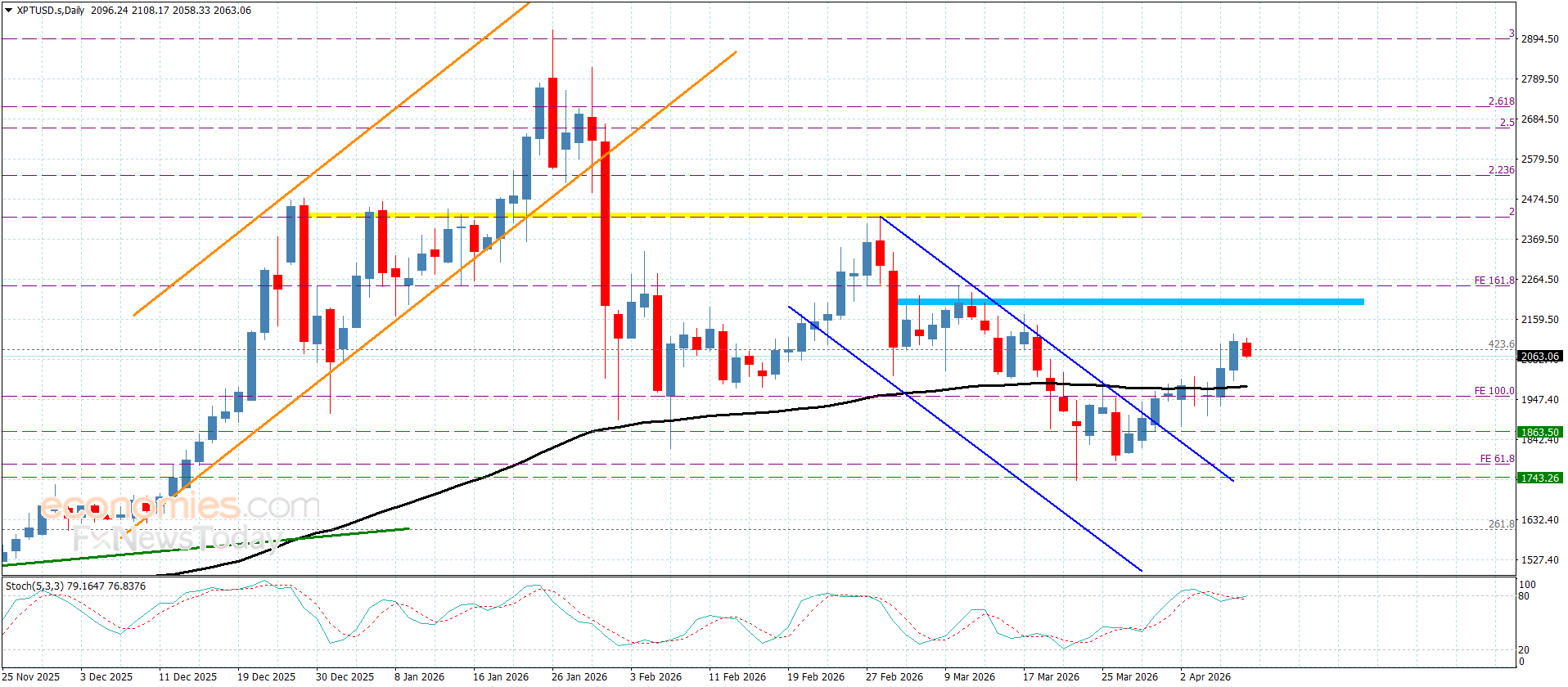
Platinum price approached by its last rally from $2130.00, forming an intraday barrier against the bullish rally, rebounding negatively and its stability near $2065.00, increasing the chances of gathering the positive momentum gain.
The stability above $1950.00 support, by the attempt of providing positive momentum by the main indicators will increase the chances of surpassing $2130.00 level, to begin targeting new positive stations that might begin at $2205.00 and $2205.00.
The expected trading range for today is between $2010.00 and $2205.00
Trend forecast: Bullish
The GBPJPY pair is under strong positive pressures, pushing it to surpass the resistance at 213.30, to settle above it to confirm regaining the bullish bias by its stability within the minor bullish channel’s levels, recording 213.85 level.
The continuation of providing positive closes above 213.30 level will allow it to take advantage from the main indicators, to begin targeting new positive stations that might begin at 214.10 and 215.00, while the return to settle below 213.30 will force it to activate the bearish corrective scenario again, forming the initial negative targets at 211.90 level.
The expected trading range for today is between 213.30 and 215.00
Trend forecast: Bullish
Silver (XAG/USD) struggles to capitalize on a three-day-old modest recovery from levels below the $70.00 psychological mark and oscillates in a narrow band during the Asian session on Friday. The white metal currently trades below the $75.50 level, nearly unchanged for the day, albeit it remains on track to end in the green for the third straight week.
From a technical perspective, the XAG/USD holds below the 200-period Exponential Moving Average (EMA) on the 4-hour chart, keeping the near-term tone capped despite a mildly constructive backdrop in momentum. In fact, the Relative Strength Index (14) hovers around 57, while the Moving Average Convergence Divergence (MACD) indicator is marginally positive. This, in turn, hints at lingering upside attempts but not yet enough to negate the broader bearish bias imposed by the dominant overhead resistance.
Meanwhile, the 200-period EMA on the 4-hour chart, at $76.66, might continue to act as initial resistance. This is followed by the 50.0% Fibonacci retracement level of the March downfall at $78.71, with higher hurdles at the 61.8% retracement at $82.86 and the 78.6% level at $88.76 before the cycle high at $96.28.
On the downside, first support emerges at the 38.2% Fibo. retracement level at $74.57, ahead of deeper floors at the 23.6% level at $69.44 and the structural base around $61.15.
(The technical analysis of this story was written with the help of an AI tool.)
Silver is a precious metal highly traded among investors. It has been historically used as a store of value and a medium of exchange. Although less popular than Gold, traders may turn to Silver to diversify their investment portfolio, for its intrinsic value or as a potential hedge during high-inflation periods. Investors can buy physical Silver, in coins or in bars, or trade it through vehicles such as Exchange Traded Funds, which track its price on international markets.
Silver prices can move due to a wide range of factors. Geopolitical instability or fears of a deep recession can make Silver price escalate due to its safe-haven status, although to a lesser extent than Gold’s. As a yieldless asset, Silver tends to rise with lower interest rates. Its moves also depend on how the US Dollar (USD) behaves as the asset is priced in dollars (XAG/USD). A strong Dollar tends to keep the price of Silver at bay, whereas a weaker Dollar is likely to propel prices up. Other factors such as investment demand, mining supply – Silver is much more abundant than Gold – and recycling rates can also affect prices.
Silver is widely used in industry, particularly in sectors such as electronics or solar energy, as it has one of the highest electric conductivity of all metals – more than Copper and Gold. A surge in demand can increase prices, while a decline tends to lower them. Dynamics in the US, Chinese and Indian economies can also contribute to price swings: for the US and particularly China, their big industrial sectors use Silver in various processes; in India, consumers’ demand for the precious metal for jewellery also plays a key role in setting prices.
Silver prices tend to follow Gold’s moves. When Gold prices rise, Silver typically follows suit, as their status as safe-haven assets is similar. The Gold/Silver ratio, which shows the number of ounces of Silver needed to equal the value of one ounce of Gold, may help to determine the relative valuation between both metals. Some investors may consider a high ratio as an indicator that Silver is undervalued, or Gold is overvalued. On the contrary, a low ratio might suggest that Gold is undervalued relative to Silver.
BitcoinWorld
EUR/GBP Forecast: Crucial Support Zone Expected to Hold Through 2025 – ING Analysis
Financial markets in London and Frankfurt are closely monitoring the EUR/GBP currency pair as ING analysts project a crucial support zone will hold through 2025, potentially stabilizing the cross-rate amid diverging monetary policies between the European Central Bank and Bank of England. The euro-pound exchange rate, currently trading around 0.8550, faces significant technical and fundamental tests as central banks navigate inflation challenges while economic growth patterns diverge across European economies.
Technical analysts at ING have identified a critical support zone between 0.8520 and 0.8480 for the EUR/GBP pair. This zone represents a confluence of multiple technical factors that historically provided substantial buying interest. The 200-day moving average currently intersects this region, creating additional technical significance. Furthermore, Fibonacci retracement levels from the 2024 rally align with these price points, strengthening the zone’s importance.
Market participants observe several key technical indicators suggesting potential stabilization. The Relative Strength Index (RSI) recently approached oversold territory near 30, typically preceding corrective bounces in trending markets. Additionally, trading volume patterns show increased activity near the support zone, indicating heightened institutional interest at these levels. Bollinger Band analysis reveals the pair testing the lower band boundary, a condition that often precedes mean reversion moves in currency markets.
The identified support zone carries historical significance dating back to pre-Brexit trading ranges. Market memory often creates psychological barriers at price levels where previous reversals occurred. Technical analysts note that this zone previously acted as resistance during 2023’s downward trend before breaking higher in early 2024. Such role reversals between support and resistance frequently create stronger technical barriers, as multiple market participants establish positions around these levels.
Monetary policy divergence represents the primary fundamental driver for EUR/GBP movements in 2025. The European Central Bank maintains a cautious approach toward interest rate adjustments, prioritizing inflation control over growth stimulation. Conversely, the Bank of England faces different economic pressures, particularly regarding consumer spending patterns and housing market stability. This policy divergence creates natural currency valuation pressures that technical levels must withstand.
Economic growth differentials further influence the currency pair’s trajectory. Eurozone economies demonstrate varying recovery paces, with Germany’s manufacturing sector showing signs of stabilization while Southern European nations experience stronger service sector growth. Meanwhile, UK economic indicators reveal persistent challenges in productivity growth and trade balance improvements. These fundamental factors create underlying currents that technical analysis must incorporate for accurate forecasting.
Key economic indicators affecting EUR/GBP:
Central bank communications increasingly influence currency valuations beyond mere policy decisions. The European Central Bank’s forward guidance emphasizes data dependency, creating uncertainty about the timing and magnitude of future rate adjustments. This uncertainty typically increases currency volatility but may also strengthen support zones as markets price in various scenarios. The Bank of England faces similar communication challenges while managing market expectations about inflation persistence.
Quantitative tightening programs represent another crucial factor. Both central banks continue balance sheet reduction efforts, though at different paces and scales. The relative speed of these programs affects currency supply dynamics, potentially strengthening the currency of the central bank pursuing more aggressive balance sheet normalization. Market participants closely monitor these technical aspects of monetary policy implementation, as they directly impact currency valuation models.
Commitments of Traders reports reveal changing institutional positioning around the EUR/GBP support zone. Hedge funds and asset managers adjusted their exposure throughout 2024, with recent data showing reduced net short positions as the pair approached technical support. This positioning shift suggests professional traders anticipate potential stabilization or reversal near current levels. Meanwhile, retail trader sentiment indicators show increased caution, typically a contrarian signal in currency markets.
The eurozone and United Kingdom face distinct economic challenges that influence their respective currencies. Eurozone integration efforts continue affecting currency stability, particularly regarding fiscal policy coordination and energy market reforms. These structural factors create longer-term currency valuation pressures that technical analysis must consider. Meanwhile, UK-specific factors including post-Brexit trade arrangements and financial services competitiveness create unique pound sterling dynamics.
| Indicator | Eurozone (Latest) | United Kingdom (Latest) | Impact on EUR/GBP |
|---|---|---|---|
| Core Inflation | 2.8% | 3.2% | Moderate Sterling pressure |
| GDP Growth Forecast | 1.2% | 0.8% | Euro supportive |
| Unemployment Rate | 6.5% | 4.2% | Mixed implications |
| Manufacturing PMI | 48.7 | 47.2 | Neutral to Euro positive |
| Consumer Confidence | -14.2 | -21.5 | Euro supportive |
Several risk factors threaten the integrity of the identified EUR/GBP support zone. Geopolitical developments in Eastern Europe continue affecting energy markets and European economic stability. Any escalation in regional conflicts could disproportionately impact eurozone economies through energy price channels. Additionally, political developments within European Union member states create uncertainty about fiscal policy coordination and structural reform implementation.
UK-specific risks include persistent inflation surprises that might force more aggressive Bank of England action than currently anticipated. Housing market vulnerabilities represent another concern, particularly if mortgage rate resets create consumer spending constraints. Furthermore, trade relationship developments with both European Union and non-EU partners could significantly impact pound sterling valuations through current account effects.
Primary risk scenarios for EUR/GBP:
Currency market structure evolution affects how support zones function in modern trading environments. Algorithmic trading participation continues growing, potentially amplifying moves toward technical levels while also providing liquidity near those levels. The EUR/GBP pair benefits from deep liquidity pools during European trading hours, though Asian and American session liquidity varies significantly. This liquidity pattern creates potential for overnight gaps that technical analysts must consider when evaluating support zone reliability.
Market microstructure analysis reveals changing transaction patterns around key technical levels. Order book data shows concentrated liquidity accumulation near the 0.8520 support level, with both resting orders and algorithmic liquidity provision creating a buffer against rapid declines. This market structure development supports ING’s analysis that the zone should hold against normal market volatility, though exceptional events could overwhelm these technical defenses.
ING’s EUR/GBP analysis presents a technically grounded forecast suggesting the identified support zone between 0.8520 and 0.8480 should hold through 2025’s market conditions. This projection combines rigorous technical analysis with fundamental understanding of central bank policies and economic divergences. While risk factors exist that could challenge this support zone, the confluence of technical indicators, institutional positioning, and market structure developments creates substantial evidence for the zone’s durability. Currency traders and risk managers should monitor this EUR/GBP support zone closely, as its integrity will significantly influence cross-rate volatility and directional bias throughout the coming year.
Q1: What specific price levels define the EUR/GBP support zone according to ING?
ING analysts identify the critical support zone between 0.8520 and 0.8480, representing a confluence of technical factors including the 200-day moving average and key Fibonacci retracement levels.
Q2: How does monetary policy divergence affect the EUR/GBP exchange rate?
Divergence between European Central Bank and Bank of England policies creates natural currency valuation pressures, with interest rate differentials and quantitative tightening pace differences directly impacting the exchange rate’s fundamental valuation.
Q3: What technical indicators support the analysis that this zone will hold?
Multiple technical indicators suggest potential stabilization, including RSI approaching oversold conditions, Bollinger Band positioning, historical support/resistance role reversal, and volume patterns showing increased activity near these levels.
Q4: What are the main risk factors that could break this EUR/GBP support?
Primary risks include unexpected central bank policy pivots, geopolitical developments affecting European energy markets, UK inflation persistence requiring additional rate hikes, and significant economic divergence beyond current expectations.
Q5: How does market structure affect support zone reliability in modern currency trading?
Algorithmic trading participation and order book liquidity concentration near technical levels can both amplify moves toward support zones and provide defensive liquidity, creating more defined technical barriers than in previous market eras.
This post EUR/GBP Forecast: Crucial Support Zone Expected to Hold Through 2025 – ING Analysis first appeared on BitcoinWorld.
Gold remains at a crossroads in Friday’s Asian trades, trying to find a clear direction as markets remain cautiously optimistic ahead of the US inflation report and the US-Iran peace negotiations.
Gold buyers cheer the optimism heading into the peace talks between the United States (US) and Iran in Pakistan later on Friday, which is keeping the downside cushioned in the bullion.
However, sellers refuse to give up yet, as markets anticipate a surge in the US Consumer Price Index (CPI) for March, as the war impact on energy prices will likely be reflected, completely reshaping expectations around the US Federal Reserve’s (Fed) interest rate outlook.
The FOMC Minutes on Wednesday showed that the policymakers still expect the Fed to resume cutting rates later this year.
If the data suggests any hints of a potential hawkish Fed pivot, the non-yielding Gold could come under intense selling pressure.
On the other hand, if markets ignore higher inflation readings as a one-off amid the Middle East crisis, that could downplay inflation concerns and retain bets for a Fed rate cut this year. This scenario could be the breakout trigger for Gold buyers.
That being said, any reaction to the US inflation data could be limited or countered by the sentiment surrounding the US-Iran peace talks and its likely outcome.
In the meantime, a lack of de-escalation in the Israel-Lebanon conflict keeps investors on edge and the haven bid for the US Dollar (USD) intact.
Israeli Prime Minister Benjamin Netanyahu said that there is “no ceasefire in Lebanon” and Israel would continue “to strike Hezbollah with full force” as the country’s military launched fresh strikes.
His remarks came after US President Donald Trump asked Netanyahu to be “more low-key” in Lebanon.
Hence, Gold continues to trade with caution early Friday, with traders refraining from placing fresh directional bets.
In the daily chart, XAU/USD trades at $4,742.85, holding a neutral near‑term bias as spot consolidates between short- and medium-term trend signals. Price remains above the 21-day simple moving average (SMA) at $4,692.08 and the 100-day SMA at $4,680.72, which together suggest underlying demand on dips, while staying capped beneath the 50-day SMA at $4,901.95 that limits topside follow-through. The 200-day SMA at $4,178.71 continues to underpin the broader bullish structure, and the Relative Strength Index (14) hovering around 49.2 reflects balanced momentum with neither buyers nor sellers in clear control.
However, risks appear in favor of the downside as the 21-day SMA is looking to cross the 100-day SMA from above. If that is materialized on a daily closing basis, it will confirm the bearish bias.
On the downside, initial support is seen at the 21-day SMA near $4,692, followed closely by the 100-day SMA at roughly $4,681, forming a nearby demand band that, if broken, would expose the deeper medium-term floor around the 200-day SMA at $4,179. On the topside, immediate resistance comes at the 50-day SMA around $4,902; a daily close above this barrier would be needed to revive bullish traction and open the way for a more sustained recovery phase.
(The technical analysis of this story was written with the help of an AI tool.)
Inflation measures the rise in the price of a representative basket of goods and services. Headline inflation is usually expressed as a percentage change on a month-on-month (MoM) and year-on-year (YoY) basis. Core inflation excludes more volatile elements such as food and fuel which can fluctuate because of geopolitical and seasonal factors. Core inflation is the figure economists focus on and is the level targeted by central banks, which are mandated to keep inflation at a manageable level, usually around 2%.
The Consumer Price Index (CPI) measures the change in prices of a basket of goods and services over a period of time. It is usually expressed as a percentage change on a month-on-month (MoM) and year-on-year (YoY) basis. Core CPI is the figure targeted by central banks as it excludes volatile food and fuel inputs. When Core CPI rises above 2% it usually results in higher interest rates and vice versa when it falls below 2%. Since higher interest rates are positive for a currency, higher inflation usually results in a stronger currency. The opposite is true when inflation falls.
Although it may seem counter-intuitive, high inflation in a country pushes up the value of its currency and vice versa for lower inflation. This is because the central bank will normally raise interest rates to combat the higher inflation, which attract more global capital inflows from investors looking for a lucrative place to park their money.
Formerly, Gold was the asset investors turned to in times of high inflation because it preserved its value, and whilst investors will often still buy Gold for its safe-haven properties in times of extreme market turmoil, this is not the case most of the time. This is because when inflation is high, central banks will put up interest rates to combat it.
Higher interest rates are negative for Gold because they increase the opportunity-cost of holding Gold vis-a-vis an interest-bearing asset or placing the money in a cash deposit account. On the flipside, lower inflation tends to be positive for Gold as it brings interest rates down, making the bright metal a more viable investment alternative.