The main category of All News Articles.
You can use the search box below to find what you need.
[wd_asp id=1]
The main category of All News Articles.
You can use the search box below to find what you need.
[wd_asp id=1]
For weeks, users have waited for the Treasure NFT Withdrawal Update, hoping the final withdrawal phase would begin. But why is the team pushing the date again and again? Is this delay just technical—or is something much darker happening behind the scenes?
The latest announcements claim that Treasure NFT members must deposit again into Nova NFT to unlock funds. But the same community that deposited in one click months ago is now being told returns will take 6 to 12 months in EMI-style payouts. Naturally, people are scared.
Many now believe the delay in the final phase signals internal issues the team is not revealing.
The platform is aggressively promoting Nova NFT news, promising a major relaunch, smoother systems, and even a supposed BlackRock partnership. They claim:
Source: X
1U daily rebates
20%, 30%, 50% asset release cycles
1.5% daily growth
Login verification priority via the Nova app
But in reality, none of these claims have been independently verified. Leaders who once trusted the project now publicly warn: “Do NOT deposit. Their new promises look like an attempt to trap the community again.”

Source: X
Users also question why TreasureNFT login and Nova NFT login requirements keep changing every week. If the platform were stable, why would access links and apps shift so frequently? Traffic reports showing “15M+ users in minutes” also look exaggerated—another element raising suspicion.
The biggest red flag is simple: The final withdrawal phase has still NOT begun.
Every week, the team promises:
“Final phase coming soon.”
But instead of opening withdrawals, they ask for more deposits. That alone breaks trust.
If the platform genuinely had BlackRock backing, why would they need public deposits to process withdrawals? Why would an actual global investor delay payments for 10 months? These contradictions are why many now believe the delay could be strategic—allowing the team more time to collect new deposits before disappearing again.
At this stage, leaders and victims agree on one thing:
NO DEPOSIT. NO RISK.
Stopping deposits forces the project to take responsibility. In case they still have liquidity, they shall at least return the principal amount. In other words, if not, pushing new deposits might well be their final attempt to survive before shutting down.
The wisest move now is to
Don’t click any new links
Don’t believe daily rebate promises.
Don’t believe partnership claims
Keep records of chats, IDs, and transactions
The only pressure that can compel the team to provide real updates is remaining united.
The Treasure NFT Withdrawal Update: a disturbing trend of continuous delays, changing platforms, new demands for deposits, and unverified NovaNFT news. Until the team truly opens the final withdrawal phase, the safest choice is to stop deposits, stay alert, and protect your funds. Community unity is the only real safeguard left now.
Disclaimer: This is for educational purposes only. Always do your own research before any crypto investment.
The Sterling has opened the year in a mild bullish trend against the Japanese Yen, despite the overall New Year’s market lull, but remains capped below the top of the last two weeks’ range, at the 211.50 area.
The Yen is on its back foot on Friday amid a moderate market sentiment, with trading volumes at low levels as markets in China and Japan remain closed for the New Year festivities.
In the UK, the final S&P Manufacturing PMI release is expected to confirm that the sector’s activity accelerated to 51.2 in December from 50.2 in November. The release, however, will have a limited impact on the Pound, unless there is a significant revision of the preliminary estimations.
The GBP/JPY trades at 211.17, after an unsuccessful attempt to break the 211.50 area earlier on the day. The Relative Strength Index (RSI) stands at 57.50, highlighting a modestly bullish tone, añthough a bearish divergence with price action suggests the pòsibility of a bearish reversal.
Immediate support remains at the area between the trendline resistance, around 210.15, and the December 24 low, at 210.05A clear break of these levels is likely to increase pressure towards the mid-December lows, around 208.90.
Bulls, on the contrary, need to break long-term highs, at 211.59 (December 22 high). Above here, the 127.2% Fibonacci extension of the December 15-22 rally, at 212.75, and the 161.8% extension of the same cycle, at 214.38, emerge as the next potential targets.
(The technical analysis of this story was written with the help of an AI tool)
The table below shows the percentage change of Japanese Yen (JPY) against listed major currencies today. Japanese Yen was the strongest against the US Dollar.
| USD | EUR | GBP | JPY | CAD | AUD | NZD | CHF | |
|---|---|---|---|---|---|---|---|---|
| USD | -0.01% | 0.04% | 0.00% | -0.17% | -0.35% | -0.20% | -0.02% | |
| EUR | 0.01% | -0.09% | 0.04% | -0.16% | -0.40% | -0.19% | -0.00% | |
| GBP | -0.04% | 0.09% | 0.11% | -0.10% | -0.32% | -0.10% | 0.09% | |
| JPY | 0.00% | -0.04% | -0.11% | -0.17% | -0.48% | -0.27% | -0.01% | |
| CAD | 0.17% | 0.16% | 0.10% | 0.17% | -0.22% | -0.06% | 0.16% | |
| AUD | 0.35% | 0.40% | 0.32% | 0.48% | 0.22% | 0.21% | 0.40% | |
| NZD | 0.20% | 0.19% | 0.10% | 0.27% | 0.06% | -0.21% | 0.19% | |
| CHF | 0.02% | 0.00% | -0.09% | 0.01% | -0.16% | -0.40% | -0.19% |
The heat map shows percentage changes of major currencies against each other. The base currency is picked from the left column, while the quote currency is picked from the top row. For example, if you pick the Japanese Yen from the left column and move along the horizontal line to the US Dollar, the percentage change displayed in the box will represent JPY (base)/USD (quote).
Japanese tea just pulled up on US shelves and investor watchlists. Ito En Ltd is going viral, but is it actually worth your money or just vibes?
The internet is low-key losing it over Ito En Ltd right now – from Matcha TikTok to finance bros on YouTube. But real talk: is this Japanese tea giant actually a must-have in your life or your portfolio… or just another overhyped import?
We dug into the vibes, the numbers, and the competition so you don’t have to. Spoiler: the story is way deeper than “just green tea.”
If you’ve scrolled past a calming matcha pour, a convenience-store haul, or a “what I drink instead of energy drinks” video, you’ve probably seen Ito En without even clocking the logo.
US creators are boosting anything that feels “clean,” “Japanese,” and “aesthetic” – and Ito En’s bottled green teas and matcha are slipping right into that lane. The clout is fueled by:
• Healthy switch energy: People are ditching soda and sugary energy drinks for unsweetened green tea and matcha. Ito En’s zero-sugar options are getting praise as a “grown-up” drink flex.
• Bento-core and Japan-core: Japanese convenience-store culture is trending hard, and Ito En’s teas are basically props in every “Japan trip haul” video.
• Silent flex branding: The bottles don’t scream at you, they just sit there like, “If you know, you know.” That low-key aesthetic is huge with Gen Z.
Is it viral on the level of Prime or Celsius? Not that loud. But inside niche health, wellness, and Japan-obsessed corners of TikTok and YouTube, Ito En is fully in the rotation.
Want to see the receipts? Check the latest reviews here:
Let’s break this down like you’re deciding between a random energy drink and a premium matcha bottle.
1. Taste and “Health Flex” Factor
Ito En is known for unsweetened and low-sugar teas – especially green tea and oolong. If you’re used to super-sweet iced tea, this hits very different. It’s more “grown palate” than “candy in a can.”
Why people say it’s a game-changer:
• Clean label: Short ingredients, no wild neon color, no dessert-level sugar. That makes it a go-to for people trying to look healthy on camera.
• Caffeine, but calmer: Green tea gives you a lighter buzz than most energy drinks. Think focus, not jitter.
• Fit check approved: Fitness and wellness creators love dropping it in “what I eat in a day” content as the anti-soda flex.
If you want sweet, this might feel like a flop on first sip. If you’re into gym-core, wellness-core, or that “I drink matcha now” lifestyle, it’s a must-cop.
2. Price vs. Vibes
In US stores, Ito En bottled teas usually sit above basic iced tea but below premium kombucha or trendy canned adaptogen drinks. It’s not dirt cheap, but it’s not luxury-only either.
Is it worth the hype for the price?
• For casual drinkers: If you just want something sweet and cold, there are cheaper options. You’re paying partially for the imported-Japan aesthetic and healthier profile.
• For wellness and Japan-core fans: This is a no-brainer. You get a recognizable Japanese brand, solid quality, and health flex with every bottle or tea bag.
Bottom line: not a price drop steal, but not a rip-off either. More “solid upgrade” than “budget hack.”
3. Brand Story and Trust
Ito En isn’t some random startup that popped up last month. It’s a long-running Japanese tea company that’s expanded worldwide and built a rep for consistent quality.
That matters because:
• It feels safe: People trust established Japanese food brands for quality control and tradition.
• It’s not trying too hard: The branding doesn’t chase memes or loud collabs, and that chill energy actually reads as more premium and authentic.
• Long game, not quick viral: Ito En is playing the slow-burn respect route instead of the “shock launch, influencer blitz, then disappear” playbook.
So while the clout level isn’t chaotic-viral, the brand has deep roots. That’s why it keeps showing up in stores long after flashier drinks vanish.
If Ito En is the calm, traditional tea kid, the rivals are the loud pre-workout cousin and the soda friend who swears they’re “healthy now.”
Main rival in the US clout war: think of brands like AriZona Iced Tea on the mass side and health-forward drinks like Celsius, Olipop, or Poppi on the hype side.
Clout check:
• AriZona: Cheaper, iconic design, but way sweeter and not really in the wellness lane. It wins on price and nostalgia, loses on health flex.
• Celsius / energy drinks: Massive online buzz, fitness-core audience, big influencers. But also loaded with caffeine and sometimes additives that wellness purists side-eye.
• Kombucha / gut-health sodas: Trendy, “I’m fixing my gut” vibes, but taste is polarizing and prices can spike.
Where Ito En wins:
• Subtle flex: It’s the choice for people who want to look put-together, healthy, and a little bit international – not chaotic.
• Ingredient simplicity: Especially with unsweetened green tea, it’s hard to argue with a short, clean label.
• Cross-culture appeal: Anime, J-pop, and Japan-trip content all give Ito En free cultural boosts.
Where Ito En loses:
• Less memeable: It doesn’t have outrageous flavors or collabs that turn into instant TikTok challenges.
• Price pressure: It’s competing against super-cheap tea and ultra-hyped functional drinks at the same time.
Winner? If you’re chasing pure online hype, the energy drink brands probably win the clout war. But if you care about long-term “I’m that healthy friend” energy, Ito En quietly takes the crown.
Let’s keep it honest.
For your everyday life: Ito En is a cop if you’re trying to get off soda, energy drinks, or extra-sweet teas and want something that still feels like a treat. It’s not a sugar bomb, it photographes well, and it fits right into wellness-core content.
For pure hype factor: It’s more “respectable classic” than explosive viral. If you want a drink that makes your comments go wild with “what is THAT,” there are louder options. Ito En is for the friend who has their life together, not the friend who’s doing backflips in the parking lot.
Is it worth the hype? For health-focused, Japan-loving, aesthetic-chasing drinkers: yes. For people who just want maximum sugar per dollar: probably not.
Is it a must-have? If your vibe is clean ingredients, quiet flex, and Japanese-brand clout, definitely. Otherwise, it’s a solid upgrade, not a life-changing obsession.
Now for the money side, because some of you are absolutely wondering if this is just a cool drink or a stock you should actually watch.
Ito En Ltd trades in Japan under ISIN JP3143600009. According to live market data pulled from multiple financial sources on the latest trading day (cross-checked via major finance platforms), the stock’s most recently available price reflects typical daily market moves, not some insane moonshot or crash.
Here’s what matters for you:
• Steady, not meme-stock: Ito En trades more like a classic consumer staples company than a meme rocket. Think “slow grind” rather than “YOLO this and pray.”
• Real-world product, real demand: This isn’t a concept app. It’s tea. People actually buy it, drink it, and post it. That real consumption helps give the business staying power.
• Global growth angle: As Japanese food and wellness trends keep spreading in the US and beyond, Ito En is set up to benefit from that long-term cultural shift.
Because markets don’t run nonstop, any quote you see might be a last close price rather than a live tick, depending on when you check. Always confirm the latest numbers on a trusted finance site before making moves.
Investor real talk: If you’re looking for a wild day-trading play, Ito En probably isn’t your main character. But if you’re into slow-burn consumer brands, healthy lifestyle trends, and you like the idea of owning a piece of the Japanese tea wave, it’s a name worth putting on your watchlist and researching deeper.
The bottom line: In your fridge, Ito En is a smart, slightly bougie health switch. In the market, it’s a steady, culture-backed player, not a lottery ticket. Either way, it’s one of those brands that quietly sticks around while the loud fads come and go.
After swinging between optimism and caution in late 2025, bitcoin’s outlook for the year ahead hinges on how key forces such as monetary policy, liquidity, regulation, and institutional demand evolve, as per a Yahoo Finance report. Market watchers say these drivers are likely to shape price moves quarter by quarter rather than deliver a single, clear trend.
Some strategists see early signs of support forming. Fabian Dori, chief investment officer at Sygnum Bank, believes the opening months of 2026 could be constructive for bitcoin, helped by improving macro conditions and a gradual easing of fear across crypto markets. He said, “Overall, we see various fundamental, sentiment and regulatory drivers that from a historical perspective should be supportive for bitcoin (BTC-USD) over the next 6–9 months,” as quoted by Yahoo Finance.
Dori highlighted signs of an accelerating business cycle, including improving purchasing managers’ indices and easing liquidity as quantitative tightening winds down and US Treasury account balances return to more normal levels. He also expects crypto market sentiment to stabilise after a period of heightened fear at the end of 2025, potentially encouraging more activity across trading, staking, and decentralised finance, as per the Yahoo Finance report.
Also read: MSFT stock price today: Why Microsoft stock dropped on first trading day of 2026
He pointed out that “if crypto markets remain stable, concerns of the four-year cycle repeating itself decline, further improving sentiment,” as quoted in the report. He also noted that progress on US regulation, particularly the proposed Clarity Act, could bolster confidence by reducing long-standing uncertainty around how digital assets are classified. Still, he warned that near-term risks remain, including the chance that a US government shutdown could spark short-term volatility, as per the Yahoo Finance report.
Not all forecasts point higher. Bloomberg Intelligence senior commodity strategist Mike McGlone has cautioned that a sharp reversal is still possible, suggesting bitcoin could slide back toward $50,000 as part of a broader normalisation across risk assets. In a post on X, McGlone linked his view to shifting macro dynamics, including the possibility of a deflationary adjustment in equities, which could pressure both stocks and digital assets despite longer-term adoption trends.Also read: S&P 500 climbs, Dow Jones today edges higher and Nasdaq surges as tech stocks rebound – why US stock market is up on first trading day of 2026
Others are taking a more measured stance. Bitfinex analysts expect the early part of 2026 to be marked by consolidation rather than a decisive move in either direction. Bitfinex analysts said, “Q1 2026 is likely to be a consolidation phase for bitcoin (BTC-USD) as markets digest late 2025 volatility and rebalance portfolios,” as quoted by Yahoo Finance.
While price action may remain range-bound, they believe liquidity conditions should slowly improve. Bitfinex also highlighted refinancing as a potential tailwind, arguing that lower or stable policy rates could ease financial conditions by freeing up cash flow for governments and companies, even without new stimulus, as per the Yahoo Finance report.
What factors will shape Bitcoin’s price in 2026?
Monetary policy, liquidity conditions, regulation, and institutional demand are seen as the main drivers.
Why do some analysts see early support for Bitcoin?
Improving macro conditions and easing fear across crypto markets could help stabilize prices.
If you purchase an independently reviewed product or service through a link on our website, WWD may receive an affiliate commission.
6 Best Ritual Supplements of 2026
New Year’s resolutions: We hate to love them and love to hate them. At the start of each year, millions of people pledge to become healthier versions of themselves, but whether or not they actually end up following through on this — by being nothing short of consistent when it comes to daily habits — is a different story. Science-backed supplement brand Ritual, though, is here to grant you real results that cut through the BS and the buzzwords. Some things to appreciate: Ritual has a loyal celebrity following, is trusted by everyday users, and appointed Serena Williams to be its first Women’s Health Advisor.
The best part about the brand’s effective formulas is no doubt their sheer diversity. Whether you’re on the lookout for a daily multivitamin that helps fill nutritional gaps, are searching for a fertility support solution you can actually trust, have a cranky gut that needs healing, or else want to augment the powers of your favorite anti-aging serum with a daily capsule that’s been proven to help smooth out fine lines, you’ll find something to love (and add to cart, immediately) at Ritual’s site. What’s more, it has a sitewide sale going on until January 22, and there could be no better incentive for leveling up your wellness routine in 2026 — with something that sticks for longer than two weeks (sorry, 75 Hard challenge).
Ritual’s supplements, like the HyaCera anti-wrinkle solution seen here, have fully traceable ingredients and are clinically backed — delivering no-nonsense results with consistent use.
Courtesy Kat Borchart, Ritual
Amidst the myriad of health trends booming on TikTok right now, supplements are in the lead.
“Supplements and ingestibles have been growing very fast on TikTok, with 134.5 percent growth compared to last year, demonstrating the robust social community that’s continually developing around wellness,” Addison Cain, senior insights and marketing lead at trend forecasting agency Spate, told WWD’s Emily Burns. “Consumers are turning to TikTok to learn about and discuss supplements, making trends like ashwagandha, moringa and nootropics no longer niche — they’re driving mainstream conversation and consumer demand.”
Of course, social media is replete with myths and truths alike, so it’s important to verify the contents of any given supplement, not to mention check with your health provider if it’s the right fit for your unique needs. On Ritual, you can take a helpful and quick quiz that — based on your age, gender, health goals, current diet, protein intake, skin concerns, and other factors — pairs you up with a relevant, targeted complex of supplements.

Make a ritual out of your new Ritual buys, building up healthy (and, most importantly, sustainable) habits for the new year.
Courtesy Ritual
The ingredients at play in Ritual’s top-performing offerings, from Omega-3 DHA to magnesium to postbiotics to saffron, are fully traceable, meaning you can literally see where in the world they’re coming from and how exactly they landed in your vitamin bottle. Ritual prioritizes customers’ peace of mind, which is exactly why the company also stages university-led clinical trials to gauge the efficacy of its most in-demand supplements. The Women’s 18+ Multivitamin, for example, was “shown to increase Vitamin D and Omega-3 DHA levels in 12 weeks,” as compared to the placebo, in a group of 94 women ages 21-40. If you ask us, this kind of transparency, combined with real numbers, is exactly what makes Ritual stand apart from counterparts on the market — making it worth your time and hard-earned money.
Right now, not only can you get every last thing on your Ritual wishlist for close to half off, but the brand is treating shoppers to free gifts with every purchase: in the form of two free months, no strings attached, of the buzzy workout platform The Sculpt Society and complimentary lip oil from Osea when purchasing two or more products.
Also note that Ritual automatically delivers a 15-day supply of its supplements every month (shipping is always free). While the subscriptions renew on their own without needing your involvement, you can totally pause the delivery, skip it if traveling, toy around with dates, or cancel at will. Because freedom to choose feels good, and Ritual is all about chasing that good feeling.
Below, the six Ritual bestsellers that will bless you with better health in the new year. (Start clearing space on your bathroom shelves.)
Sign up for WWD Shop‘s newsletter to get the scoop on the best in beauty and style with in-depth reviews of exciting new releases and buyer’s guides to find the products you need to try ASAP.

Ritual Daily Shake
Planning to spend more time at the gym this winter? Make sure your body’s up for the task with Ritual’s Vanilla Essential Protein, which bypasses whey, soy, or casein in favor of none other than Wisconsin-grown peas. The vanilla flavor here is delicious and never artificial, created with a vanilla bean extract from Madagascar. The powder’s also tested for heavy metals and food allergens, while featuring sustainable packaging. The 20 grams of protein in every serving (1/3 cup) aid in the formation of lean muscle, speed up post-workout recovery, and are bound to boost your strength in a noticeable way. In other words, you’ll soon find yourself reaching for the Daily Shake every morning before stepping out of the house. You’re welcome.
Price upon publish date of this article: $26.40

Ritual Magnesium+
Make your sleepy time sleepier with Ritual’s Magnesium+ Mind & Muscle Relaxation supplement, which fuses magnesium with Montmorency tart cherry: a natural source of melatonin. Ritual urges its customers to ingest it in the evenings, mixing two teaspoons of the drink mix with eight ounces of water. The blend’s flavor profile is fruity to the max, tapping into the tartness of cherry while balancing it with the fullness of strawberry and raspberry. Shortly after sipping your night potion, you’ll find that your muscles feel looser, your mind is more at ease, and your entire body is ready to drift off into dreamland — no counting sheep necessary.
Price upon publish date of this article: $30

Ritual Women’s 18+ Multivitamin
The aforementioned, clinically backed Women’s 18+ Multivitamin demands prime real estate in your 2026 habit-stacking routine. Instead of being geared towards a specific concern, like poor gut health or questionable sleep hygiene, this multivitamin (which includes vitamins D, E, B12, and K2, as well as folate, iron, magnesium, and more) is good for any woman out there who wants to support her daily diet and close its inevitable nutrition gaps. Two capsules, once a day, with or without food — that’s the only equation you need to memorize in this case. And while most multivitamins are flavorless, Ritual, of course, had to one-up that: Its version boasts an invigorating, minty flavor courtesy of essential oil.
Price upon publish date of this article: $19.80

Ritual Synbiotic+
If your tummy hurts and you’re being very brave about it, look no further than a cure in the form of Ritual’s Synbiotic+ Gut Health formula, which is composed of prebiotics, probiotics, and postbiotic for giving your gut microbiome the care and attention it craves. The supplement is also vegan, gluten-free, and, once again, fully traceable (its probiotics, for instance, come straight from the town of Hvidovre, Denmark). With consistent intake, Synbiotic+ will increase the growth of beneficial bacteria in your gut and make it more diverse — a win when it comes to gastrointestinal wellness. Not a fan for whatever reason? Ritual has a 30-day money-back guarantee, no questions asked.
Price upon publish date of this article: $32.40

Ritual HyaCera
There are LED face masks, handheld microcurrent tools, retinol-rich creams, and Ritual’s HyaCera. We’re talking about the leading anti-aging treatments of 2026, and the latter is one of the most low-effort ways to see real results when it comes to a smooth, fine line–free complexion. Harnessing the benefits of hyaluronic acid, ceramide- and glycolipid-backed plant oil, and other good-for-skin ingredients, HyaCera is proven to iron out crow’s feet, lead to glowier skin, and amp up its overall elasticity. With an essence of vanilla, each swallow of the Ritual top hit will feel like a reward. Because you sooo deserve it.
Price upon publish date of this article: $32.40

Ritual Sleep
Another sleep-promoting heavy hitter in a small package, this dietary supplement helps stabilize your sleep-wake cycle and ensures constant melatonin release from the time you hit the pillow to when you rise and shine come morning. The five milligrams of melatonin in each capsule-slash-portion work to help you fall asleep faster and stay asleep longer: reassuring news for anyone who’s ever experienced that dreaded “tired but wired” feeling when trying to doze off. This melatonin dosage stays potent throughout the whole night, but the capsules’ revolutionary, three-in-one technology (combining different release times) also manages to taper off their effects close to the time your body is prone to waking up naturally — all in favor of you feeling refreshed, and nothing close to groggy, when first opening your eyes to the early morning light.
Price upon publish date of this article: $15
Since 1910, WWD — often referred to as “the fashion bible” — has been the leading industry voice of authority for senior executives in the global women’s and men’s fashion, retail and beauty communities, while also informing the consumer media that cover the market. Today, WWD’s breaking news and trend coverage continues to be a trustworthy resource for both fashion insiders and consumers alike. Our shopping editors continue to uphold WWD’s editorial standards and values with quality, expert-backed product selections. Learn more about us here.
Stacia Datskovska is a Senior Commerce Writer at WWD. Previously, she worked at ELLE DECOR as an assistant digital editor, covering all things luxury, culture, and lifestyle through a design lens. Her bylines over the past five years have appeared in USA Today, Baltimore Sun, Teen Vogue, Boston Globe, Food & Wine, and more. Prior to joining ELLE DECOR, Datskovska learned the ins and outs of e-commerce at Mashable, where she tested products, covered tentpole sales events, and curated gift guide roundups. She graduated from NYU with a bachelor’s degree in journalism and international relations. Datskovska regularly reports on beauty and wellness trends, plus the popular products in each category that are actually worth shopping.
1: What is the current price range of Dogecoin?
Dogecoin trades around the $0.12 to $0.13 range after a short-term rebound at the start of 2026.
2: Can Dogecoin reach $1 next year?
DOGE can reach $1 only in a strong bull market with heavy retail hype and high liquidity, but this scenario remains less likely.
3: What factors influence Dogecoin price the most?
Social sentiment, overall crypto market trends, liquidity conditions, and sudden news drive Dogecoin price movements.
4: Is Dogecoin a long-term investment?
Dogecoin suits short- to medium-term trading more than long-term holding due to high volatility and limited fundamentals.
5: What is the biggest risk for DOGE in 2026?
Falling market confidence, reduced liquidity, and loss of social interest pose the biggest risks for Dogecoin.
Curcumin, vitamin D, and XP-828L appear to be the most promising dietary supplements for addressing
These results and others were drawn from a network meta-analysis (NMA) written to assess and rank the effectiveness and safety of various dietary supplements in patients with psoriasis. The data, authored by such investigators as Danping Chen, MD, of Heilongjiang University of Chinese Medicine, highlighted several potential adjunctive options for patients prior to evaluation.
These supplements included vitamin D, omega-3 fatty acids, probiotics, selenium, curcumin, micronutrients, and XP-828L. Typical psoriasis
“Unlike earlier reviews limited to single supplements or pairwise comparisons, this study jointly evaluates multiple supplements and outcomes in a coherent framework,” Chen and colleagues said.1 “The objective is to conduct an NMA comparing and ranking the effectiveness and safety of dietary supplements as adjunctive therapy for plaque psoriasis.”
The investigative team set out to conduct an NMA that would compare and rank adjunctive dietary supplements for plaque psoriasis by safety and efficacy, with the team integrating both direct and indirect evidence from Chinese- and English-language sources. Chen and colleagues’ aim was to generate clinically meaningful effect estimates with quantified uncertainty that could support individualized treatment decisions on supplement use.
A set of 8 databases, including China National Knowledge Infrastructure (CNKI), WanFang, VIP Chinese Science and Technology Journal Database, Cochrane Library, PubMed, SinoMed, Embase, and Web of Science, were searched by 2 investigators from the time of database inception through March 2025. The investigators’ strategy involved the use of the term “psoriasis” alongside an extensive array of keywords which were supplement-related. Such keywords included minerals, nutritional, food, herbal supplements, vitamins, folic acid, probiotics, coenzyme Q10, fish oil, amino acids, cherry extract, turmeric, and celery seed extract.
Assessment of risk of bias for included research was done via the Cochrane Risk of Bias 2 (RoB 2) tool, which examines 5 methodological domains: the randomization process, completeness of outcome data, deviations from intended interventions, outcome measurement, and selective reporting. Each domain was classified by Chen and coauthors as lower risk, some concerns, or high risk. 21 randomized controlled trials (RCTs), encompassing a total of 1463 patients with psoriasis, were shown by the investigators to have met the necessary criteria to be included in the NMA. The interventions evaluated across these RCTs included XP-828L, vitamin D, fish oil, probiotics, selenium, curcumin, and diifferent micronutrient formulations.
In their evaluation of primary outcomes, Chen et al looked into any shifts in Dermatology Life Quality Index (DLQI), Psoriasis Area and Severity Index (PASI), physician global assessment (PGA), the incidence of adverse events (AEs), and inflammatory biomarkers [interleukin (IL)-6, IL-17, IL-23, and IL-22]. A frequentist NMA was conducted by the investigators using Stata version 17.0. They generated supplement rankings via the surface under the cumulative ranking curve (SUCRA).
Across these 21 RCTs, supplementation with vitamin D was linked with a statistically significant PASI score reduction, with a mean difference of −3.29 (95% CI, −6.38 to −0.20). Additionally, the investigative team found XP-828L showed the highest probability of DLQI and PGA score outcome improvements. The use of vitamin D alongside narrowband ultraviolet B (NB-UVB) therapy was shown to have the most consistent IL-6, IL-17, and IL-23 level reductions among patients. The team also pointed to a link between curcumin and decreases in levels of IL-22.
There was not a meaningful distinction between AE rates in the different interventions, with a pooled risk ratio of 1.02 (95% CI, 0.94–1.10). There was no single supplement shown by Chen and coauthors to have emerged as superior across all measured outcomes. The overall certainty of evidence was determined to be low to moderate, and this was largely due to heterogeneity and imprecision.
These data support a personalized approach to psoriasis treatment supplementation. The findings underscore the importance of additional, larger, and well-designed RCTs with standardized dosing regimens as well as longer follow-up periods.
“No single dietary supplement optimally addresses all indicators in plaque psoriasis,” Chen et al concluded.1 “This NMA (21 RCTs) highlights the differential roles of key supplements: Patterns observed across supplements suggest complementary roles: vitamin D appears more relevant to systemic inflammation, XP-828L to quality-of-life domains, and curcumin to IL-22-linked inflammatory pathways.”
References
The XRP price has been put back in the spotlight as a crypto analyst has forecasted an even more ambitious target than the widely circulated $100 projections currently gaining traction in the market. According to the analyst, XRP has just reached a critical trendline that could trigger a surge toward a Pi Cycle Top. He has shared a detailed chart outlining a roadmap for this bullish price outlook.
Analyst Shares Bold $300 XRP Price Prediction
A crypto analyst known on X as @Cryptobilbuwoo0 has released a fresh update on XRP, examining its long-term cycle behaviour in 2026. He predicts that the XRP price could surge dramatically, potentially rising from its current low below $2 to as high as $300.
Backing his bold forecast, the analyst noted that XRP recently touched a major green support line on its chart and is now showing early signs of a bullish reversal. He explained that this interaction with support has raised the question of whether the price action is repositioning for a new Pi Cycle Top, a signal typically associated with extreme market peaks.
Notably, the chart shared alongside the analysis shows XRP price data stretching from 2014 into future projections beyond 2026. Price action is contained within a rising channel defined by white parallel trendlines, with the green line marking the lower boundary of the long-term support. Previously, whenever XRP reached this green support line, a breakout phase followed shortly. These breakouts often triggered explosive rallies that climbed through the rising channel and peaked near Pi Cycle top markers placed at earlier highs.
On the right side of the chart, the crypto expert has highlighted several price targets, including $20, $100, $300, and $1000. The $300 level is near the top of the rising channel, indicating where a future Pi Cycle top could form if XRP follows its historical path. The momentum indicator at the bottom of the chart also shows upward oscillations, with the analyst’s projections for XRP extending deep into 2026 and beyond.
Why A $300 XRP Price Might Not Be Feasible
While the possibility of XRP reaching $300 is supported by @Cryptobilbuwoo0’s technical analysis, the cryptocurrency is currently trading at $1.83–more than 99% below the projected target. For XRP to achieve such an explosive surge, favorable market conditions would need to align, including stronger investment sentiment and sustained buying pressure.
At present, however, XRP’s price structure appears weak. Its value has been declining and consolidating at lower levels for several months, while overall market sentiment has turned negative. This is reflected in XRP’s Fear and Greed Index, which currently indicates more fear than confidence among investors.
Even analysts like Nick, a known crypto crusader and researcher, have stated that XRP is unlikely to reach $100 by the end of 2026. Based on his assessment, a $300 price projection appears even less attainable.
D.R. Horton, Inc. (DHI) showed calm and slightly positive sideways trading in its latest intraday movements, as the stock attempts to recover part of its previous losses. At the same time, it is trying to unwind its clear oversold condition on the RSI, especially with the emergence of early positive signals. This comes amid the dominance of a minor bearish wave in the short term, with price action moving alongside a supporting downward trendline, in addition to ongoing negative pressure from trading below its 50-period SMA.
Therefore we expect the stock price to decline during the upcoming trading sessions, as long as resistance at $151.40 holds, to target the support level at $134.75.
Today’s price forecast: Bearish
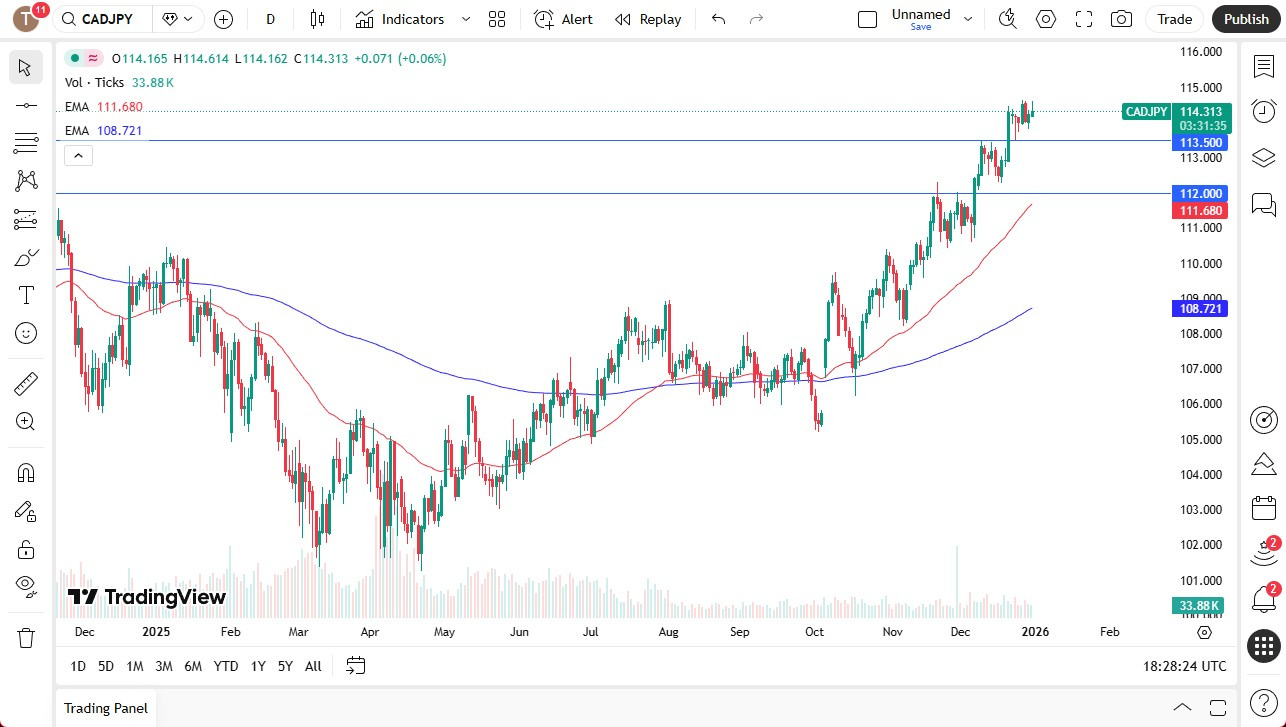
Short-term pullbacks should be buying opportunities, with the 113.50 yen level being a bit of a floor. After that, you have the 112 yen level, which is also attracting the 50-day EMA.

Breaking above the 115 yen level would, of course, be very positive, and a lot of people would look at that through the prism of a sign that we are going much higher, and therefore that is what I am waiting for as well.
I still like the idea of buying dips because I do not like the yen. It isn’t so much about Canadian dollar strength, although it is worth noting that the Canadian dollar has held its own against the US dollar as of late. The reality is, this is all about Japan.
If oil starts to pick up, that will send the Canadian dollar much higher against the Japanese yen because, unlike against the US dollar, Japan is not a producer of crude oil. That makes this more of a pure play on the petroleum markets. When you look at longer-term charts, it is very possible we could be going as high as 119 yen, but I don’t think that is something that happens very quickly or easily. I think that is just a potential destination in what has been a very strong uptrend.
Ready to trade our CAD Forex forecast? Here’s some of the top trading account in Canada to check out
Christopher Lewis has been trading Forex and has over 20 years experience in financial markets. Chris has been a regular contributor to Daily Forex since the early days of the site. He writes about Forex for several online publications, including FX Empire, Investing.com, and his own site, aptly named The Trader Guy. Chris favours technical analysis methods to identify his trades and likes to trade equity indices and commodities as well as Forex. He favours a longer-term trading style, and his trades often last for days or weeks.