Copper price approached the initial corrective target yesterday at $5.6500, to confirm delaying the attempts to resume the bullish trend due to its stability at $5.9700, besides providing negative momentum by its continued leaning below 80 level as appears in the above image.
Therefore, we will keep preferring the temporary negative attempts, which might target $5.6200 and $5.5100, while regaining the bullish trend requires a positive close above the mentioned barrier, to reinforce the chances of recording new historical gains that might begin at $5.6200 and $5.8500.
The expected trading range for today is between $5.6200 and $5.8500
The Pound to Dollar exchange rate (GBP/USD) regained some composure after renewed equity market losses briefly dragged the pair back to key support levels.
GBP/USD Forecast: Recovery from Test of 1.34 Support
After a calmer start, there were fresh losses in equities which hampered the Pound with the Pound to Dollar (GBP/USD) exchange rate dipping to re-test the 1.3400 level before a recovery to 1.3430 as the dollar lost ground.
According to UoB, there is scope for gains to 1.3505, but added; “On the downside, a breach of 1.3380 could indicate that GBP is likely to range-trade instead of trading with an upward bias.”
HSBC has an end-year GBP/USD forecast of 1.35.
There was no major impact from the latest UK inflation data with geo-political developments dominating domestic and global markets. Events in Davos will continue to be monitored very closely.
Macquarie Group global forex and rates strategist Thierry Wizman commented; “The next step in the ‘Greenland or Bust’ saga is to see whether a common ground, such as NATO joint administration of Greenland, can be reached, starting at Davos this week.”
Save on Your GBP/USD Transfer
Get better rates and lower fees on your next international money transfer.
Compare TorFX with top UK banks in seconds and see how much you could save.
He added; “Until that happens the so-called primacy of the U.S. remains at risk of further dissolution, and with it an upending of the geopolitical alignments that have upheld markets in recent years.”
As far as financial markets are concerned, the developments in bond markets will be a key element.
Upward pressure on bond yields unsettled the dollar on Tuesday and had a knock-on effect on the Pound as UK bond yields also moved higher.
According to ING; “Greenland will be the dominant theme today and there may be scope for de-escalation, offering the dollar some support. Trump is meeting EU leaders in Davos today, and if the past year has shown anything, it’s that face‑to‑face engagement tends to provide the best opportunity for tensions with the US president to ease.”
MUFG noted; “The news yesterday that the Danish pension fund Akademikerpension was exiting the US Treasury market certainly added to the speculation of further foreign investor selling.”
It notes that this is not a sum which would destabilise the markets.
Nevertheless, it added; “But another announcement like the Danish one can certainly reinforce the negative momentum and feed the speculation of a broader sell-off of US assets. Investors sense that the taking of Greenland could be a step too far and warrants a more serious flight of capital from the US than what took place in April last year. The selling then was fleeting.”
Rabobank commented on the potential lack of alternatives; “The question remains, however; if we see mass dumping from European institutions, where do the dollars go?”
Domestically, the headline UK inflation rate increased to 3.4% from 3.2% and marginally above consensus forecasts of 3.3% with the core rate held at 3.2%.
Markets continued to price in around a 20% chance of a Bank of England rate cut at the March meeting.
Like this piece? Please share with your friends and colleagues:
International Money Transfer? Ask our resident FX expert a money transfer question or try John’s new, free, no-obligation personal service! ,where he helps every step of the way,
ensuring you get the best exchange rates on your currency requirements.
The market has clearly spoken that it does not like the rising interest rates in Japan, as traders continue to punish the bond markets in Tokyo.
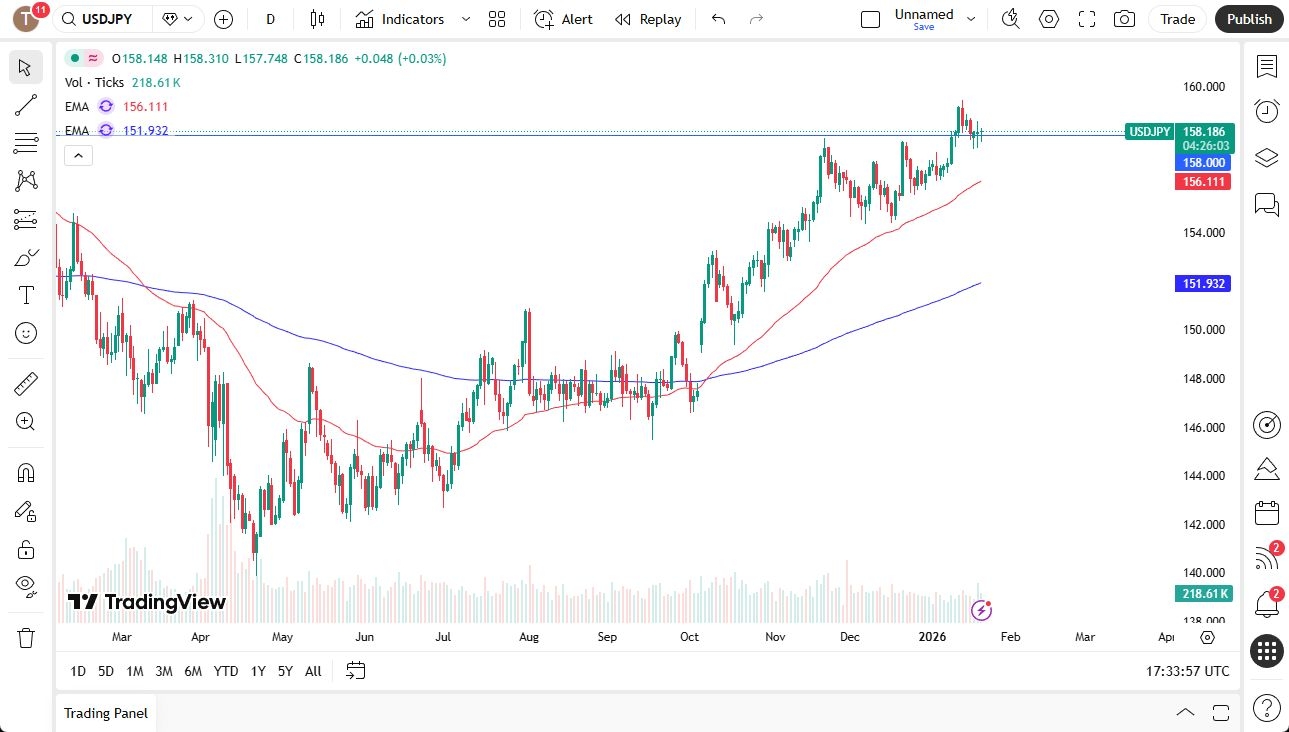
The US dollar has gone back and forth against the Japanese yen during trading on Wednesday as we continue to see a lot of choppiness right around this 158 yen level. It does make a certain amount of sense because we have the Bank of Japan interest rate decision happening on Friday, and that obviously will have a lot to do with where we go next.
While a cut or a hike isn’t necessarily expected, what people will be watching is the statement and the press conference. The Japanese are painted into a corner as they offer 75 basis points interest, but quite frankly, their bond market is starting to get out of control, and a lot of that comes down to the debt.
The market has clearly spoken that it does not like the interest rates rising in Japan and therefore continues to punish Japan via its bond market. If the central bank starts to talk about quantitative easing again, that probably helps the bond market but crushes the yen.
Interest Rate Differential
The interest rate differential, even after the Fed cuts a total of 50 basis points this year as expected, is still wide enough to drive a truck through, and therefore, you get paid at the end of every day to hold this currency pair. I think that continues to be one of the main drivers.
The 50-day EMA is down at the 156.11 level, and I think it is going to continue to offer a bit of a floor in the market. I like buying dips. I’ve been hanging on to this one for a while, adding occasionally, and building up a sizeable position that pays me at the end of every day. That’s how I think this continues. 160 yen will be the next target.
Christopher Lewis has been trading Forex and has over 20 years experience in financial markets. Chris has been a regular contributor to Daily Forex since the early days of the site. He writes about Forex for several online publications, including FX Empire, Investing.com, and his own site, aptly named The Trader Guy. Chris favours technical analysis methods to identify his trades and likes to trade equity indices and commodities as well as Forex. He favours a longer-term trading style, and his trades often last for days or weeks.
The interest rate differential is still wide enough to drive a truck through in this pair, and that’s the main focus longer-term. At this point, I look at pullbacks as an opportunity.
The British pound initially rallied against the Japanese yen during trading on Tuesday but has given back quite a bit of the gains. This does make a certain amount of sense because it has been more or less a risk-off type of environment. That to me doesn’t really matter, though, because I think that’s a temporary situation. The interest rate differential is still wide enough to drive a truck through, so I still prefer to own the British pound over the Japanese yen.
Furthermore, the bond market in Japan is all over the place, and I think that is a story that will continue to play out. While the interest rates in Japan have been climbing, it’s not for the right reasons, and therefore, I think the Japanese yen will continue to suffer.
Pullbacks and Support Levels
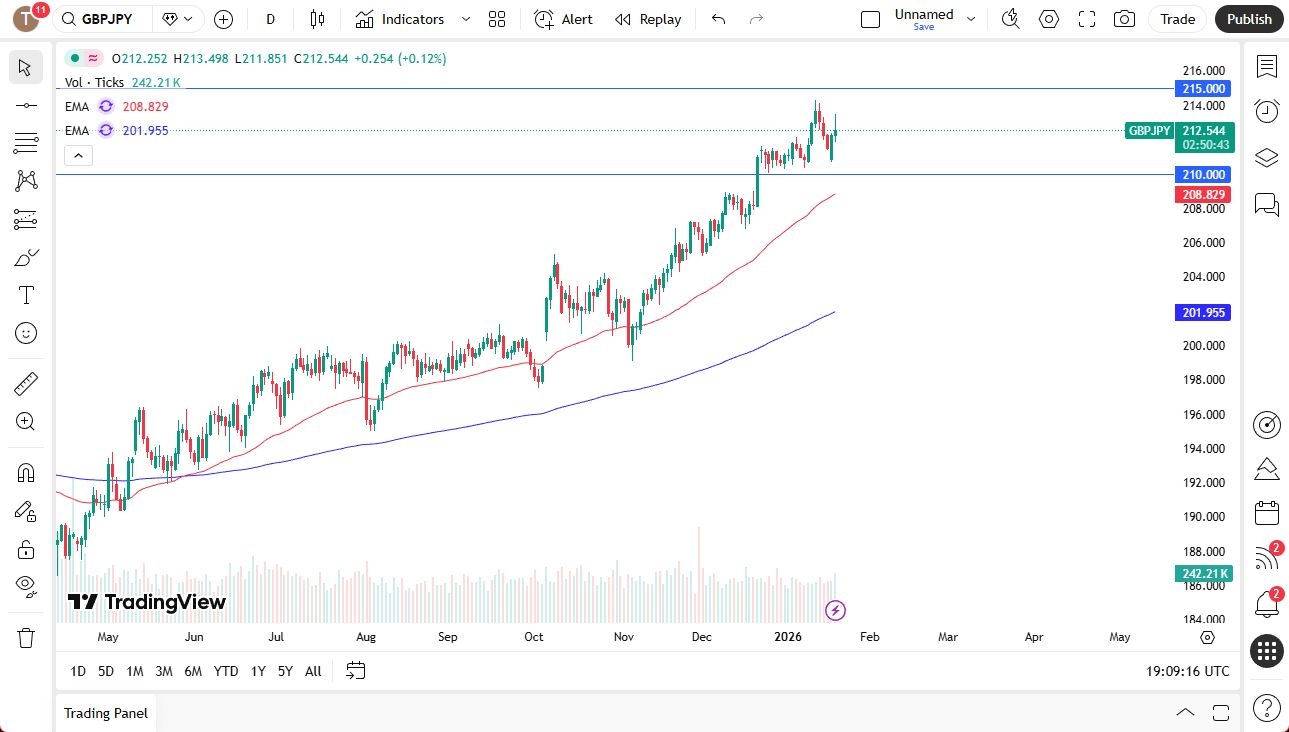
Pullbacks at this point in time will more likely than not look at the ¥210 level as a floor. After that, we have the 50-day EMA sitting just below the ¥209 level. To the upside, the ¥215 level could be your target, but we haven’t made it there yet. It looks like the area right around ¥214 continues to cause a little bit of a headache.
I think it makes a lot of sense to go sideways for a while and perhaps have more of a buy-on-the-dip type of behavior in this market. The Bank of England has a little bit of a negative, kind of dovish tone to it, but it’s not aggressively so, and therefore, the carry trade will be very much alive in this pair going forward for the foreseeable future.
Christopher Lewis has been trading Forex and has over 20 years experience in financial markets. Chris has been a regular contributor to Daily Forex since the early days of the site. He writes about Forex for several online publications, including FX Empire, Investing.com, and his own site, aptly named The Trader Guy. Chris favours technical analysis methods to identify his trades and likes to trade equity indices and commodities as well as Forex. He favours a longer-term trading style, and his trades often last for days or weeks.
The Pound to Dollar exchange rate (GBP/USD) has edged closer to 1.35 as renewed dollar weakness offsets a softer risk backdrop, with markets increasingly focused on US political risks rather than UK fundamentals.
GBP/USD Forecasts: Trump Agenda Dominates
The Pound to Dollar (GBP/USD) exchange rate held above 1.3400 in Asia on Tuesday and has advanced to highs just below 1.3500 amid dollar losses. Major GBP/USD resistance levels come in above 1.3550.
Risk conditions are likely to dominate and a key issue will be whether the dollar can gain defensive support or whether there is a renewed sell-off in the currency amid fears over the US outlook. If equities continue to slide, it will be tough for the Pound to make headway.
The key issues are likely to be intense uncertainty and higher volatility with a focus on rhetoric at the Davos gathering.
RBC Capital Markets has a year-end GBP/USD target of 1.36 and added; “while some cable downside risks can be priced out of 2026, new uncertainties may emerge.”
Geo-political developments have dominated with further concerns over the US threat of tariffs on eight European countries if there is no deal on Greenland.
Save on Your GBP/USD Transfer
Get better rates and lower fees on your next international money transfer.
Compare TorFX with top UK banks in seconds and see how much you could save.
The dollar has been hurt by renewed talk of a sell America mentality, especially with the risk of retaliation from Europe. Overall risk appetite, however, has dipped again with sharp losses for equities.
Adding to the sense of unease has been a highly critical post from Trump calling the UK deal on the Chagos Islands as an act of great stupidity.
Markets are also still having to deal with uncertainty surrounding Federal Reserve independence.
According to MUFG; “The trade uncertainty, Fed independence threats, and Trump’s approach to geopolitics generally are all factors that could result in a sudden pick up in appetite for reducing US dollar exposures. The cost involved in that should also cheapen if we see the Fed deliver further rate cuts this year.”
ING notes that US assets are still performing well and added; “until the performance outlook for those assets significantly shifts, we are unlikely to see a significant exodus of European capital from the US.”
It added; “That said, we are a little negative on the dollar this year for macro reasons. But a 10% sell-off akin to last April’s ‘sell America’ theme looks unlikely.”
As far as data is concerned, the UK unemployment rate held at 5.1% in the three months to November, matching the 4-year high, and in line with consensus forecasts.
The ONS reported a 33,000 decline in payrolls for November with a provisional decline of 43,000 for December.
Headline average earnings growth slowed to 4.7% from 4.8% with underlying growth at 4.5% from 4.6% previously and in line with expectations.
There was no shift in Bank of England expectations with markets not expecting a February cut.
Like this piece? Please share with your friends and colleagues:
International Money Transfer? Ask our resident FX expert a money transfer question or try John’s new, free, no-obligation personal service! ,where he helps every step of the way,
ensuring you get the best exchange rates on your currency requirements.
The US dollar has been very noisy against the Japanese yen on Tuesday as we see the JGB markets show signs of stress.
The US dollar has been very noisy against the Japanese yen during the bulk of the Tuesday trading session, as we continue to see a lot of noisy action. That being said, you should also pay close attention to the fact that the Japanese bond market is showing extreme stress and volatility, so this is going to make the Japanese yen very difficult to get a handle on in the short term.
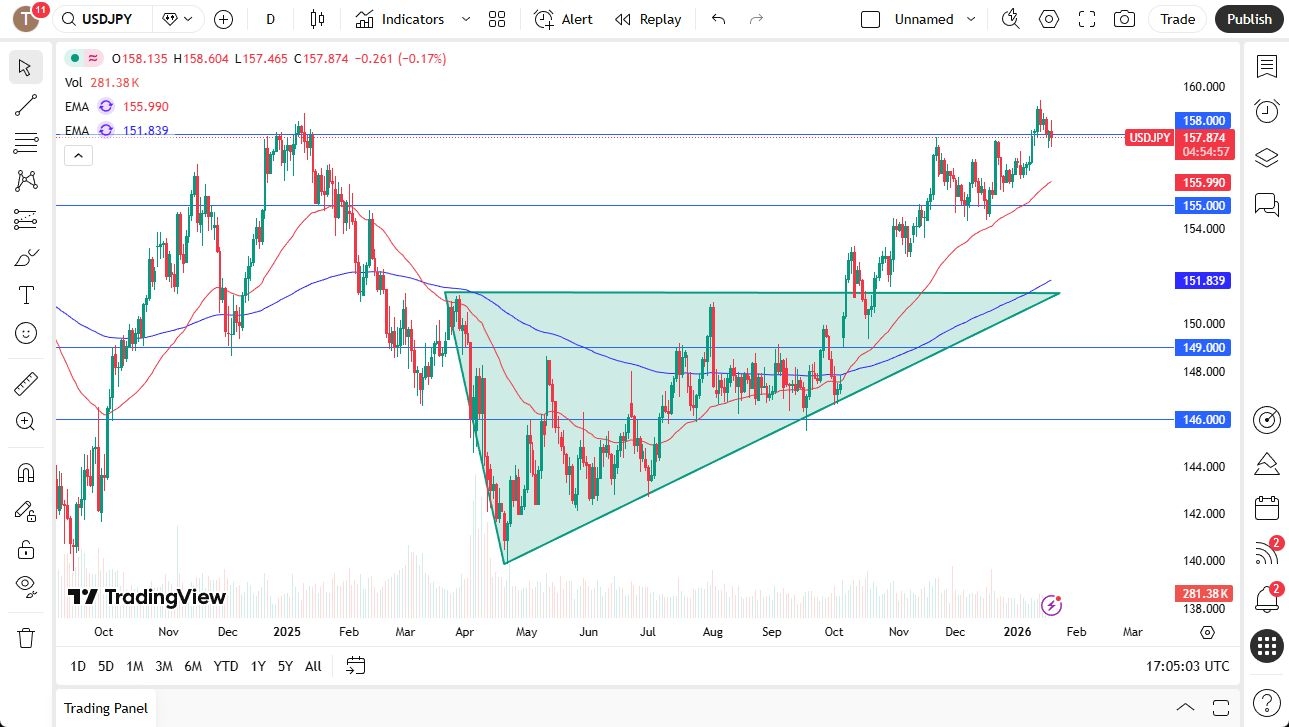
That being said, longer term, we certainly have a lot of upward pressure at this point with the 158 yen level being a bit of a magnet, and I think the 160 yen level being a bit of a target. Short-term pullbacks would open up the possibility of buying opportunities with the 156 yen level offering support at the 50-day EMA.
The 50-day EMA, of course, is an indicator that I think a lot of people will continue to look at as a potential trend line. To the upside, I do think that we could eventually go looking to the 162 yen level after we get above 160 yen, but I think that would take a certain amount of momentum.
The Carry Trade Is Still Alive
Keep in mind that the carry trade is still very much alive, and of course, the US dollar does pay you to hold it against the Japanese yen despite the fact that yields are rising in Japan, because that’s a sign of stress.
That will be very volatile, and I think at this point in time, the market is trying to tell Japan you are not going to be able to raise rates too much, and therefore, the Bank of Japan may find itself acquiescing. There is the possibility of intervention, but intervention just gets bought into before it’s all said and done, as we have seen multiple times.
Support Levels for EUR/USD Today: 1.1590 – 1.1530 – 1.1440
Resistance Levels for EUR/USD Today: 1.1800 – 1.1860 – 1.1920
EUR/USD Trading Signals:
Buy EUR/USD from the support level of 1.1650 with a target of 1.1800 and a stop-loss at 1.1560.
Sell EUR/USD from the resistance level of 1.1800 with a target of 1.1500 and a stop-loss at 1.1880.
Technical Analysis of EUR/USD Today:
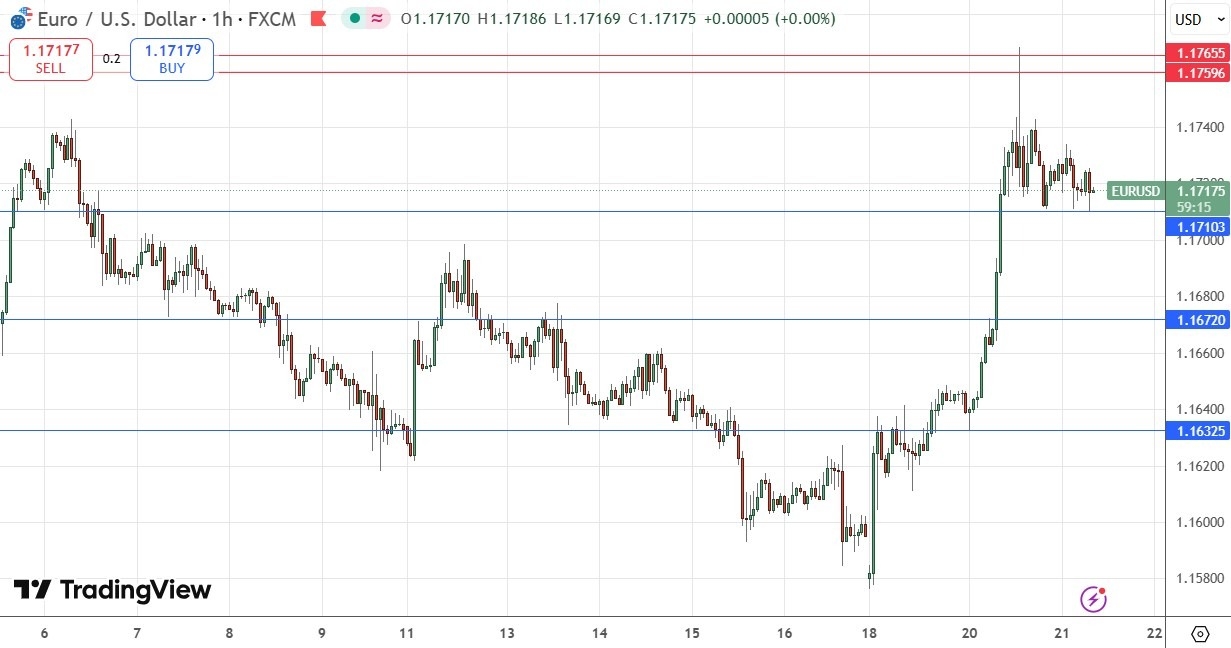
For two consecutive sessions, the EUR/USD pair has been rebounding from the support level of 1.1576 – the pair’s lowest level in two months. Gains extended to the resistance level of 1.1768, and the price is currently stabilizing around 1.1730 at the time of writing. According to performance on reliable trading platforms, the “Greenland Deal” continues to dominate the narrative for the second straight day, as traders begin to fear this is more than just a passing headline.
Generally, financial markets perceive heightened risks associated with the confrontation between the United States and Europe over the Greenland issue. As of Tuesday, Trump did not appear willing to back down from his stance on annexing Greenland to the United States, meaning that the UK and the EU will face a 10% tariff starting February 1st.
According to Forex market activity, the U.S. Dollar tends to decline as investors realize the negative economic impact of tariffs, which are largely borne by American consumers. Conversely, the Euro tends to benefit as a “large” and more liquid alternative to the U.S. Dollar, even if it is the party directly hit by Trump’s tariffs.
In general, Trump’s recent statements represented a new escalation in the Greenland dispute and confirmed the deterioration in relations between the United States and the European Union, keeping financial markets on edge. However, the euro avoided sustained losses. Its strong inverse relationship with the US dollar (USD) provided some protection, as the dollar came under pressure following Trump’s latest tariff threat.
EUR/USD Opportunities for a Bearish Breakout
The EUR/USD pair’s upward trend, as seen on the daily chart, could gain positive momentum if bulls manage to push the currency above the psychological resistance level of 1.1800. Recent gains have pushed the 14-day Relative Strength Index (RSI) towards 57, away from the neutral line, suggesting bullish momentum towards stronger upward levels if investor sentiment improves amid the recent US-EU dispute over the Greenland trade deal. Technically, the MACD indicator is also trending upwards, awaiting further positive momentum.
A EUR/USD a bearish scenario on the daily chart would require bears to push the currency back towards the support levels of 1.1655 and 1.1580, respectively. The EUR/USD’s direction today will be influenced first by statements from European Central Bank President Lagarde at 9:30 AM Egypt time. Then, most importantly, statements from US President Trump at 3:30 PM Egypt time.
Trading Advice:
We advise waiting for the EUR/USD to break through the 1.1800 resistance level before considering selling again. However, never take risks, no matter how strong the available currency trading opportunities may seem.
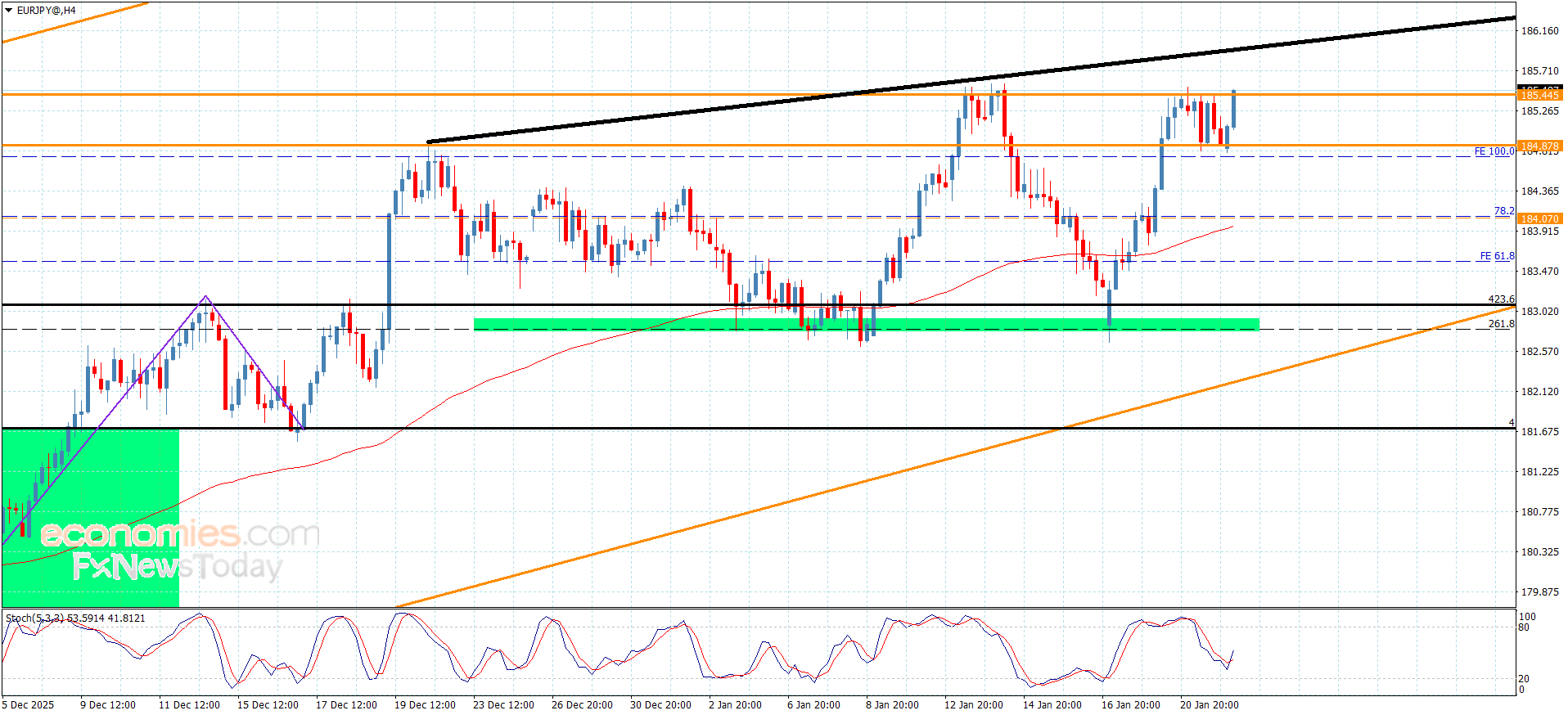
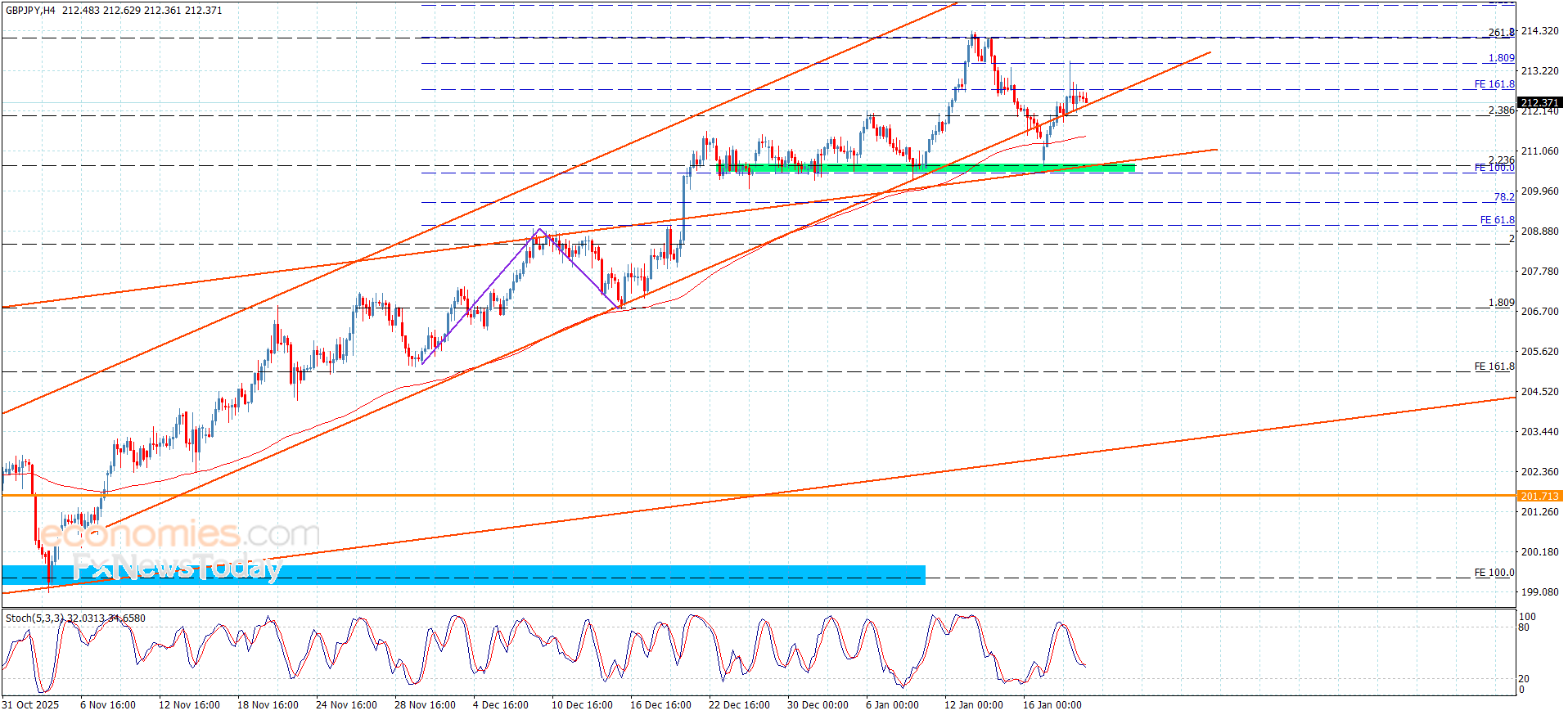
The GBPJPY pair ended its last bullish rally by recording the target at 213.45, to form a strong obstacle against the attempts of resuming the bullish trend, which forces it to activate with the stochastic negativity by forming corrective rebound, to notice testing the bullish channel’s support at 212.30.
Reminding you that the repeated rise above 212.00 level which represents %2.380 Fibonacci extension level supports the chances of renewing the bullish attempts, to expect targeting 213.00 level, to attempt to surpass the mentioned obstacle, while declining below 212.00 and providing a negative close will confirm its surrender to the dominance of the bearish corrective bias, to expect suffering some losses by reaching 211.45 initially.
The expected trading range for today is between 212.00 and 213.45
The GBPJPY pair ended its last bullish rally by recording the target at 213.45, to form a strong obstacle against the attempts of resuming the bullish trend, which forces it to activate with the stochastic negativity by forming corrective rebound, to notice testing the bullish channel’s support at 212.30.
Reminding you that the repeated rise above 212.00 level which represents %2.380 Fibonacci extension level supports the chances of renewing the bullish attempts, to expect targeting 213.00 level, to attempt to surpass the mentioned obstacle, while declining below 212.00 and providing a negative close will confirm its surrender to the dominance of the bearish corrective bias, to expect suffering some losses by reaching 211.45 initially.
The expected trading range for today is between 212.00 and 213.45
The Euro had rallied against the US Dollar, but the British Pound has given back most of the gains already. So, with that being the case, I think you have to look at this as a situation where the 1.35 level continues to be a major barrier that just can’t be broken. If we do break above there, it’s really not until we break above 1.3550 that you start to talk about a move to the upside. This to me looks like a drop, a bounce, and perhaps a rollover. We’ll just have to wait and see. We did get claimant count change numbers earlier in the session, but it was slightly more negative, not really enough to affect the currency market, though in my estimation, directly.
EUR/GBP Technical Analysis
You can see what the strength of the Euro has done to the Euro against the British Pound. I still think this is a market that rolls over, but now we have to reset, and we’ll have to keep an eye on that 0.8750 level because this is an area that’s been important multiple times. If we do start to see the Euro roll over against the dollar, we’ll have to wait, but I think that probably will have an influence here as well.
So, with all of that being said, I like fading signs of exhaustion. We could send this market down to the 200-day EMA again, but if we clear 0.8750, I probably step back from this pair for a while.
For a look at all of today’s economic events, check out our economic calendar.